
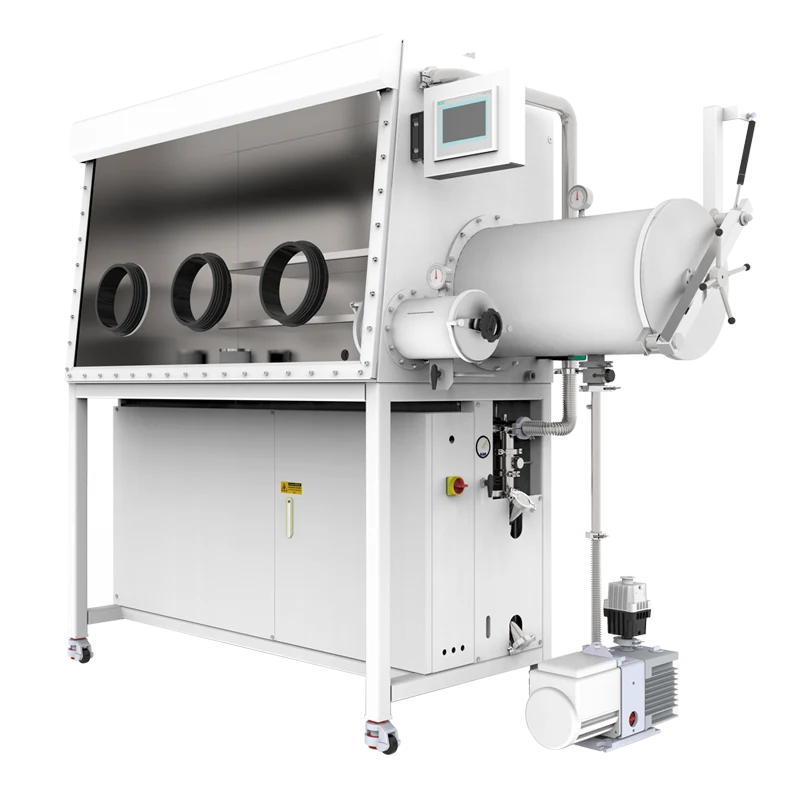
A three-glove single-sided glove box with gas purification is an enclosed workbench with three glove ports on one operating face and a recirculating purification loop designed to control moisture and oxygen in the working atmosphere. It sits between the operator and an air-sensitive sample: the gloves allow manipulation, the antechamber limits air ingress during transfer, and the purification system treats the internal gas. The aim is not simply to contain a sample, but to make repeated handling practical under a controlled inert atmosphere.
What Does the System Do, and Where Does Purification Fit?
The product discussed here is TENCAN's Three-Glove Single-Sided Glove Box with Gas Purification System. Its name gives the essential architecture: an enclosed box with three glove ports on a single working face, supplied with a gas purification system. The box provides the physical barrier and the working volume; the gloves provide manual access without opening the chamber; the purification system manages the atmosphere; and the transfer antechamber is the main route for introducing and removing materials.
The distinction between a purified glove box and a simple sealed enclosure matters. A sealed box can be filled with inert gas, but it cannot actively remove moisture or oxygen that enters with materials, gloves, or small leaks. A purification loop recirculates the internal atmosphere through a purifier and returns it to the box. Oxygen and moisture analyzers monitor the result; a controller manages the blower, valves, regeneration, and pressure. That closed-loop arrangement is what supports longer or repeated work with air-sensitive materials.
It is also different from a vacuum glove box. Evacuation and inert-gas backfill can establish a controlled atmosphere, but a continuously purified box is built around recirculation and regeneration. Some purified boxes include a vacuum antechamber for transfer; this does not mean the main chamber is a vacuum vessel. The rated function of each chamber must be checked separately.
How the Gas Purification Loop Works
The loop begins with inerting. Before a target atmosphere can be maintained, air in the box is displaced by the working inert gas. The antechamber is purged or evacuated and refilled during transfers so that each load adds as little air as possible. Purification is not a substitute for this step; it is the continuous control that follows it.
During normal operation, a blower draws gas from the box and passes it through a purifier column before returning it. Purifier materials capture water and oxygen by adsorption or chemical reaction, depending on the medium. When the medium approaches saturation, it must be regenerated or replaced according to the manufacturer's procedure. Regeneration is a separate operating state with its own gas supply, valves, and safety logic; it should not be confused with normal recirculation.
Working gas, control gas, and regeneration gas therefore need separate consideration. The working gas fills and blankets the box. Control gas may operate valves or instruments. Regeneration gas restores the purifier. The required gas purity, supply pressure, flow, and connection details are configuration data, not assumptions. A purification system cannot correct a persistent leak, an unsuitable glove material, or a transfer procedure that admits large volumes of air.
Monitoring is equally important. Oxygen and moisture analyzers indicate the condition of the atmosphere, but they do not purify it. Their ranges, resolution, accuracy, and calibration should be matched to the control target. Pressure is managed separately, usually through make-up gas, exhaust, or relief arrangements; pressure is not a measure of oxygen or moisture. A clean loop with stable pressure can still have a rising moisture level if a transfer door seal is failing.
The exact achievable oxygen and moisture levels depend on the box, purifier, gas supply, leak rate, load, and procedure. A model name alone is not evidence of a guaranteed continuous value.
What the Three-Glove, Single-Sided Layout Means
Three glove ports on a single face give the operator more than the two hands needed for manipulation. The third port can hold a tool, support a second task, or let a colleague assist. It does not automatically turn the box into a three-person workstation. On a single-sided box, users stand at the same face, so port spacing, working width, and reach determine whether two people can work together comfortably.
Single-sided construction has practical advantages. The rear wall can be reserved for services, feedthroughs, and connections; the footprint is easier to place against a wall or in a controlled area; and the operator has one clear working face. The trade-off is collaboration and process integration. A long campaign with two full-time operators, or a workflow that needs access from opposite sides, may be better served by a different layout.
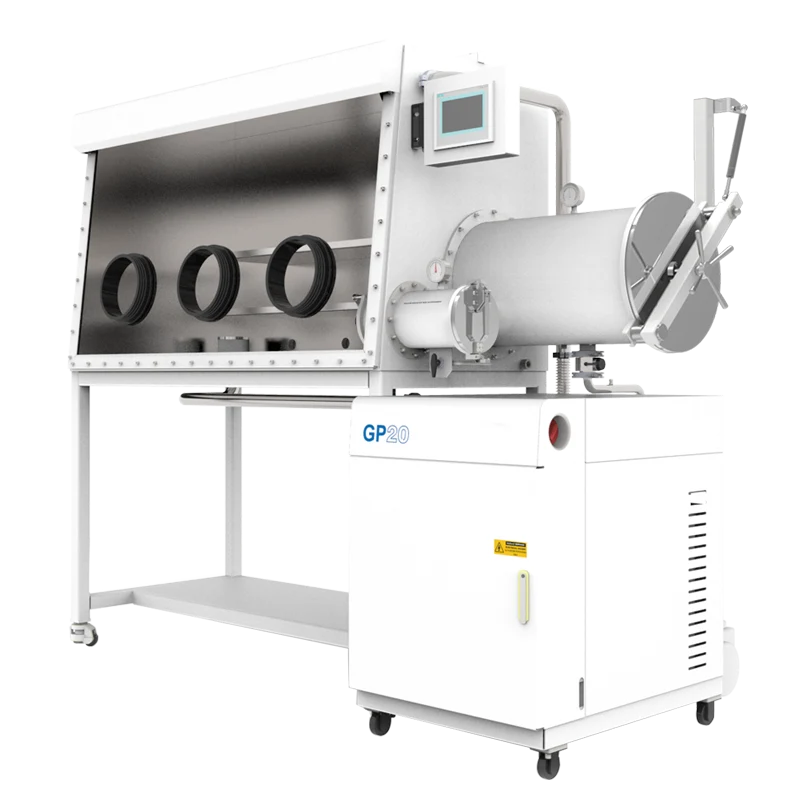
Ergonomics should be evaluated with the intended task, not just the glove count. Check the working height, the depth of the rear reach, the viewing panel, shelf position, and the location of the antechamber doors. A three-glove box can be well suited to a primary operator who needs an extra port for tools; it can be awkward if the third port is expected to support a second operator at a poorly placed station.
Material transfer also shapes the layout. The antechamber should be positioned so that heavy or frequent loads can be moved without stretching across the working area. Shelving and internal fixtures must not block glove movement or the return-air path.
Which Components and Configuration Choices Matter?
A product name identifies the general architecture, not every detail. For a purified three-glove box, the following items should be confirmed on the configuration sheet and compared with the work the box must support.
Purification capacity and operating strategy
Ask how the purifier is sized for the expected load: the number and type of columns, the working gas, the regeneration arrangement, and the acceptable interval between regeneration cycles. More capacity is not automatically better if it makes the system harder to service or requires a gas supply the laboratory cannot provide. The correct choice depends on how often the box is opened, how much air enters with each transfer, and whether the work is continuous or intermittent.
Antechamber and transfer path
The antechamber is the main interface between the room and the controlled atmosphere. Confirm its internal volume, door size, shelf arrangement, and whether it uses vacuum, gas purge, or both. The antechamber vacuum rating is separate from the main chamber rating. A large antechamber may accept equipment that a small one cannot, but each transfer also presents a larger air load unless the purge procedure is matched to it.
Gloves, ports, and material compatibility
Glove material, thickness, size, and port design affect dexterity, permeation, and service life. The glove is a barrier, not a purification device. Solvent contact, sharp tools, and frequent flexing can shorten its life. Confirm the glove material against the chemicals and processes used, and check that replacement gloves and O-rings are available for the chosen port size.
Analyzers, pressure control, and records
Oxygen and moisture analyzers need ranges and calibration appropriate to the control target. Resolution is not the same as accuracy. If pressure is monitored, the transmitter's range, process connection, wetted materials, output signal, and calibration must match the installation point and control system. Records of atmosphere, pressure, and regeneration events are useful for troubleshooting and for demonstrating that the process stayed within its defined limits.
Solvent and particle control
HEPA filtration captures particles; it does not remove water or solvent vapor. Solvent adsorption can reduce organic vapor in the loop, but it does not replace water and oxygen purification. If solvents, powders, or reactive by-products are part of the work, the compatibility of gloves, seals, purifier media, and filters must be reviewed as a system.
Pressure Transmitter: A Monitoring Accessory, Not a Purifier
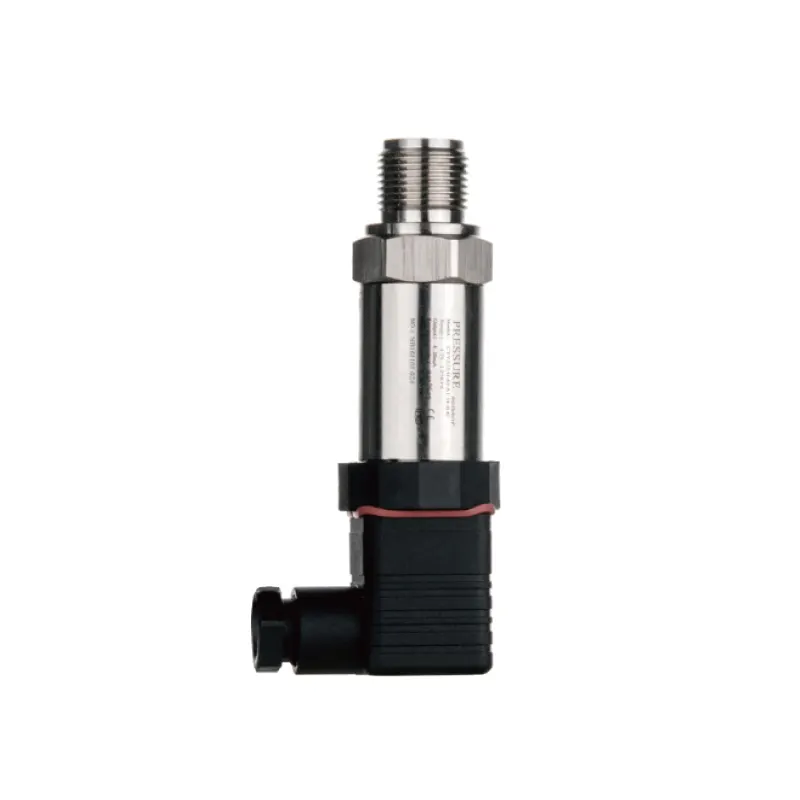
A high-precision pressure transmitter converts pressure into an electrical signal for display, logging, or control. In a glove box, it is a monitoring device. It does not remove oxygen or moisture, and it does not make an unsealed box suitable for sensitive work. Its usefulness depends on where it is installed, what range it covers, and whether its signal is compatible with the controller.
TENCAN lists a High Precision Pressure Transmitter as a glove box accessory; it should not be assumed to be part of the three-glove box unless the configuration confirms it. Compatibility should be checked against the product page, installation drawing, and controller specification. Check the measurement range, accuracy, resolution, stability, output, electrical supply, process connection, sealing material, and calibration method before selecting it. Also confirm whether the intended measurement point is the main chamber, the antechamber, or a gas line; these have different pressure regimes and safety requirements.
For troubleshooting, a pressure trend can reveal a leaking door, a blocked filter, or a valve that is not sealing. It cannot replace a leak test or an oxygen and moisture measurement. Pressure, oxygen, moisture, leak rate, and purifier performance are separate indicators.
Where Is It Suitable, and Where Are Its Limits?
A three-glove single-sided purified box fits work that needs a controllable inert atmosphere, repeated manual access, and a compact one-operator layout. Typical settings include lithium and solid-state battery material preparation, air-sensitive chemical handling, perovskite and OLED device work, semiconductor-related processing, advanced materials research, and additive-manufacturing powder handling or post-processing where the material must be kept away from ambient moisture and oxygen. The box supports the handling step; it does not by itself validate the process or guarantee sample quality.
Within those settings, it is most comfortable for small to medium batches, method development, and tasks where one primary operator works at the glove ports. If the process requires two people working face to face, very large equipment, heavy continuous transfer, or production-level throughput, the single-sided three-glove format may become a constraint.
What it should not be assumed to do
It should not be assumed to be a vacuum chamber, a cleanroom, a sterile isolator, a fume hood, or a hazardous-materials enclosure unless the specific configuration has been designed and documented for that service. A vacuum antechamber does not make the main chamber vacuum-rated. HEPA filtration does not remove moisture or solvent vapor. Solvent adsorption does not replace water and oxygen purification. An analyzer measures the atmosphere; it does not condition it.
An inert atmosphere is not automatically safe or suitable for every sample. Some materials react with the working gas, some release corrosive or flammable vapors, and some require a different gas purity or a different handling protocol. Inert gases can displace oxygen in the room, so installation, exhaust, gas monitoring, and emergency procedures must be planned with the site's safety requirements. The box's manuals and site risk assessment take precedence over general selection advice.
The system also cannot compensate indefinitely for poor transfer practice. Large loads, wet containers, damaged gloves, and worn door seals increase the purification load. If the target atmosphere is tight, the operating procedure must include antechamber purging, glove inspection, leak checks, and a response plan for rising moisture or oxygen.
How Should You Select and Integrate It?
Start with the process, not the model name. Write down the atmosphere target and the allowed excursion, the duration of each session, the frequency of transfer, the size and weight of typical loads, and the chemicals and particles involved. Then match the configuration to those facts.
- Confirm the working volume and ergonomics. Check usable width, depth, height, port spacing, viewing panel, shelf position, and antechamber door swing. Test the reach with the intended tools; a three-glove layout is only useful if the third port is accessible.
- Size purification for the real load. Provide the expected transfer frequency, load size, working gas, and target atmosphere. Ask about purifier capacity, regeneration interval, gas supply, and service access. Do not select on a single advertised value without the conditions behind it.
- Specify the transfer path. Choose antechamber volume and door configuration for the largest routine item, not the smallest. Confirm whether vacuum, purge, or both are used and how the procedure prevents air ingress.
- Verify glove and seal compatibility. Match glove material, thickness, and size to dexterity needs and chemical exposure. Confirm O-ring and seal materials against solvents and cleaning agents.
- Define monitoring and control. Select oxygen and moisture analyzers for the control target and calibration plan. If pressure monitoring is required, confirm the pressure transmitter's range, output, connection, and controller compatibility. Separate alarms for atmosphere, pressure, and regeneration state are easier to troubleshoot.
- Review solvent and particle control. Add HEPA filtration for particles and solvent adsorption for vapors only after confirming compatibility and service requirements. Neither replaces the water and oxygen purifier.
- Check utilities and room integration. Confirm inert gas supply, exhaust, electrical services, floor loading, service clearance, and signal connections. Plan for gas-cylinder changeover and safe venting.
- Require verification and training. Ask for the leak-test method, acceptance procedure, calibration records, alarm setpoints, and maintenance schedule. Train users on transfer, glove inspection, regeneration, and emergency response. Keep a log of atmosphere and pressure trends so that drift can be investigated.
Common Questions About a Three-Glove Purified Glove Box
Does the gas purification system make the box completely oxygen-free?
No absolute claim should be made. The system reduces and controls moisture and oxygen within the capability of the configuration. Final performance depends on leak-tightness, gas purity, purifier condition, load, and procedure. Verify the specified target and test method.
Can the box be used for vacuum processing?
Only if the main chamber and antechamber are documented for the required vacuum. A purified box is not automatically a vacuum vessel. Check the rating of each chamber and the effect of pressure cycling on gloves and seals.
Is the third glove port for a second operator?
It can allow assistance at the same face, but it is not a separate workstation. Port spacing, working width, and task duration determine whether two people can work together effectively.
Can I add a pressure transmitter later?
Possibly, but do not assume compatibility. Confirm the installation port, pressure range, wetted materials, output signal, electrical supply, and controller interface. The accessory product page and the box documentation should be checked together.
Do I need a solvent adsorber?
If solvents are used, review vapor compatibility and the need for adsorption. HEPA filtration captures particles, not solvent vapor, and a solvent adsorber does not replace water and oxygen purification.
