
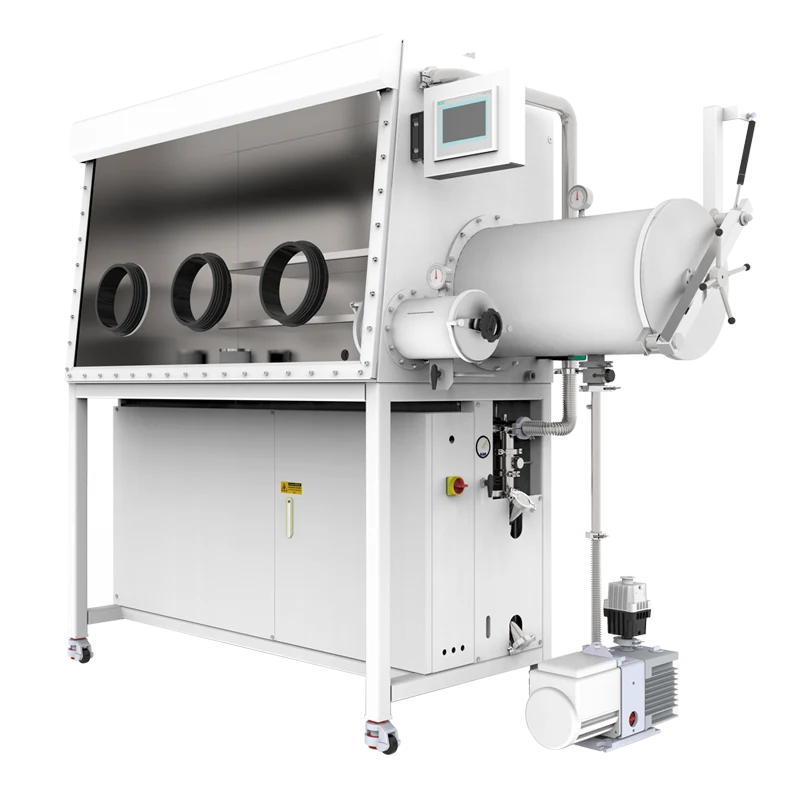
A three-glove single-sided glove box with gas purification system is a sealed, transparent workspace with three glove ports on one operator face, connected to a purification loop that circulates and conditions the internal atmosphere. It sits between the laboratory environment and the sample: the enclosure provides the isolated working volume, while the purification system manages moisture and oxygen in the recirculating gas. It is used when a compact one-sided workstation is sufficient and when air-sensitive handling needs more stable atmosphere control than a single inert-gas purge can provide.
What Does a Three-Glove Purification Glove Box Do?
At the most basic level, the box separates the operator from a controlled working volume. Samples, tools, and small devices are manipulated through the glove ports, so the user never reaches directly into the enclosure. The purification system then treats the gas inside that volume and returns it to the box. This combination is what distinguishes a continuously purified glove box from a simple glove bag or a sealed chamber that is filled with inert gas only once.
The phrase “three-glove single-sided” describes the layout, not the performance. Three ports provide more reach across the workspace and may support more than one operator in some arrangements, but the number of ports does not by itself establish simultaneous working capacity. Single-sided access means the operator works from one face; it does not imply that the opposite side has the same access, nor that every service connection is on a particular face. Those details should come from the current product drawing and configuration.
The gas purification system is the atmosphere-management part of the installation. In a continuously purified box, the internal gas is circulated through purification material rather than being replaced only at start-up. A circulator moves gas around the closed loop; the purifier removes water and oxygen; sensors monitor the atmosphere; controls manage circulation, alarms, and regeneration. The exact arrangement and capacity depend on the supplied configuration, so the product page and quotation should be used to confirm what is included.
How the Recirculating Atmosphere Works
During operation, the working gas is selected for the process, commonly an inert gas such as nitrogen or argon, and is circulated through the purification columns before returning to the box. The purification material has a finite capacity, so the system needs regeneration and eventual replacement according to the manufacturer’s instructions. Regeneration is a separate procedure with its own gas, temperature, and sequencing requirements; it should not be confused with normal circulation or with a simple purge. Because those steps are configuration-specific, they should come from the manufacturer’s documentation rather than from a generic overview.
This distinction matters when evaluating performance. A purifier can reduce moisture and oxygen only within its design and condition; a leaking glove, a saturated column, a wet transfer cycle, or an unexpected solvent load can overwhelm it. A monitor reports what the sensor detects at its location; it does not improve the atmosphere. Likewise, particulate filtration addresses particles rather than water or oxygen, and solvent adsorption addresses solvent vapor rather than replacing the water-and-oxygen purifier. These are separate functions and should be specified separately.
Why the Single-Sided, Three-Glove Layout Matters
A three-port, one-sided box is often considered when bench space is limited, when work is organized around a single operator face, or when three ports improve reach without moving to a larger multi-sided enclosure. It can be a practical compromise between a two-glove box and a larger workstation: more ports can reduce awkward reaching and allow tools to be staged across the width, while the single-sided layout keeps the operator interface concentrated on one side. None of these benefits should be assumed without checking the internal dimensions, port spacing, glove size, and the size of the equipment that must pass through the transfer chamber.
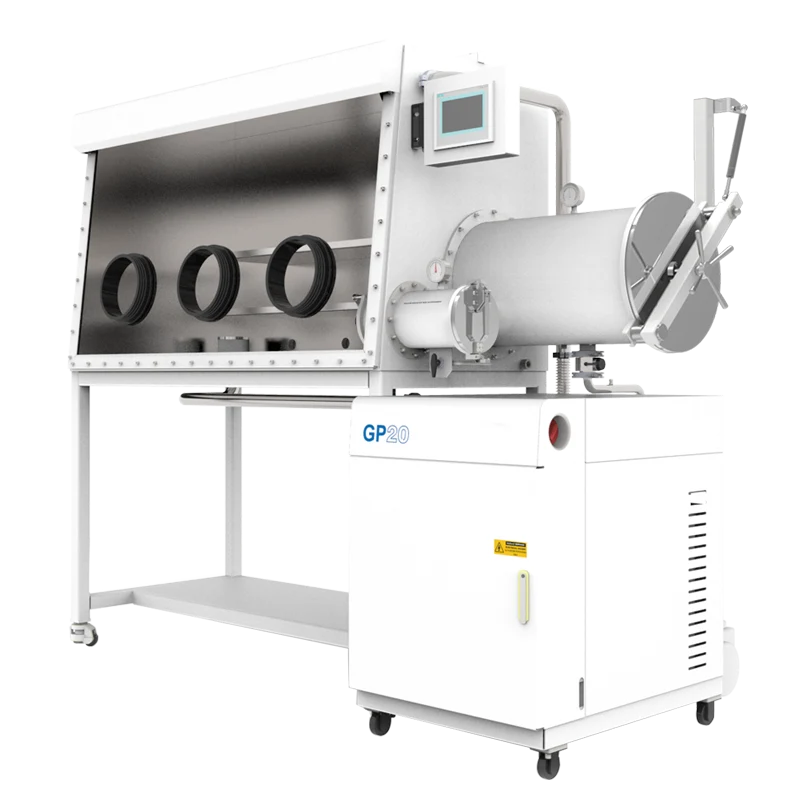
For materials research, the layout also affects workflow. A wider workspace may allow a balance, a small press, or sample trays to remain in position, but internal obstructions and the arc of the gloves limit what can be manipulated comfortably. The position of the transfer chamber, the viewing window, and any internal power or signal connections can matter as much as the number of gloves. If two people need to work at the same time, confirm that the working width and port positions actually support that use; otherwise the third port is mainly a reach and staging feature.
Which Specifications Should You Check?
The product name confirms the broad architecture—three glove ports, single-sided access, and a gas purification system—but it does not replace a configuration review. The following items determine whether the box fits the work. Request current documented values rather than relying on a generic description.
- Working space and ergonomics: internal dimensions, usable height, window size and material, port diameter, port spacing, glove size and material, and the maximum size and weight of items that can be handled or transferred. Check left- and right-hand reach, not just total width.
- Atmosphere targets: the required oxygen and moisture levels, the duration for which they must be held, the measurement points, and the test conditions. A displayed resolution is not the same as measurement accuracy, and a short stabilization test is not the same as continuous performance under process load.
- Leak integrity and pressure: box working pressure, leak-rate specification, transfer-chamber vacuum capability if vacuum transfer is required, and the pump specification. These are separate quantities. Box pressure, transfer-chamber vacuum, pump ultimate vacuum, and oxygen or water readings should not be combined into one performance claim.
- Purification system: purification capacity, circulation arrangement, regeneration requirements, utility needs, alarm functions, and expected service intervals. Confirm whether the purification unit is part of the supplied system and how it is connected to the box.
- Transfer and access: transfer-chamber volume, door arrangement, shelf or tray capacity, and the cycle needed to move samples without introducing unacceptable moisture or oxygen. If the process requires vacuum, verify that the specific configuration supports it.
- Materials and solvent compatibility: window, seals, gloves, interior surfaces, and any tubing exposed to process gases or solvent vapor. A box suitable for one chemistry is not automatically suitable for another.
- Integration: available ports for gas, liquid, electrical, or signal connections; the sealing method; and the space needed for service loops. Connection hardware must match the box and the line, not merely the thread or tube size.
A specification review should also ask how each value was measured and what it applies to. A performance figure obtained on a clean, stable box may not be maintained after frequent transfers, high solvent loading, or glove changes. The correct question is not only “What is the lowest value?” but “Under what conditions, with what load, and for how long?”
Where Is It Suitable, and What Are Its Limits?
The product is relevant to work where a compact, one-sided, three-port workspace and continuous atmosphere management are a reasonable match. Examples include handling lithium metal or solid-state battery components, weighing and transferring air-sensitive powders inside the controlled zone, assembling perovskite or OLED test devices, working with semiconductor or advanced-material samples, and performing small-scale air-sensitive chemistry. The box can also support inert transfer and sample staging where the process is organized around one operator face.
The limits are just as important. This is not a sterile enclosure, a cleanroom classification, a biological safety cabinet, or a substitute for a fume hood. Inert atmosphere is not automatically safe or inert for every material, and not every gas is inert toward every sample. Solvent-heavy work may require a different materials and vapor-management approach; a standard purification loop should not be assumed to manage solvent vapor adequately. High particulate loading, reactive dusts, or hazardous substances require an application review that goes beyond the phrase “glove box.” Vacuum-only operation, if needed, must be confirmed for the exact model and chamber arrangement; a purification glove box should not be treated as a vacuum chamber by default.
How Should You Select and Integrate It?
Start with the operation, not the model number. Define the sample size, the number of transfers per session, the required atmosphere, the acceptable recovery after opening, the need for vacuum, the need for heating or electrical connections, and the solvent or particulate load. Then compare those requirements with the current TENCAN three-glove single-sided glove box with gas purification system. The product page is the appropriate place to confirm the layout and purification scope; dimensions, achievable atmosphere, and utilities should be confirmed in the current technical documents rather than inferred from the title.
A useful sequence is:
- List every task that will occur inside the box, including weighing, storage, tool changes, and cleaning.
- Define oxygen and moisture targets separately, with acceptable limits and test conditions.
- Map the material flow: what enters through which transfer path, how often, and whether vacuum is needed.
- Identify connections for gas, liquid, power, or signals, and decide whether they can be fixed or should be removable.
- Check the space around the box for the purifier, pump, gas supply, service access, and safe routing of lines.
- Request the current configuration drawing, utility requirements, and maintenance schedule before purchase.
Integrating a Gas or Liquid Feedthrough
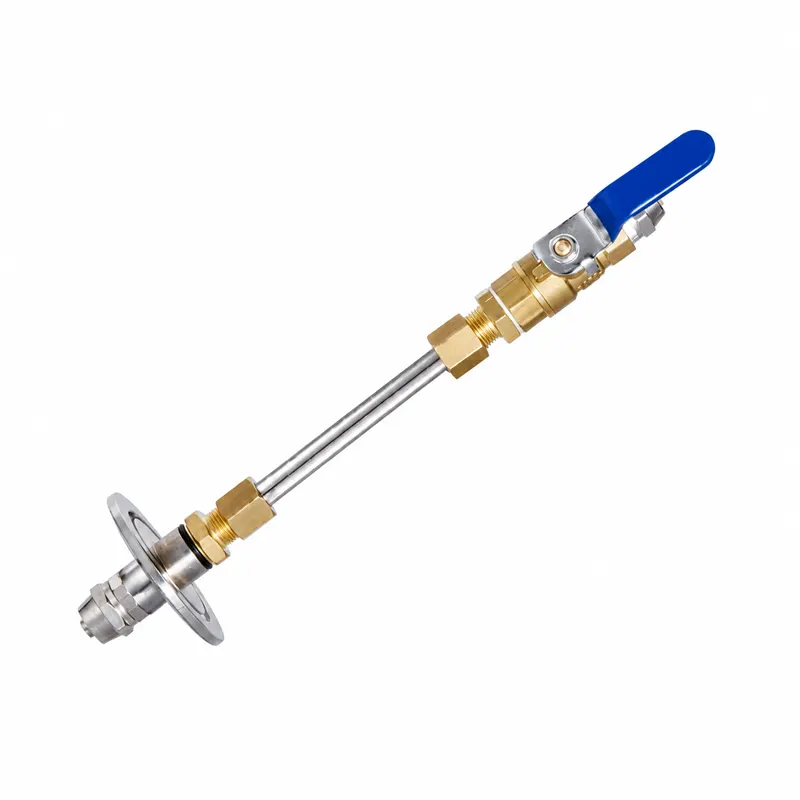
When a process needs a line inside the controlled zone, a gas and liquid feedthrough can provide a defined route through the enclosure wall. Its role is an interface, not atmosphere control. Selection should focus on line size and type, wetted materials, sealing method, installation orientation, and the ability to maintain the box’s leak integrity. A feedthrough that is mechanically compatible but chemically unsuitable, or one that is difficult to seal and service, can create a leak path that the purifier must continually compensate for. Confirm compatibility with the specific box and process before adding it; do not assume that any feedthrough fits any port arrangement.
Similarly, the purification system should be selected as part of the whole box, not as an isolated accessory. The purifier needs a compatible closed volume, a suitable circulation path, and a defined maintenance plan. If a process changes later—more solvent, more transfers, a larger load, or a different working gas—the atmosphere strategy may need review. That is why the selection should include a margin for realistic use and a plan for monitoring and service.
Frequently Asked Questions
Does this glove box include gas purification?
Yes. The referenced product is a three-glove single-sided glove box with a gas purification system. The specific purifier capacity, regeneration requirements, and achievable atmosphere should be confirmed from the current product documentation.
Can it hold low oxygen and moisture levels continuously?
It is designed for atmosphere management, but continuous performance depends on leak integrity, glove condition, transfer frequency, material load, purification capacity, and maintenance. Ask for documented performance and the conditions under which it applies; do not rely on a single number without context.
Is a three-glove box meant for three operators at once?
Not necessarily. Three ports improve access and can support multiple users in some layouts, but simultaneous use depends on working width, port spacing, and the tasks being performed. Port count is not a capacity rating.
Can I bring gas or liquid lines into the box?
That requires a compatible feedthrough and a review of sealing, materials, line size, and service access. The feedthrough preserves a route through the wall; it does not replace the box’s purification system.
Is it suitable for solvent-heavy processes?
Not automatically. Solvent vapor can affect materials, gloves, and purification performance, and may require specific compatibility and vapor-management measures. Confirm the intended solvents and loads with the supplier before configuring the box.
