
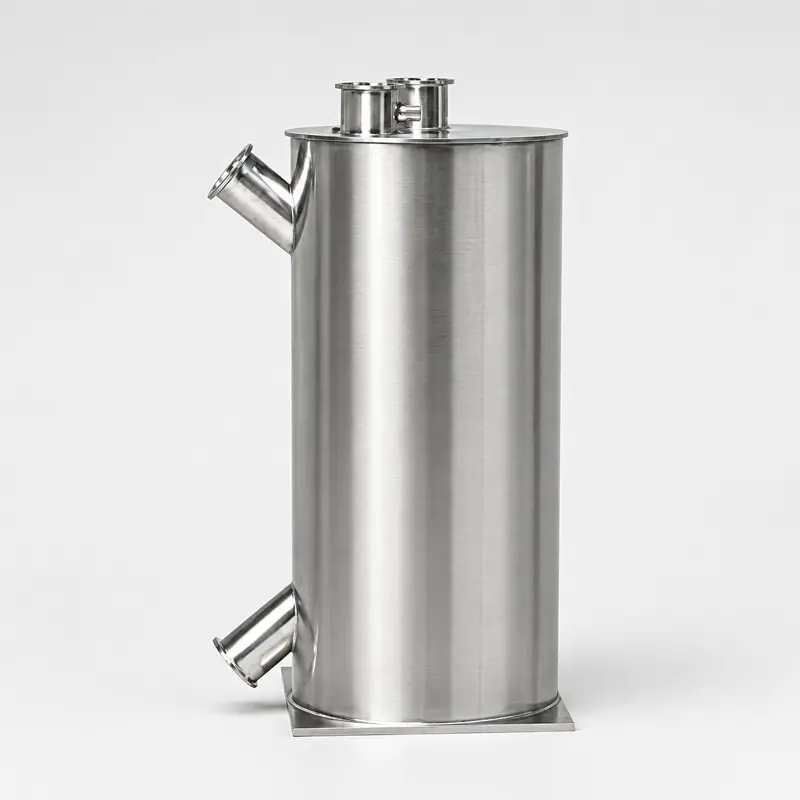
An organic solvent vapor adsorption system is a glove box accessory that removes volatile organic compounds from the enclosure’s circulating atmosphere. It is installed in the gas-handling path—typically on a dedicated port or a bypass loop—and is used to protect the main water and oxygen purifier, analytical sensors, seals, and interior surfaces from solvent exposure. It is not a complete atmosphere-control system. It does not create a low-oxygen or low-moisture environment by itself; its job is to reduce a specific class of contaminants before they accumulate or reach components that were not designed for them.
What Does an Organic Solvent Vapor Adsorption System Do?
The accessory addresses a common conflict in glove box operation. A purified glove box is built to keep water and oxygen low, but many useful processes—solution casting, spin coating, printing, cleaning, or small-scale electrolyte work—release organic solvent vapor. Those molecules can travel with the circulating gas, compete with water and oxygen on the purifier’s adsorbent, contribute to odor and film formation, and affect sensors or elastomer seals. A solvent adsorber intercepts part of that vapor load before it reaches those components.
The process is adsorption, not absorption. A porous solid presents a large internal surface; solvent molecules leave the gas stream and attach to that surface as the gas passes through the bed. The exhaust stream is therefore lower in the target vapor than the inlet stream, provided the medium is appropriate, the flow gives enough contact time, and the bed has remaining capacity. The effect is selective and finite. When the bed approaches saturation, outlet concentration rises—a condition usually called breakthrough—and the medium must be regenerated or replaced.
This is not the same function as a HEPA filter. HEPA media capture particles; they do not remove solvent molecules from the gas phase. It is also not the same as the water and oxygen purification column in a purified glove box. That column is selected and regenerated for its own duty. Adding solvent vapor to it can reduce its useful life or interfere with its performance. Keeping the functions separate makes the system easier to understand and maintain.
How the Accessory Fits Into a Glove Box Atmosphere Loop
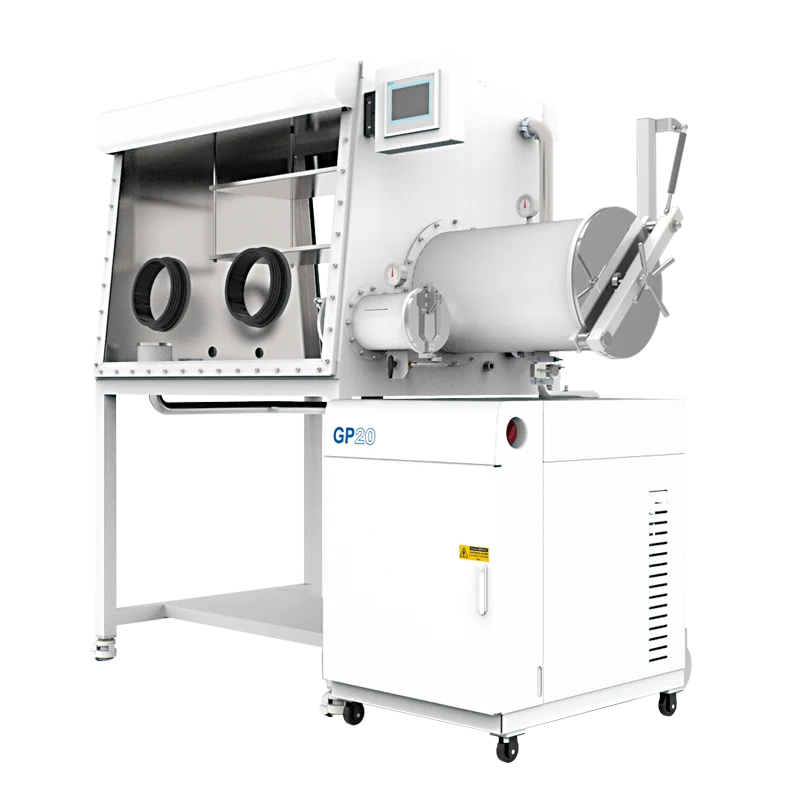
In a closed-loop purified glove box, a blower circulates atmosphere from the box through a purification column and back to the enclosure. The loop controls water and oxygen, but it is not a general chemical exhaust. The two-station double-sided glove box with gas purification system is an example of this architecture: a work space is coupled to a gas-purification system, and the quality of the atmosphere depends on the whole loop, not on one component. If solvent operations are planned, the solvent load should be considered at the system-design stage rather than treated as an afterthought.
A solvent adsorber can be arranged in different ways. In one common approach, a side stream is drawn through the adsorber and returned to the box, so the main purification loop continues to operate while a fraction of the atmosphere is polished. In another, the adsorber is placed in a bypass that is opened only during or after solvent work. A dedicated small blower may be used, or the existing pressure differential may drive flow. Each arrangement changes the actual flow through the bed, the pressure balance, and the maintenance interval. The correct choice depends on the box volume, solvent release rate, allowable pressure drop, and whether the box has a circulation loop at all.
That last point matters. A stainless-steel vacuum glove box establishes its atmosphere through sealing, evacuation, and inert-gas replacement. If it has no circulation fan or gas loop, an adsorption canister cannot treat the whole atmosphere by itself; it can only treat gas that is actively passed through it. The same logic applies to acrylic glove boxes with different levels of vacuum or isolation. Material, port availability, and pressure capability vary by model. A product photo or a generic glove box label is not enough to confirm that an accessory can be connected safely.
Which Types or Configurations Matter?
The supplied product information describes one accessory—the Organic Solvent Vapor Adsorption System—rather than a published family of model variants. That makes it more honest to discuss configuration choices than to invent a model list. The following distinctions are the ones that usually determine whether an adsorber does useful work:
- In-line or bypass operation. Continuous treatment can keep solvent concentration low, while bypass treatment may be reserved for solvent-heavy periods. Bypass design needs valves and a clear operating logic so that untreated gas is not accidentally sent to a sensitive component.
- Replaceable or regenerable medium. A replaceable cartridge simplifies change-out but creates consumable and disposal costs. A regenerable bed needs a validated regeneration procedure, purge gas, temperature control, and cooling before it returns to service. Regeneration conditions are equipment-specific and should not be guessed.
- Dedicated or shared capacity. A small canister sized for occasional cleaning is not equivalent to a bed sized for continuous coating operations. The duty cycle, not the enclosure volume alone, drives capacity.
- Manual or monitored operation. A simple canister may have no instrumentation. A monitored installation may include pressure drop, flow indication, or vapor concentration measurement. Monitoring helps detect breakthrough, but a sensor reading is not a guarantee that the bed is fully effective for every solvent.
- Media selection. Different adsorbents have different affinities. A medium that works well for one solvent family may be poor for another, and high humidity can compete for adsorption sites. The data sheet should identify the intended media and exclusions rather than relying on a general claim of solvent removal.
Which Specifications Should You Check?
The useful specifications are the ones tied to the accessory’s real function: capturing vapor at the expected flow without creating an unacceptable pressure drop or maintenance burden. Numerical values must come from the current data sheet for the exact unit; they should not be transferred from another product or assumed from a photograph.
- Connection and interface. Confirm the port type, flange or thread, seal material, and whether the connection is compatible with the glove box’s existing ports. KF interfaces are common in vacuum and gas systems, but KF alone does not establish size or compatibility. Adapters add volume and leak paths.
- Flow and pressure drop. The adsorber must pass the intended flow without upsetting the box pressure or starving the purification loop. Check pressure drop at the actual operating flow, not only at a nominal rating. A bed that is too restrictive may be ineffective in practice even if its capacity looks adequate.
- Capacity and breakthrough. Ask for capacity at the relevant solvent concentration and for the defined breakthrough condition. A single capacity number without a challenge gas, concentration, flow, and end point is difficult to apply. Size for the maintenance interval you can realistically support.
- Solvent compatibility. List the solvents that will be used, including carriers and additives. Low-volatility residues, reactive monomers, acids, amines, and some halogenated compounds may need a different approach. A solvent adsorber should not be treated as a universal chemical sink.
- Temperature and humidity. Adsorption performance depends on both. Water vapor can compete with organic molecules for sites, and high temperature generally reduces the equilibrium capacity. The installation should be evaluated at the conditions actually seen in the loop.
- Regeneration or replacement. For a regenerable unit, confirm the required gas, temperature, time, cooling step, and purge volume. For a disposable unit, confirm replacement frequency, handling, and waste classification. Spent adsorbent may retain flammable or hazardous solvent.
- Materials and seals. Wetted materials must be compatible with the solvent list and with the cleaning agents used on the box. Elastomer swelling or degradation can create leaks that are unrelated to adsorption performance.
- Monitoring and verification. A pressure gauge, flow indicator, or VOC analyzer can help show that gas is moving and that the bed is not exhausted. The analyzer measures concentration; it does not purify the gas and does not by itself prove the water or oxygen performance of the glove box.
- Safety review. Organic vapors may be flammable, irritating, or toxic. Consider static control, pressure relief, isolation, ventilation of the surrounding room, and the consequences of a spill or accidental high concentration. The accessory does not convert a glove box into a fume hood or a certified hazardous-duty enclosure.
Where Is It Suitable, and What Are Its Limits?
Suitable duties
A solvent vapor adsorber is most useful when relatively small amounts of organic vapor are released inside an otherwise well-controlled glove box and the objective is to protect the atmosphere loop and reduce cross-contamination. Examples include small-scale solution processing, solvent cleaning of fixtures, sample preparation with volatile solvents, and research workflows where solvent odor or film formation is a concern. In these cases, the accessory can reduce the solvent burden on the purifier and sensors while the main system continues to manage water and oxygen.
It can also be part of a broader contamination-control strategy. If a process releases both particles and solvent vapor, separate particle filtration and vapor adsorption may be needed. One device should not be credited with both functions unless its construction and test data support that claim.
Boundaries
The main limitation is functional. An organic solvent adsorber does not remove oxygen, does not remove water vapor as its primary duty, and does not establish inert conditions. It cannot replace the gas-purification column, and it should not be used to justify operating outside the box’s specified atmosphere. If the question is how to lower oxygen in a glove box, the answer lies in the enclosure, purifier, gas supply, leak control, and operating procedure—not in a solvent canister.
Capacity is finite. High solvent loading, a spill, or an open container can overwhelm the bed quickly and lead to breakthrough. The accessory is not a spill-response system, an exhaust scrubber for a production line, or a substitute for local ventilation. It also cannot be assumed to handle every organic compound. Very low-volatility materials may condense on surfaces before they reach the bed, and some vapors require a different adsorption medium or a different control strategy.
Finally, compatibility is a system property. Not every glove box has the ports, flow capacity, pressure tolerance, or controls needed to accept an adsorber. A box with a continuous purification loop, a box with only vacuum/inert-gas replacement, and an acrylic box with a defined vacuum rating are different starting points. The accessory should be selected against the actual enclosure and the actual solvent list.
How Should You Select and Integrate It?
- Inventory the solvents and the duty. List each solvent, its approximate volatility, the amount used per session, the frequency of use, and whether heating or spraying increases release. The worst credible case matters more than the average.
- Map the gas path. Identify where the adsorber will draw gas and where it will return it. Confirm that the main purification loop, pressure control, and sensors are not bypassed or starved.
- Confirm the mechanical and material compatibility. Match the port, flange, seal, and tubing to the box. Check that the adsorbent and wetted materials are suitable for the solvent list. Ask for a dimensional drawing rather than inferring fit from a photo.
- Size for a practical maintenance interval. Use capacity at the expected concentration, not the highest theoretical value. Include a margin for humidity, mixed solvents, and occasional higher release.
- Decide how breakthrough will be detected. A combination of use records, pressure drop, and, where appropriate, VOC measurement is more reliable than a fixed change-out schedule with no verification. Record the baseline and the change-out condition.
- Plan regeneration or disposal before installation. Confirm who will handle the medium, what gas and temperature are required if regenerable, and how spent material will be managed. These are operational commitments, not purchasing details.
- Review safety and commissioning. Leak-check the connections, verify flow and pressure, and confirm that the box still meets its atmosphere specifications after integration. Follow the manufacturer’s instructions and the site’s chemical-safety review.
TENCAN Glove Box Systems lists the Organic Solvent Vapor Adsorption System as a glove box accessory. The current product page should be used to confirm the supplied configuration, connections, and documentation for the exact unit. The two-station double-sided purification glove box linked above is useful background for understanding the atmosphere loop, but the two pages do not by themselves prove that every accessory configuration is compatible with every enclosure. Compatibility should be confirmed from the current specifications and the application data.
Frequently Asked Questions
Does a solvent vapor adsorber replace the glove box’s water and oxygen purifier?
No. The purifier is responsible for managing water and oxygen in a closed-loop system. A solvent adsorber targets organic vapors and is intended to reduce the load on the loop, not to perform the purifier’s job.
Can it lower the oxygen concentration in the box?
No. Adsorption of solvent vapor does not remove oxygen. Oxygen control depends on the enclosure, gas supply, purifier, leak rate, and operating procedure.
Will a HEPA filter remove solvent vapor?
No. HEPA filtration captures particles. Solvent molecules require an adsorbent with appropriate affinity, contact time, and capacity.
Can the accessory be fitted to any glove box?
Not automatically. The enclosure needs a suitable port or circulation path, compatible materials, and enough flow and pressure margin. A box without a gas loop may need a different approach.
When is it worth adding?
Consider it when organic solvents are used inside the box and solvent vapor is likely to reach the purifier, sensors, seals, or samples. The decision should be based on the solvent list, release rate, box volume, and maintenance plan.
