
The GP20 Gas Purification System Cabinet is an independent gas-processing unit for a compatible sealed glove box or similar enclosure. It sits outside the operator's working space and conditions the circulating atmosphere; the enclosure supplies the physical workspace, gloves, and transfer interface. Its function is to remove moisture and oxygen from the inert gas inventory and return conditioned gas to the box, not to provide a place to handle samples. It is not a complete glove box, and it is not a universal add-on that can be connected to any enclosure without checking the gas circuit, pressure control, materials, and controls.
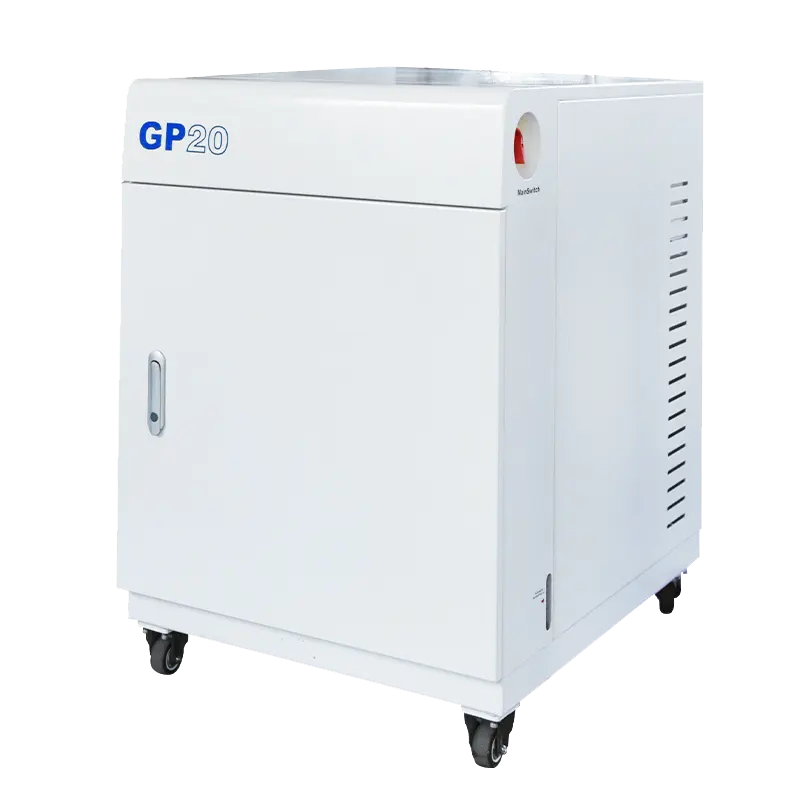
Why use a separate purification cabinet?
A purification cabinet separates the atmosphere-processing hardware from the working volume. That division can make service access easier: purification media, valves, controls, and regeneration hardware need attention without opening the glove box to the room. It can also keep heat, vibration, and maintenance activity away from a sensitive process, provided the layout and utilities allow it. The trade-off is that a separate cabinet adds interfaces. The enclosure, cabinet, gas supply, exhaust, and monitoring system must be designed as one loop. A cabinet that is excellent on its own is not useful if the box leaks, the return path is restricted, or the control system cannot coordinate circulation and regeneration.
The GP20 should therefore be read as part of a system, not as a stand-alone product that creates a controlled atmosphere by itself. The box defines the working volume and the contamination load; the cabinet defines how the gas is conditioned and managed. Selection starts with the enclosure and the process, then moves to the cabinet.
How the GP20 works in a closed purification loop
In a closed loop, gas leaves the enclosure, passes through the purification cabinet, and returns. The same gas inventory is conditioned and reused rather than being continuously vented. Purification media capture water and oxygen from the inert gas; when the media approach the end of their working capacity, they are regenerated or replaced according to the manufacturer's procedure. The cabinet's controls coordinate circulation, regeneration, and the interlocks that protect the box and the operator.
This description is functional, not a substitute for the GP20 manual. The order of valves, the direction of flow, the regeneration sequence, and the acceptable operating envelope belong to the specific configuration. A normal circulation cycle and a regeneration cycle are different states. Regeneration is not a more aggressive version of purification; it is a maintenance process that may use a separate gas, heat, vacuum, and exhaust. Treating it as a simple purge can damage media, leave the loop in the wrong state, or create a hazard.
Working gas, control gas, and regeneration gas
These three roles should be kept separate in the piping diagram and in operating logic. The working gas is the inert atmosphere inside the glove box. It is the gas that the process and the operators are exposed to, and it must be compatible with the samples, the box materials, and the purification media. Control gas, where used, drives valves, instruments, or other utilities; it may be a separate supply, and a cross-connection with the working gas should not be assumed to be acceptable. Regeneration gas is used to restore the purification media. It requires its own supply, flow control, and vent path, and it must not be allowed to enter the glove box during regeneration.
Clear labeling, non-interchangeable fittings where appropriate, and a written valve sequence reduce the chance of a wrong connection. The exact gases and conditions are configuration-specific and should come from the GP20 documentation, not from a generic article. A system that looks simple on a piping and instrumentation diagram can still fail at commissioning if the control gas and working gas are confused.
What the cabinet does not do
The GP20 does not provide the glove box workspace, the glove ports, the viewing window, or the antechamber. It does not necessarily evacuate an antechamber or a process chamber; evacuation is a separate function with its own pump and pressure rating. It does not measure the atmosphere simply because it purifies it; an oxygen or moisture analyzer is a separate instrument with its own range, resolution, accuracy, and calibration. It does not replace a leak-tight enclosure, and it does not turn a particle filter into a water or oxygen remover. These distinctions matter when a project team writes a specification, because they prevent one component from being asked to do a job it was never designed to perform.
Which configurations and interfaces matter?
The GP20 is a purification cabinet rather than a complete box, so the meaningful configuration questions sit at the interface between the cabinet and the enclosure it serves. A single-station box, a multi-station box, a single-sided or double-sided layout, and a split enclosure all change the working volume, the number of glove ports, the transfer frequency, and the way the loop is routed. Those differences affect gas demand and the practical layout of supply and return lines.
The main integration points are the gas supply and return connections, the pressure-control scheme, the regeneration exhaust, the electrical and signal interfaces, the sensor locations, and service access. The cabinet needs enough clearance for maintenance and for the removal or replacement of purification media. The enclosure needs a return path that does not short-circuit the flow or create stagnant zones. Controls should make the state of the loop visible: circulating, standby, regenerating, alarm. If the cabinet and box come from separate suppliers, the responsibility for pressure protection, interlocks, and commissioning should be written down before the order, not resolved after installation.
Which specifications should you check?
For the purification cabinet itself, ask for the gas compatibility and wetted materials, the purification capacity and target conditions, the circulation rate and allowable pressure drop, the regeneration method and its utility requirements, the control and alarm functions, the leak and pressure integrity, the electrical supply, the footprint, and the service procedure. For the enclosure, ask for its working pressure, leak rate, internal volume, transfer arrangement, and expected contamination load. The two sets of data must be evaluated together.
Be precise about performance claims. An oxygen or moisture value can refer to the cabinet outlet, to an empty box after a long purge, to a box with a defined leak rate, or to a best-case demonstration. It can be a transient reading or a sustained guarantee. Resolution is not accuracy, and a sensor reading is not a purification capacity. If a value is quoted without its conditions, ask for the missing conditions. The same rule applies to circulation rate, regeneration time, and pressure drop: a number without a reference point is not a specification.
Keep different pressure quantities separate as well. The glove box working pressure, the antechamber vacuum, the pump's ultimate pressure, and the leak rate are not interchangeable. A pump can reach a low ultimate pressure in a clean, empty chamber and still be unable to evacuate a real load quickly, because gas load, surface area, and outgassing matter. A cabinet can control the atmosphere of a sealed box and still not be a vacuum pump. A leaky box can consume purification capacity faster than any cabinet can remove contamination.
Evacuation, transfer, and the turbomolecular pump accessory
Atmosphere purification and evacuation are different jobs. The GP20 conditions the gas that remains in the enclosure; an evacuation system removes gas from a chamber or antechamber. Where a process needs high-vacuum pump-down, a turbomolecular pump may be considered as a separate accessory. The Glove Box Turbomolecular Vacuum Pump is not a purification device and does not replace the purification loop. Its suitability depends on the chamber volume, the gas load, the required ultimate pressure, the backing pump, the exhaust arrangement, and the controls of the enclosure.
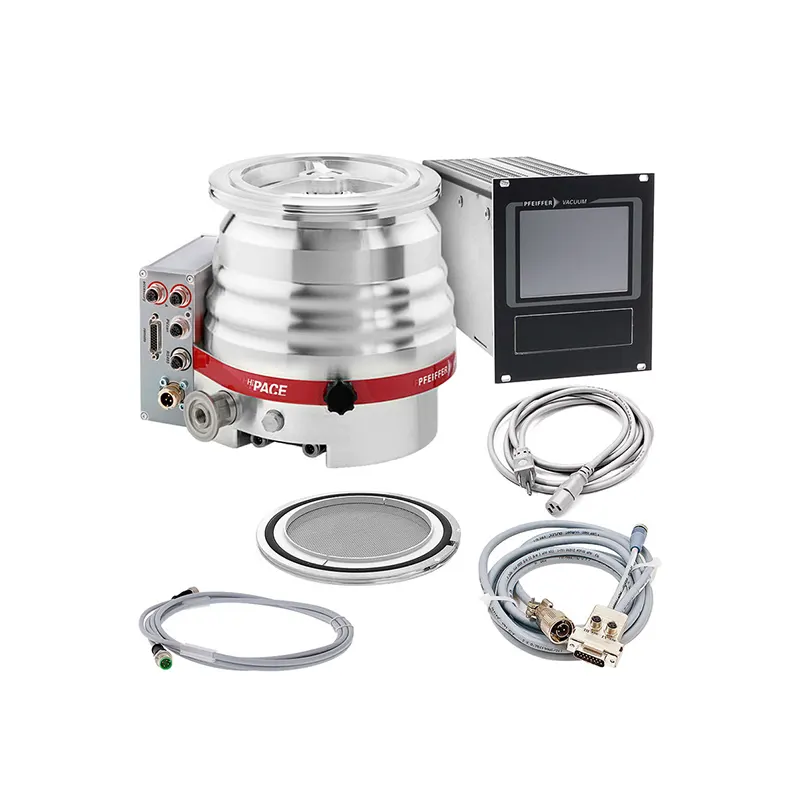
Compatibility should not be assumed. A pump that is suitable for one load-lock design may be wrong for another because of conductance, condensable vapors, particle load, or the way the pump is isolated from the box. The same caution applies to the GP20: a cabinet that works with one sealed enclosure is not automatically suitable for every enclosure. The interface drawing, pressure protection, and control logic must be reviewed together.
Where the GP20 is suitable, and where its limits begin
The GP20 is relevant where a sealed enclosure needs a managed inert atmosphere: lithium battery and solid-state battery research, perovskite and OLED device work, semiconductor and air-sensitive chemistry, advanced materials handling, additive manufacturing pre- and post-processing, and general laboratory work with moisture- or oxygen-sensitive samples. In these settings, the value of the cabinet is that it can be integrated into a closed loop and serviced as a separate unit, while the glove box remains the operating space.
The limits are just as important. Inert atmosphere protection is not the same as sterility, a cleanroom classification, biological safety containment, or hazardous-material containment certification. A glove box with a purification cabinet is not automatically suitable for every gas or every sample; material compatibility, solvent vapors, and reaction by-products must be assessed. HEPA filtration addresses particles, not water or oxygen. Solvent adsorption addresses selected organic vapors, not the entire purification duty, and it does not replace the water and oxygen media. An analyzer tells you what the atmosphere is doing; it does not change the atmosphere. Do not extend a single configuration's demonstrated value to every GP20 installation or to every process gas.
How to select and integrate a GP20
Start with a short process definition: the enclosure volume and layout, the required inert atmosphere, the samples and solvents, the transfer frequency, the expected leak and outgassing load, and the pressure and vacuum steps. Then ask for the GP20 configuration that matches those conditions. Do not select the cabinet from a headline capacity alone, and do not assume that a larger cabinet is always better; an oversized system can add utility demand and space requirements, while an undersized one will run near its limits.
- Confirm the gas circuit. Obtain a piping and instrumentation diagram showing supply, return, bypass, regeneration, vent, and sampling points. Check that working, control, and regeneration gases are separated and labeled.
- Check the enclosure interface. Verify connection sizes, pressure ratings, relief protection, and the allowable working pressure of the box. Confirm that the return path and sensor locations represent the atmosphere the process actually sees.
- Define the performance test. Agree on how oxygen and moisture will be measured, where the sample will be taken, how long the system will stabilize, and what constitutes pass or fail. Include the leak rate and the contamination load in the test conditions.
- Plan regeneration and service. Confirm the regeneration gas, utilities, exhaust, duration, and the state of the box during regeneration. Provide access for media service and for valve or sensor maintenance.
- Review controls and alarms. The operator should be able to see circulation state, regeneration state, pressure status, and analyzer status. Alarms should lead to a defined action, not just a screen message.
- Ask for the exact configuration record. The model name alone is not enough. Request the current datasheet, interface drawing, utility list, and operating limits for the cabinet you are buying.
A good integration decision is therefore a chain of checks, not a single product choice. The GP20 can be the atmosphere-processing center of a well-defined loop, but it cannot compensate for an unsealed box, an incompatible gas, a missing exhaust path, or an uncontrolled contamination source. When those conditions are satisfied, the separation between working space and purification hardware becomes an advantage: the box stays dedicated to the process, and the cabinet stays accessible for the work that keeps the atmosphere under control.
FAQ
Does the GP20 include a glove box workspace?
No. It is a gas purification system cabinet, not a complete glove box. It must be integrated with a compatible sealed enclosure that provides the working space, gloves, and transfer interface.
Can the GP20 lower oxygen and moisture by itself?
Its role is to condition circulating gas in a closed loop, but the result depends on the enclosure, leak rate, gas, contamination load, circulation, media condition, and instrumentation. A cabinet specification should not be read as a guarantee for every box or every process. Ask for performance data for the exact configuration.
Is the turbomolecular vacuum pump part of the GP20?
No. It is a separate accessory for evacuation. It does not purify the atmosphere and should not be assumed to be compatible with every GP20 installation; the chamber, gas load, backing pump, and controls must be checked.
Can HEPA filtration or solvent adsorption replace water and oxygen purification?
No. HEPA filtration removes particles. Solvent adsorption targets selected organic vapors. Neither is a substitute for the water and oxygen removal performed by purification media, and each has its own compatibility and service limits.
What should be confirmed before ordering?
Confirm the enclosure interface, gas diagram, pressure protection, purification duty, regeneration requirements, analyzer locations, alarm logic, utilities, footprint, service access, and the documents that define the exact configuration. If any of these are unclear, resolve them before the cabinet is built into the project schedule.
