
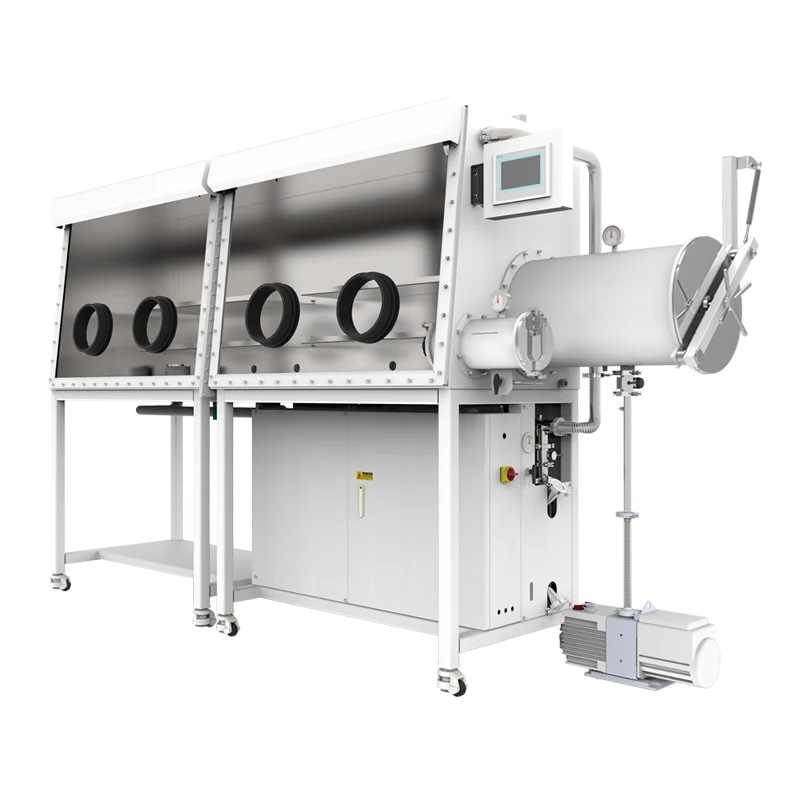
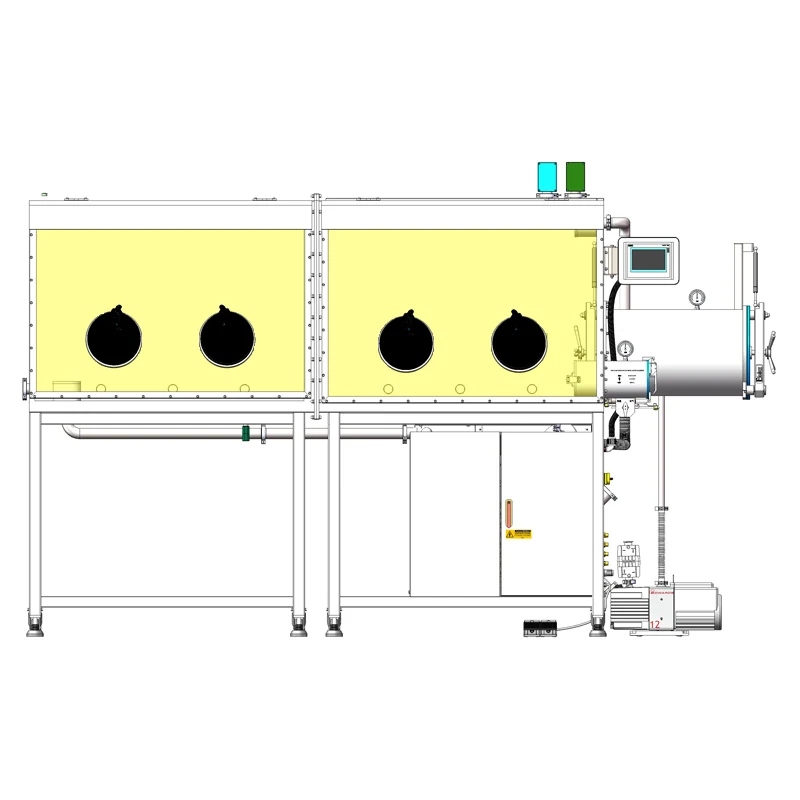
A two-station, single-sided, split-type glove box with a gas purification system is a sealed working enclosure whose internal atmosphere is continuously circulated and cleaned, so moisture and oxygen stay at low, monitored levels while an operator handles samples through gloves. The word "split" describes the layout rather than the chemistry: the purification unit sits in its own cabinet and connects to the glove box body through piping instead of being mounted on the enclosure itself. "Two-station" and "single-sided" describe the working area — two operating positions on one face of the box, with a viewing panel on the opposite side. The system solves one problem: keeping air- and moisture-sensitive materials protected during long, hands-on work without opening the chamber to room air.
What Does the System Do, and How Does It Work?
The main job of a purification glove box is atmosphere management, not sample handling. The chamber provides the space; the purification system is what keeps that space usable hour after hour. Two impurities matter most: water vapour and oxygen. Both enter whenever the box is opened, whenever a sample passes through an antechamber, and slowly over time through seals and gloves. A closed-loop purification system removes them continuously rather than in a single pass.
Following the gas path
In a typical loop, gas leaves the working chamber through a return line, passes through a blower, moves through one or more purification columns, and is fed back into the box. The columns do two different jobs with two different materials: an adsorbent such as molecular sieve captures water, while a copper-based catalyst removes oxygen by chemically binding it. Because the working gas recirculates instead of being consumed, the loop needs only occasional make-up gas rather than a constant supply, which is why a sealed box with a purifier can hold a stable atmosphere for long periods.
Measuring instruments — normally an oxygen analyser and a moisture analyser — sample the gas in the loop or at the chamber. Their readings are the operator's basis for deciding whether the atmosphere is ready for sensitive work. Valves route gas during normal circulation and isolate the columns when they are regenerated, so circulation and regeneration are separate operating states that should not be confused with each other.
What a split structure changes
In a split-type configuration, the purification cabinet and the glove box body are separate units joined by piping, and that arrangement has practical consequences. The blower and columns generate some heat and vibration, and placing them outside the enclosure keeps both away from the working zone — relevant for delicate microscopy or weighing inside the box. Service access also improves: columns can be regenerated, inspected or replaced without disturbing the box interior, and the cabinet can often be positioned below or beside a bench to fit a crowded laboratory.
The trade-off is that the connecting lines become part of the sealed system. Every joint, valve and flange between cabinet and chamber is a potential leak path, so installation quality and leak testing matter more than they would on a single integrated unit. A split system also needs slightly more total floor or bench space, and the pipe run should be planned before delivery rather than improvised in the room.
Why two stations on a single side
Two-station means the box offers two working positions, so one operator can move between tasks without reaching across the whole chamber, or two people can work side by side. Single-sided means the gloves are mounted on one face only. That layout suits work where the operator must watch the sample through the front panel, and it keeps the usable depth within a comfortable reach. Reach is the limiting factor to check: interior depth, glove port spacing and glove port height together determine whether two stations are genuinely usable or merely two sets of ports. Where two people must work from opposite sides, a double-sided box is the more appropriate layout.
Which Configurations and Components Matter?
Purification glove boxes vary along a few axes that change daily usability far more than a model number does. The first is the number of working positions and whether gloves are on one side or both. The second is the structure: an integrated box with the purifier mounted on the enclosure, or a split arrangement with a separate purification cabinet. The third is the transfer path — how samples and tools get in and out, and how much air that transfer carries with it. A larger antechamber shortens loading time for bulky items; a smaller one limits how much atmosphere is disturbed per transfer. The two-station single-sided split-type purification glove box is one concrete example of this layout.
The accessory layer then defines what can actually be done inside. Gloves determine dexterity, chemical resistance and permeation behaviour. Feedthroughs carry power, signals, gas or liquid through the wall without breaking the seal. Analysers provide the atmosphere data. Vacuum pumps support antechamber evacuation or a vacuum-capable chamber. Solvent adsorption and particle filtration address different contaminants, and neither replaces water and oxygen removal. These choices are not decoration: a poorly matched glove or an oversized pump can undermine the atmosphere the purification system is working to maintain.
Which Specifications Should You Check?
Oxygen and water figures: achievable values, not guarantees
Published oxygen and water levels for a purification glove box are usually achievable values under defined conditions — a sealed, leak-tested box, a stable load, and a purification system in good condition. They are not a continuous guarantee for every sample, every solvent or every working session. When comparing systems, ask where the measurement is taken, whether the reading comes from the loop or the chamber, and what the analyser's accuracy is. Resolution and accuracy are different properties: an instrument can display fine resolution while carrying a wider uncertainty. The figure that matters is the one your process actually needs, measured where your samples sit.
Pressure, vacuum and leak rate are three different numbers
Box working pressure, antechamber vacuum, pump ultimate vacuum and leak rate are often quoted side by side and then treated as interchangeable. They are not. Working pressure describes the small positive or negative offset the chamber is held at during normal operation. Antechamber vacuum describes how far the transfer chamber is evacuated before refilling with inert gas. Pump ultimate vacuum is a property of the pump, reached at the pump inlet under specific conditions, not necessarily inside the chamber. Leak rate describes how quickly the sealed system gains or loses gas under a defined pressure difference. Keep each figure attached to its own object and unit, and treat any value whose configuration or unit is unclear as unconfirmed rather than as a specification to design around.
Regeneration, utilities and service access
Purification columns eventually become saturated and must be regenerated: heated while a reducing gas mixture flows through them, driving off captured water and restoring the catalyst. Regeneration requires a gas supply, a power supply and time during which the box is not at its normal performance. Ask how regeneration is triggered — by a fixed schedule, by analyser readings, or by the control system — and how long the process takes, because it shapes your working calendar. Also confirm which utilities the installation needs and whether the split cabinet can be reached for service without moving the glove box.
Where Is a Purification Glove Box Suitable, and Where Is It Not?
Closed-loop purification suits work where prolonged low-oxygen and low-moisture conditions matter: lithium and solid-state battery materials, perovskite and OLED device fabrication and testing, semiconductor and thin-film processing, air-sensitive synthetic chemistry, and the handling of precursors or processed powders where surface oxidation changes the result.
Its limits are equally concrete. A purification glove box is not a sterile barrier, a cleanroom classification, a biosafety cabinet or a certified containment system for hazardous materials, and it should not be presented as any of these. Inert gas is not automatically inert for every sample: some materials react with nitrogen, and some solvents attack seals, gloves or internal components. HEPA filtration captures particles but does not remove water or oxygen. Solvent adsorption protects the purification columns from organic vapour but does not replace the water and oxygen circuit. Where a process needs high-vacuum conditions, thermal treatment or aggressive chemistry, those requirements must be designed into the enclosure rather than assumed from the reputation of the purification system.
How Should You Select or Integrate One?
Start from the process, not the product list. Write down the materials to be handled, the acceptable exposure time, the number of operators, the largest item that must pass through the antechamber, and any electrical, gas or liquid connections the work requires. Those answers determine the working positions, the box depth, the antechamber size and the feedthrough count far more reliably than a specification table does. Then verify the atmosphere target against the measurement point, confirm whether a split or integrated purifier fits your bench layout, and check that the glove material is compatible with everything you will touch, including solvents.
Finally, plan the installation as a sealed system. Leak testing after assembly, a defined regeneration routine, and a maintenance schedule for gloves, seals and analysers keep the atmosphere where it was designed to be. The Two-Station Single-Sided Split-Type Glove Box with Gas Purification System follows exactly this logic: two working positions, a single-sided glove layout, and a purifier housed separately from the working chamber.
When a feedthrough belongs in the plan
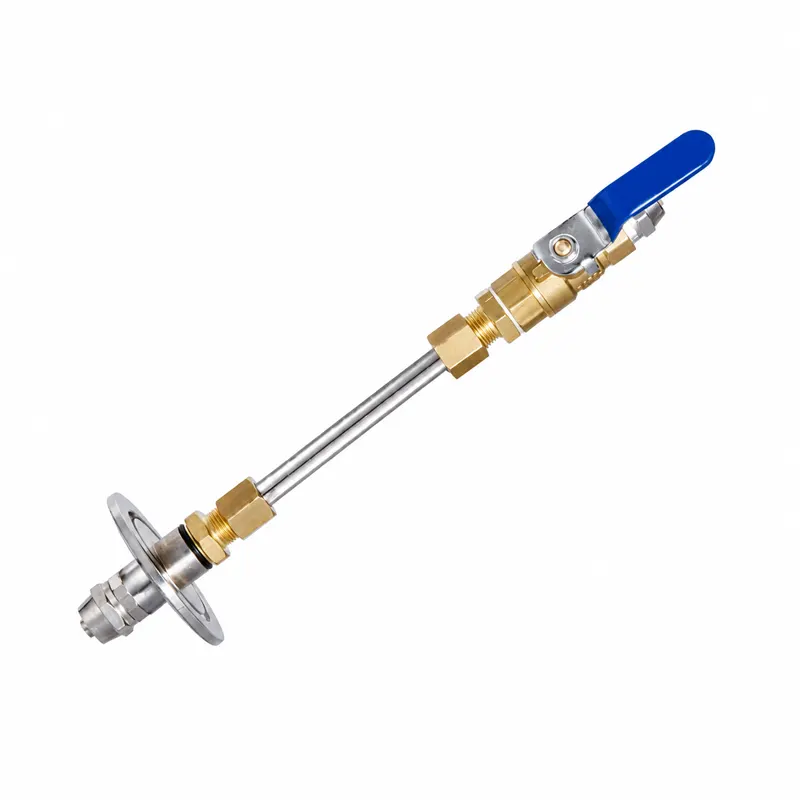
Any experiment that needs power, a signal, a gas line or a liquid line inside the chamber while it stays sealed needs a feedthrough. A gas and liquid feedthrough is a wall-mounted component in this category: it passes media through the enclosure wall while maintaining the separation between the internal atmosphere and the laboratory. Selection questions are mechanical and chemical rather than electrical — which port size and sealing method the box provides, which materials suit the media being carried, and whether the feedthrough is intended for gas, liquid or both. A feedthrough does not improve the atmosphere; it allows work to continue without breaking it.
Common Questions About Split-Type Purification Glove Boxes
Does the glove box clean the atmosphere by itself?
No. The chamber only provides a sealed volume. Water and oxygen removal happens in the purification circuit — blower, columns, valves and controls — whether that circuit is mounted on the box or housed in a separate cabinet.
Can a purification glove box also be evacuated like a vacuum glove box?
Not by default. Continuous purification and vacuum operation are different capabilities. Most antechambers are built to be evacuated; whether the main chamber is depends on its construction, wall thickness and sealing. Confirm this for the specific configuration rather than assuming it.
Are analyser readings the same as guaranteed process conditions?
They are measurements of the gas at the sampling point at that moment. Sample load, solvent release, glove condition and transfer frequency all shift the numbers, so treat them as operating data rather than as a warranty on the material inside.
When is a separate purification cabinet the better choice?
When bench space allows a two-part installation, when servicing the columns without disturbing the box interior matters, or when heat and vibration near the working zone are a concern. It is a layout decision, not a performance upgrade.
Do accessories such as feedthroughs or solvent adsorbers change the achievable atmosphere?
They support it rather than create it. A feedthrough preserves the seal while adding a connection; solvent adsorption protects the purification columns from organic vapour. Neither replaces water and oxygen removal by the purification circuit.
Deciding between a split and an integrated purification glove box, or how many feedthroughs and antechambers the work needs, comes down to the process rather than the catalogue. Define the exposure limits, the transfer path and the connections first; the enclosure and purification layout follow from there.
