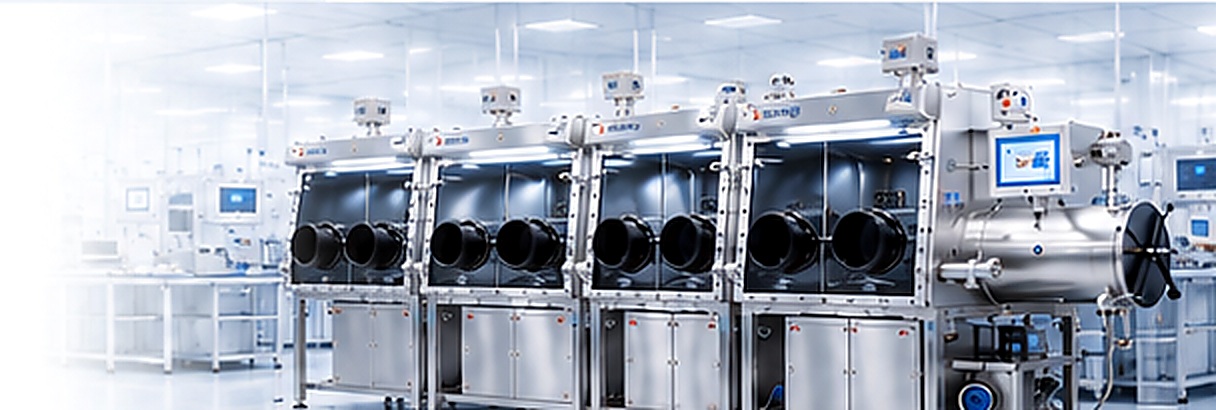
What is a Three-Station Single-Sided Split-Type Glove Box with Gas Purification System?
From the core, a Three-Station Single-Sided Split-Type Glove Box with Gas Purification System is a professional inert atmosphere workstation that R&D laboratories, battery material manufacturers, and advanced chemistry facilities use to process multiple sensitive samples simultaneously under an ultra-low water and oxygen environment. This equipment combines a modular split-body design with a high-performance gas purification system, providing a stable, clean inert atmosphere for up to three operators working side-by-side on a single side of the main chamber.
Core Function and Working Principle
The fundamental function of this glove box is to transform the initial air environment inside the sealed chamber into a target inert atmosphere, typically filled with pure argon or nitrogen, with water and oxygen levels maintained below 1 ppm (parts per million). The working principle relies on a continuous gas circulation loop: a fan draws the chamber atmosphere through a purification column containing copper catalyst and molecular sieves. The copper catalyst chemically removes oxygen, while the molecular sieves adsorb water vapor. The purified gas is then returned to the chamber, creating a progressive reduction and stabilization of H₂O and O₂ concentrations.
Key process parameters include the purification column's flow rate (typically 100-200 m³/h), the regeneration temperature (around 350-450°C for removing adsorbed impurities), and the system's leakage rate (usually less than 0.05 vol%/h). The transition chamber (antechamber) plays a vital role: samples and tools are placed in the transition chamber, which is evacuated and refilled with inert gas several times, ensuring that the main chamber atmosphere remains undisturbed. The system's PLC controller monitors water and oxygen levels in real-time, automatically switching between purification and regeneration cycles as needed.
Product Types and Classification
While the Three-Station Single-Sided Split-Type model is a specific configuration, the broader family of gas purification glove boxes can be classified along several dimensions:
By Number of Stations
- Single-Station: Suitable for individual researchers handling small batches of materials. For example, the Single-Station Single-Sided Glove Box.
- Two-Station: Allows two operators to work together, increasing throughput. Examples include both standard and split-type versions.
- Three-Station (the focus): Provides three glove ports on one side, ideal for moderate team workflows.
- Four-Station or more: For larger teams or production-like environments, double-sided configurations (e.g., Four-Station Double-Sided) offer up to 8 or even 12 stations.
By Operation Side
- Single-Sided: All glove ports are on one face of the chamber, suitable when space is limited on one side.
- Double-Sided: Glove ports on both front and back, allowing operators to work from opposite sides, useful for larger equipment or collaborative tasks.
By Structural Design
- Standard (Integrated) Type: The purification system is housed within the same cabinet as the chamber.
- Split-Type (the focus): The purification unit is separate from the main chamber, offering flexibility in placement, easier maintenance, and reduced vibration transmission. This split design is especially beneficial when the glove box is integrated with other equipment like coaters or testers.
Choosing among these types depends on the number of operators, space constraints, and the need for integration with downstream equipment.
Key Performance Indicators and Selection Criteria
When selecting a Three-Station Single-Sided Split-Type Glove Box, users should consider the following critical metrics:
- Water and Oxygen Control: The system should achieve <1 ppm of both H₂O and O₂, with stable long-term performance. High-quality purification columns and precise sensors are essential.
- Chamber Dimensions and Usable Space: The main chamber volume (typically 1200-1500 mm width for three stations) must accommodate planned experiments. Split-type designs often allow larger chambers without increasing the footprint excessively.
- Number of Glove Ports and Operation Mode: Three stations on one side provide efficient access for three operators. Ensure glove size and material (e.g., butyl rubber for chemical resistance) are suitable for the intended chemicals.
- Purification System Efficiency: Look for high cycle flow rate (e.g., 100 m³/h or more) and low regeneration frequency. A split-type system often allows independent regeneration of the purification column without interrupting the chamber atmosphere.
- Leakage Rate: A low leakage rate (<0.05 vol%/h) ensures minimal gas consumption and long-term atmosphere stability.
- Control System: A modern PLC with touchscreen interface, data logging, and alarm functions (e.g., for high water/oxygen levels or low gas pressure) is standard. Remote monitoring capabilities are a plus.
- Glove Material and Chemical Resistance: Common materials include butyl rubber, neoprene, and Viton. The choice depends on the chemicals used (e.g., lithium metal requires butyl rubber to minimize permeation).
- Maintenance Convenience: Consider ease of purification column regeneration (automatic or manual), glove replacement procedure, and accessibility of internal components. Split-type designs often simplify maintenance by allowing the purification unit to be serviced separately.
Application Fields and Selection Recommendations
This glove box is widely used in:
- Lithium-ion Battery Research: Handling lithium metal anodes, solid electrolytes, and electrode materials under moisture-free conditions.
- Perovskite Solar Cell Fabrication: Sensitive precursor materials and device encapsulation require environments with <1 ppm O₂ and H₂O.
- OLED and Display Material Development: Organic compounds that degrade rapidly in air are processed in glove boxes.
- Semiconductor and Wafer Processing: For air-sensitive steps in microfabrication.
- Metal-Organic Framework (MOF) Synthesis: Many MOFs are moisture-sensitive.
- Nanomaterials and Powder Metallurgy: Preventing oxidation of ultrafine metal powders.
- Pharmaceutical and Chemical Handling: For compounds that react with water or oxygen.
For a laboratory with 2-3 operators working on common projects, the Three-Station Single-Sided Split-Type offers an excellent balance of capacity, flexibility, and cost. If only one operator is needed, a single-station model may suffice. For larger teams requiring simultaneous operation from both sides, consider a double-sided configuration with six or more stations.
References
- Three-Station Single-Sided Split-Type Glove Box with Gas Purification System: https://www.gloveboxs.com/products/three-station-single-sided-split-purification-glove-box.html