Introduction
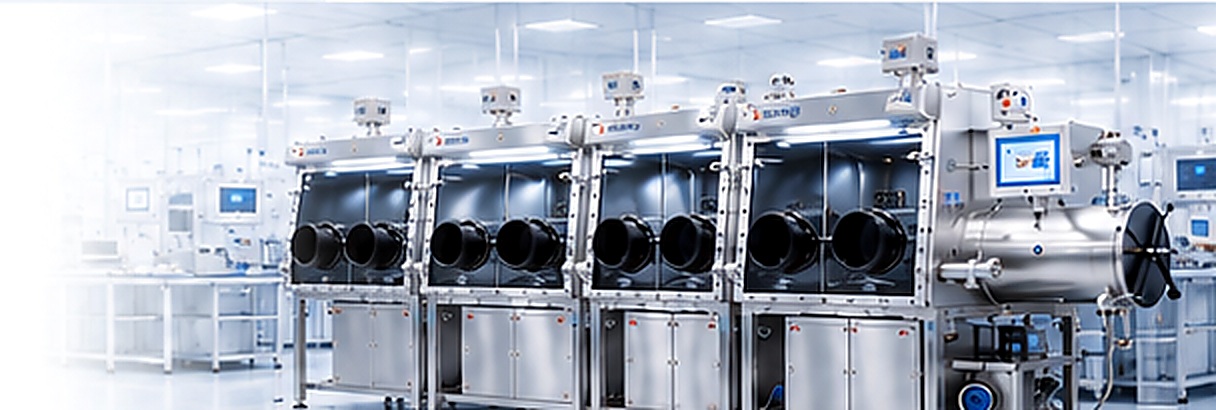
From the core, a Six-Station Double-Sided Split-Type Glove Box with Gas Purification System is a professional, high-capacity inert atmosphere workstation. Research laboratories, battery manufacturing facilities, OLED development centers, and advanced materials industries use it to process moisture- and oxygen-sensitive materials in a strictly controlled environment. This glove box combines a large internal workspace, dual-sided operation for six stations, and a split-type gas purification system to maintain water and oxygen levels below 1 ppm, ensuring reliable and reproducible experimental conditions.
Core Functions and Working Principle
How It Transforms the Environment
The glove box converts the initial ambient air inside the sealed chamber into an ultra-low moisture and oxygen inert atmosphere. This is achieved through a closed-loop gas circulation and purification system. The working gas (typically argon or nitrogen) is continuously drawn from the main box, passed through a purification column, and returned to the box. The purification column contains a copper catalyst that chemically removes oxygen (via oxidation) and molecular sieves that adsorb water vapor. A high-performance blower ensures a circulation flow rate of up to 70 m³/h, enabling rapid purification and stable maintenance of the target atmosphere.
Key Components and Process
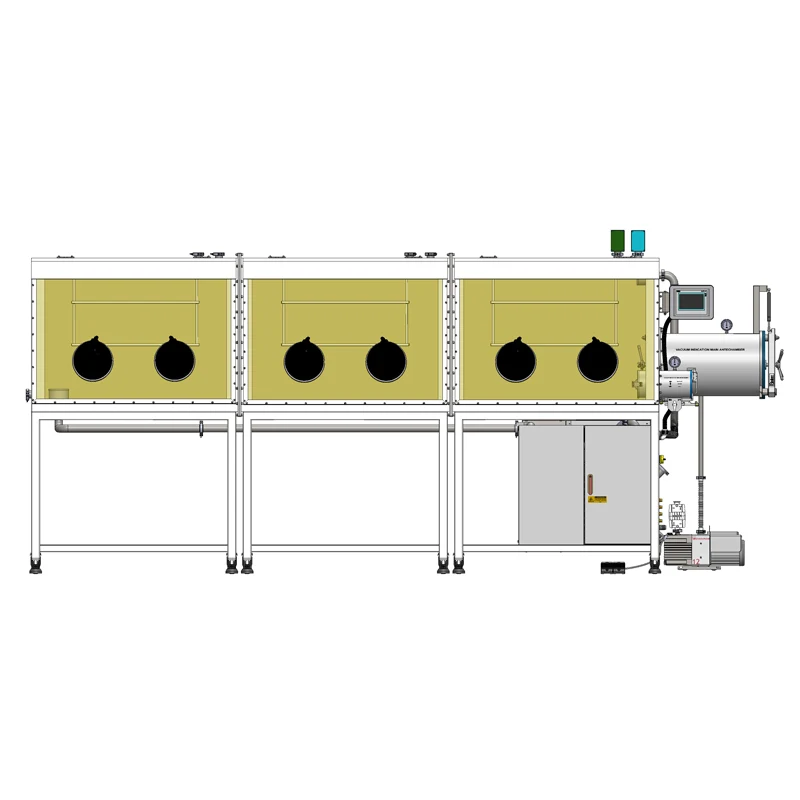
- Sealed Stainless Steel Chambers: Made of SUS304 (3 mm thick), the two interconnected boxes provide a total workspace of 2400 mm (L) × 750 mm (D) × 900 mm (H) each, offering ample space for multiple operators and large equipment.
- Gas Purification System: The split-type design houses the purification column separately from the main box, allowing easier maintenance and reducing heat transfer. The column contains oxygen and moisture adsorbents (capacities: 60 L O₂, 2 kg H₂O) and can be regenerated automatically or manually via a PLC-controlled process using a N₂/H₂ mixture (3–5% H₂).
- Transition Chamber (Anteroom): Samples and tools are transferred in and out without breaking the inert atmosphere. The transition chamber is evacuated and refilled with inert gas multiple times to ensure minimal contamination.
- Control System: A PLC with a 5.7-inch touchscreen HMI manages pressure control (0–16 mbar, adjustable), automatic pressure hold, and foot pedal pressure adjustment. The system also logs regeneration data and displays water/oxygen readings in real time.
Core Components and Key Technologies
Split-Type Design
Unlike integrated glove boxes, the split-type configuration separates the purification unit from the main chamber. This reduces thermal stress on the box, simplifies maintenance, and allows the purification system to be placed in a separate area for better space utilization. It is particularly advantageous for large-scale installations where the purification unit may need to be serviced without disrupting the workspace.
Gas Purification Column and Regeneration
The purification column uses a combination of copper catalyst for oxygen removal and molecular sieves for water adsorption. After saturation, the column is regenerated by heating it to a specified temperature (typically 200–300°C) while purging with a reducing gas mixture (N₂/H₂ or Ar/H₂). The regeneration process is fully automated by the PLC, with three modes: automatic, semi-automatic, and manual. The system records the last regeneration date and displays it on the HMI for easy scheduling.
Leakage and Vacuum System
The entire circulation loop, including valves and connections, is designed with a leakage rate better than 10⁻⁵ mbar·L/s. A two-stage rotary vane vacuum pump with a pumping speed of 12 m³/h achieves a vacuum level below 1×10⁻³ mbar. The pump includes an oil mist filter and an oil return kit to prevent oil backflow, and it features a built-in check valve to maintain vacuum when the pump is off.
Key Performance Indicators and Selection Criteria
Moisture and Oxygen Control
The most critical performance indicators are the achievable H₂O and O₂ concentrations. This glove box can maintain H₂O < 1 ppm and O₂ < 1 ppm under normal operating conditions. The stability of these levels depends on the purification capacity, circulation flow, and user discipline (e.g., proper use of the transition chamber, minimizing glove perforations).
Box Dimensions and Workstations
The six-station double-sided design provides three glove ports on each side, allowing up to six operators to work simultaneously. Each station is spaced to accommodate large equipment or multiple process steps. The total internal volume is approximately 2× (2400×750×900) mm, offering a generous working area. For smaller teams, consider Single-Station Single-Sided Glove Box or Two-Station Single-Sided Glove Box.
Purification System Efficiency
The circulation flow rate of 70 m³/h and the large adsorbent capacity (60 L O₂, 2 kg H₂O) ensure rapid pulldown and long operational intervals between regenerations. The regeneration process consumes a N₂/H₂ mixture and requires cooling water (2–3 L/min). Users should plan for a regeneration cycle every 2–4 weeks depending on usage intensity.
Control and Automation
A PLC-based control system with a touchscreen HMI offers precise pressure control, automatic regeneration, data logging, and alarm functions. The system can be integrated with external sensors or remote monitoring for advanced applications. Foot pedal pressure control allows hands-free adjustment during delicate operations.
Material and Seal Quality
The chambers are constructed from SUS304 stainless steel with a thickness of 3 mm, ensuring durability and corrosion resistance. The glove ports are sealed with high-quality O-rings, and gloves are available in different materials (e.g., butyl rubber, neoprene) to resist chemical attack. The overall leakage rate of the system is better than 0.001 vol/hr, guaranteeing long-term atmosphere stability.
Application Areas and Selection Advice
Typical Applications
- Lithium-Ion Battery Research: Handling lithium metal, solid electrolytes, and electrode materials.
- Perovskite Solar Cells: Fabrication and encapsulation of moisture-sensitive perovskite layers.
- OLED/Display Materials: Synthesis and testing of organic light-emitting materials.
- Semiconductor Processing: Wafer handling and device fabrication under inert atmosphere.
- Metal-Organic Frameworks (MOFs): Synthesis and storage of air-sensitive MOFs.
- Pharmaceuticals: Handling of highly sensitive drugs or intermediates.
Selection Guidance
For laboratories with fewer than three operators, a Two-Station Double-Sided Glove Box or Four-Station Double-Sided Glove Box may be more cost-effective. For large-scale production or multi-user collaborative projects, the six-station model offers maximum throughput. The split-type design is recommended when the purification unit needs to be placed in a separate room or when heat dissipation is a concern. Always verify the required water/oxygen specification (e.g., <1 ppm, <0.1 ppm) and choose a system with sufficient purification capacity to meet your process demands.