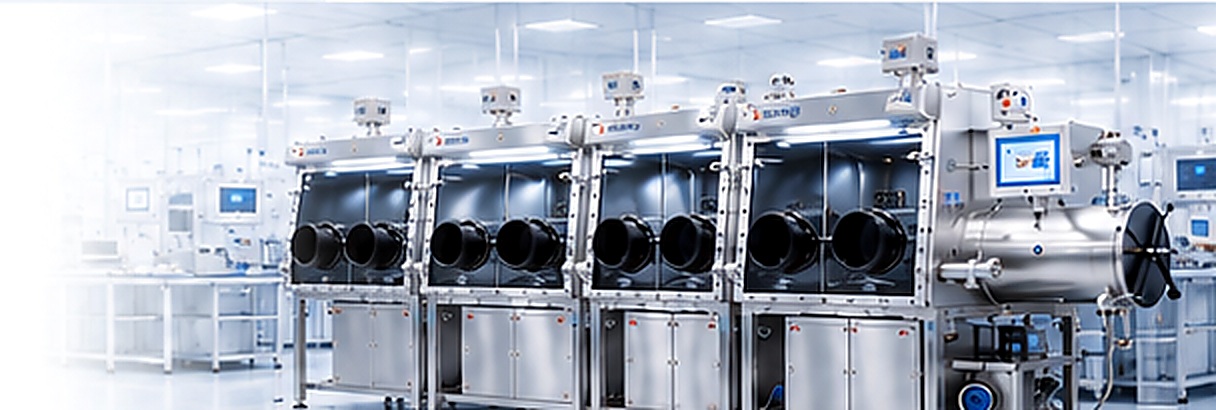
What is a Glove Box Trace Moisture Analyzer?
At its core, a Glove Box Trace Moisture Analyzer is a specialized analytical instrument used to continuously measure and display the concentration of water vapor inside a glove box. Laboratories and production facilities involved in lithium‑ion battery research, perovskite solar cell development, OLED manufacturing, and other air‑sensitive processes rely on this device to maintain the ultra‑dry environment required for handling reactive materials. By providing real‑time moisture data, it helps operators confirm that the inert atmosphere meets the stringent water vapor specifications (often <1 ppm) necessary for reproducible experiments and product quality.
Core Function and Working Principle
The analyzer’s primary function is to convert the ambient glove box atmosphere into a measurable signal that reflects the moisture content. Most trace moisture analyzers for glove box applications employ a sensor technology that is sensitive to parts per million (ppm) or even parts per billion (ppb) levels of water vapor. Common sensor types include aluminum oxide capacitive sensors, quartz crystal microbalance (QCM) sensors, or electrolytic (P2O5) cells. The sensor is installed in a small bypass loop that continuously draws a sample of the glove box gas, passes it over the sensing element, and returns it to the box. The electronics then convert the sensor’s response into a digital readout, often displayed on a touchscreen or transmitted to a central control system.
To achieve accurate and stable readings, the analyzer must be calibrated regularly using known moisture standards, and its flow rate and temperature must be controlled. The sensor’s response time is typically in the range of seconds to a few minutes, allowing operators to detect leaks or contamination events promptly. The presence of a reliable trace moisture analyzer is essential for verifying that the oxygen analyzer and moisture analyzer work together to maintain the desired low‑H2O and low‑O2 environment.
Key Components and Sensor Technologies
While the product itself is a single instrument, different sensor technologies are available depending on the required sensitivity and application:
Aluminum Oxide Capacitive Sensors
These are the most common for glove box use. They operate by measuring the change in capacitance of an aluminum oxide layer as water molecules adsorb onto it. They offer good sensitivity down to the low ppm range, fast response, and reasonable cost. However, they can be affected by corrosive gases and require periodic calibration.
Quartz Crystal Microbalance (QCM) Sensors
These sensors detect mass changes on a coated quartz crystal when water is adsorbed. They provide high sensitivity and excellent stability, making them suitable for sub‑ppm measurements. They are often used in research settings where extreme accuracy is needed.
Electrolytic (P2O5) Sensors
These sensors use a phosphorous pentoxide (P2O5) coating that absorbs water and then electrolyzes it, generating a current proportional to the moisture content. They are very accurate and can measure down to low ppb levels, but they require a carrier gas flow and periodic re‑coating of the sensor.
When choosing a trace moisture analyzer, one must consider the typical moisture levels in the glove box, the presence of any interfering gases (e.g., solvents), and the maintenance requirements. For most standard glove box applications, an aluminum oxide or QCM sensor with a range of 0–100 ppm and a resolution of 0.1 ppm is sufficient.
Key Performance Indicators and Selection Criteria
Selecting the right trace moisture analyzer for your glove box involves evaluating several critical parameters:
- Measurement Range and Resolution: The analyzer should cover the expected moisture levels, typically from 0.1 ppm to 1000 ppm. A resolution of 0.1 ppm is common for trace applications.
- Accuracy and Repeatability: Look for instruments with an accuracy of ±1% of reading or ±0.1 ppm, whichever is greater. Repeatability should be within ±0.5% of full scale.
- Response Time: A fast response (T90 < 30 seconds) allows quick detection of leaks or sample introduction events.
- Gas Compatibility: The sensor must be compatible with the inert gas (argon, nitrogen, helium) and any trace solvents or reactive species present in the glove box.
- Calibration and Maintenance: How often does the sensor need calibration? Can it be easily calibrated in‑house using certified gas standards? Some sensors require periodic replacement or regeneration.
- Integration with Glove Box Control System: Many analyzers offer analog outputs (4–20 mA, 0–10 V) or digital communication (RS‑232, Modbus) to integrate with the glove box’s PLC or monitoring software.
- Durability and Environmental Resistance: The analyzer should be robust enough to withstand the glove box environment, including potential chemical exposure and temperature fluctuations.
For typical laboratory glove boxes, a compact analyzer with a built‑in display and simple calibration procedure is ideal. For production‑scale systems, consider a model with remote monitoring and data logging capabilities.
Applications and Selection Recommendations
Glove Box Trace Moisture Analyzers are used in virtually any situation where an inert atmosphere must be maintained below a critical moisture threshold. Key applications include:
- Lithium‑ion Battery R&D: Electrode coating, electrolyte filling, and cell assembly require <1 ppm H2O to prevent degradation.
- Perovskite Solar Cells: Moisture can rapidly degrade perovskite materials; monitoring ensures consistent device performance.
- OLED and Display Materials: Organic emitters and charge transport layers are extremely sensitive to water.
- Metal‑Organic Frameworks (MOFs): Synthesis and characterization of MOFs often require strict moisture control.
- Pharmaceutical and Chemical Synthesis: Handling hygroscopic or water‑sensitive intermediates.
When selecting a trace moisture analyzer, start by defining the required moisture level for your process. If you need to maintain <1 ppm, choose a sensor with ppb‑level sensitivity (e.g., QCM or electrolytic). For general purpose <10 ppm, an aluminum oxide sensor is often sufficient. Also consider the size of the glove box: a larger volume may require a faster flow rate through the analyzer to ensure representative sampling. Finally, look for a reputable manufacturer that offers local support and calibration services.
References
Product page: Glove Box Trace Moisture Analyzer
Related accessories: Glove Box Moisture Analyzer | Glove Box Trace Oxygen Analyzer