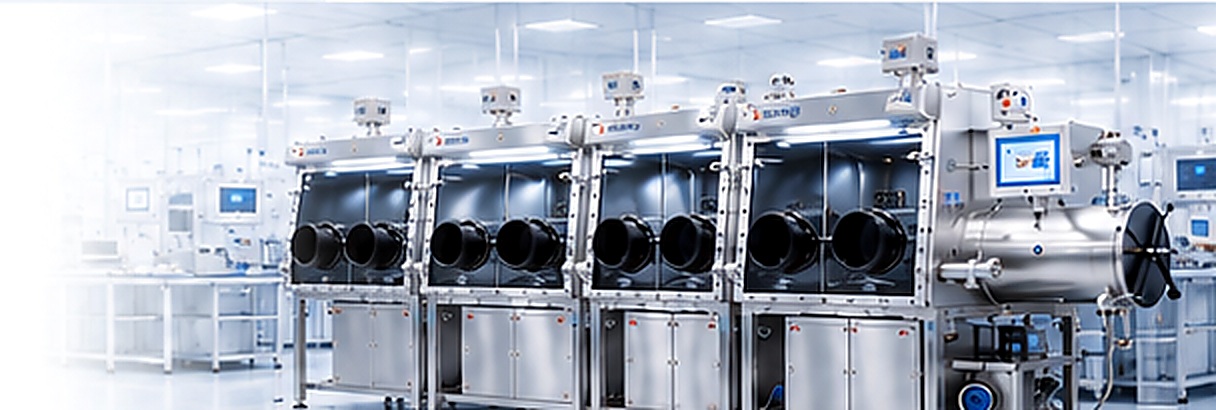
What Is a Two-Station Single-Sided Glove Box with Gas Purification System?
If you work with air-sensitive materials in a laboratory or pilot production environment, you already know how quickly moisture and oxygen can ruin your results. Whether you are handling lithium metal for battery research, encapsulating perovskite solar cells, or synthesizing moisture-sensitive compounds, maintaining an ultra-low H₂O and O₂ atmosphere is not optional — it is essential. The Two-Station Single-Sided Glove Box with Gas Purification System from TENCAN is a purpose-built enclosure that creates and maintains a controlled inert atmosphere (typically argon or nitrogen) with H₂O and O₂ levels below 1 ppm. It allows two operators to work simultaneously from one side, making it ideal for medium-scale research or small-batch production.
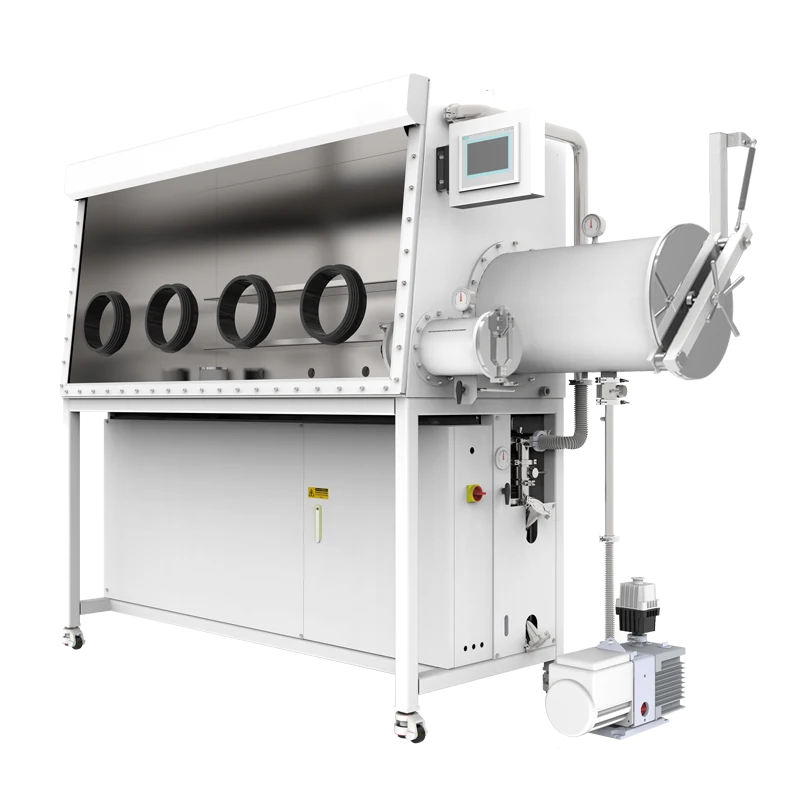
This type of glove box integrates a gas purification system directly into the unit or as a separate module, continuously circulating the chamber atmosphere through purification columns to remove trace water and oxygen. Unlike a simple isolation box that relies on a continuous gas purge, a purification glove box can sustain high-purity conditions for extended periods with much lower gas consumption.
How Does the Gas Purification Glove Box Work?
The heart of the system is the gas purification circulation loop. Inside the glove box, the inert gas (commonly argon or nitrogen) is drawn from the chamber by a circulation fan, passed through a purification column filled with copper catalyst and molecular sieve, and then returned to the chamber. The copper catalyst reacts with oxygen to form copper oxide, and the molecular sieve physically adsorbs water vapor. Over time, the purification material becomes saturated and must be regenerated — typically by heating the column to 200–300°C while purging with a hydrogen-containing gas mixture (if using a copper catalyst) or by applying vacuum and heat for the molecular sieve.
A key advantage of a two-station single-sided configuration is that two operators can access the chamber side by side, sharing the same workspace. The single-sided design means all glove ports are on the front panel, which simplifies cabinet placement against a wall or in a row of equipment. The purification system automatically maintains the atmosphere, so you can focus on your experiments rather than constantly monitoring gas levels.
The system typically includes:
- Main chamber — welded stainless steel construction with viewing windows and glove ports.
- Two-station single-sided glove ports — positioned for comfortable side-by-side operation.
- Gas purification system — integrated or split-type, with circulation pump, purification columns, and regeneration hardware.
- Moisture and oxygen analyzers — real-time monitoring of H₂O and O₂ concentrations.
- Transition chamber (antechamber) — for transferring materials in and out without contaminating the main atmosphere.
For a detailed look at the product, visit the Two-Station Single-Sided Purification Glove Box product page.
Why Choose a Two-Station Single-Sided Glove Box?
Many laboratories start with a single-station glove box. But as your research evolves, you may need more workspace or the ability for two people to collaborate inside the same inert environment. The two-station single-sided design gives you that flexibility without requiring access from both sides of the chamber. It is an excellent middle ground between compact single-station units and larger double-sided configurations.
Here are some common scenarios where this configuration proves valuable:
- Lithium-ion battery research — preparing electrodes, assembling coin cells or pouch cells, handling lithium metal.
- Perovskite solar cell development — spin-coating, thermal evaporation, and encapsulation under inert atmosphere.
- OLED and display material synthesis — handling organic luminescent materials that degrade rapidly in air.
- Nanomaterial synthesis — working with air-sensitive precursors and catalysts.
- Pharmaceutical and chemical research — handling moisture-sensitive reagents or intermediates.
When two researchers share the same box, they can reduce the number of separate installations, save floor space, and lower overall gas and maintenance costs. The single-sided access also simplifies integration with other equipment placed beside or behind the box.
Comparison with Single-Station and Double-Sided Models
If you are deciding between configurations, consider the following:
- Single-station single-sided — suitable for one operator; compact and economical.
- Two-station single-sided — accommodates two operators side by side; good for collaborative work and slightly larger throughput.
- Two-station double-sided — allows operators on both sides; ideal for larger components or when access from two sides is needed.
- Four-station or more — for production-scale operations or larger research teams.
TENCAN offers a range of purification glove boxes, including Single-Station Single-Sided, Two-Station Double-Sided, and larger split-type models. The two-station single-sided is a popular choice for growing research groups.
Key Technical Considerations for Selecting a Purification Glove Box
When evaluating a two-station single-sided glove box with gas purification system, you should pay attention to several technical factors that directly affect your experimental reproducibility and operational efficiency.
1. H₂O and O₂ Control Capability
The primary function of a purification glove box is to maintain extremely low levels of moisture and oxygen. Most advanced systems can achieve and hold H₂O < 1 ppm and O₂ < 1 ppm under normal operating conditions. However, the actual performance depends on several variables:
- Chamber leak rate (typically < 0.05 vol%/h in a well-sealed system).
- Glove integrity (any microscopic punctures increase contamination).
- Frequency of transition chamber use (each transfer cycle should follow proper evacuation/purge procedures).
- Regeneration schedule of the purification columns.
- Purity of the supply gas (argon or nitrogen should be ≥ 99.999% for best results).
For most sensitive applications, targeting < 1 ppm for both H₂O and O₂ is a standard requirement. If your process can tolerate higher levels (e.g., < 10 ppm or < 100 ppm), you may be able to use a simpler design, but the purification system still offers better stability and lower gas consumption than a purge-only box.
2. Purification System Type: Integrated vs. Split
Some glove boxes integrate the purification columns directly into the base cabinet (integrated type). Others have a separate purification unit that connects to the chamber via flexible hoses (split type). The two-station single-sided model can be offered in both styles.
- Integrated — compact footprint, all-in-one design. Easier to move as a complete unit.
- Split type — provides more flexibility in layout; the purification unit can be placed remotely (e.g., on a cart or in a separate enclosure). Useful when floor space is limited near the glove box.
For example, TENCAN offers a Two-Station Single-Sided Split-Type Purification Glove Box for those who prefer separate modules.
3. Chamber Size and Usable Volume
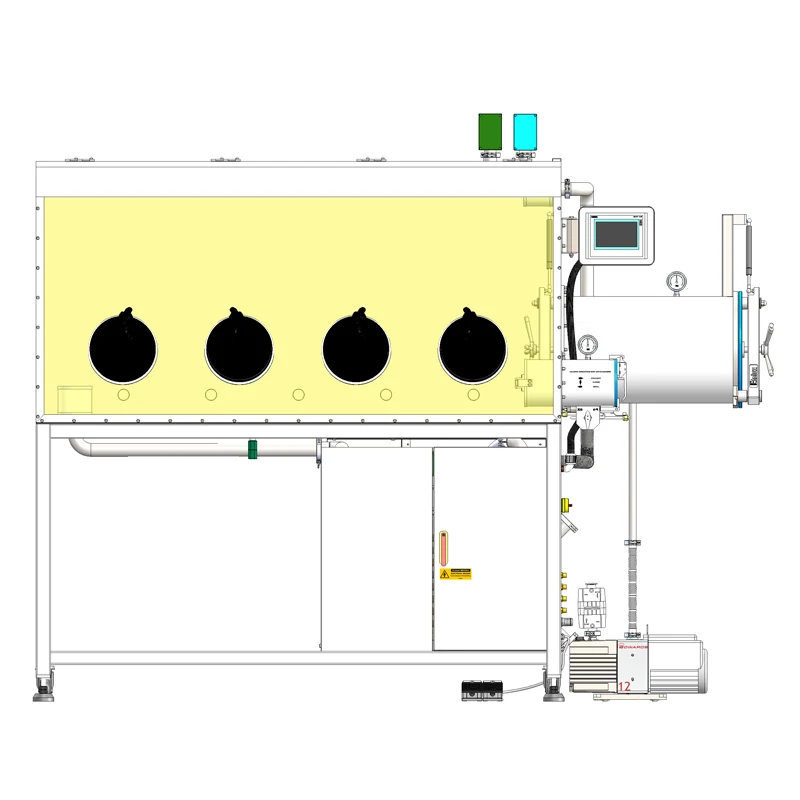
A two-station glove box typically has a chamber length of around 1500–1800 mm, depth of 750–1000 mm, and height of 900–1000 mm. The exact dimensions vary by manufacturer. Make sure the internal space is sufficient for your equipment (e.g., spin coater, balance, thermal evaporator) and that the glove ports are ergonomically positioned.
4. Transition Chamber (Antechamber) Configuration
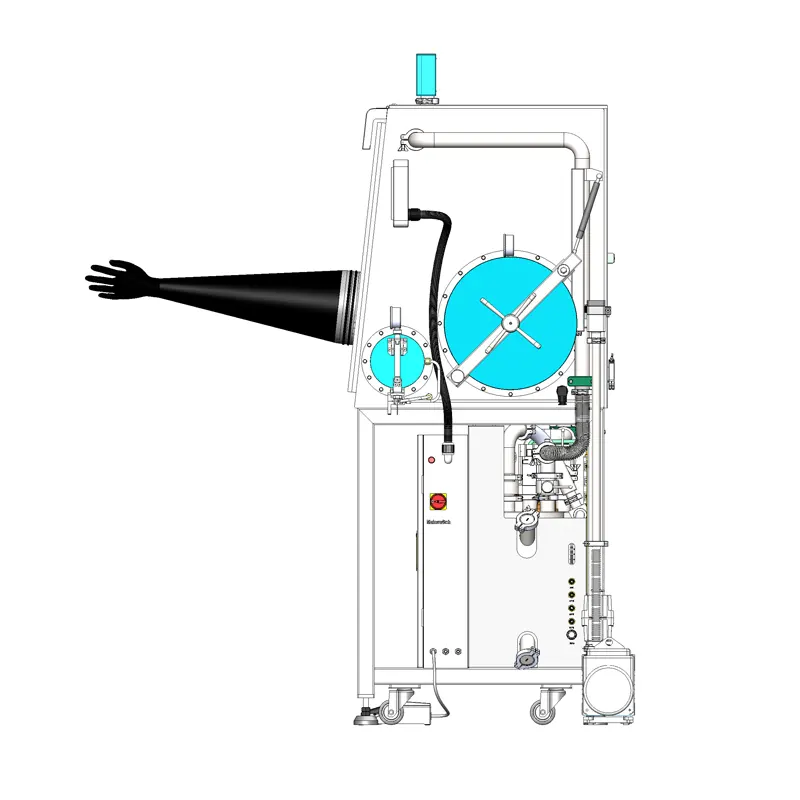
The antechamber is critical for moving materials in and out without breaking the inert atmosphere. A two-station single-sided box usually includes a cylindrical or rectangular antechamber on one side. It should have rough vacuum capability (typically a rotary vane pump) and a purge gas connection. For efficient transfer, the antechamber should be large enough to accommodate your sample containers, substrates, or small tools. A typical size is φ150–200 mm × 300–400 mm, but larger options are available.
5. Glove Material and Size
Glove material must be chosen based on the chemicals you handle. Common options include:
- Butyl rubber — excellent resistance to moisture permeation; good for general inert atmosphere work.
- Chloroprene (neoprene) — better solvent resistance but slightly higher moisture permeability.
- Hypalon (chlorosulfonated polyethylene) — good for ozone and oxidation resistance.
For most applications, butyl rubber gloves are recommended. Ensure the glove size fits comfortably for extended use.
6. Control System and Monitoring
Modern purification glove boxes come with a PLC-based control system with a touchscreen interface. Features to look for include:
- Real-time display of H₂O and O₂ concentrations.
- Automatic regeneration control (setting temperature, duration, and gas flow).
- Pressure control and alarms (overpressure/underpressure).
- Data logging capability for traceability.
Having accurate analyzers is crucial. The moisture sensor is typically an electrolytic or aluminum oxide type for ppm-level detection. The oxygen sensor can be an electrochemical or paramagnetic cell. Some systems also include a solvent purification column if you work with volatile organic solvents inside the glove box.
Installation and Operational Tips
Setting up a two-station single-sided glove box requires proper planning:
- Location — place the unit on a level floor, away from direct air conditioning drafts and strong heat sources. Leave sufficient clearance around the back for service access and ventilation.
- Utilities — ensure you have a compressed inert gas supply (argon or nitrogen) at suitable pressure (typically 0.4–0.6 MPa), a vacuum pump connection, and 220V/50Hz or 110V/60Hz power (specify your local requirement).
- Initial purging — before first use, the chamber must be thoroughly purged with inert gas to displace air. The purification system then circulates and removes residual contaminants. This initial process may take several hours to reach < 1 ppm levels.
- Transition chamber operation — always follow a proper procedure: place items in the antechamber, close the outer door, evacuate the chamber, then backfill with inert gas. Repeat the cycle 3–5 times for best results.
Maintenance and Regeneration
The purification columns will eventually become saturated with water and oxygen. Regeneration is required to restore their capacity. The regeneration process varies by manufacturer, but typically involves:
- Heating the column to 200–300°C (for copper catalyst) or 150–200°C (for molecular sieve).
- Purging with a regeneration gas (e.g., a mixture of 5% hydrogen in nitrogen for copper catalyst, or pure inert gas for molecular sieve).
- Cooling down and returning to circulation mode.
The frequency of regeneration depends on how much contamination enters the system. A glove box operated with proper transfer techniques may only need regeneration every 3–12 months. Regular monitoring of H₂O and O₂ levels helps you determine when regeneration is needed.
Safety Considerations
Working with inert atmospheres and flammable materials (e.g., lithium metal, organic solvents) requires strict safety measures. Ensure your glove box is equipped with:
- Overpressure relief valve to prevent positive pressure buildup.
- Oxygen alarm that warns you if O₂ levels drop below safe breathing thresholds (for humans) — note that argon or nitrogen displaces oxygen, creating an asphyxiation risk.
- Emergency stop button for the circulation pump and other electrical components.
- Solvent vapor monitoring if you plan to use volatile chemicals; some purification systems can be damaged by solvent vapors.
Always follow your local safety regulations and consult with the glove box supplier about the specific hazards of your materials.
How to Get the Right Configuration for Your Application
Choosing the right two-station single-sided glove box depends on your specific process, material sensitivity, throughput, and budget. When contacting a supplier like TENCAN, be prepared to provide:
- Material types and their sensitivity to moisture/oxygen.
- Target H₂O and O₂ levels (e.g., < 1 ppm).
- Desired chamber dimensions and number of operators.
- Preferred gas type (argon or nitrogen).
- Any special requirements (solvent purification, custom glove ports, additional feedthroughs).
- Local power supply and available floor space.
With this information, the supplier can recommend the most suitable model and optional accessories. For a starting point, explore the Two-Station Single-Sided Purification Glove Box page to see standard specifications and available customizations.
The two-station single-sided glove box with gas purification system strikes an excellent balance between collaborative workspace, small footprint, and high-performance atmosphere control. Whether you are advancing battery technology, developing next-generation solar cells, or synthesizing novel materials, this configuration can provide the reliable inert environment your work demands.