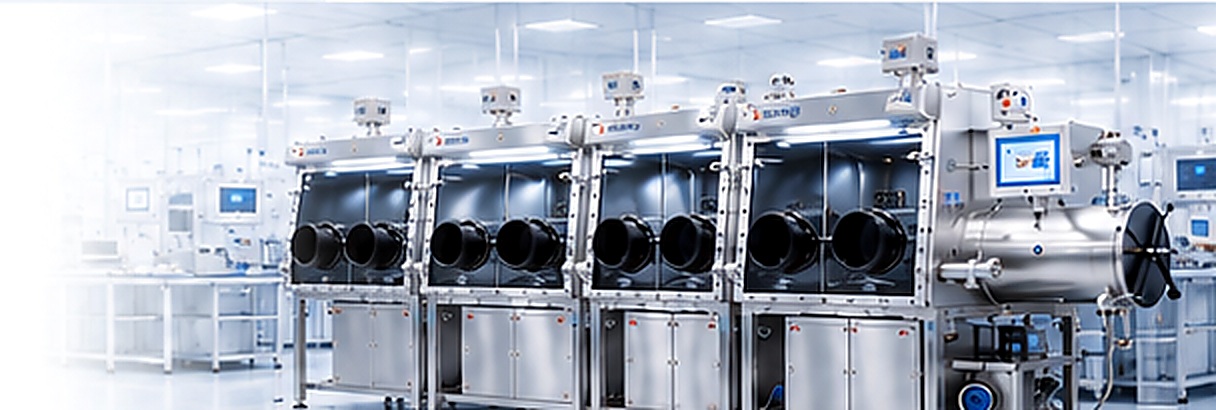
Why a Four-Station Double-Sided Glove Box?
When your research or small-scale production requires multiple operators working simultaneously on sensitive materials, a single-sided workstation often becomes a bottleneck. You need a system that allows two people on each side to perform tasks without cross-interference, while maintaining a strictly controlled inert atmosphere. That is exactly where a four-station double-sided glove box with gas purification system shines. In this article, we will walk through its design principles, the gas purification loop, typical applications, and key factors to consider when selecting such a system.
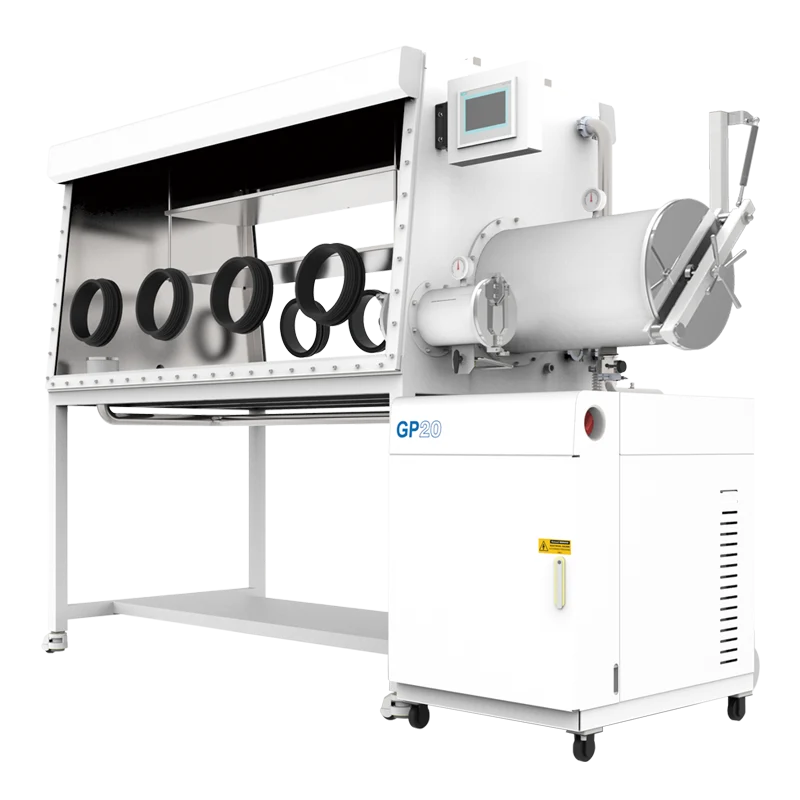
How the Gas Purification System Works
The core of any high-performance glove box is its ability to remove moisture and oxygen from the circulating inert gas (argon, nitrogen, or helium). In a typical gas purification system, a circulation blower continuously draws gas from the main chamber through a purification column containing two types of media: a copper-based catalyst (or similar) for oxygen removal and molecular sieves for water vapor adsorption. The gas then flows back into the chamber, maintaining H₂O and O₂ levels below 1 ppm under normal operating conditions.
The purification column can be regenerated when saturated, usually by heating it to 200–300 °C while purging with a hydrogen‑containing gas mixture (e.g., N₂/H₂ or Ar/H₂). This process restores the adsorption capacity, allowing the column to be reused many times. The entire regeneration cycle is typically controlled automatically by the PLC and HMI, with options for manual or semi‑automatic operation.
Key Features of the Four-Station Double-Sided Configuration
Space and Accessibility
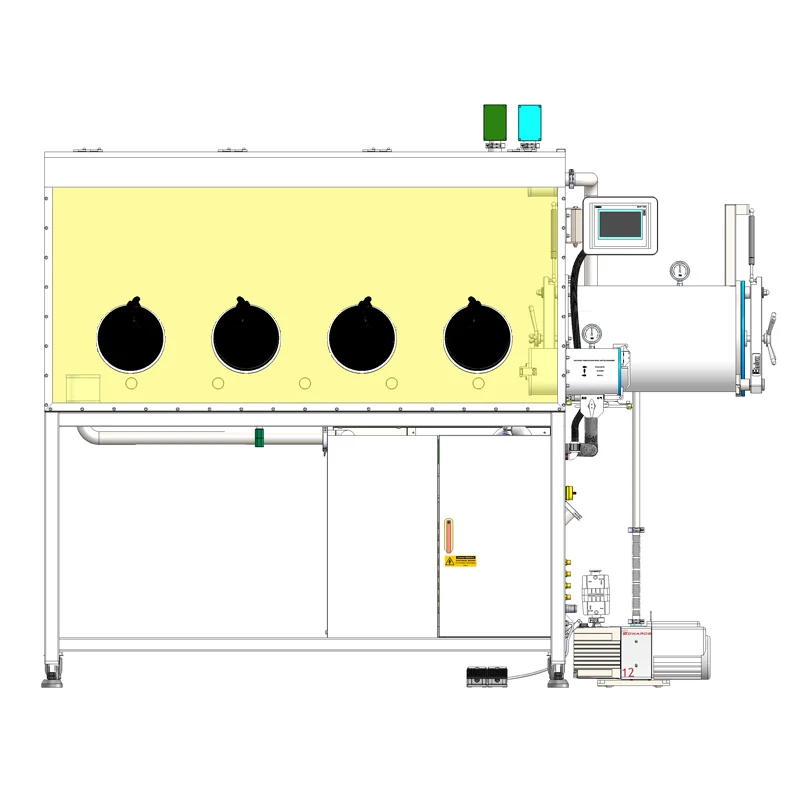
A four-station double-sided glove box usually has a chamber length ranging from 2400 mm to 3000 mm, a depth around 750 mm to 1000 mm, and a height of approximately 900 mm. This provides ample internal workspace for large equipment (e.g., coating machines, spin coaters, or electrochemical test stations) and allows two operators on each side to work comfortably. The double-sided design reduces idle time because operators on opposite sides can prepare tools or load samples without interfering with each other.
Workstations and Gloves
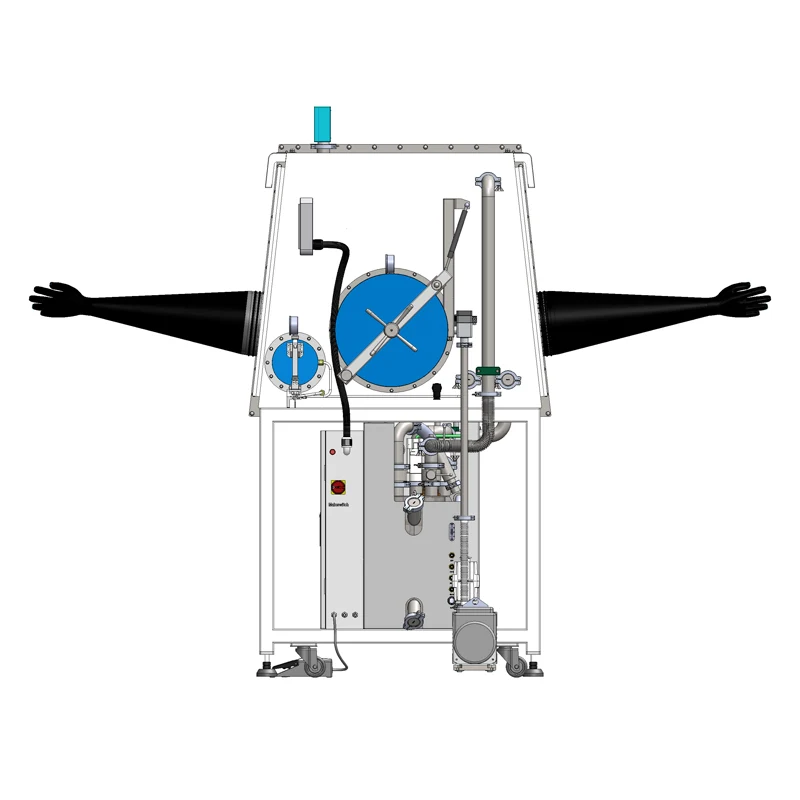
Each station typically has two glove ports, so a four-station double-sided box comes with eight glove ports (four on each side). The gloves are usually made of butyl rubber, which offers excellent resistance to common organic solvents and low permeability to moisture and oxygen. For applications involving aggressive chemicals, you may opt for chloroprene or other specialty materials. The number of gloves directly influences how many tasks can run concurrently, making the four-station setup ideal for teams of 3–5 researchers.
Antechamber (Transfer Chamber)
Materials must be introduced or removed without contaminating the main atmosphere. A large antechamber (often Ø380 mm × 600 mm or larger) is integrated into the system. It can be evacuated and refilled with inert gas multiple times (typically 3–5 cycles) to reduce the introduced moisture and oxygen to acceptable levels before opening the inner door. Some configurations also include a small antechamber for quick transfers of small items.
Purification System Specifications
A typical gas purification system for this size glove box has a circulation flow rate of 60–120 m³/h at a pressure drop of about 60 mbar. The purification column (stainless steel, with heater and insulation) contains copper catalyst and molecular sieves. The system can achieve H₂O < 1 ppm and O₂ < 1 ppm under steady-state conditions, provided that the box leak rate is well controlled (< 0.05 vol%/h) and the antechamber is used properly.
Applications That Benefit from a Four-Station Double-Sided Box
Lithium Battery Research and Assembly
Handling lithium metal, electrolytes, and cathode/anode materials requires extremely low moisture and oxygen levels to prevent degradation and safety hazards. With multiple operators, you can simultaneously prepare electrode sheets, assemble coin cells or pouch cells, and perform electrolyte filling—all inside the same controlled atmosphere.
Perovskite Solar Cell Fabrication
Perovskite precursor solutions are highly sensitive to moisture; even a few parts per million can cause premature crystallization or device failure. A four-station double-sided glove box allows one team to work on spin‑coating on one side while another team performs annealing or encapsulation on the other side, greatly accelerating the fabrication process.
OLED and Display Material Processing
Organic light-emitting materials are prone to oxidation and hydrolysis. Multiple operators can handle different steps—substrate cleaning, organic layer deposition, cathode evaporation—without breaking the inert atmosphere. The double-sided access also makes it easier to connect to external equipment like vacuum evaporators or atomic layer deposition systems.
3D Printing of Reactive Powders
Metal powders such as titanium, aluminum, or magnesium alloys are pyrophoric when exposed to air. The inert atmosphere glove box provides a safe environment for handling these powders, and the generous chamber size can accommodate a 3D printer or a powder‑screening station.
Selecting the Right Configuration
Every laboratory has unique requirements. When considering a four-station double-sided glove box, you should evaluate the following factors:
- Process requirements: Target H₂O/O₂ levels, type of inert gas (argon is common for most chemical work; nitrogen is cheaper but may react with certain materials), and whether you need solvent purification or vacuum oven integration.
- Number of users: Four stations enable up to four people to work simultaneously. If your team is smaller, a two-station double-sided or single-sided model might be more cost‑effective.
- Glove material: Butyl rubber is standard; for strong solvents, consider chloroprene or a disposable glove system.
- Purification system type: Integrated purification system (compact) or split type (separate purification cabinet for larger systems). The split design allows easier maintenance and can be placed under the main chamber or beside it.
- Control and monitoring: PLC with touchscreen HMI, real‑time display of H₂O and O₂ concentrations, automatic pressure control (typically 0–16 mbar), data logging, and alarm functions.
- Safety features: Over‑pressure protection, oxygen level alarm, emergency stop, and automatic shut‑off for critical failures.
- Installation conditions: Power supply (110 V or 220 V, depending on region), cooling water for the purification column (flow rate ~2–3 L/min), and proper ventilation.
Why Choose a Double‑Sided Design?
Double‑sided glove boxes offer a significant ergonomic advantage. Operators can face each other, passing tools and samples through a central aisle without having to reach around. This layout also simplifies the integration of roll‑to‑roll processing equipment, large‑area substrates, or lengthy instruments. For processes that require glove‑bag attachments or temporary isolation, the double‑sided ports provide additional flexibility.
Understanding Performance Limits
While the commonly quoted specification for a gas purification glove box is H₂O < 1 ppm and O₂ < 1 ppm, achieving and maintaining these values depends on several factors:
- Box leak rate: Even pinhole leaks can introduce moisture and oxygen. A well‑maintained system typically has a leak rate below 0.05 vol%/h.
- Glove integrity: Butyl gloves have low but finite permeability; small punctures or aging can cause gradual contamination.
- Antechamber operation: Insufficient purge cycles or leaving the outer door open for too long will spike impurities.
- Purification column condition: As the column approaches saturation, its efficiency decreases. Regular regeneration (depending on usage, every few weeks to months) is necessary.
- Gas purity: The inert gas supply should have very low levels of H₂O and O₂ (e.g., 99.999% or higher) to reduce the load on the purification system.
- Environmental factors: High ambient humidity (e.g., >70% RH) can increase the moisture load during antechamber transfers.
In practice, many laboratories successfully operate their glove boxes below 0.5 ppm for both H₂O and O₂ for extended periods, but the actual achievable level should be verified through regular calibration of the oxygen and moisture analyzers.
Maintenance and Regeneration
Regeneration of the purification column is an automatic process controlled by the PLC. Typically, the column is heated while a hydrogen‑containing gas mixture flows through it, reducing the copper oxide back to metallic copper and desorbing water from the molecular sieves. The process takes several hours and consumes moderate amounts of cooling water. After regeneration, the system should be purged with inert gas before returning to service. Most modern glove boxes provide a regeneration cycle counter and estimated remaining capacity, helping you plan maintenance.
Customization and Accessories
Beyond the standard configuration, you can equip a four-station double-sided glove box with various add‑ons to tailor it to your specific workflow:
- Solvent purification system: For removing water from organic solvents inside the glove box (e.g., using molecular sieves or solvent stills).
- Vacuum oven: To dry samples under vacuum without removing them from the inert atmosphere.
- Refrigerator/freezer: For low‑temperature storage of sensitive compounds.
- Glove bag or temporary isolation chamber: For attaching to external equipment (e.g., a furnace or X‑ray diffractometer).
- Additional feedthroughs: For electrical, optical, or fluid connections.
- Height‑adjustable table or mobile base: To fit under fume hoods or integrate with existing lab benches.
Conclusion: Matching the System to Your Needs
Choosing the right glove box is a balance between current requirements and future flexibility. A four-station double-sided glove box with gas purification system from TENCAN provides the capacity, performance, and reliability needed for demanding research and small‑scale production. If your team works on moisture/oxygen‑sensitive materials and requires efficient multi‑user operation, this configuration is an excellent investment.
Before making a final decision, we recommend discussing your specific process details—materials, target atmosphere, daily usage hours, and available utilities—with our technical team. This ensures you receive a system that truly fits your application rather than a “one‑size‑fits‑all” solution.
For alternative configurations, you may explore our single‑station single‑sided model or our two‑station double‑sided model to better match your operator count and spatial constraints.