
Sample transfer is the moment a purification glove box is most likely to look as if it is misbehaving. You open the inner door of the antechamber, move a crucible or a sealed pouch of cathode powder into the working volume, and the moisture reading starts to climb. Fifteen minutes later it is still above the value it held before the transfer, and half an hour later it has only partly returned. The instinctive conclusion is that the purifier has failed.
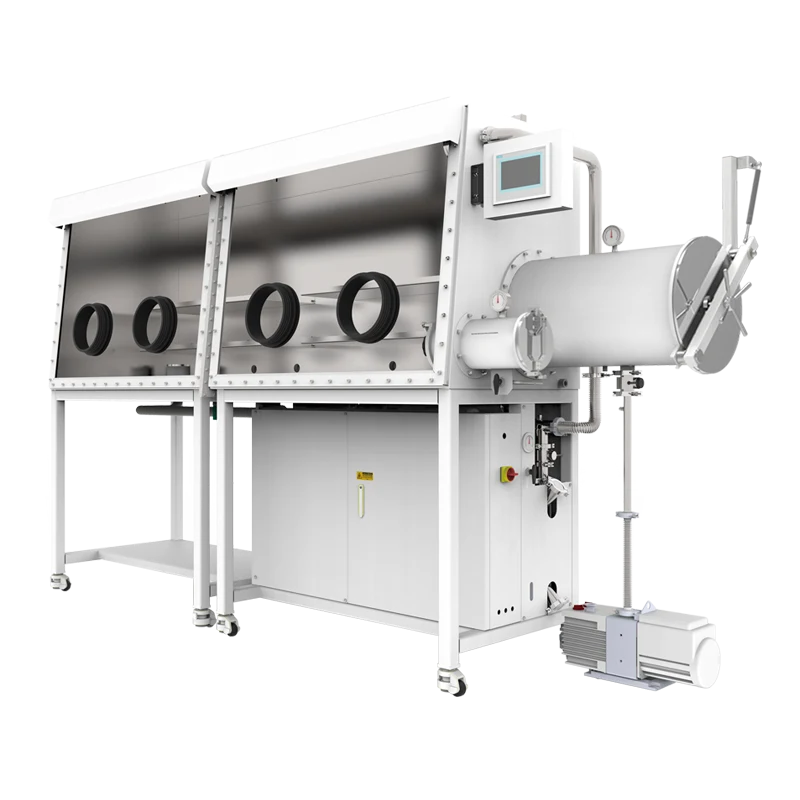
Usually it has not. What you are watching is a system-level event, and the shape of that recovery curve is set by the size of the disturbance, the volume the loop has to sweep, the condition of the purification beds, the circulation path, and the integrity of the barrier, gloves and seals included. This article takes one concrete configuration as its reference case: a two-station, single-sided, split-type glove box with a gas purification system, combined with the glove option most often paired with air-sensitive work, butyl rubber gloves. Numbers are treated cautiously throughout: achievable oxygen and moisture levels, leak rates and recovery times depend on the specific unit, the load being transferred and the condition of the purifier, and they should be confirmed against the specification of the exact system rather than inferred from a category description.
Recovery Time Is a System Property, Not a Component Specification
Four processes are routinely merged in day-to-day conversation, and separating them removes most of the confusion. Gas replacement, or purging, displaces the air in a chamber with inert gas. Vacuum pumping removes gas by lowering pressure. Circulation purification runs the box atmosphere through purifier media in a closed loop. Regeneration restores those media after they have taken up water or oxygen. Each has a different purpose, a different measurable result, and a different place in the schedule.
A purge cycle on an antechamber reduces the air inside the antechamber. It does not remove water already adsorbed on the interior surfaces of the box, on the tools inside it, or on the sample itself. Circulation purification removes water and oxygen from the gas stream continuously, but at a finite rate that depends on the flow path and the media's remaining capacity. Regeneration is not something the box can do for you while you are working; it is planned maintenance.
When recovery is slow, three broad explanations dominate. First, the disturbance was larger than the operator assumed: more air admitted, a porous or hygroscopic load, a solvent container opened inside the box, a transfer that took longer than planned. Second, the loop is not sweeping the atmosphere efficiently, whether because circulation is interrupted, a line or filter is restricted, the effective loop volume is large, or the bed's remaining capacity is low. Third, there is a continuing source of water or oxygen rather than a single event: a glove with a pinhole, a port seal that has aged, a fitting disturbed during service, or an outgassing material left inside.
No single reading distinguishes these cases. The evidence that does is comparative: the baseline before the event, the rate of change during it, and whether the value returns to the previous baseline or settles at a new, higher plateau. There is no universal recovery time for a purification glove box, because recovery is not a property one component owns; it is the outcome of disturbance size, loop volume, circulation rate, bed capacity and barrier integrity acting together. A reading that climbs and then decays is a different problem from a reading that climbs and stays.
How the Two-Station, Single-Sided, Split-Type Layout Changes the Dynamics
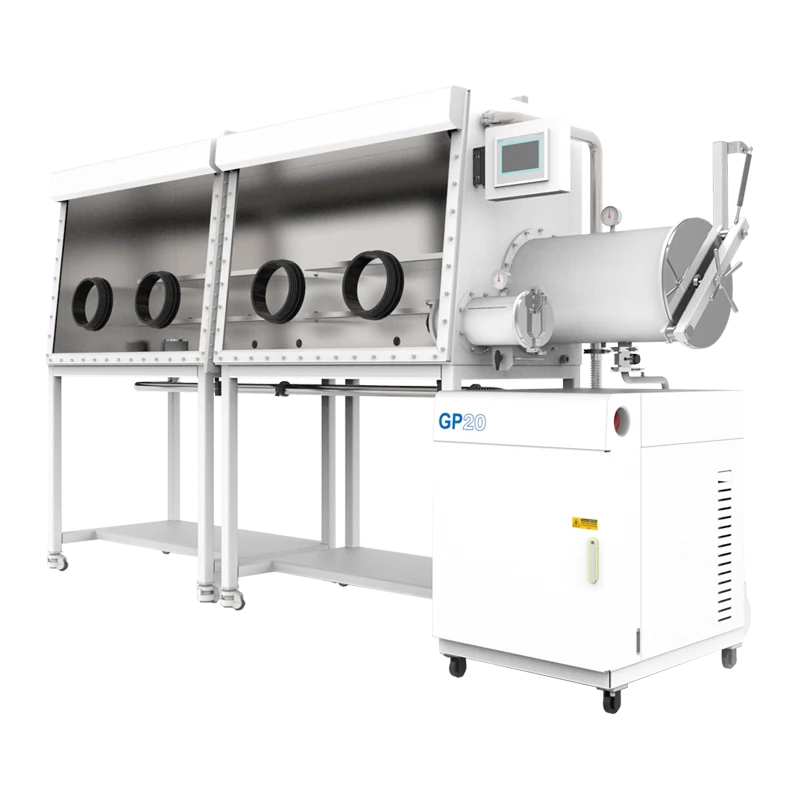
The reference system here differs from a basic single-station enclosure in three ways at once: it has two working positions, access is from one side only, and the working box and the purification system are separate modules. Each choice has a cost as well as a benefit, and all three show up in the shape of the recovery curve.
Two Stations, One Shared Atmosphere
A two-station box provides two working positions under a single controlled atmosphere. The practical gain is process flow: one station can be used for weighing, sealing or assembly while the other is used for opening containers, so a sample does not have to leave the box and pass through the antechamber again. Since every antechamber transfer is a deliberate disturbance, a layout that removes one transfer step has a direct effect on atmosphere stability.
The trade-off is that the two stations are not independent. Whatever happens at one station is measured by the same sensor and felt by whoever is working at the other: an open solvent bottle, a fibrous sample left on a tray, an inner door held open while the load is rearranged. In a two-station arrangement, agreeing on transfer timing and on how volatile materials are handled is an atmosphere-control practice, not simply a courtesy between colleagues.
Single-Sided Access and the Role of the Antechamber
Single-sided access means gloves are mounted on one face only, with the opposite wall solid. Compared with a double-sided box, there are fewer glove ports and fewer openings in the envelope, and more uninterrupted wall area for feedthroughs, windows and instrument connections; the limitations are reach depth to the rear of the working volume and the impossibility of handing work between two people standing on opposite sides.
For a two-station, single-sided box, antechamber discipline matters more than it would in a box with a much larger working volume. The air admitted per transfer is a larger fraction of the atmosphere being protected, and the same purification loop has less atmosphere in which to dilute that disturbance. Whether the antechamber is a compact pass-through or a larger transfer chamber also changes how much gas the load and its container carry in with them, and how many evacuation and backfill cycles a full load actually needs.
Split-Type Construction: Flexible Placement, a Longer Loop
In a split-type system, the box and the purification cabinet are separate modules joined by piping or ducting rather than built on one integrated frame. This is normally chosen for layout flexibility, because the cabinet can be placed where there is room to service it, and for maintenance convenience, because the beds can be regenerated or replaced without disturbing the working volume. It also keeps the heat generated during regeneration, and any vibration from the purification unit, away from the box envelope.
The trade-off is a longer circulation path with more joints. There is more gas volume to sweep, more connections that must remain leak-tight, and more opportunities for a line to sag, collect condensate or be stressed during a move. It is also worth stating plainly that a purification cabinet alone is not a glove box: it forms a controlled environment only when connected to a compatible, sealed enclosure, and that compatibility should be confirmed against the supplier's documentation rather than assumed from the fact that both parts exist.
| Layout decision | What it changes | What to verify |
|---|---|---|
| Two stations on one loop | One atmosphere shared by two work positions; process steps can be combined | Transfer scheduling; solvent-handling rules; which station is used for what |
| Single-sided access | Fewer glove ports and openings; more solid wall area; limited cross-box collaboration | Port positions and count; rear-wall reach; placement of feedthroughs and windows |
| Split-type box and cabinet | Flexible placement and easier bed service; longer loop path and more connections | Joint integrity; duct routing and support; confirmed box-cabinet compatibility |
| Antechamber size | The gas volume admitted with each transfer | Cycle definition matched to chamber volume and to the load being moved |
Inside the Purification Loop: Two Media, Four Different Processes
A closed-loop gas purification system normally combines an adsorbent for water with a medium that removes oxygen, and the two have different capacities, different failure modes and different regeneration behaviour. Understanding that the beds are consumables with a finite working capacity explains the single most common misreading of glove box instrument data.
Moisture Removal and Oxygen Removal Are Different Jobs
Water is removed by adsorption; oxygen is removed by a reaction with a medium that is periodically regenerated. Because both are capacities rather than switches, a bed approaching the end of its useful cycle can still maintain a good steady-state reading in a quiet box. The reading is acceptable precisely because nothing is challenging the bed. Then a transfer arrives, the atmosphere is loaded with a pulse of water or oxygen, and the recovery is slow.
Slow recovery after a period of apparently stable readings is therefore a classic symptom of a bed due for regeneration, not automatic proof of a leak. It is also the reason a maintenance log matters: the interval since the last regeneration and the nature of the work done in the meantime are the two facts that make a recovery observation interpretable at all.
Regeneration Restores the Bed; It Does Not Purify the Box
Regeneration, performed according to the manufacturer's procedure for the specific media and cabinet, is what restores removal capacity. While it is under way, the purification loop is not available to the box, and the box atmosphere is managed according to the system design. This is why regeneration is best scheduled around experimental work rather than during a critical run, and why circulation is running and the purifier is working are different statements: a loop moving gas through spent media will stir the atmosphere without removing much from it.
Solvent Adsorption and Particle Filtration Sit Outside the Loop
Solvent vapour competes for adsorption sites and can degrade some purification media, which is why solvent-adsorption media and controlled venting of solvent work are used in support of the main purifier. They protect it; they do not replace it. HEPA filtration, likewise, is a particle-control function and does not remove water or oxygen. Treating particulate filtration as if it were atmosphere purification makes recovery problems much harder to reason about, because it hides the fact that the water and oxygen load is unchanged.
Where the Disturbance Enters: Transfers, Gloves, Seals and Leak Rate
With the loop understood, the remaining question is where the load comes from. In most laboratories, the largest deliberate source is the antechamber, and the largest continuous one is the elastomer in the glove ports.
The Antechamber Is the Largest Deliberate Disturbance
Every opening of the inner door admits a finite volume of gas from the antechamber, plus whatever the sample, its container and the operator's tools bring with them. The remedy is sequence discipline rather than equipment: evacuate and backfill enough times for the actual chamber volume and for the load being moved, use supply gas that is itself dry and low in oxygen, let the chamber reach box conditions before the inner door is opened, and avoid holding the inner door open while the load is arranged.
It is also worth separating two manoeuvres that are often used interchangeably. Purging with the outer door slightly open is a dilution step; evacuating and backfilling the sealed chamber is a displacement step. They achieve different results, and a cycle procedure written for one has different implications when applied as the other.
Butyl Rubber Gloves: A Controlled Permeation Path
Gloves are part of the barrier, and they form the largest elastomeric area in most boxes. Butyl rubber gloves are frequently chosen for air-sensitive work because butyl offers low permeability to moisture vapour and gases alongside good flexibility, so a glove that transmits water vapour slowly adds less to the load the purifier must remove. Material choice alone does not settle the question, however. Thickness affects both permeation and feel; glove length and port diameter must match the box; and solvent compatibility has to be checked against the specific chemicals in use, because a glove that swells or hardens will fail at the sealing surface long before it tears.

Gloves are consumables. Inspection for pinholes, discoloration, stiffness and correct seating at the port should be part of routine maintenance, and the port's O-ring or clamping ring is just as common a leak path as the glove itself. When a slow upward drift appears in a box that has recently been re-gloved, the port assembly is the first place to look.
Leak Rate, Fittings and Feedthroughs Are Separate Variables
Several quantities are easily confused and should be kept apart: box working pressure, which is the small positive or negative pressure at which the envelope is operated; antechamber vacuum, which is what the transfer chamber must withstand during its cycle; pump ultimate vacuum, which is a property of the pump rather than of the box; leak rate, which describes how much gas enters a sealed envelope over time; and oxygen and moisture readings, which describe the composition of the atmosphere at the sensing point. A pump with a deep ultimate vacuum does not compensate for an envelope with a high leak rate, and a low leak rate does not produce fast recovery if the circulation path is restricted. KF connections, valves, electrical and signal feedthroughs, and any tubing moved during service all belong on the post-maintenance check list.
Reading the Instruments: Measurement Versus Purification
Analysers measure; they do not purify. A moisture analyser reports water content at its sampling point and an oxygen analyser reports oxygen at its sampling point, and neither removes anything from the atmosphere. Resolution is not accuracy: an instrument that reports in fine increments does not necessarily determine the true value to that increment, and calibration status matters more than the number of digits on the display. Sensor location matters too, because a probe sampling downstream of the purification media sees a different gas stream from one sampling the box interior, so two readings that disagree are not automatically evidence of a fault.
Curve shape is the most underused diagnostic available. A step change followed by a decay points to a single disturbance. A monotonic rise while the box is idle points to continuous ingress. A sawtooth pattern correlated with a specific task points to that task. Recovery that improves after regeneration points to bed capacity. Recovery that degrades gradually over weeks points to a permeation or leakage source. Sluggish response may say as much about sensor response time as about the atmosphere, since the box can be recovering faster than the reading suggests.
A practical sequence for a slow-recovery complaint looks like this:
- Establish what changed: a new material, new gloves, solvent work, recent service, a new operator, or an unusually long transfer.
- Confirm the loop is running and that the flow path is not obstructed or restricted.
- Compare the event with a logged baseline rather than with a remembered impression, including small routine transfers.
- Check antechamber practice against the chamber's volume and the load actually being moved.
- Inspect gloves, port seals, O-rings and any fitting touched during recent service.
- Review the bed history: when it was last regenerated and what the box has been exposed to since.
- Only after those steps consider a formal leak test or service call.
This order matters because it moves from the cheapest and most likely explanations to the most expensive ones, and because it avoids the common error of treating an analyser as a leak detector. An analyser shows the result of a leak, not its location.
Specification and Verification Checklist
The same reasoning that guides troubleshooting also guides specification. When a two-station, single-sided, split-type purification system is being selected, the useful information is the load and the workflow, not the headline category. The two-station single-sided split-type purification glove box combines two working positions with one shared atmosphere and separates the purification cabinet from the working envelope, so the questions below are the ones that determine whether that arrangement fits a given laboratory.
- Materials and samples: chemistry, particle size and porosity matter, because fine or hygroscopic powders and porous solids carry adsorbed moisture and release it slowly inside the box.
- Volatiles: solvents, acids or bases that will be present, and how they will be vented or adsorbed.
- Atmosphere targets: which oxygen and moisture conditions must be met, and where they must be met, since the value at the sensor is not necessarily the value at the far corner of the working volume.
- Transfer profile: typical load size and geometry, and transfer frequency, which together determine whether a compact pass-through or a larger transfer chamber suits the work.
- Operator pattern: whether both stations will be used at once or alternately, and by how many people.
- Glove specification: material, thickness, length and port size, plus the intended inspection and replacement interval.
- Instrumentation and feedthroughs: analysers, electrical and signal pass-throughs, and any heating or cooling requirement inside the box.
- Pump and gas supply: compatibility of the pump with the specified pressure range and with what it will evacuate, and the purity and capacity of the supply gas.
- Site conditions: footprint, floor loading, service access for regeneration, and how the two modules will be connected and supported.
- Documentation: connection diagrams, the recommended circulation configuration, the antechamber cycle definition, the regeneration interval and procedure, and acceptance conditions.
A one-page baseline log is the most useful maintenance document a purification glove box owner can keep: readings with the box idle, immediately after regeneration, and during a representative transfer. It converts a subjective impression into a comparison, and it gives a supplier something concrete to work with when recovery does become slow.
Purification glove boxes are rarely specified by a single headline figure. They are specified by how the barrier, the transfer path and the purification loop behave together under the loads the laboratory actually imposes, and by whether the practices in between those three parts support each other.
