
Why a Ten-Station, Double-Sided Split Glove Box Reframes Atmosphere Control
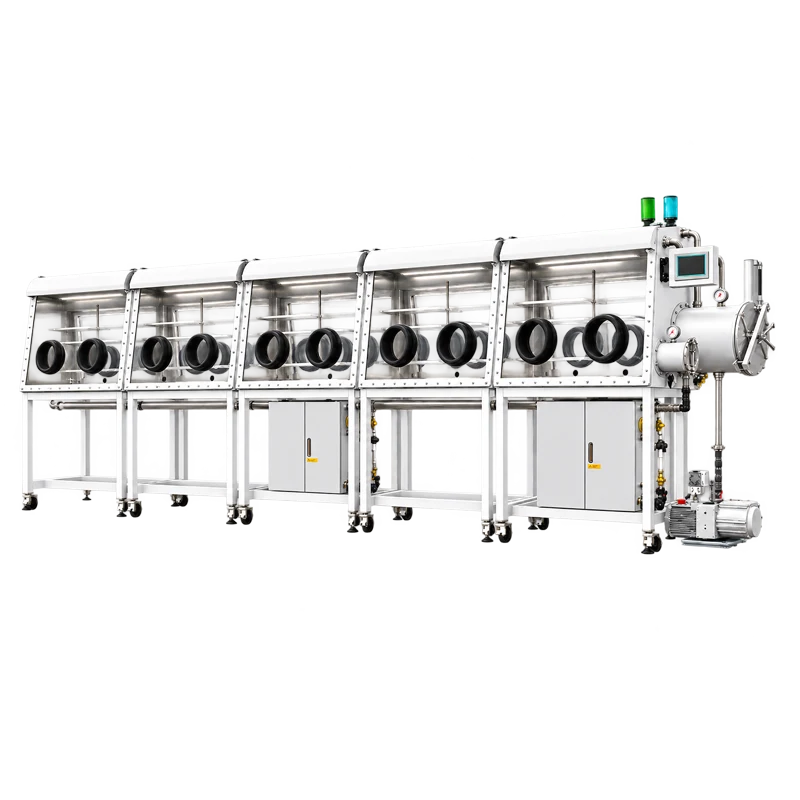
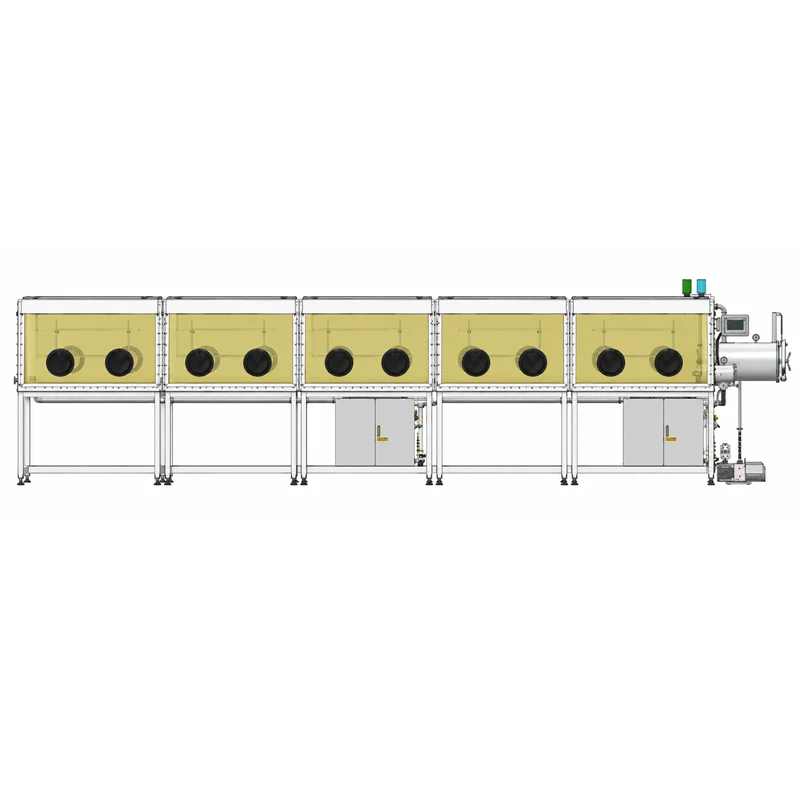
A single-user enclosure poses a fairly narrow problem: keep one small volume dry, keep one pair of gloves sealing, and let one person work. Growth breaks that problem apart. When several researchers need the same controlled atmosphere at the same time, the enclosure typically expands in two directions at once — more work positions along the front face, and a second working face on the opposite side. The Ten-Station Double-Sided Split-Type Glove Box with Gas Purification System is built around that pattern: ten glove ports arranged across two opposing faces, with the purification hardware handled as a separate assembly rather than being folded into a single cabinet.
That layout solves a scheduling problem and creates an atmosphere problem at the same time. Every new port, window, feedthrough, and door adds an interface where the inner atmosphere meets the room. Every additional liter of internal volume adds surface area that can adsorb water and later release it. And every person who reaches into the box changes the traffic pattern around the antechambers, which are the only places where the gas environment is deliberately disturbed. The purification loop sits at the center of this trade-off, and understanding it is what separates a smooth multi-operator installation from one where the moisture reading never quite settles.
The full configuration is described on the ten-station double-sided split glove box with gas purification system product page. What follows is a practical framework for how this class of system behaves in daily use, which parameters drive its performance, and what to confirm before committing a laboratory to it.
What “split” changes, and what it does not
In a split-type design, the working enclosure and the gas purification unit are separate physical assemblies connected by a circulation loop rather than packaged as one monolith. The practical gains are usually about installation and service: the cabinet can be positioned for ergonomics and floor space, while the purification module sits where there is room for it and where a technician can reach it. Service access matters more than it first appears, because the module is the part of the system that periodically needs attention, and a box that must be partly dismantled for routine work tends to be maintained late.
What a split design does not do is give you two independent atmospheres unless the specification says so. Unless a system is explicitly described as having independently controlled sections, assume all ten stations share one common gas environment. A solvent spill at one end, a door left ajar at the other, or a poorly purged transfer all register on the same instruments and are handled by the same purification loop. Zoning inside a shared volume is therefore a matter of layout and discipline, not of compartmentalization.
Station count is an atmosphere variable, not a seat count
Ten glove ports read like ten seats, but each one is also a mechanical interface: a port ring, a glove, a seal, and a hatch or flange depending on the design. Seals are a classic slow leak path — they age, they get pinched, they react with solvents, and they are disturbed every time a glove is replaced. A box with twice as many ports has roughly twice as many opportunities for a small, gradual ingress that no one notices until the analyzer baseline drifts. Occupancy matters just as much: the more people working at once, the more transfers per hour, and transfers are when the internal atmosphere is genuinely disturbed.
Inside the Purification Loop: Removal, Recirculation, and Regeneration
A glove box with a gas purification system maintains its atmosphere through closed-loop recirculation. Gas from inside the enclosure is drawn into the purification unit, passed through media that bind water and oxygen, and returned to the box. The loop runs continuously rather than only when readings rise, which is why the internal environment can be held steady rather than merely restored after each event. The unit typically contains a circulation blower, one or more purification columns, and a control layer that coordinates operation with the monitoring instruments.
It helps to separate three tasks that are often blurred together in conversation.
- Gas replacement or purging. Filling the box with inert gas and displacing the air initially present. This is dilution and displacement; it lowers concentration but does not capture anything.
- Recirculating purification. Continuous removal of water vapor and oxygen from the circulating stream. This is what holds a low baseline over time.
- Particle filtration. HEPA filtration removes airborne particulates. It has no meaningful effect on water or oxygen content, and treating it as if it did leads to confused troubleshooting.
Solvent adsorption belongs in its own category as well. Where a process introduces solvent vapor, a dedicated adsorption stage can protect the purification media from being consumed by organic species, but it does not replace water and oxygen removal. If solvent vapor reaches the columns, the practical symptom is usually a loop that seems to work harder for the same result — and media that must be regenerated or replaced sooner than expected.
Monitoring: measuring is not the same as purifying
The humidity and oxygen instruments report what the atmosphere is doing; they do not change it. This distinction resolves a great deal of confusion during troubleshooting. A rising reading tells you the net balance between ingress and removal has shifted, but not which side moved. It could be a new leak, a wet sample, an incomplete antechamber cycle, or a loop temporarily offline for regeneration. The instrument is your evidence, not your remedy.
It is also worth remembering that a sensor’s resolution is not its accuracy. A display that reports small increments may be reading a value offset from the true concentration, especially after long service without calibration. When a number looks surprising, ask first whether the measurement itself is trustworthy, then whether the process changed.
Regeneration and the reality of uptime
Purification media have finite capacity. Over time they saturate and must be regenerated — a process in which captured species are driven off so the media can be used again. Regeneration is scheduled work: during it, part or all of the purification capability is unavailable, and the box atmosphere depends on how well the enclosure is sealed and how much traffic continues.
For a ten-station box with a busy user group, this is a planning problem rather than a technical one. Regeneration periods should be scheduled around campaigns, not in the middle of them, and users should know in advance that the loop will be unavailable so they can avoid transfers during that window. The specific regeneration conditions, media life, and required gas supply are configuration details that must come from the manufacturer for a given system; they depend on the columns and controls actually installed and should never be inferred from a generic description.
Zoning a Ten-Station Box: Material Flow and Human Traffic
Because the ten stations share one atmosphere, the layout inside the enclosure is effectively a workflow design. The goal is to keep the operations that disturb the atmosphere — opening an antechamber door, bringing in a sample exposed to room air, handling solvent-bearing materials — physically separated from the operations that depend on stability, such as weighing, sealing a cell, or storing a sensitive sample.
Antechambers do the heavy lifting
Almost every disturbance the purification loop has to absorb originates at a transfer. A small antechamber is intended for parts, tools, and small samples; a larger one accommodates equipment. The routine is familiar: place the item inside, close it, evacuate and refill with inert gas, usually repeating the cycle, then open the inner door. Each cycle reduces the residual air in the antechamber but does not necessarily eliminate it, and the inner door opening admits whatever remains.
Two habits make a disproportionate difference. First, cycle discipline: skipping repetitions to save time during a busy shift puts a predictable load on the loop. Second, staging: items that must enter the box should be prepared, dried, and where possible pre-purged outside, so the antechamber is not doing work that belongs upstream. Porous materials, textiles, high-surface-area powders, and anything stored in humid air will carry adsorbed water in with them.
Assigning stations by task rather than by person
In a single-user box, personal ownership of a workspace is harmless. In a ten-station box it creates collisions, because two users at adjacent stations reach into overlapping volumes. A task-based organization usually works better: locate high-frequency transfer work near the antechambers, keep the most sensitive operations at stations farthest from the doors, and designate a specific area for anything that offgasses — freshly introduced samples, solvent work, or materials that have just come out of a process step.
It is also worth deciding, in advance, who opens the box to the room. Any operation that requires breaking the enclosure — glove replacement, a major feedthrough addition, internal cleaning — is a planned event with its own recovery time. Treating these as spontaneous favors to a colleague is what produces unexplained readings later in the week.
Diagnosing Slow Moisture and Oxygen Recovery After a Transfer
The most common question about a purification-equipped box is not “why did the reading rise?” — a transfer always raises it — but “why is it taking so long to come back?” The answer usually lies in one of four places: the size and nature of the load that entered, the transfer procedure itself, a change in the enclosure’s leak tightness, or the state of the purification loop. The table below offers a structured way to narrow it down.
| Observation | Plausible contributors | Evidence to collect |
|---|---|---|
| Reading rises with every transfer and returns to baseline in a consistent time | Normal antechamber exchange; the loop is absorbing the admitted air as designed | Log of recovery time versus load type; compare small and large antechamber cycles |
| Recovery is slower after specific samples are introduced | Adsorbed water or solvent on porous, fibrous, or poorly dried materials | Material history: storage humidity, pre-drying step, surface area, solvent content |
| Baseline drifts upward over days with no unusual activity | Gradual ingress through glove ports, seals, feedthroughs, or window gaskets | Leak check of the enclosure and interfaces; comparison against a known-good period |
| Recovery stalls only during a scheduled window | Purification capacity is unavailable by design during regeneration | Regeneration schedule versus the timing of the observation |
| Readings fluctuate with no corresponding process change | Instrument calibration, sensor condition, or sampling path rather than atmosphere | Calibration record and, where available, an independent reference measurement |
This framework is deliberately diagnostic rather than conclusive. No row is a fault finding on its own, and no article can substitute for the manufacturer’s instructions for a specific unit. What the table does is prevent the most expensive mistake in troubleshooting: changing purification hardware when the problem is a wet sample, or chasing a sample issue when a glove seal has been leaking for a month.
Read a recovery curve, not a single number
Single readings are almost useless for diagnosis. What carries information is the shape of the curve — how fast the value rises, how high it goes, and how the return compares with previous events. A team that logs transfer type, duration, and recovery time develops an intuitive baseline within a few weeks, and deviations from that baseline become meaningful signals. Without the log, every unusual reading looks the same.
One more distinction is worth keeping straight: working pressure inside the enclosure, antechamber vacuum level, and pump ultimate vacuum are three different specifications, measured at three different points for three different purposes. Quoting one in place of another is a common source of misunderstanding in both specification documents and troubleshooting.
Matching Antechambers, Pumps, and the Rest of the Accessory Chain
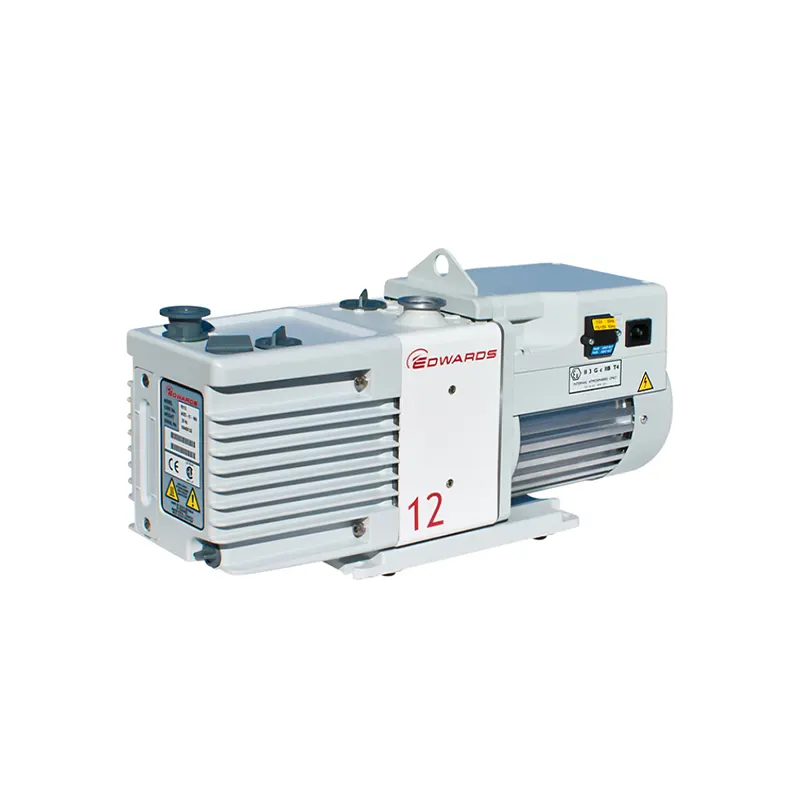
The vacuum pump is the accessory most directly tied to how quickly and how cleanly transfers happen. Its job in a glove box context is normally to evacuate antechambers rather than the main enclosure, and matching it requires attention to the gas being pumped, the vapor load, and the required vacuum level — not just a headline specification. The glove box vacuum pump is listed among the support hardware for these systems.
Three points deserve attention when specifying one. First, compatibility: the pumped stream may contain solvent vapor or traces of corrosive species, so the pump’s construction and sealing materials must suit that service. Second, condensable load: vapor that condenses inside a pump degrades performance and shortens service life, which is why solvent-bearing transfers need a considered approach rather than a hopeful one. Third, the vacuum level the antechamber actually needs, which is a design question specific to that antechamber. A pump that reaches far below the required pressure does not automatically produce a cleaner transfer; cycle discipline does.
The rest of the accessory chain follows the same logic: each item is selected against the job it performs, in the environment where it will perform it. Feedthroughs are chosen by connection type, conductor or tube count, and sealing arrangement. Filters are chosen for the particles they must capture and the pressure drop they introduce. Adsorption stages are sized for the solvent load the process actually generates. Analyzers are selected by range, resolution, accuracy, and available calibration support — and their readings should be read as measurements of the atmosphere, never as proof that purification is occurring.
Multi-Operator Discipline: Gloves, Seals, Feedthroughs, and Sensors
In a ten-station box, wearable items are multiplied. Gloves are the most visible. Fit and material matter: an oversized glove folds and pinches, a glove whose material is incompatible with the solvents in use will degrade quietly, and permeation through the glove material is a real consideration for prolonged contact with aggressive chemicals. Replacement intervals should be based on inspection rather than a calendar, since use patterns differ sharply between stations.
Seals around ports, windows, doors, and feedthroughs are the quieter wear items. Each added feedthrough is a useful penetration and also one more sealing interface to verify. Plan the penetrations the process will need — power, signal, gas lines, liquid lines, thermocouples, and any future expansion — before commissioning, rather than adding them one at a time and disturbing the enclosure repeatedly. Give instrumentation the same care: a monitor that is never calibrated becomes decorative, so assign one person responsibility for calibration records and the transfer log.
Configuration Checklist Before You Specify a Ten-Station System
A supplier can only size and configure a system against a described workload. The following information turns a general request into a workable specification.
- Simultaneous users: how many people will actually be inside the box at once, and how they will be distributed across the two faces.
- Throughput: transfers per hour or per shift, and whether they cluster at shift changes.
- Load characteristics: sample size, shape, mass, porosity, and whether items need pre-drying or pre-purging.
- Chemistry: solvents, acids, and other species that may appear as vapor, and the adsorption capacity required for them.
- Feedthrough plan: power, signal, gas, liquid, and instrumentation needs, including expected growth over the system’s service life.
- Monitoring needs: which atmosphere parameters must be measured, in what range, and with what calibration routine.
- Layout: where the cabinet and the purification unit will sit, how the circulation loop will be routed, and how service access will be preserved.
- Uptime constraints: when the system can leave full service for regeneration or maintenance, and who performs it.
- Acceptance criteria: the leak-check method and performance checks used at commissioning, agreed in writing before delivery.
Supplying this information up front does two things: it lets the configuration be matched to the real work — antechamber sizes, accessory selection, loop arrangement — and it establishes a shared baseline for judging performance after installation. Most disputes about a glove box trace back to an unspecified assumption: the buyer assumed a transfer routine, the supplier assumed a load profile, and neither was written down.
A ten-station, double-sided, split-type enclosure with a purification loop is an efficient instrument when the atmosphere is treated as a shared resource and the workflow is designed around it. The enclosure is only half of that system; antechamber discipline, the purification loop, the pumps and accessories, and the measurement routine are the other half — and they are the half that determines how the box performs on the two-hundredth day rather than the second. Details for the enclosure described here are available on the product page for the ten-station double-sided split-type glove box.
