
Two laboratories can operate what appears to be the same glove box and report completely different experiences. One holds a steady oxygen and moisture reading for weeks. The other watches both values climb every time material goes in and never quite settle again. The box shell is rarely the deciding factor. What usually differs is the fit between the impurity-control method the system uses, the way samples and tools cross the boundary, and the stability the work actually requires.
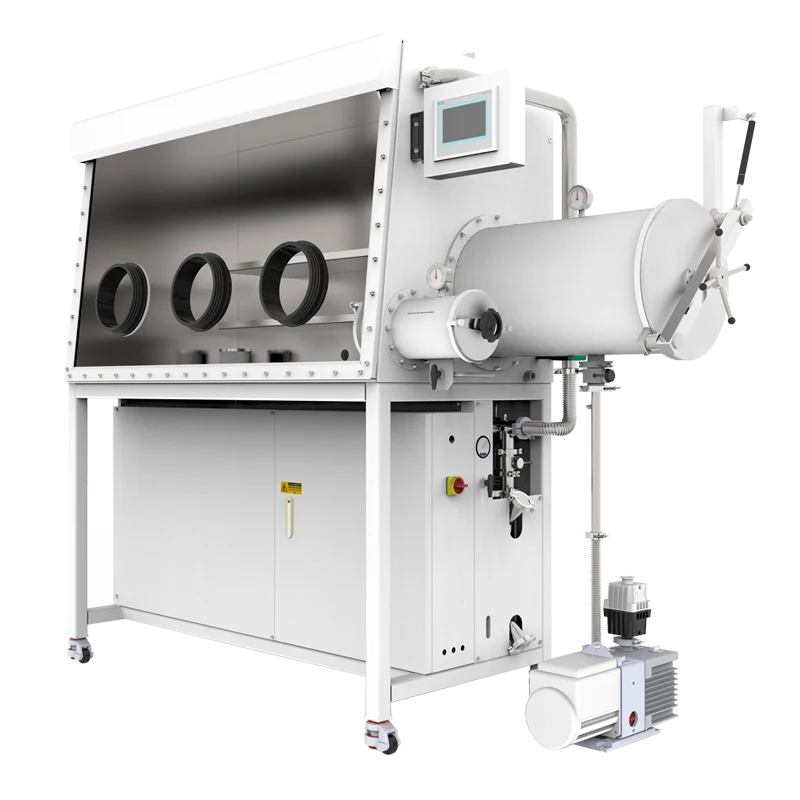
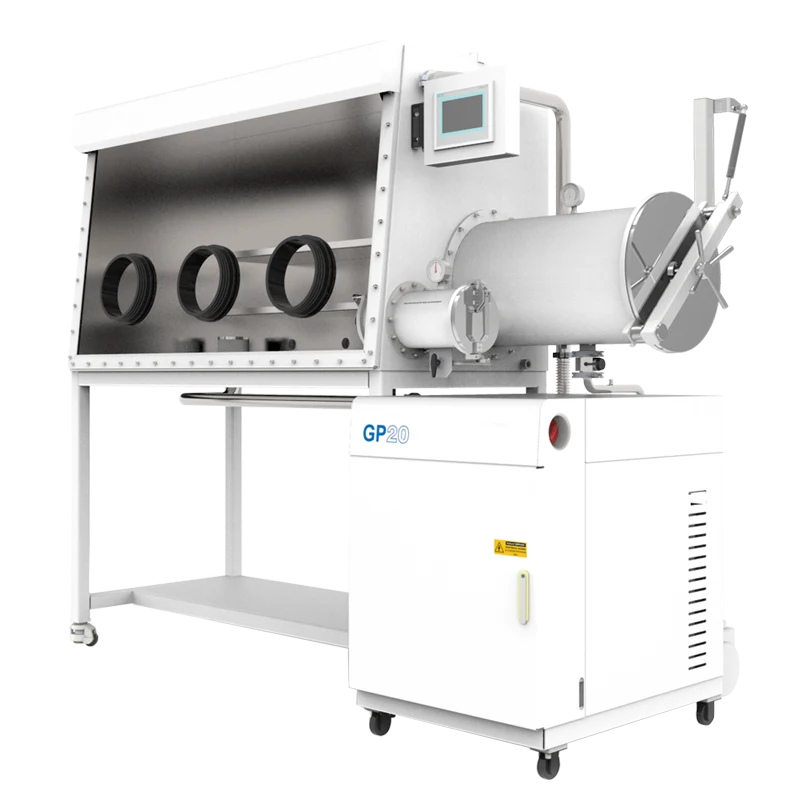
This article examines that fit for a three-glove, single-sided glove box with a gas purification system, and the smaller decisions — antechamber cycling, glove and seal selection, monitoring practice, and vacuum connections — that decide whether the purification loop ever gets a chance to do its job.
Purge and Purification Solve Different Problems
Purge and purify are used almost interchangeably in lab conversation, yet they describe different physical processes with different cost structures and different endpoints.
Purging is displacement. Inert gas is fed into the box and the atmosphere already inside leaves through a vent or relief path. Oxygen and moisture fall roughly in proportion to how much gas is pushed through and how thoroughly the incoming gas mixes with what is already there. The hardware is simple and the method is robust, but the gas consumption never stops: purge is a one-way flow, so protection is rented by the hour.
Purification is removal inside a closed loop. Working gas already in the box is drawn out, passed through a column that takes up moisture and oxygen, and returned to the enclosure. After the initial fill, gas consumption is low, and the impurity level can be held near a value rather than merely approached once and then lost.
The distinction matters because the two methods fail in different ways. A purge-only arrangement degrades whenever the gas supply stops or the flow rate drops. A purification system degrades when the column approaches saturation, when a leak exceeds its capacity, or when circulation is restricted. Diagnosing a slow recovery is difficult if it is not clear which mechanism is expected to be doing the work.
What purge alone can and cannot do
- It can knock down bulk contamination quickly after installation, after maintenance, or after a door has been open for a long time.
- It can carry solvent vapour out of the box before that vapour reaches the purification material — a genuinely useful function, since many solvents degrade purification media.
- It cannot hold a setpoint against continuous in-leakage, outgassing from gloves and interior surfaces, and the small volumes of air dragged in with every transfer.
- It cannot distinguish between a well-sealed box and a box that is leaking at the same rate it is being flushed.
In practice, purge is best treated as a pre-step rather than an alternative. It is the fast, blunt way to get the atmosphere into range; purification is the way to keep it there.
Where purification earns its cost
Purification justifies its complexity when the sample reacts on the timescale of the experiment. Lithium metal, solid electrolytes, perovskite films, OLED layers, low-valent organometallic reagents, and many fine metal powders all react at rates that turn a slowly drifting atmosphere into a data-quality problem rather than a housekeeping annoyance. What matters here is not the lowest number a system can reach once, but the stability it can hold across the hours a process actually takes.
Inside the Closed Loop: Column, Circulation, and Regeneration
In a purifying glove box the atmosphere is not a static reservoir. It is a working fluid that moves continuously: box, circulation path, purification column, back to box. Three elements must be understood separately — the circulation, the removal chemistry, and the regeneration that restores removal capacity.
Circulation is mechanical. A blower keeps gas moving through the loop at a rate high enough to mix the box contents and controlled enough to avoid stirring up dust or disturbing delicate samples. Whenever circulation stops — during maintenance, a power interruption, or column regeneration — the box becomes a static volume in which leaks and outgassing accumulate with nothing to remove them.
Removal is chemical and physical. Moisture is normally taken up by adsorption on a porous desiccant, while oxygen is removed either by reaction with a medium that is later regenerated or catalytically by combining it with hydrogen added to the loop. Both mechanisms have finite capacity and are sensitive to what else is in the gas stream. Whatever chemistry a given unit uses, the same rule holds: the column is a consumable, and its life depends on how much impurity and contamination it is asked to absorb.
Regeneration restores the column periodically. It normally means isolating the column from the box, heating it while a flow of regeneration gas carries released moisture away, then cooling it before reconnection. Because the procedure involves heat, gas flow, valving, and venting, the sequence must come from the manufacturer's documentation for the specific unit. Temperatures, gas compositions, durations, and safe venting are unit-specific; improvising them risks damaging the medium, driving adsorbed material back into the box, or creating a pressure condition the enclosure was never designed for.
Working gas, control gas, and regeneration gas
These three streams are often confused because they may come from the same cylinder. The working gas is the atmosphere inside the box, chosen for compatibility with the samples. The regeneration gas sweeps the column during regeneration, and its composition is dictated by the purification chemistry, not by the experiment. Control gas may refer to small flows used for pressure regulation, instrument zeroing, or loop make-up. Mixing these categories leads to the classic mistake of assuming the gas best for the samples is automatically the gas best for regenerating the column.
Particles, solvents, and what the column cannot fix
A purification column addresses moisture and oxygen. It does not address airborne particles, and it does not reliably remove organic solvent vapour; solvent that reaches the medium can reduce its capacity or alter its behaviour. This is why particle filtration and solvent adsorption are separate functions with separate components, and why acceptable moisture readings are not evidence that a solvent problem has been solved. HEPA filtration removes particles only — it will not lower a moisture reading, and treating it as an atmosphere-control device leads to misdiagnosis. An analyser, for its part, measures the atmosphere and removes nothing. A system can be perfectly instrumented and still be accumulating contamination.
What the Three-Glove Single-Sided Layout Implies
Glove count and sidedness are not cosmetic choices. They change gas volume, seal perimeter, working reach, and the kind of work that can be done without breaking the atmosphere.
A single-sided enclosure places all glove ports on one face, so operators stand on one side and reach in. A three-glove single-sided box therefore offers a wider working front than a two-glove box of similar depth, with three access points along that face. The layout suits processes that move along a line — weighing at one end, reaction or assembly in the middle, inspection or packaging at the other — and it supports two people working simultaneously at adjacent ports, which is often faster and less error-prone than one operator shuttling samples back and forth.
The trade-offs are equally real. Reaching the far side of a deeper box from a single face is awkward, and items near the back wall may be effectively out of reach without tools. Visibility from the front is good, but the front of the enclosure can shadow objects at the rear of the floor. Before choosing this configuration, write down the workflow in sequence and check that every step can be performed within arm's reach of one of the three ports.
Volume, seal perimeter, and impurity load
Larger internal volume brings two opposite effects. There is more gas to buffer a small intrusion, so the concentration change from passing a small object is diluted over a larger reservoir. But more gas also means a longer initial purge, and a larger enclosure means more interior surface area, more seams, more gloves, and a longer seal perimeter — each a potential source of outgassing and slow in-leakage. A three-glove box with a large volume is not automatically more stable than a smaller one; it depends on construction quality, seal condition, and how much material is stored inside.
Reach, workflow, and coordination
Three ports also change how work is coordinated. Two operators sharing one face need clear conventions about who moves what and when, especially around the antechamber and around any open vessel. A layout that keeps the transfer port on the operator's left and waste on the right will produce fewer collisions than one that puts the antechamber in the middle of the busiest area. Because a single-sided arrangement concentrates all activity on one front, discipline about what lives where matters more than it does in a double-sided box, where the two faces naturally separate dirty and clean operations.
Sample Transfer Is Where the Atmosphere Takes the Hit
Most glove box frustration traces back to transfer. The box can be quiet for days; then a morning of bringing samples in and out produces a recovery curve that takes hours to flatten. Understanding why means looking at the mechanics of the antechamber and at what the samples themselves bring with them.
How antechamber cycling works
An antechamber, or transfer port, is a small chamber with two doors: one to the outside, one to the box interior. Material is placed inside, the outer door is closed and sealed, and the chamber is evacuated and refilled with working gas, often several times. Each evacuation removes a fraction of the original air; each refill replaces it with clean gas. Additional cycles continue to reduce the residual, but with diminishing returns, because the achievable vacuum is limited by the pump and by outgassing from the items inside, and because each cycle dilutes what remains rather than removing it entirely.
Two practical consequences follow. First, an antechamber that cannot be pumped down far will need more cycles for the same result, and a pump poorly matched to the chamber volume or to the gas being handled will take longer per cycle. Second, bulky or porous items — powders, foams, fibrous materials, cardboard, unsealed containers — carry adsorbed moisture and air that keep desorbing inside the chamber throughout the cycle. No number of cycles removes moisture still migrating out of the object itself. Sealed containers, pre-dried materials, and a small chamber volume relative to the item all improve the outcome.
Reading a recovery curve instead of a single number
After a transfer, oxygen and moisture readings rise and then fall. The shape of that curve carries more information than the peak value.
- A fast initial drop followed by a long, shallow tail is normal: the loop clears the bulk of the intrusion quickly, and the remainder is dominated by slow outgassing and small leaks.
- A curve that plateaus well above the previous baseline and stays there points to a change in the system rather than to the transfer: a saturated column, a leaking seal or glove, a contaminated door seal, a circulation restriction, or a genuine new leak.
- A curve that falls and then climbs again without any new activity suggests in-leakage the loop is only just able to offset; the steady-state value, not the recovery time, is the diagnostic.
- A curve that improves after gloves are handled or the box is disturbed points towards a mechanical seal, a glove pinhole, or a fitting that moves under pressure.
None of these observations by itself proves a fault. They are reasons to check specific components in a specific order — beginning with what can be verified cheaply, such as door seals, glove condition, valve positions, and instrument calibration, and only then moving to the purification side. Declaring a column exhausted before the seals have been ruled out is a common and expensive mistake.
Monitors, Seals, and Vacuum Hardware: Small Parts, Large Effects
Once the box and the purification loop are in place, the outcome of a project usually depends on a handful of small components that are easy to treat as afterthoughts.
Resolution is not accuracy
Moisture and oxygen analysers are often compared by resolution — the smallest change in reading the instrument can display. Resolution is not accuracy. An analyser reading to a fine increment may still be offset from the true value if it has not been calibrated against a known reference or has drifted since the last calibration. Placement matters too: a sensor sitting in a stagnant corner reports the local atmosphere, not the composition of gas returning from the purification loop, and the two can differ during recovery. Before trusting a number, confirm when the instrument was last calibrated, what reference was used, where the sensor sits relative to the circulation path, and whether the reading responds sensibly when the loop is deliberately disturbed.
Gloves and seals: permeation, not just thickness
Gloves are handled constantly, which makes them the components most likely to be compromised. Material choice should follow chemical compatibility and permeation behaviour rather than thickness alone; a thick glove of the wrong elastomer can be both uncomfortable and more permeable to the vapours in use than a thinner glove of the correct material. Solvent exposure also affects seal materials at doors, ports, and antechamber closures. Pinhole testing, scheduled replacement, and keeping a stock of the correct glove type matter more than most hardware upgrades, because a single pinhole is an unrestricted path between the atmosphere and the work.
KF connections and vacuum integrity
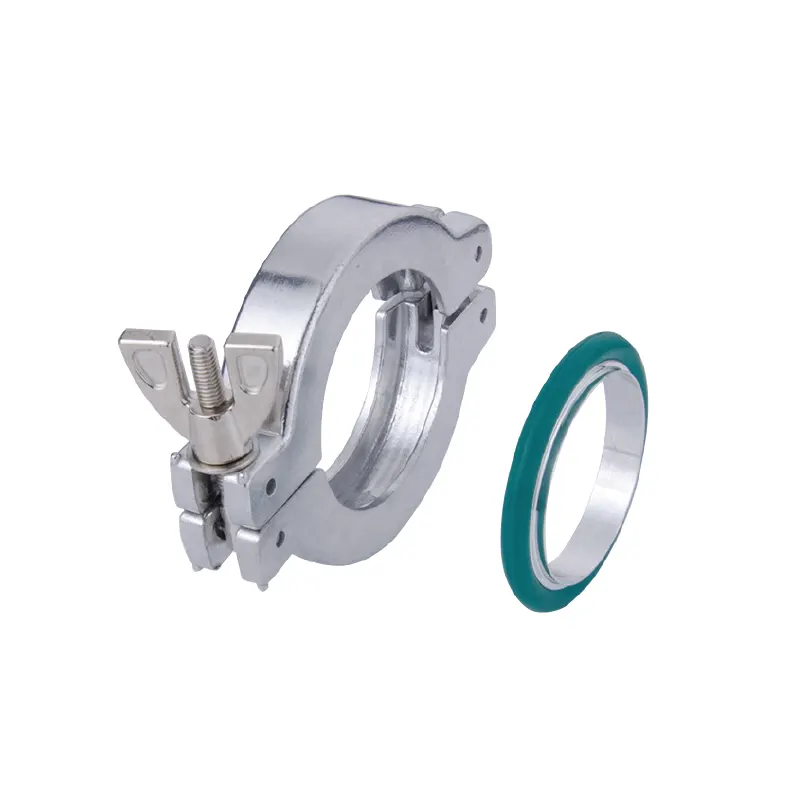
Vacuum lines in a glove box system — to pumps, antechambers, and sensors — are typically assembled from flanged components. The KF (or NW) flange series is a common standard, in which two flanges are held together with a centring ring and an elastomer O-ring, and the joint is closed by a clamp around the outside of the flange pair. A KF vacuum clamp is therefore a sealing element, not a valve: it applies the force that compresses the O-ring and keeps the two faces aligned. It provides no shutoff and no flow control.
Three details decide whether such a joint holds: the clamp must match the flange series it is sealing, the O-ring material must be compatible with the gases and vapours in the line, and the assembly must be tightened enough to compress the seal without distorting the flanges. Over-tightening is a real failure mode — it can deform the centring ring or the flange face and create the leak it was meant to prevent. Whether a particular antechamber, pump connection, or sensor port uses KF flanges depends entirely on how that unit is configured, so the flange standard, size, and elastomer should be confirmed against the actual system before ordering hardware.
Vacuum performance is not one number either. The vacuum level an antechamber reaches during a transfer cycle, the base pressure a pump can achieve on a clean, empty line, the leak rate of an assembled joint, and the pressure inside the working box are four different quantities with four different specifications. Confusing them leads to unrealistic expectations — for instance, assuming a pump's best achievable pressure will be seen inside an antechamber loaded with outgassing material, or that a leak-tight box and a leak-tight vacuum line are the same requirement.
Matching the Box to the Application
A three-glove single-sided purifying box suits a particular class of work: processes that need a stable, low-impurity atmosphere over hours to days, that involve multiple steps along a single working face, and that may need two people at the ports at once. Typical examples include preparing and assembling lithium and solid-state battery components, handling perovskite and OLED materials, air-sensitive organometallic chemistry, processing reactive metal powders, and finishing additively manufactured parts that must not oxidise between steps.
Two boundaries are worth stating clearly. First, an inert atmosphere is not the same thing as a sterile environment, a cleanroom classification, a biosafety barrier, or a containment system for hazardous materials — those are separate performance claims with separate test methods, and a box that keeps moisture low makes no statement about any of them. Second, "inert" is relative to the sample. Some materials react with nitrogen, some with trace impurities in argon, some with the hydrocarbons that come from pumps and elastomers. Selecting a working gas means checking it against the specific chemistry, not assuming any inert gas is equally inert to everything.
Configuration Checklist Before You Specify a System
Most specification errors are information errors. The items below are the ones that most often change the answer, and the ones a supplier needs from you before any recommendation can be meaningful.
- Required purity and how it will be verified. State the level you need, for how long, under what workload, and with which instrument. Distinguish a target you must hold continuously from a value the system can reach under ideal conditions.
- Workflow, in sequence. List each step, the size and number of items transferred, how often, and how many operators are at the face at once. This determines glove count, sidedness, and antechamber sizing.
- Material inventory. What will be stored inside, in what containers, and for how long. Outgassing from stored material often dominates the steady-state load.
- Solvents and vapours. Any solvent introduced into the box must be managed before it reaches the purification medium, and it constrains glove, seal, and O-ring material selection.
- Gas supply. Working gas, its purity, available pressure, and sufficient supply for purge, make-up, and regeneration. Regeneration requirements are unit-specific and must come from the manual.
- Vacuum demand. Antechamber volume and target pressure, pump type and its compatibility with the gases handled, and the flange standard and elastomer used on every joint.
- Instrumentation. Range, resolution, accuracy, calibration interval, and sensor location for both moisture and oxygen measurement, plus whatever independent method you will use to check them.
- Feedthroughs and service items. Power, signal, gas, and liquid lines that must cross the boundary, along with spare gloves, seals, O-rings, and purification media with documented replacement procedures.
- Operating limits. Maximum working pressure, antechamber vacuum limits, and the conditions under which circulation or purification must be stopped.
With these answers on the table, the conversation with a supplier becomes concrete: which parameters are guaranteed and which are typical, measured under what load and over what period, and what maintenance the guarantee assumes. A three-glove single-sided glove box with a gas purification system is a capable platform, but it performs as one link in a chain — enclosure, antechamber, pump, connections, instruments, and operating discipline. The weakest link in that chain sets the atmosphere you actually get, and it is usually cheaper to identify that link before the order than after the first failed experiment.
