
When Evacuation and Gas Replacement Are the Right Atmosphere Strategy
A glove box does not have to be a continuously purified, closed-loop system to be useful. Many laboratories need a controlled inert environment for intermittent work: storing air-sensitive powders, preparing samples, assembling small cells, or moving moisture-sensitive materials between process steps. For those tasks, a stainless steel vacuum glove box such as the GBV-1 offers a different route to atmosphere control. Instead of circulating gas through a purification column, it uses a sealed chamber, evacuation, and inert gas replacement to lower the concentration of air and moisture inside the working volume.
That difference matters during specification. A continuously purified glove box is designed to hold a low oxygen and water level while the operator works, because the purification system keeps removing contaminants that enter through gloves, antechambers, and small leaks. A vacuum glove box builds its atmosphere in batches. The operator seals the chamber, pulls a vacuum, refills with inert gas, and may repeat the cycle. The quality of the final atmosphere depends on how many cycles are used, how well the chamber holds vacuum, how much gas remains in dead spaces, and how much water or oxygen is released from surfaces and samples during the process.
The GBV-1 product information makes this distinction explicit. It is a stainless steel vacuum glove box, not a purifier-equipped circulating glove box. Readers should not assume that it includes a continuous purification column, and they should not assume sub-ppm oxygen or water performance for every application. Those are performance claims that must be tied to a specific configuration, a specific test method, and a specified target. The practical question is not whether one architecture is universally better, but whether the required atmosphere, sample sensitivity, and workflow match the way the box actually controls its environment.
A second component often enters this discussion: the vacuum valve that connects the chamber, antechamber, or pump line. The KF Vacuum Butterfly Valve is a compact isolation and flow-control element used in vacuum paths. Its role is not to purify gas or to replace a purification system. It is to open, close, or modulate a vacuum connection so that pump-down, venting, and transfer sequences can be carried out in a controlled way. Understanding that role helps explain why valve choice and placement affect both pump-down time and atmosphere recovery.
What the GBV-1 Is Designed to Do, and What It Does Not Claim
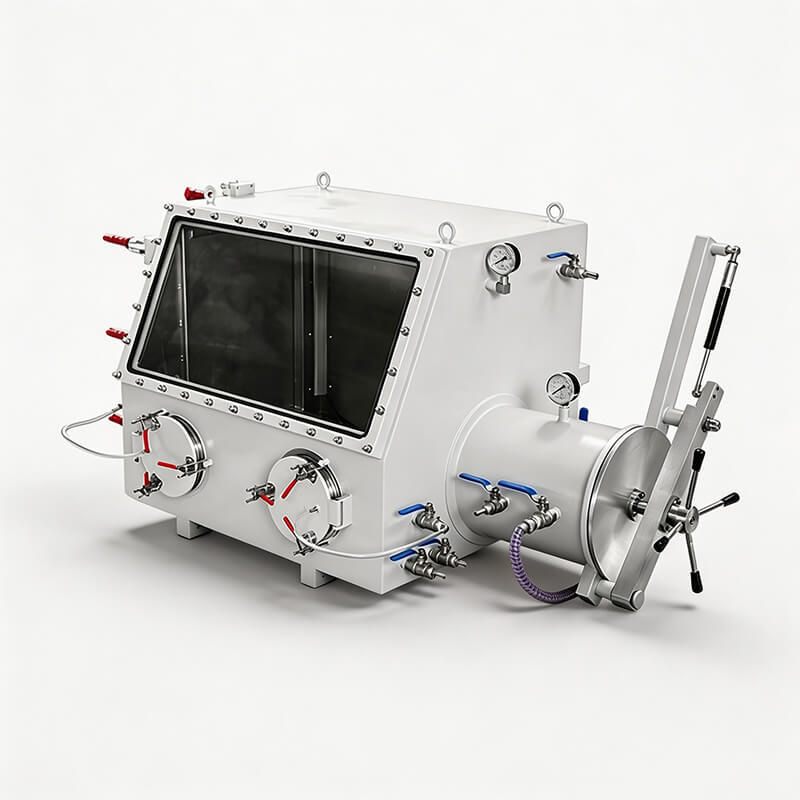
The GBV-1 is a stainless steel vacuum glove box. Its working principle is straightforward: a sealed enclosure isolates the working volume from the surrounding air; a vacuum pump removes part of the internal gas; and an inert gas such as nitrogen or argon is admitted to replace the removed gas. Repeating this evacuation-and-refill sequence reduces the concentration of oxygen, water vapor, and other air-borne contaminants that were present at the start. Because the process is batch-based, the final atmosphere is a function of the starting condition, the number of cycles, the vacuum level reached, and the amount of outgassing from materials inside the chamber.
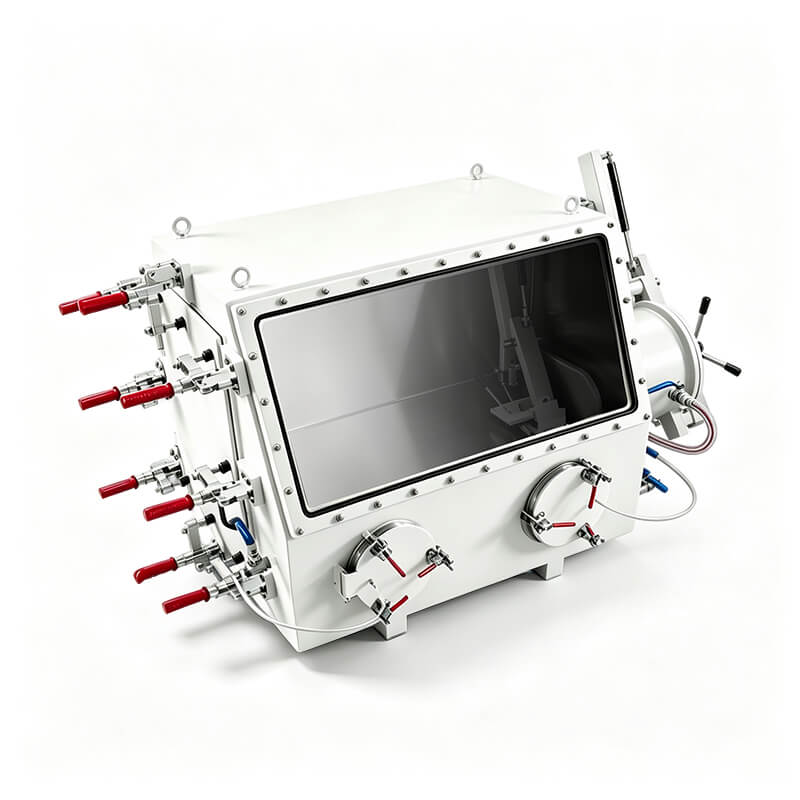
This architecture is well suited to applications where the sample is protected during a defined operation rather than continuously exposed for many hours. Examples may include transferring air-sensitive powders, loading a sealed cell, preparing a moisture-sensitive sample for measurement, or handling materials that react with humid air. The exact suitability depends on the material and the operation, not on the label "glove box." A material that is extremely sensitive to trace oxygen may still require a purifier-based system or an additional getter or scavenger strategy, even if the initial evacuation is thorough. The GBV-1 Stainless Steel Vacuum Glove Box product page is the correct reference for its available configuration details.
The GBV-1 should not be described as a continuously purged glove box with automatic purification. Its product information separates it from systems that use a closed-loop gas purification column, circulation blower, and continuous monitoring to maintain a steady low-level atmosphere. That separation is important for procurement because it affects the auxiliary equipment list. A purifier-based box needs a purification column, regeneration provisions, and a circulation loop. A vacuum box needs a vacuum pump, a reliable valve arrangement, a gas supply with appropriate regulation, and a pressure or vacuum gauge that allows the operator to verify each step. Some users combine a vacuum box with a separate purification unit or a gas purification cabinet, but that must be treated as a system integration question, not as a standard feature of the GBV-1.
Likewise, the GBV-1 should not be assumed to support every vacuum level, every chamber size, or every solvent. Stainless steel construction is generally chosen for durability, cleanability, and compatibility with a broad range of conditions, but the specific interior volume, port layout, glove material, window material, and seal materials determine what can be done. When a process involves solvents, the user must check compatibility with the glove material and the internal components, and must consider whether solvent vapor will be removed by the vacuum cycle or will linger and interfere with the next operation.
The Mechanism of Vacuum-Assisted Gas Replacement
A useful way to think about a vacuum glove box is as a dilution machine. Each pump-and-refill cycle removes a fraction of the gas currently in the chamber and replaces it with inert gas. If the chamber is pumped from atmospheric pressure down to a lower absolute pressure and then refilled to atmospheric pressure with inert gas, the residual air fraction after one cycle is roughly the ratio of the final absolute pressure to the starting absolute pressure. Two cycles multiply that fraction again, and so on. This relationship explains why deeper vacuum and more cycles both improve the result, but it also shows why the improvement is not unlimited in practice.
Real chambers do not behave as ideal, empty vessels. Water molecules adsorb on stainless steel surfaces, on gloves, on window materials, and on any sample or fixture inside. When the chamber is evacuated, some of that adsorbed water desorbs and joins the gas phase; when the chamber is refilled, the remaining surface water can re-equilibrate with the new atmosphere. Oxygen can also be released from oxide layers or from materials with trapped air. For that reason, a vacuum cycle that removes gas-phase air very effectively may still leave a slow rise in water and oxygen after refilling. The rise is not necessarily a leak. It can be outgassing from surfaces, and it may continue until the surfaces have been conditioned by repeated cycles or by a purge.
This is one reason that vacuum replacement and continuous purification should not be confused. A purification system removes contaminants on a continuing basis while the box is closed and operating. A vacuum replacement sequence removes a large fraction of contaminants at the start and then relies on the sealed chamber to keep the atmosphere stable. If the chamber has a high leak rate, or if the gloves are highly permeable to water and oxygen, the atmosphere will degrade over time. If the chamber is well sealed and the internal surfaces are clean and dry, the atmosphere can remain suitable for a longer working period. The difference is not a matter of one being "real" inert atmosphere and the other not; it is a matter of how the contaminants are managed over time.
Pumping speed and conductance also matter. The pump may have a high ultimate vacuum on a clean, empty test dome, but the chamber volume, the piping, the valve, and the feedthroughs all restrict gas flow. A small-diameter vacuum line, a restrictive valve, or a long path between the chamber and the pump will slow pump-down and can make the process take much longer than expected. That is where the vacuum valve becomes part of the atmosphere-control system rather than a generic plumbing item. The operator needs a valve that opens the path fully when pump-down is required, closes reliably when the chamber is isolated, and provides a repeatable way to control the sequence.
Where the KF Vacuum Butterfly Valve Fits in a Vacuum Glove Box
A KF Vacuum Butterfly Valve is a vacuum-direction component built around a KF flange connection. KF flanges use a centering ring and an O-ring to make a quick, demountable seal, and they are common in laboratory vacuum systems because they allow components to be assembled and reconfigured without threaded fittings. The butterfly design uses a circular disc that rotates within the flow path. When the disc is parallel to the flow, the valve is open and offers a relatively unobstructed passage. When the disc rotates to the closed position, it seals against the body and isolates the two sides of the line.
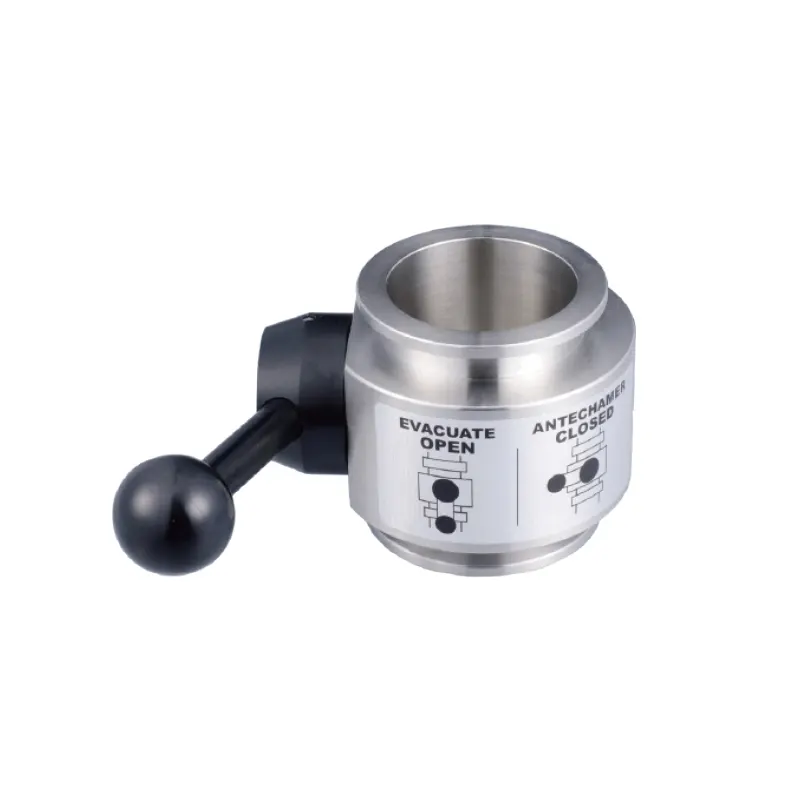
In a vacuum glove box, this type of valve can appear in several places. It may sit between the chamber and the vacuum pump, allowing the operator to isolate the pump after pump-down or to protect the chamber from pump oil or particulates. It may be used on an antechamber line, where samples are transferred into and out of the main chamber without exposing the working volume to air. It may also be used on a vent or gas-admission line, although the gas-admission function often calls for a different valve type because it requires fine flow control rather than simple isolation. The exact placement depends on the box configuration and on whether the valve is intended for manual operation, pneumatic actuation, or a combination.
The butterfly valve is not a purification device, and it does not remove oxygen or water. It does not replace a solvent trap, a HEPA filter, or a purification column. Its contribution is to make the vacuum path controllable. A well-chosen valve supports a clean pump-down sequence: open the valve, evacuate the chamber or antechamber to the intended pressure, close the valve, admit inert gas, and repeat if needed. A valve that is too restrictive, that leaks at the seat, or that cannot be actuated repeatably will make the sequence slower and less predictable. In that sense, the valve influences atmosphere quality indirectly by influencing how well the evacuation-and-replacement process can be executed.
Selection should be based on the specific vacuum line, not on a generic assumption that all KF butterfly valves are interchangeable. The user should confirm the KF flange size, the body and seal materials, the intended pressure range, the method of actuation, and the compatibility of the seal with the gases and any solvent vapors present. The KF Vacuum Butterfly Valve product page is the appropriate place to check the available configuration details before matching it to a GBV-1 or to another vacuum chamber. If the required details are not stated, the safe course is to ask the supplier rather than to infer a rating from the flange size alone.
Choosing Between Vacuum Replacement and Continuous Purification
The choice between a vacuum glove box and a continuously purified glove box is usually a question of duty cycle, sensitivity, and how the laboratory works. It is rarely a question of one technology replacing the other entirely.
A vacuum replacement box tends to fit workflows where the box is used in defined sessions. The operator loads the sample, closes the chamber, performs the evacuation and refill sequence, and then carries out the work. Between sessions, the box may be left under inert gas or opened for cleaning and loading. The approach is efficient when the sample load is moderate, when the box is not occupied continuously, and when the required atmosphere can be reached by a finite number of cycles. It is also attractive when the user wants to avoid the complexity of a purification loop, regeneration schedules, and continuous monitoring equipment.
A continuously purified box tends to fit workflows where the atmosphere must remain stable for long periods and where the operator needs low oxygen and water levels during extended manipulation. The purification system continuously removes contaminants that enter through gloves, antechambers, and small leaks. That continuous removal is valuable when the sample is exposed for hours, when multiple users open and close the box frequently, or when the process cannot tolerate a gradual rise in contaminants between vacuum cycles. It also introduces its own requirements: the purification material must be regenerated or replaced, the circulation loop must be maintained, and the atmosphere must be monitored with instruments that are calibrated for the relevant range.
A practical comparison can be organized around a few questions:
| Question | Vacuum replacement box (for example, GBV-1 type) | Continuously purified box |
|---|---|---|
| How is the atmosphere established? | Sealed chamber, evacuation, inert gas refill, repeat as needed | Closed-loop circulation through a purification column |
| How are contaminants managed over time? | Batch removal at the start; stability depends on sealing and internal outgassing | Continuous removal while the system operates |
| Typical auxiliary equipment | Vacuum pump, valves, gas supply, vacuum or pressure gauge | Purification column, blower, monitors, regeneration provisions |
| Best fit | Intermittent work, moderate sensitivity, transfer and preparation steps | Long, frequent, or highly sensitivity-critical work |
| Key limitation to verify | Achievable vacuum, cycle count, leak rate, outgassing, glove permeability | Purification capacity, regeneration interval, monitor range and calibration |
The table is deliberately qualitative. It does not assign numerical performance to the GBV-1 or to any accessory, because those numbers depend on the actual configuration, the chamber volume, the pump, the gas supply, and the test conditions. A supplier can provide the relevant data for a defined setup; a generic catalog description cannot substitute for that.
There is also a middle path. Some users operate a vacuum box for sample transfer or preparation and then move the sample into a purified box for extended work. Others use a vacuum antechamber on a purified box to reduce the air load before the sample enters the main chamber. These combinations can be effective, but they require the user to understand which part of the system is doing the purification and which part is doing the replacement. A vacuum antechamber, for example, reduces the amount of air carried into the main chamber, but it does not maintain the main chamber atmosphere. A purifier maintains the main chamber atmosphere, but it does not eliminate the need for a proper transfer procedure.
Atmosphere Disturbance During Transfer and Recovery
The most common practical complaint about any glove box is that the atmosphere changes when samples move in or out. In a vacuum replacement box, the disturbance is easiest to see because the atmosphere is built in cycles. When the main chamber is opened to an antechamber, or when a transfer door is opened, gas from the less clean side can enter the working volume. The size of the disturbance depends on the antechamber volume, the pressure difference, the number of transfer cycles, and how carefully the operator purges the antechamber before opening the inner door.
The KF vacuum butterfly valve is directly relevant here. If the valve isolates the antechamber from the pump, the operator can evacuate the antechamber, refill it with inert gas, and repeat before opening the inner door. If the valve is undersized or partially obstructed, the antechamber may not reach the intended pressure in the expected time, and the operator may open the inner door too early. If the valve leaks at the seat, the antechamber may not hold its vacuum, and the refill will be less effective. These are mechanical effects that show up as atmosphere problems, even though the valve itself does not measure or purify anything.
Gloves are another major factor. Glove material, thickness, and condition affect how quickly water and oxygen can pass from the laboratory air into the box. A glove that is highly permeable, or a glove with a pinhole or a worn area, will allow a continuous inward flow of contaminants. In a purifier-based box, the purification system may mask this flow by removing contaminants continuously, at least until the load exceeds capacity. In a vacuum replacement box, the effect is more visible because there is no continuous removal. This is not evidence that the box is defective; it is evidence that the sealing and barrier properties matter. The correct response is to check the gloves, the seals, the door gaskets, and the valve seats, and to confirm the leak rate with a proper test rather than assuming a particular cause.
Monitoring is the third factor. A vacuum glove box needs at least a way to verify that the evacuation and refill sequence has been carried out as intended. A vacuum gauge on the pump line or chamber can show whether the expected pressure has been reached. An oxygen or moisture analyzer can show the resulting atmosphere, but only if its range, resolution, and calibration are appropriate for the measurement. A reading with high resolution is not automatically a reading with high accuracy, and an analyzer measures the atmosphere; it does not improve it. Users should treat the instrument as a verification tool and should confirm its calibration and measurement principle before drawing conclusions from small changes.
Configuration Checklist Before Specifying a System
When requesting a vacuum glove box or a related accessory, the most useful information is the application, not the model number alone. The following checklist helps the supplier recommend a configuration that matches the actual work.
- Working volume and geometry: chamber dimensions, single or multiple workstations, single-sided or double-sided access, and the space required for the sample, tools, and fixtures.
- Atmosphere target: the oxygen and water levels required during the actual operation, the duration of exposure, and whether a purge or continuous purification is needed in addition to vacuum replacement.
- Vacuum requirement: the intended chamber or antechamber pressure, the pressure measurement method, and the pump type that will be used. The achievable vacuum depends on the pump, the valve, the piping, and the chamber, not on the box name alone.
- Cycle requirements: the number of evacuation and refill cycles that the workflow can tolerate, the acceptable cycle time, and the gas consumption per cycle.
- Gas supply: gas type, purity, supply pressure, regulation method, and whether the gas is vented or recovered.
- Valve and line details: KF flange sizes, number and location of valves, manual or actuated operation, and the required sealing materials.
- Material compatibility: sample chemistry, solvents, acids, and any process that could attack the chamber, gloves, seals, or windows.
- Instrumentation: vacuum gauge, oxygen or moisture analyzer, range, resolution, calibration method, and alarm or logging requirements.
- Access and utilities: electrical feedthroughs, signal feedthroughs, KF ports, cooling lines, and HEPA or solvent-trapping provisions.
- Maintenance and verification: leak-test method, glove replacement interval, seal inspection, pump maintenance, and the procedure for confirming that the atmosphere is ready before work begins.
A vacuum glove box such as the GBV-1 can be an effective part of this picture when the application fits its mode of operation. The KF Vacuum Butterfly Valve can be a useful part of the vacuum path when it is selected for the actual line size, pressure range, and gas or solvent environment. The decisive step is to define the target atmosphere and the workflow first, then choose the chamber, pump, valves, and monitoring that can meet those requirements together. If a requirement cannot be verified from the available product information, it should be listed as an open question for the supplier rather than assumed.
Match the Atmosphere Strategy to the Work, Not the Label
The useful distinction is not between "good" and "bad" glove boxes, but between systems that create an atmosphere in batches and systems that maintain it continuously. A stainless steel vacuum glove box uses evacuation and inert gas replacement to remove air and moisture at the start of a session, and it relies on sealing, cleanliness, and operating discipline to keep the atmosphere stable afterward. A continuously purified glove box uses a closed-loop purification system to remove contaminants while work proceeds. Both approaches have a place, and the right choice depends on how sensitive the sample is, how long it is exposed, how often the box is used, and what level of verification the laboratory requires.
For a GBV-1 configuration, the practical questions are concrete: what vacuum level can the pump and valve arrangement actually reach in this chamber, how many cycles are needed for the target atmosphere, how quickly do water and oxygen rise afterward, and what maintenance keeps the seals and gloves in good condition. For a KF Vacuum Butterfly Valve, the practical questions are equally concrete: does the flange size match the line, is the seal compatible with the gases and solvents in use, does the valve open far enough to allow effective pump-down, and does it close reliably enough to isolate the chamber? Answering those questions with the supplier, using the specific product information and a defined test procedure, is more valuable than relying on a general expectation about what a glove box should do.
