
When the oxygen or moisture reading in a six-glove double-sided glove box climbs after a transfer and then falls more slowly than expected, the natural first reaction is to suspect the purification system. That suspicion is understandable, but it often targets the wrong part of the system. In a recirculating glove box, the measured oxygen and water levels are the result of several interacting functions: the leak-tightness of the enclosure, the volume of air introduced during transfer, the rate at which the atmosphere passes through the purification column, the condition of the purification material, and the way the analyzer samples the atmosphere. Slow recovery is therefore a system-level symptom, not a single-component fault.
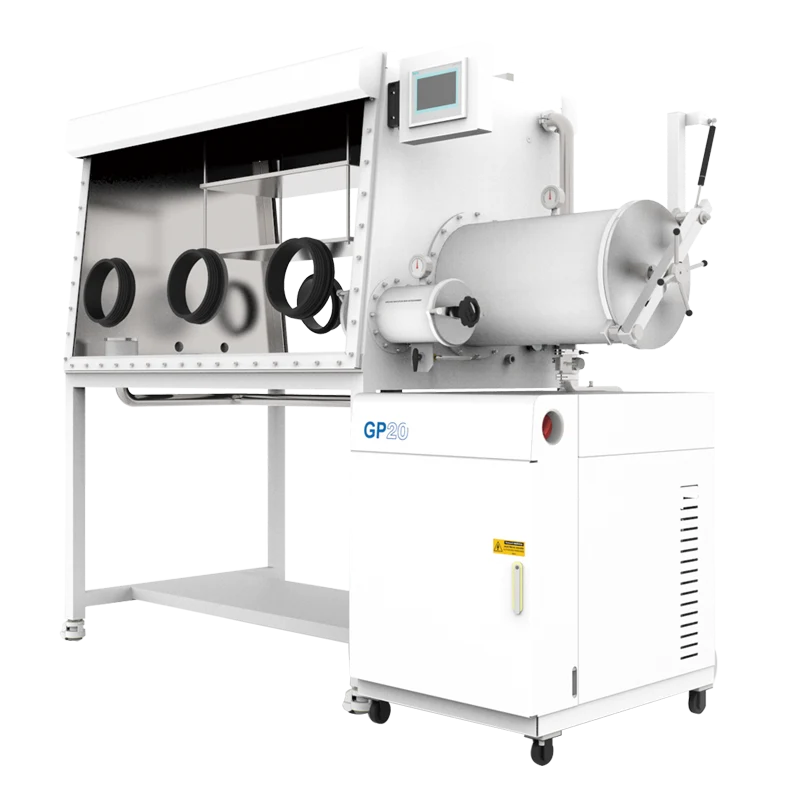
This article focuses on that symptom in the context of the Six-Glove Double-Sided Glove Box with Gas Purification System. The goal is to separate the effects of transfer practice from the limits of purification capacity, and to show which configuration details matter when recovery time becomes part of the process cycle. It is written for materials researchers, laboratory managers, and equipment buyers who need predictable atmosphere control for air-sensitive work. No glove box can promise zero oxygen or zero moisture under every load, and the useful question is not whether the reading is low at some moment, but how quickly and reliably the system returns to its normal operating window after a known disturbance.
What slow O2 and H2O recovery actually means
Recovery is a rate, not a number. Two glove boxes can display the same oxygen reading at steady state and behave very differently after a transfer. One may return to its baseline within minutes, while the other takes much longer or never fully returns. The difference usually comes from the balance between the amount of air that entered, the volume of the enclosure, the circulation flow through the purification loop, and the capacity of the purification material at that moment. If any one of those factors changes, recovery time changes even when the displayed steady-state value looks unchanged.
In a six-glove double-sided box, the working volume is typically larger than a compact single-sided enclosure, and there are more glove ports, more seals, and more opportunities for small leaks or for gloves to be disturbed. That does not make the design unsuitable; it simply means the atmosphere has more boundary to manage. When a researcher reports that recovery feels slow, the most useful next step is to define what slow means in that specific workflow: seconds, minutes, tens of minutes, or hours. The answer determines whether the dominant cause is transfer practice, purification capacity, leakage, or simply an expectation that does not match the system's design.
Disturbance versus trend
A disturbance is a temporary departure from the normal operating window after a known action, such as opening the antechamber or replacing a glove. A trend is a change in the baseline itself. If the baseline oxygen or moisture level drifts upward over days, the cause is more likely to be a leak, a saturated purification column, a contaminated glove, or a problem with the analyzer than a single transfer. If the baseline is stable but recovery after transfer becomes slower, the cause is more likely to be the transfer load, the purge sequence, or the circulation path. Separating disturbance from trend prevents unnecessary repairs and helps identify the right corrective action.
The purification loop in a recirculating glove box
A glove box with a gas purification system is not a sealed box that simply holds inert gas. It is a closed loop. The atmosphere is continuously drawn from the working volume, passed through purification material that removes moisture and oxygen, and returned to the box. The loop also includes a circulation blower, valves, monitoring instruments, and a control system that manages the operating sequence. The purification material eventually becomes loaded and must be regenerated or replaced according to the manufacturer's procedure. Each of these functions has a different effect on recovery time, and conflating them leads to poor troubleshooting.
The circulation blower determines how quickly the box atmosphere passes through the purification material. The purification columns determine how much moisture and oxygen can be removed before the material needs regeneration. The analyzer determines what you can see. A strong blower with saturated columns will move contaminated gas around the loop without removing much of it. A fresh column with poor circulation will clean only the gas that reaches it. A good analyzer with a poorly placed sample line will report a clean reading while the working zone remains contaminated. For recovery performance, all three must be matched to the box volume and the expected transfer load.
Regeneration is not normal purification
Regeneration is the process that restores the purification material after it has absorbed moisture or oxygen. It is not the same as normal recirculation, and it should not be confused with the routine removal of a small transfer load. During normal operation, the loop removes contaminants from the atmosphere. During regeneration, the purification material is treated according to a specific procedure, often involving heat and a regeneration gas, to drive off the absorbed species. If regeneration is incomplete or the material is beyond its useful life, the loop may still circulate gas but with reduced removal capacity. The result is slower recovery and a baseline that may never reach its previous level.
Because regeneration details are product- and material-specific, they should come from the manufacturer's documentation for the exact system. This article cannot provide a universal regeneration recipe, and no generic procedure should be used in place of the supplied instructions. The important diagnostic point is that regeneration status is a separate variable from circulation and leak-tightness. If recovery has gradually worsened over many months, and the transfer practice has not changed, the purification material's condition deserves attention. A HEPA filter removes particles, not water vapor or oxygen; a solvent adsorber can capture organic vapors but does not replace the water and oxygen purification loop.
Why the six-glove double-sided layout changes the transfer picture
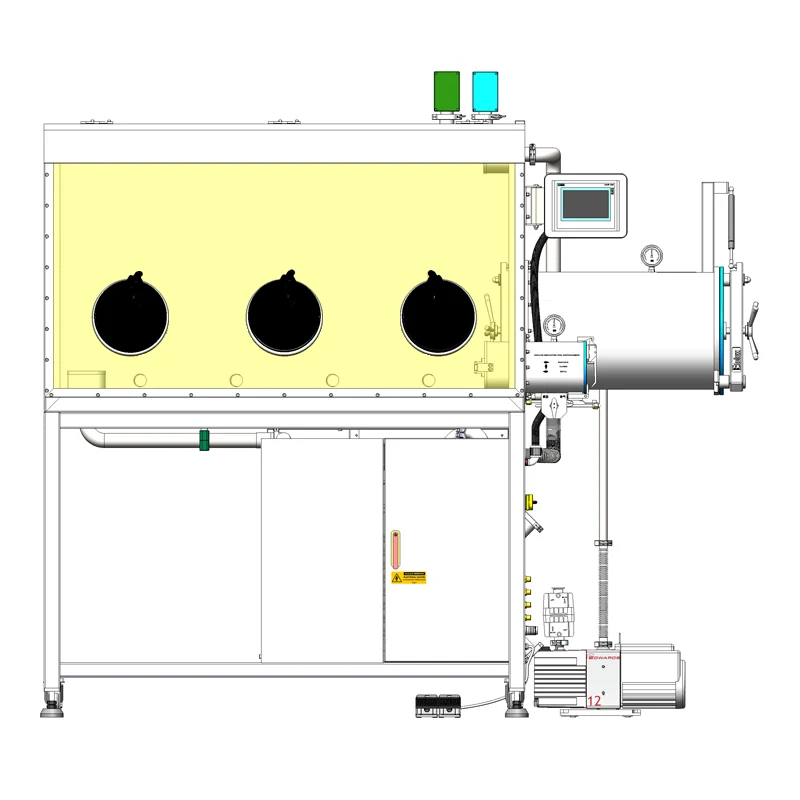
The product name identifies six glove ports and access from two sides. That configuration is useful when multiple operators work in parallel, when a process requires a long working path, or when equipment needs to be shared across a wide enclosure. It also changes the atmosphere-management problem. More glove ports mean more seals, more gloves, and more potential leak paths. A double-sided layout often means a larger internal volume and a longer gas path. Both factors can increase the time needed to mix and purify the atmosphere after a disturbance, even if the purification loop itself is well matched.
None of this means a six-glove double-sided box is inherently slow. It means the box rewards careful transfer discipline and a clear understanding of where the atmosphere is sampled and how it circulates. A single-sided box with a small volume may appear to recover faster simply because there is less gas to clean and fewer boundaries to seal. A double-sided box with a larger volume may provide better workflow and capacity, but it requires a transfer strategy that minimizes air ingress and distributes the purified gas effectively.
More access points, more atmosphere boundary
Each glove port includes a glove, an O-ring or gasket, and a mounting interface. Each of these is part of the atmosphere boundary. A small leak at one glove port may not be obvious at steady state, especially if the purification loop is continuously removing the incoming moisture and oxygen. But during recovery, that same leak competes with the purification loop, extending the time required to reach the baseline. If the leak is intermittent, recovery may vary from transfer to transfer. Checking glove condition, seal seating, and port hardware is therefore part of recovery troubleshooting, not just maintenance.
On a double-sided box, operators may work from both sides at the same time. That can be efficient, but it also means gloves may be moved, folded, or pressed against each other more often. A glove that is twisted or partially detached can create a path for air. A glove with a pinhole may be difficult to detect without a leak test. If recovery slows after a glove change or after a period of heavy use, the gloves and their seals should be among the first items to inspect. A larger internal volume also acts as a buffer: it dilutes a small air ingress, but it stores more gas that must be cleaned before the whole volume returns to baseline. Transfer planning should therefore scale with box volume, using pre-purged antechambers, minimized door-open time, and a circulation strategy that avoids dead zones.
The antechamber and transfer sequence: where air usually enters
In most purified glove boxes, the antechamber is the largest intentional source of air ingress. Every time the outer door opens, the antechamber fills with ambient air. The purge cycle then removes most of that air before the inner door opens. The effectiveness of the cycle depends on the antechamber volume, the vacuum level achieved, the number of purge cycles, and the nature of the load. A large antechamber can accommodate bigger items, but it also holds more air and may require a longer or more repeated cycle. A small antechamber reaches a given vacuum faster but cannot pass large equipment.
The load itself matters. A solid metal block has a small surface area and little adsorbed moisture. A porous ceramic, a stack of foils, a solvent-wet sample, or a box of gloves has a large surface area and may release moisture or solvent vapor into the antechamber and then into the main box. In that case, the purge cycle removes the free air, but the load continues to outgas after the inner door opens. The result is a slow recovery that looks like a purification problem when it is actually a load-conditioning problem. When estimating air load, consider everything that enters: the sample, its container, the tools, the transfer tray, and the surfaces of the antechamber itself. Packaging materials can be significant moisture sources.
Vacuum purge and refill is a dilution process. Each cycle removes a fraction of the air in the antechamber and replaces it with inert gas. The remaining air fraction depends on the vacuum level reached and the number of cycles. It does not remove moisture that is chemically or physically bound to surfaces, and it does not remove gas dissolved in liquids. It also does not purify the main box atmosphere. It only reduces the air load that enters when the inner door opens. Understanding this distinction prevents unrealistic expectations: a vacuum purge cycle is a transfer preparation step, not a substitute for the recirculating purification loop.
| Function | What it does | What it does not do | Key check |
|---|---|---|---|
| Vacuum purge and refill | Reduces ambient air in the antechamber before transfer | Does not remove moisture from surfaces or purify the main box | Vacuum level, number of cycles, load surface area |
| Recirculating purification | Continuously removes moisture and oxygen from the box atmosphere | Does not remove particles or solvent vapors | Circulation flow, column condition, sampling point |
| Regeneration | Restores purification material after it is loaded | Is not a normal operating mode and is not a quick fix for a leak | Procedure, gas supply, temperature and timing per manufacturer |
| HEPA filtration | Captures particles | Does not remove water vapor, oxygen, or solvent vapor | Filter placement and pressure drop |
| Analyzer | Measures oxygen or moisture at its sampling point | Does not purify the atmosphere or guarantee uniform readings | Location, calibration, response time |
When a turbomolecular vacuum pump may be considered
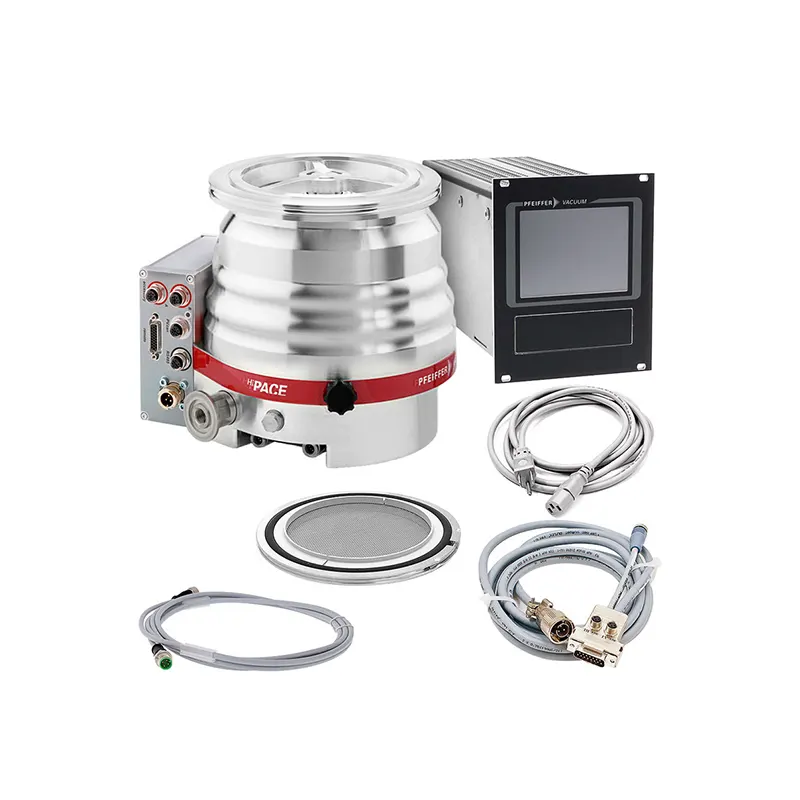
Most glove box antechambers are evacuated with a roughing pump, because the goal is to remove the bulk of the air, not to reach high vacuum. A turbomolecular vacuum pump, such as the Glove Box Turbomolecular Vacuum Pump, is a different class of accessory. It is designed for high-vacuum applications where a cleaner, lower-pressure environment is required. In a glove box context, it might be considered for a dedicated load-lock, a sample-transfer chamber, or an analytical interface that needs better evacuation than a simple roughing cycle can provide. It is not a drop-in replacement for the main purification loop, and it does not remove moisture or oxygen from the box atmosphere.
Compatibility is not automatic. Before selecting a turbomolecular pump for a glove box application, the system designer must consider the chamber volume, the gas load, the required vacuum level, the flange size, the foreline pump, the control and safety interlocks, and whether the chamber and seals are rated for high vacuum. A turbomolecular pump also has specific operating requirements, including backing pressure and protection against sudden gas bursts. It should be integrated as part of a properly designed vacuum system, not added as a generic accessory. The relevant product page should be consulted for the actual configuration and specifications, and the pump should only be used with a compatible chamber and controller.
Reading the numbers correctly: pressure, vacuum, leak rate, O2, H2O
Atmosphere troubleshooting goes wrong when different measurements are treated as interchangeable. Working pressure, antechamber vacuum, pump ultimate vacuum, leak rate, oxygen concentration, and moisture concentration are separate quantities with separate units and separate meanings. A pump's ultimate vacuum is not the same as the antechamber's working vacuum. A leak rate is not the same as a pressure reading. An oxygen analyzer reading is not a direct measure of purification capacity. Keeping these distinctions clear prevents false conclusions and helps identify the actual limiting factor.
An analyzer is a measurement device; it reports the concentration at its sampling point. A purification system is a removal device; it reduces the concentration in the circulating gas. Having one does not guarantee the other. If the analyzer is calibrated and sampling correctly, it can tell you whether the purification loop is keeping up. If the analyzer is out of calibration or sampling from a non-representative location, it can mislead you in either direction. Resolution is not accuracy: a display with fine resolution can show a small change, but that does not mean the absolute value is accurate. When using readings to judge recovery, focus on repeatability and trend rather than on a single decimal place.
Configuration trade-offs in a six-glove double-sided purified box
The six-glove double-sided configuration is a workflow choice. It supports multiple operators, long processes, and equipment that would be difficult to manage in a smaller box. It also increases the atmosphere boundary and the internal volume, which affects recovery. The right decision depends on the process: how many people need access, how large the equipment is, how often transfers occur, and how tight the atmosphere specification must be. There is no universal best configuration; there is only a configuration that matches the application and the recovery expectation.
A single-sided box concentrates the glove ports on one face, which can simplify sealing and reduce the number of potential leak paths. A double-sided box provides access from both sides, which can improve collaboration and allow a process to be split into stages. The trade-off is that more ports and seals must be maintained, and the larger volume may take longer to purify after a disturbance. If the process does not require two-sided access, a single-sided design may offer faster recovery for the same purification capacity. If it does, the double-sided design can still perform well with appropriate transfer discipline.
Accessories that affect recovery
Accessories can improve recovery or make it worse, depending on how they are selected and used. Gloves with the right material, thickness, and fit reduce the chance of leaks and improve dexterity, which in turn reduces awkward movements that can disturb seals. Antechambers sized to the load reduce the volume of air that must be purged. Feedthroughs and KF interfaces should be sealed and matched to the box, because every additional penetration is a potential leak path. Vacuum pumps must be matched to the chamber volume and gas load. Analyzers must be calibrated and placed where they provide useful data. Solvent adsorbers can protect the purification material from organic vapors, but they do not remove water or oxygen. HEPA filters can manage particles, but they do not replace the purification loop.
An accessory that works well on one glove box may not be compatible with another. The random pairing of a main product and an accessory in a catalog does not guarantee that they belong together. Flange sizes, control signals, vacuum levels, gas compatibility, and physical mounting all matter. When considering an accessory such as a turbomolecular pump, confirm with the supplier that the chamber, controller, and safety system are designed for it. When considering a glove or seal, confirm the material compatibility with the samples and solvents used in the box. Compatibility is a system property, not a product property. The six-glove double-sided purification glove box should be reviewed as an integrated atmosphere system, not as a box with add-ons.
A practical checklist for faster, more predictable recovery
If recovery after transfer is a recurring concern, a structured check is more effective than changing one component at a time. The checklist below focuses on the variables that most often explain slow recovery in a six-glove double-sided purified glove box. It is not a substitute for the manufacturer's operating instructions, but it can help organize the investigation.
- Define the transfer load: sample type, surface area, container, tools, and whether the load is wet or dry.
- Review the antechamber procedure: vacuum level, number of purge cycles, refill gas, and waiting time before opening the inner door.
- Check the inner and outer door seals and confirm that the doors are fully closed before each cycle.
- Inspect gloves and glove port seals for damage, twisting, or improper seating.
- Verify circulation: confirm that the blower is running and that the gas path is not obstructed by equipment or poor layout.
- Confirm the purification material status and whether regeneration is due according to the manufacturer's schedule.
- Check the analyzer: calibration, sampling location, response time, and whether the sample line is blocked or leaking.
- Look for continuous sources: solvent vapors, wet samples, outgassing materials, or a small leak that the loop is masking.
- Record the baseline before the transfer and the recovery curve after, so that changes can be compared over time.
- Before adding an accessory, confirm compatibility with the chamber, pump, controller, and process gas.
Useful records include the baseline oxygen and moisture readings, the time the outer door was open, the antechamber vacuum and number of cycles, the inner door open time, the load description, and the time for the readings to return to the normal operating window. Over several transfers, these records reveal patterns: a particular load, a particular operator, or a particular time of day may correlate with slower recovery. Patterns are more actionable than single observations.
When contacting the supplier, provide the system model or configuration, the baseline readings, the transfer procedure, the load type, the observed recovery time, and any recent changes such as a glove replacement, a new material, or a regeneration cycle. This information allows the supplier to distinguish between a transfer practice issue, an accessory compatibility issue, and a system service issue. Vague reports such as the box is slow are difficult to diagnose; specific records are much more useful. Do not conclude that the purification system is failing simply because recovery is slower than expected, and do not assume that a higher-capacity purification column will solve a leak or a wet-load problem.
Bringing the system back to a stable baseline
Recovery performance in a six-glove double-sided glove box with a gas purification system is a balance between what enters the box and what the purification loop can remove. The loop is designed for continuous removal, but it works against the air load from transfers, the moisture released by surfaces and samples, and any small leaks at gloves, seals, or feedthroughs. When recovery slows, the most productive approach is to measure the disturbance, inspect the transfer path, confirm the purification loop is circulating and regenerated as required, verify the analyzer, and only then consider additional accessories. This sequence keeps the investigation grounded in evidence and avoids unnecessary changes.
For a configuration review or a new system specification, prepare the following information for the supplier: the number of operators and glove ports required, the size and type of items to be transferred, the frequency of transfers, the atmosphere specification that matters to the process, the gases and solvents used, the vacuum requirements for any load-lock or analytical chamber, and the available utilities and space. With those details, the six-glove double-sided platform can be configured with an appropriate purification capacity, antechamber arrangement, and accessory set. The result is not a promise of zero oxygen or zero moisture, but a system whose recovery behavior is understood and matched to the work it needs to support.
