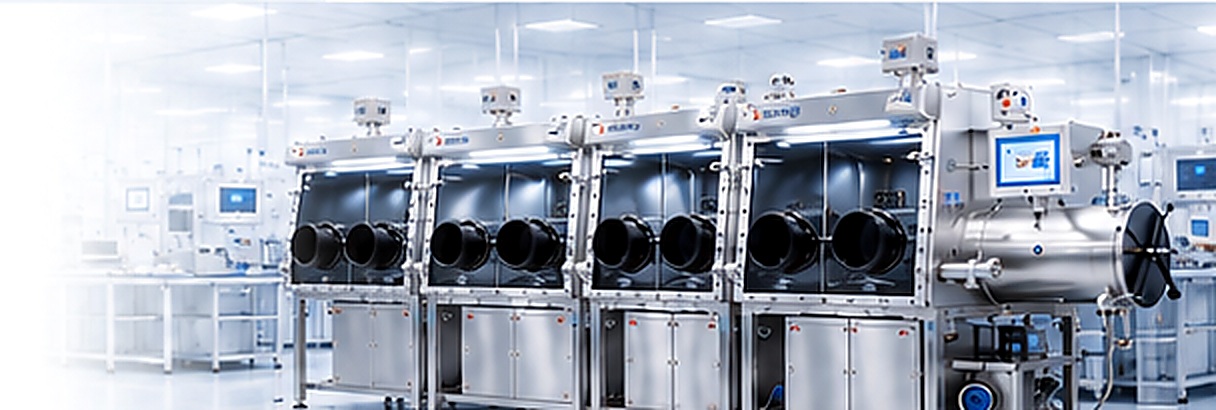
An inert-atmosphere glove box is only as stable as the path by which items enter it. A purification system can hold water and oxygen at low levels while the box is closed, but every transfer introduces a new atmosphere load. The main chamber door is large, the gloves are exposed, and the operator has to reach across a controlled space. A glove box antechamber changes that event into a smaller, repeatable operation. The TENCAN Small Glove Box Antechamber belongs to this accessory category: a compact transfer chamber intended to sit between the outside environment and the glove box interior. Its value is not that it creates a perfect atmosphere on its own. Its value is that it limits how much air, moisture, and particulate matter reach the main chamber during a routine transfer.
That distinction matters because an antechamber is often described too simply. It is not a miniature glove box, and it is not a second purification system. It is a buffer volume with two interfaces: one to the room and one to the controlled workspace. The way those interfaces seal, the way the buffer volume is conditioned, and the way the operator uses the doors determine whether the accessory helps or merely adds another leak path. For the TENCAN Small Glove Box Antechamber, details such as internal volume, door clear opening, mounting interface, seal material, and whether the unit is configured for purge-only or vacuum-assisted operation should be confirmed from the current product page and with TENCAN. The product title identifies the accessory and its intended role, but it does not replace a configuration drawing.
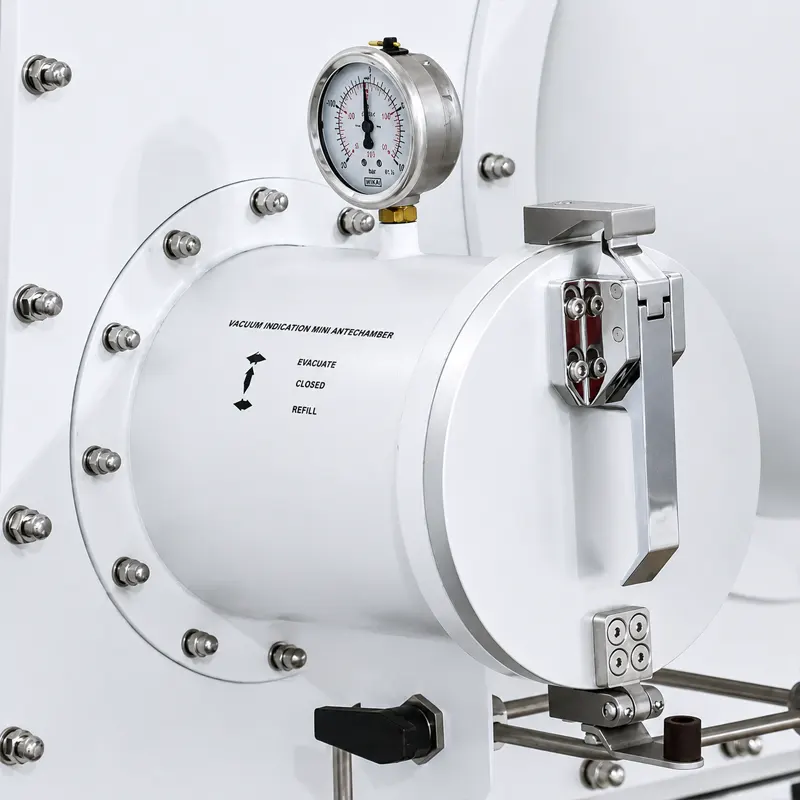
The transfer interface is often the real atmosphere-control boundary
In a closed glove box, the purification column, circulation blower, and analyzers work as a system. The purifier removes moisture and oxygen from the circulating gas, the blower moves gas through the column and back into the chamber, and the analyzer reports the condition of the atmosphere at its sampling point. That system is designed for a certain leakage rate and a certain rate of contaminant introduction. A door opening is not a steady-state condition. It is an event. Large door openings create a pressure disturbance, expose a large surface area to room air, and can force the purification system to work harder for minutes or hours afterward.
An antechamber reduces the size of that event. The operator places the item in a small chamber, seals the outer door, conditions the chamber, and then opens the inner door to the glove box. The main chamber is exposed to the antechamber volume rather than to the room. If the antechamber is small and the conditioning step is appropriate, the total contaminant load is lower than it would be for a direct transfer through a large main door. This is why antechambers are common on glove boxes used for moisture-sensitive or oxygen-sensitive materials, even when the main chamber is already equipped with a purification system.
The benefit is conditional. An antechamber with a poor door seal, an incomplete purge, or an operator who opens both doors at once can introduce more contamination than a careful direct transfer. The accessory also has to match the host box mechanically. A gasket that does not seat, a flange that does not align, or a chamber that forces the operator to reach awkwardly will undermine the atmosphere-control benefit. The transfer interface should therefore be treated as part of the system design, not as an afterthought selected only by external dimensions.
What the antechamber contributes to atmosphere control
The first contribution is isolation. The antechamber separates the room atmosphere from the glove box atmosphere for most of the transfer sequence. The second is repeatability. A defined chamber volume, a defined door sequence, and a defined conditioning method give the operator a routine that can be checked and repeated. The third is protection of the main chamber and gloves from unnecessary exposure. Items can be staged, inspected, and wiped down before the inner door is opened. Sharp tools can be positioned so that they do not tear a glove during the transfer.
The antechamber does not remove water and oxygen from the whole glove box. It limits the amount that enters. The purification system still has to remove the residual contaminant load. This division of labor is important when troubleshooting. If water and oxygen readings rise after every transfer, the cause may be the transfer practice, the antechamber seal, the conditioning cycle, the load itself, or the main purification system. The antechamber is one part of the chain, not the whole chain.
Why a small antechamber is a deliberate compromise
A smaller chamber has less internal volume to condition. That usually means fewer purge volumes, a shorter vacuum cycle, or both, although the exact relationship depends on the design and the conditioning method. A smaller chamber also reduces the amount of gas that has to be displaced and the surface area on which moisture can adsorb. For frequent transfers of vials, substrates, small fixtures, crucibles, tools, and sample holders, a small antechamber can be more practical than opening a large main door each time.
The compromise is capacity and handling. A small chamber may not accept a large fixture, a wide tray, or a bulky piece of equipment. The door clear opening, not just the chamber volume, governs what can pass. The operator also has to be able to reach the item, turn it, and place it safely on the inner side. A chamber that is small but mounted too high, too low, or too far from the glove ports can be harder to use than a slightly larger chamber in a better position. Selection should therefore consider the load envelope, the frequency of transfer, the available wall area, and the operator's reach rather than size alone.
How a glove box antechamber works
A typical antechamber has an outer door, an inner door, a chamber body, seals, and a means of conditioning the chamber. The outer door opens to the room. The inner door opens to the glove box. The two doors should not be open at the same time. Many designs use a mechanical interlock or an operating procedure to enforce the sequence, but the presence of an interlock should be confirmed rather than assumed. The chamber may also have a gas inlet, a gas outlet, a vacuum port, a vent filter, a pressure gauge, or a small window. The exact set of features varies by model and should be checked against the intended use.
Purge, vacuum, and combined conditioning
Conditioning the antechamber means reducing the amount of room air in the chamber before the inner door is opened. One method is inert gas purge. With the outer door closed, inert gas is introduced and the mixture in the chamber is displaced or diluted. Repeated purge cycles improve the result, but each cycle uses gas and takes time. Another method is vacuum-assisted conditioning. If the chamber is designed for vacuum service, the chamber is evacuated and then refilled with inert gas. The vacuum step removes a large fraction of the initial atmosphere in one operation, while the refill restores a gas environment compatible with the glove box. A combined vacuum and purge sequence can reduce the number of gas exchanges compared with purge alone, but it requires a chamber, seals, doors, and windows that are suitable for the pressure difference.
The key point is that these are different capabilities. A purge-only antechamber is not necessarily vacuum-rated. A chamber with a vacuum port is not automatically suitable for every vacuum level or every load. A small antechamber may be intended for one method rather than the other, and the product page should be read carefully before connecting a pump or applying a vacuum. The safe approach is to confirm the allowable vacuum, the intended pressure differential, the seal arrangement, and the door-latching method with the supplier. A vacuum pump's ultimate pressure is not the same as the achievable pressure in the antechamber, and neither value is the same as the water and oxygen level in the main glove box.
Porous and high-surface-area loads complicate conditioning. Paper, cardboard, foam, fibrous insulation, powders, and some plastics can hold air or moisture and release it slowly after the inner door is opened. A vacuum step may remove bulk gas, but it does not necessarily remove adsorbed water from every surface. Pre-drying, minimizing porous packaging, and allowing more conditioning time can be more useful than adding more purge cycles blindly. Solvent-wet items need particular attention because solvent vapor can affect seals and can add to the load on any solvent-removal equipment in the host system. The antechamber should not be used to carry a solvent atmosphere into the glove box unless the host system and the accessory are intended for that service.
What the antechamber does not do
An antechamber does not purify the glove box atmosphere. It does not continuously remove oxygen or water, and it does not replace the purification column, the circulation loop, or the analyzers. It also does not provide HEPA filtration unless a filter is specifically included and validated for the intended flow path. A HEPA filter addresses particles, not water vapor or oxygen. A solvent adsorber addresses solvent vapor, not water and oxygen. An oxygen analyzer measures oxygen; it does not remove it. These distinctions prevent a common mistake: treating every accessory as if it were a purifier.
The antechamber also does not guarantee sterile conditions, a cleanroom classification, biological containment, or hazardous-materials approval. It is an atmosphere-control accessory, not a universal barrier. If the application involves infectious material, toxic powders, or reactive gases, the assessment must include the appropriate containment and safety engineering. A small antechamber can be part of a controlled workflow, but it should not be described as making any material safe for any atmosphere. Material compatibility, reactivity, and the host system's design limits still apply.
Selection factors for a Small Glove Box Antechamber
The starting point is the application, not a list of dimensions. What will be transferred, how often, how moisture-sensitive is it, does it release solvent or particles, and what does the host glove box interface look like? Once those questions are answered, the accessory can be checked against mechanical, sealing, material, and operating requirements. Because the reference listing for the TENCAN Small Glove Box Antechamber does not publish detailed performance data, the following factors should be treated as selection and verification points rather than assumed specifications.
Interface, load envelope, and door clearance
The antechamber must connect to the host box through a compatible port, flange, or mounting arrangement. The bolt pattern, gasket type, opening size, and wall thickness all matter. A drawing is more useful than a photograph because it shows the mounting plane and the clear opening. The load envelope should be checked in three dimensions, including the diagonal that must pass through the door. A tray that fits inside the chamber may still be too wide for the door, and a fixture that passes the door may not be possible to rotate once inside. The inner door also needs clearance on the glove box side, especially if the host box has a shallow wall, a divider, or a glove port close to the mounting location.
Door swing and hinge side affect the working position. An outer door that opens upward may be convenient in one layout and obstructive in another. A side-hinged door may require free space that is not available beside the host box. The operator should be able to open and close both doors while wearing gloves and without leaning across a sharp edge or a nearby instrument. If the antechamber is mounted at an awkward height, the operator may rush the cycle or fail to seat the seal properly. These are ergonomic issues, but they become atmosphere-control issues in daily use.
Sealing and intended pressure service
The door seal is the most direct barrier between the room and the controlled volume. The seal should be compatible with the cleaning agents, solvents, and particles in the application. It should also be inspectable and replaceable. A seal that is compressed unevenly, contaminated with powder, or damaged by a sharp edge will leak. A leak can be small enough to be invisible but large enough to affect the purge efficiency. The door latch should pull the seal uniformly rather than forcing the operator to compensate by over-tightening one side.
If vacuum-assisted conditioning is required, the chamber, doors, window, and seals must be designed for the pressure difference. Do not assume that a small chamber can be evacuated simply because it has a port. Confirm the allowable vacuum and the intended service with TENCAN. If the antechamber is purge-only, do not connect a vacuum pump without written confirmation that the chamber is suitable. Pressure and vacuum ratings are not interchangeable, and a small window or acrylic panel may have different limits from the metal body. The safe selection is the one that matches the documented configuration, not the one that appears convenient.
Materials, solvents, and cleaning
The chamber material and window material affect visibility, chemical compatibility, and durability. A transparent window is useful for checking that an item is positioned correctly, but it may be more sensitive to scratching or solvent attack than the chamber body. Cleaning agents should be chosen for the materials actually used. Abrasive pads can scratch a window and create places where particles or moisture collect. Solvent residues should be removed before the item enters the glove box, especially if the host system includes materials that can be affected by solvent vapor.
Powders need containment. A small antechamber is not a powder-handling enclosure by default, and a fine powder can migrate to the door seal, the inner surfaces, and the glove box. Use a closed container, a tray with a lip, or a bag that can be wiped and opened inside the box. Sharp tools should be capped or oriented so that they cannot puncture a glove or damage a seal during transfer. The goal is to keep the antechamber a transfer path, not a storage area for wet, dirty, or outgassing items.
Cycle control, valves, and operator feedback
A simple antechamber may rely on manual valves and a written procedure. A more integrated unit may have a control sequence, status indicators, or interlocks. The right choice depends on the number of users and the consequences of a skipped step. In a multi-user laboratory, a clear sequence and a visible status are valuable because a partially completed purge can be worse than no purge at all: the operator may believe the chamber is conditioned when it is not. The control method should be matched to the host system and to the training level of the users.
Instrumentation should be selected for the question being asked. A pressure gauge tells you about pressure, not oxygen. A flow indicator tells you that gas is moving, not that the chamber has reached a low water level. An oxygen analyzer in the main box tells you about the main box at its sampling point, not necessarily about the antechamber. If the antechamber is used for a critical process, the verification method should be defined in advance. That may be a documented purge cycle, a leak check, or a routine atmosphere check in the host box after transfer. The method should be appropriate to the risk and should not rely on a single number taken out of context.
Compatibility with the host glove box and purification system
There are two compatibility questions. The first is mechanical: does the antechamber fit the host box, and can it be sealed and supported correctly? The second is atmospheric: does the added volume and the transfer routine fit the capacity of the host purification system and the sensitivity of the process? A product can be mechanically compatible and still be a poor choice if it is too large for the available purification capacity, or if its seals and materials are not compatible with the items being transferred. Similarly, a product can look atmospherically suitable but fail at the mounting interface.
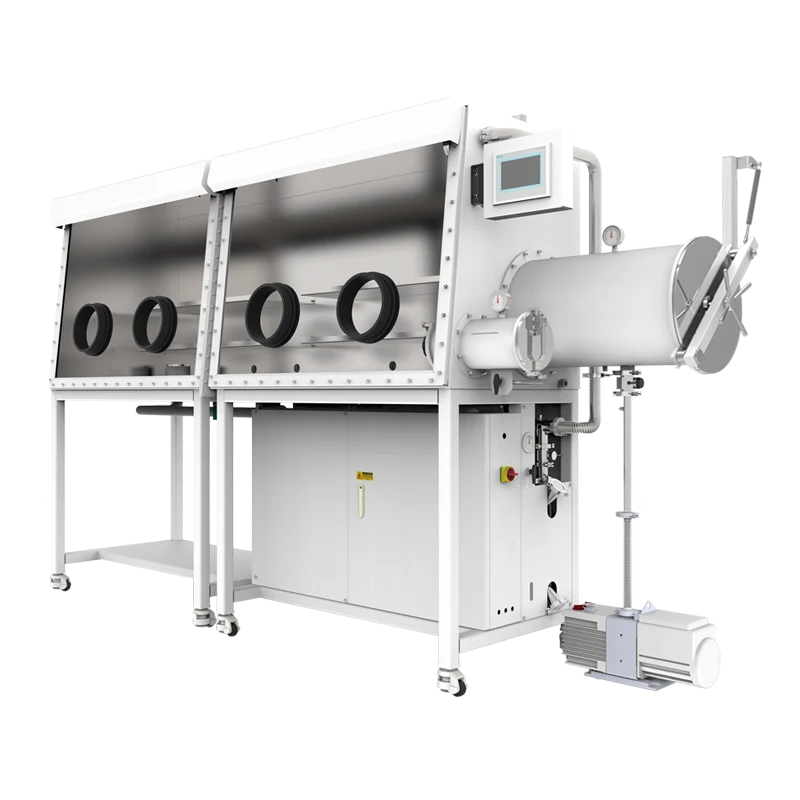
The TENCAN two-station single-sided split-type glove box with gas purification system is a useful example of host architecture because it combines multiple workstations, a single-sided layout, a split-type structure, and a purification system. Those features affect how a transfer interface is used: two stations may mean more than one operator or more than one task, a split structure may affect access and placement, and the purification system sets the atmosphere budget. The existence of this host product does not by itself prove that the Small Glove Box Antechamber is compatible with it. Compatibility should be confirmed from the current product information, the port arrangement, and TENCAN's engineering review.
How the antechamber interacts with the purification loop
In a typical purification glove box, gas circulates through a purification column and returns to the chamber. The antechamber is usually outside that continuous loop. It is a separate volume that is conditioned before it is connected to the main chamber through the inner door. When the inner door opens, the antechamber atmosphere mixes with the glove box atmosphere. If the antechamber has been purged well, the disturbance is small. If it has not, the purifier sees a step change in water, oxygen, or solvent load. The purifier then works to return the main chamber to its setpoint. This is why transfer discipline and antechamber condition are linked to purification performance even though the antechamber is not part of the purification column.
The gas supply also matters. If the antechamber is purged with working gas from the same supply as the glove box, the supply should be clean and dry enough for the application. A house nitrogen line is not automatically suitable for a moisture-sensitive process. The supply pressure, flow capability, regulator setting, tubing material, and exhaust route should be reviewed. If the antechamber uses vacuum, the pump must be compatible with the gas and with any solvent vapor that may be present. Do not route reactive or hazardous gas through an accessory without an engineering review. The antechamber is a small volume, but small volumes can still create significant pressure or exposure hazards if the wrong gas or pump is used.
Pressure, vacuum, leakage, and atmosphere readings are different metrics
It is easy to mix up the numbers associated with a glove box and its accessories. Chamber working pressure, antechamber vacuum, pump ultimate vacuum, leak rate, oxygen concentration, and water concentration are different quantities with different units and different meanings. A pump that can reach a low ultimate pressure does not guarantee that the antechamber will reach a low oxygen level after refill. A leak rate measured at one pressure does not automatically predict the water level at another pressure. An analyzer resolution is not the same as its accuracy, and a reading at one location is not necessarily representative of the whole chamber. When a product page or a verbal description gives a number without a clear object and unit, the right response is to ask for clarification rather than to compare it with a different metric.
For the Small Glove Box Antechamber, request the applicable conditions for any performance claim. If the available information does not specify the chamber volume, the intended vacuum or purge method, the seal material, or the mounting interface, treat those as open items. A careful selection uses confirmed data. It does not fill the gaps with assumptions borrowed from a different product or a different glove box model.
Transfer practice, recovery, and what the readings can tell you
Most atmosphere problems at the transfer interface are procedural as well as mechanical. A good routine starts before the outer door is opened. Only the items needed for the session should be transferred. Packaging should be minimized, and porous or wet items should be pre-dried when the process allows. The operator should inspect the door seal, confirm that the inner door is closed, load the chamber without blocking the inner opening, and close the outer door fully. The conditioning sequence should follow the manufacturer's instructions for the actual configuration. After conditioning, the inner door can be opened, the item transferred, and the inner door closed again. The next transfer should not begin until the chamber has been conditioned again.
The operator should avoid leaving both doors open, overfilling the chamber, or using the antechamber as a storage cabinet. A chamber full of items has less free volume for gas exchange and more surfaces that can hold moisture. A tray that protrudes into the door seal can create a leak that is difficult to see. A glove that reaches too far into the antechamber can transfer contamination to the inner door area. These details sound minor, but they determine whether the accessory performs as a buffer or as an open channel.
Reading the recovery curve without jumping to conclusions
If the host box has water and oxygen analyzers, the readings after a transfer contain useful information. A small rise that recovers steadily is normal for many transfers. A larger rise, a slow recovery, or a rise that does not recover may point to a different cause. The antechamber cycle may have been incomplete. The door seal may be leaking. The load may be releasing moisture or solvent. The main chamber may have a separate leak. The purification system may be due for regeneration or service. The analyzer may need calibration. The circulation path may be obstructed. The correct response is to check the sequence and the obvious physical conditions first, then use the trend to decide what to investigate next. A single reading should not be used to declare a component faulty.
| Observation after transfer | Possible contributors to check | Useful verification |
|---|---|---|
| Small rise that recovers | Normal transfer load; residual room air in the chamber; porous packaging | Confirm the purge or vacuum sequence and the load preparation |
| Repeated slow recovery | Door seal condition; incomplete conditioning; outgassing load; circulation or purifier status | Inspect seals, review the cycle, reduce porous material, check host maintenance records |
| Reading rises before the inner door opens | Leak at the outer door or chamber body; analyzer or sampling issue | Check door closure and seal seating; confirm the reading with the host system procedure |
| Visible condensation or odor | Solvent or moisture on the load; incompatible cleaning residue | Remove the source, pre-dry or contain the item, review material compatibility |
Recovery time is not a universal specification. It depends on the chamber volume, the initial condition, the load, the main chamber volume, the circulation rate, the purification capacity, and the analyzer location. A small antechamber can reduce the load, but it cannot make a wet load dry or compensate for a damaged seal. The practical target is a transfer routine that produces a consistent, acceptable disturbance and a recovery pattern the laboratory understands.
A short transfer checklist
- Confirm that the inner door is closed before opening the outer door.
- Inspect the outer door seal and the chamber interior for powder, liquid, or damage.
- Use a tray or closed container for small parts and powders.
- Keep the load within the door clear opening and away from the seal.
- Follow the documented purge or vacuum sequence for the actual antechamber configuration.
- Open the inner door only after the conditioning step is complete.
- Close the inner door before repeating the cycle for the next item.
- Record unusual readings or recovery behavior so that trends can be reviewed later.
Common misconfigurations and a practical supplier brief
One common mistake is to assume that every small antechamber is vacuum-capable. Some are intended for purge only. Another is to size the chamber by volume while ignoring the door opening and the space needed to rotate the load. A third is to mount the accessory where the operator cannot reach it comfortably, which leads to incomplete door closure or skipped conditioning. A fourth is to treat the antechamber as if it were a purification device and expect it to lower the main chamber's water and oxygen readings by itself. It does not. Its job is to reduce the load; the host purification system does the continuous removal.
Another frequent problem is incompatibility at the host interface. The gasket, bolt pattern, port size, and support method have to match. A large antechamber on a small host box may also change the access to gloves, instruments, or feedthroughs. The transfer path should be reviewed in the context of the whole workstation, not as an isolated accessory. If the host box is a two-station or split-type system, the additional chamber may be more useful at one station than another, but the final placement should be based on the actual layout and operator reach.
Information to provide to TENCAN
A useful inquiry gives the supplier enough context to recommend a configuration rather than just a part number. Provide the host glove box model and a photograph or drawing of the intended mounting area. State the largest and heaviest item that must pass through the antechamber, including its diagonal dimensions and any sharp edges. Describe the frequency of transfer and whether one operator or several will use the chamber. State whether the process requires vacuum-assisted conditioning or whether inert gas purge is sufficient. List the materials and solvents involved, including cleaning agents. Mention whether powders, liquids, or reactive materials will be handled and whether the host system has a solvent-removal provision. Confirm the available gas supply, its quality, and the exhaust arrangement. Finally, ask for the current product drawing, the door clear opening, the seal material, the mounting interface, the intended pressure or vacuum service, and the recommended operating sequence.
For the TENCAN Small Glove Box Antechamber, the product page is the correct starting point for the current configuration, and the product title should not be stretched into specifications that are not stated. The same discipline applies to the host system: the two-station single-sided split-type purification glove box is a separate product, and its features should be matched to the accessory through an actual compatibility check. A small antechamber is a simple-looking part, but it sits at the boundary where room air, moisture, particles, and operator behavior meet the controlled atmosphere. Selecting it by function, interface, and verified limits is more reliable than selecting it by appearance or by a single dimension.
The practical conclusion is a design brief, not a slogan. Define the load, define the transfer frequency, define the conditioning method, confirm the host interface, and verify the seal and material compatibility. If those points are settled, a small antechamber can do exactly what it is meant to do: keep routine transfers small, controlled, and repeatable while the purification system continues to manage the main chamber atmosphere.