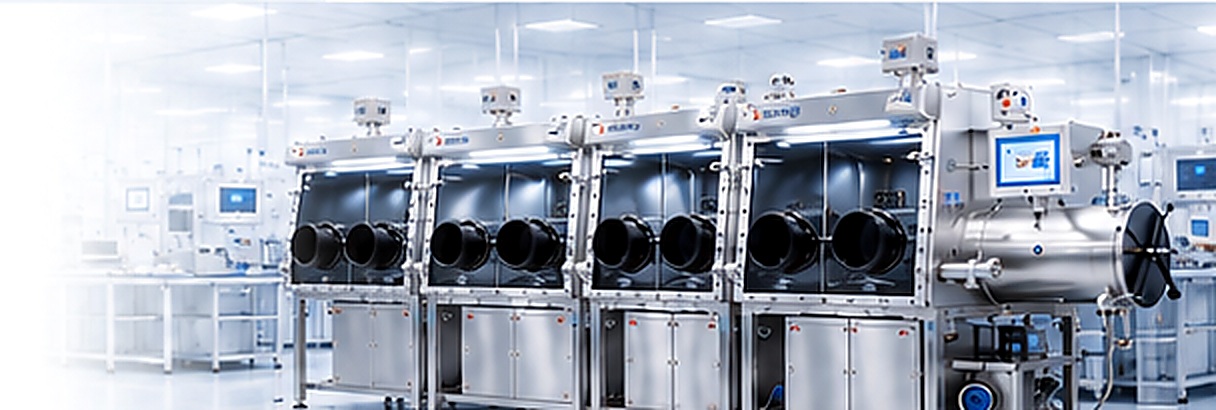
Why the powder, not the enclosure, sets the specification
Glove boxes are frequently purchased before the powder process itself is written down. A budget is approved for an enclosure, a footprint is found in the laboratory, and the atmosphere specification is copied from a previous project. For air-sensitive powders this order of decisions creates predictable problems later, because the enclosure is only one element of a chain that also includes the transfer chamber, the internal weighing arrangement, the solvent load, the cleaning routine and the way material leaves the box for analysis or shipment.
A solid electrolyte, a perovskite precursor, a reduced catalyst or a lithium alloy powder all share the same characteristic: their useful properties depend on a surface that changes as soon as it meets moisture or oxygen. The change is not always visible. A powder can remain free-flowing and still lose the surface chemistry that made it worth synthesising. This is why selection should begin with the process, not with the box, and why a brand-level comparison is only useful when both sides are assessed against the same process requirements.
This guide is written for laboratory managers, materials researchers and procurement engineers who are specifying a purification glove box for powder work. It uses TENCAN's published product documentation as the reference case and sets out the evidence a buyer should request from any international supplier, so that a shortlist can be compared on identical criteria rather than on brochure language. Where a claim is not supported by the material reviewed here, it is framed as a question to confirm rather than as a specification.
The powder workflow: five points where the atmosphere is lost
Atmosphere performance is usually discussed as a single number. In practice, a glove box serving powder work is disturbed at five distinct points, and each one places a different demand on the equipment.
1. Weighing and sub-sampling
Weighing is the most atmosphere-intensive operation in most powder laboratories. Balances are opened, sample boats are manipulated, spatulas are wiped, and the internal volume is exposed to whatever the gloves and the operator bring in. The relevant design questions are whether the internal workspace is large enough to hold a balance, a weighing dish and a hand position without crowding, whether the viewing panel allows the balance display to be read without opening anything, and whether the antistatic behaviour of the interior is adequate for fine powders that otherwise migrate to the walls and the window.
2. Transfer into the box
Every item entering the box passes through a transfer chamber, a bag port or a dedicated airlock. For powders, the transfer chamber is where most contamination is introduced, because the container that arrives from the dry room or the fume hood carries an adsorbed layer of ambient moisture on its exterior. The selection question is not simply the diameter of the chamber but how the evacuation and refill sequence is run, how quickly the chamber can be cycled, and whether the chamber can accommodate the actual containers used, including bottles, vials, crucibles, milling jars and tooling.
3. Processing interfaces
Many powder programmes include size reduction, mixing or milling either before or after the air-sensitive handling step. Those operations usually belong to separate equipment, and they are mentioned here only as interfaces that the glove box must accept: a mill jar that has to be charged and discharged inside the box, a sieve stack, a press die, or a pelletising tool. The box specification should be derived from the largest and heaviest item that must pass through the antechamber and be manipulated on the internal work surface.
4. Storage and sealing
Powders are rarely consumed in one session. Storage inside the box, in sealed vials under the working atmosphere, is often more practical than repeated transfer. This creates a requirement for internal shelving or storage volume that is seldom discussed at the quotation stage but becomes a constraint within weeks of commissioning.
5. Cleaning and solvent use
Powder work generates residue, and residue is removed with solvents. A small quantity of solvent vapour inside a closed purification loop is a different problem from the same quantity in a ventilated fume hood. Solvent vapour can be adsorbed by purification media, can desorb later, and can affect the readings that the atmosphere sensors report. This is why solvent handling inside a purification glove box deserves its own equipment decision rather than a procedural workaround.
Six selection criteria that apply to every supplier
The criteria below are deliberately written so that they can be applied to TENCAN and to any international alternative with the same rigour. For each one, the buyer should be able to obtain a written answer before placing an order.
Continuous purification versus one-through inerting
A purification glove box circulates the internal atmosphere through a purification unit that removes moisture and oxygen and returns the gas to the box. A simpler alternative is to fill a box with inert gas and accept that the atmosphere degrades with each opening. These are not the same product category, and they should not be compared as if they were. For powders that must be handled repeatedly over months, the continuous purification approach is the relevant reference point; for short, low-risk operations, a simpler enclosure may be adequate and less burdensome to maintain. The selection question is which category the process actually needs.
Transfer chamber design
Ask for the chamber volume, the door design, the pressure rating of the chamber, the typical evacuation and refill sequence, and whether the chamber is intended for vacuum cycling or for simple purge. Chamber vacuum and box working pressure are separate specifications and should be quoted separately. A chamber that is generous in diameter but shallow will not accept tall reagent bottles; a chamber that is deep but narrow will not accept a milling jar.
Working pressure and leak integrity
A glove box operates slightly above ambient pressure so that any leak moves outward. The working pressure range, the pressure control method and the leak-test procedure should all be documented. Leak integrity is the foundation on which any atmosphere specification rests, and it is worth asking how the box is tested before shipment and what the acceptance criterion is.
Moisture and oxygen measurement
Sensors should be named, their measurement ranges stated, and their calibration and replacement arrangements described. Buyers should treat any atmosphere figure as conditional on the sensor, the load and the operating procedure, and should ask for the conditions under which a stated value is expected to be reached. Very low figures should be requested in writing together with the measurement method, not inferred from marketing language.
Materials, surfaces and powder behaviour
The interior material and finish affect cleaning, powder adhesion and electrostatic behaviour. Stainless steel construction is common for purification boxes because it is cleanable and compatible with a wide range of procedures; acrylic boxes serve a different purpose, offering visibility and lighter weight where the requirement is protection rather than continuous purification. Neither material should be assumed to suit a process without confirming chemical compatibility with the specific powder and solvent involved.
Utilities, footprint and documentation
Power requirements, vacuum supply, gas supply, regeneration gas, heat load, noise and floor loading all influence whether a box can actually be installed in a given laboratory. Documentation should cover the operating manual, the maintenance schedule for purification media, spare parts availability and the commissioning procedure. These items are usually more decisive for uptime than a marginal difference in a headline atmosphere figure.
TENCAN's documented configuration for this application
TENCAN's range for this type of work includes purification glove boxes, stainless steel vacuum glove boxes, acrylic glove boxes, standalone gas purification systems and matching accessories. Two items from that range are directly relevant to air-sensitive powder handling and are used as the reference case throughout this guide.
Single-station single-sided glove box with gas purification system
The single-station single-sided purification glove box is presented as a one-operator workstation in which the enclosure and the gas purification system are supplied together as a package. That packaging matters for powder work: it means the circulation loop, the purification unit and the box are designed as one system rather than assembled from separate parts, and it gives the buyer a single point of contact for the atmosphere performance of the integrated unit.
For a single-operator powder workflow, the single-sided, single-station format is the natural starting point. Weighing, sub-sampling and vial filling are sequential tasks performed by one person, and a compact box reduces the internal volume that must be maintained and the volume of gas that must be circulated. The trade-off is internal working space, which is why the balance, the sample containers and the largest tool should be laid out on paper before the size is fixed.
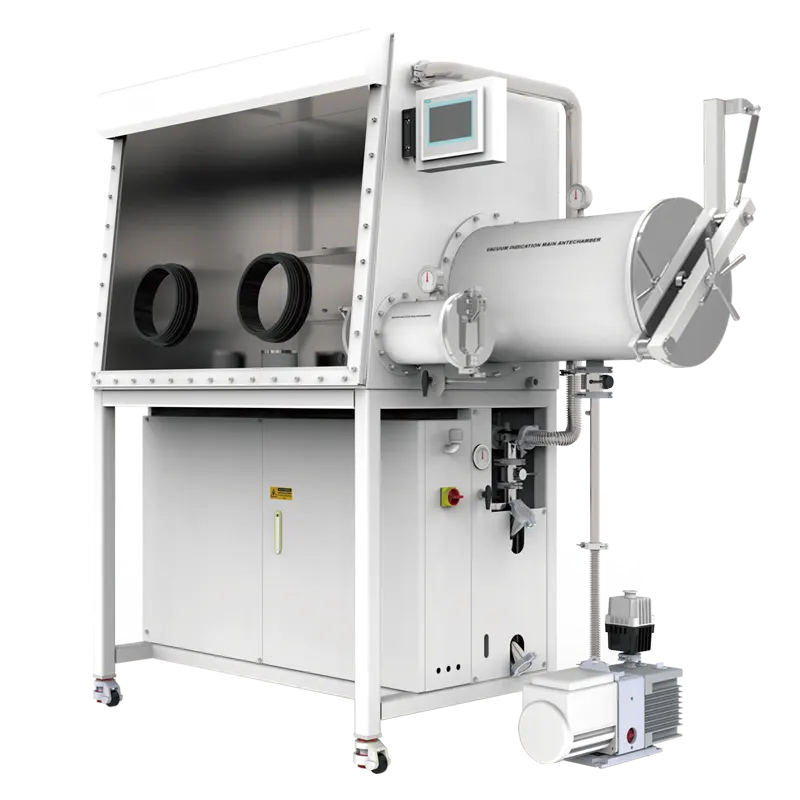
Points to confirm with TENCAN for a powder application include the interior dimensions and the usable depth in front of the viewing panel, the transfer chamber size and its vacuum capability, the purification system's working principle and regeneration procedure, the sensor types supplied, the internal storage provision, and the recommended procedure for introducing powder containers without carrying ambient moisture into the loop. Each of these is a question about the specific build, and each should be answered in writing for the configuration being quoted.
Organic solvent vapor adsorption system
Where the powder process involves solvent — washing a catalyst, cleaning a crucible, degassing a slurry before drying — the vapour load becomes part of the atmosphere problem. TENCAN lists an organic solvent vapor adsorption system as an accessory for this situation. Its role is to address solvent vapour inside the box environment, which is a different function from moisture and oxygen removal and does not replace the purification loop.
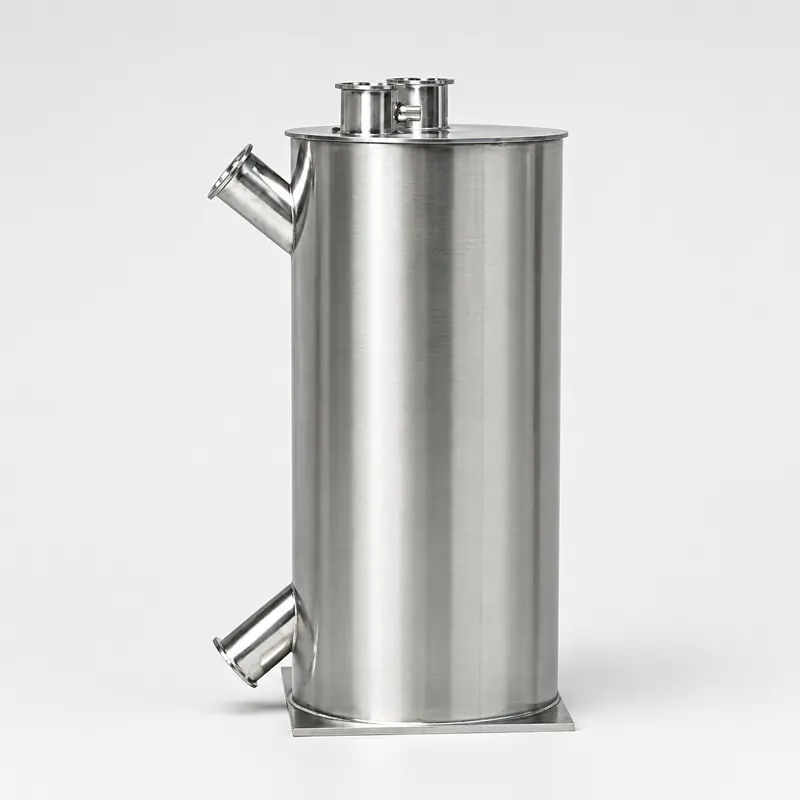
Because solvent handling inside a closed loop carries real safety and performance implications, the accessory should be specified together with the process: which solvents, how much per session, whether they are used inside the box or only for exterior cleaning, and how the adsorption medium is exchanged and disposed of. Compatibility between a specific accessory and a specific box build should be confirmed with TENCAN rather than assumed from a catalogue listing.
Comparing documented strengths on the same evidence standard
The table below sets out the criteria from the previous section against TENCAN's documented scope and against the equivalent evidence a buyer should obtain from any international supplier. The right-hand column is deliberately a list of requests rather than a set of claims: verified public specifications for the alternative systems were not part of the documentation reviewed for this guide, and a comparison that fills that column with unverified figures would be worthless to a procurement decision.
| Criterion | TENCAN reference configuration | Equivalent evidence to request from any alternative supplier |
|---|---|---|
| Atmosphere control architecture | Enclosure and gas purification system supplied as one integrated package; confirm circulation principle, regeneration procedure and sensor set | Whether the purification unit is integrated or separate, how regeneration is performed, and which sensors are included |
| Transfer of powder containers | Transfer chamber on a single-station single-sided box; confirm chamber volume, vacuum capability and cycle procedure | Chamber dimensions, pressure rating, cycle sequence, and suitability for the actual containers used |
| Working pressure and leak integrity | Confirm operating pressure range, control method and pre-shipment leak test | Same three items, with acceptance criteria stated in writing |
| Moisture and oxygen measurement | Confirm sensor type, range, calibration and replacement interval for the quoted build | Same, plus the conditions under which any stated atmosphere figure is expected |
| Solvent vapour load | Dedicated organic solvent vapour adsorption system listed as an accessory; confirm compatibility with the chosen box and solvents | Whether a solvent control option exists, what medium it uses, and how it is serviced |
| Footprint, utilities and documentation | Confirm dimensions, power and gas requirements, manual, spare parts and commissioning support | Same, plus service response arrangements in the buyer's region |
Read the table as a template rather than a scorecard. Each row can be closed out only with the supplier's written answer for the specific build being quoted, and the answers should be compared side by side before a shortlist is reduced.
Application notes for common air-sensitive powder programmes
Battery materials and solid electrolytes
Sulfide and oxide solid electrolyte powders, lithium metal foils and anode blends are the classic justification for a purification box. The dominant requirements are consistent moisture and oxygen control during weighing and pellet pressing, a transfer path that does not admit ambient air on containers, and enough internal space for a press die or a small cell-assembly jig. The atmosphere requirement should be written down as a process specification with tolerances, not as a single target figure.
Perovskite and halide precursor handling
Perovskite precursors are sensitive to moisture and, in some cases, to each other. Weighing small quantities accurately inside the box, sealing them immediately, and avoiding cross-contamination between precursor vials are the practical priorities. A compact single-operator box supports this workflow well, provided the interior is easy to wipe down between materials and the balance can be read through the panel.
Catalysts and reduced or pyrophoric powders
Reduced catalysts and fine metal powders can react rapidly on air exposure, and some are pyrophoric. In these cases the equipment choice must be governed by a documented hazard assessment, not by an atmosphere specification alone. A nitrogen-filled or argon-filled box is an inert-atmosphere measure; it is not a certified explosion-protection system, and it is not a biological safety enclosure. Solvent use, powder fineness and static discharge all need to be addressed in the procedure, with the supplier asked directly which configurations are suitable and which are not.
Advanced materials and mixed research programmes
Laboratories that move between powder types — a nitride this month, a halide the next — need a box that can be cleaned thoroughly and whose atmosphere can be recovered predictably between campaigns. In that setting, the serviceability of the purification unit and the availability of consumables matter as much as the initial atmosphere performance. A standalone gas purification system elsewhere in the TENCAN range is the relevant category when an existing enclosure needs atmosphere support, but it should not be treated as a complete glove box in its own right.
Procurement checklist before the purchase order
- Written process description: powder type, quantity per session, number of sessions per week, and the moisture or oxygen sensitivity that drives the requirement.
- Inventory of everything that must enter the box, with dimensions and weights, including the largest tool and the balance.
- Solvent list, with quantities and the point in the procedure at which solvent is present inside the box.
- Required internal storage volume and the number of containers held inside the box between sessions.
- Stated transfer chamber volume, vacuum capability and cycle procedure, quoted separately from the box working pressure.
- Sensor types, ranges, calibration arrangements and replacement intervals, in writing.
- Leak-test method and acceptance criterion, and the commissioning procedure at the buyer's site.
- Purification medium consumption, regeneration frequency, spare parts and disposal arrangements.
- Utility requirements: power, gas supply and purity, vacuum, heat load and floor loading.
- Documentation package, operator training and the named contact for technical questions.
- Hazard review for the specific powders, including pyrophoric and electrostatic risks, signed off before operation.
A practical next step
The most efficient way to close a glove box specification for powder work is to test it against real material. Send TENCAN a sample of the powder, the target indicators that define success for the process, the container sizes that must pass through the transfer chamber, and a description of any solvent step. That information allows a configuration to be proposed on the basis of the actual workflow — including whether the organic solvent vapour adsorption option is relevant — and gives the buyer a documented basis for comparing an alternative supplier's proposal on identical terms.
Sources and further reading
The product information in this guide is taken from TENCAN's published product pages: the Single-Station Single-Sided Glove Box with Gas Purification System and the Organic Solvent Vapor Adsorption System. No verified public specifications for competing international systems were included in the material reviewed, so this article compares selection criteria and evidence requirements rather than attributing performance figures to any supplier.