
Air-Sensitive Powder Work Is an Atmosphere Problem and a Handling Problem
Air-sensitive powders rarely fail in the reactor. They fail at the balance. A hygroscopic lithium salt weighed in a dry room, a sulfide solid electrolyte scraped out of a milling jar, a perovskite precursor transferred from a vial to a crucible: each step exposes a high-surface-area solid to moisture and oxygen for the minute or two a container stays open, and each is repeated dozens of times a week. The enclosure around those steps should therefore be specified around the powder operation rather than picked from a catalogue page.
That distinction changes what a good box looks like. An enclosure sized for wafer handling is usually specified around particle cleanliness and a single operator's reach. A box sized for powders is specified around how many gloved hands must be inside at once, how vials, spatulas, balance pans and waste containers enter and leave, how static-charged dust is cleaned off panels and gloves, and whether the atmosphere recovers after a lid is opened for a weighing that took longer than planned. The four specifications most often blended into one vague sentence — working pressure, antechamber vacuum, moisture level and oxygen level — need to be written as four separate requirements, because they are delivered by four different parts of the system.
This shortlist covers five options for that kind of work. It is a sourcing guide, not a ranking: no scores, no laboratory testing of our own, and no claim that any single configuration suits every powder. Where a detail is not publicly documented, it appears as a question to put to the supplier.
How the Shortlist Was Screened
Two rules shaped the list. First, only suppliers that publish glove box platforms as their own product line were considered; resellers that relabel third-party boxes were excluded, because traceability of the atmosphere specification matters more than the badge on the frame. Second, every candidate had to address powder handling as a workflow — entry and exit of containers, two-handed manipulation, and a stated position on purification — rather than offering a sealed box with no atmosphere strategy at all. Within those rules, the criteria below were applied to each candidate in the same order.
- Atmosphere strategy. A purifier-equipped box, a purge-only box and an un-purified acrylic box solve different problems. The first can hold a recirculating low-oxygen atmosphere under load; the second displaces air once; the third mainly separates operator and sample. Match the strategy to the powder before comparing anything else.
- Access and layout. Count the glove ports, note which faces they sit on, and decide how many operators must work simultaneously. For weighing, the balance position relative to the port and the operator's shoulder height decides whether a five-minute task becomes a twenty-minute one.
- Transfer path. Container size sets the antechamber dimensions; the number of transfers per day sets whether one antechamber is enough or a second, smaller pass-box is worth having.
- Vacuum and pressure, stated separately. Antechamber vacuum capability, box working pressure and purifier performance are three different numbers with three different test conditions. Ask for each one on its own.
- Powder-specific handling. Static, fine dust on viewing panels, cleaning access and the route for waste powder all matter. A box that cannot be cleaned quickly will be kept slightly dirty.
- Solvent and material compatibility. If solvents enter the box, the purification strategy and the sealing materials change. Panel material, glove elastomer and the wetted parts of the antechamber all need checking against the solvents in use.
- Documentation and acceptance. A leak test, an atmosphere commissioning record and a drawing set are what you will rely on years later. Ask what is delivered with the box, not only what is promised during the sale.
Evidence level differs by candidate and is stated openly. The TENCAN entries below are drawn from TENCAN's own product pages, which document the model designation, the physical layout and the purification function named in the product. The four international brands are described at platform level — the kind of glove box line each publishes and the questions their documentation should answer — and every specification must be confirmed against the supplier's current official documentation before an order is placed. No third-party test data, ratings or awards are claimed for any candidate, and nothing here should be read as a market ranking.
1. TENCAN — Four-Station Double-Sided Split-Type Glove Box with Gas Purification System
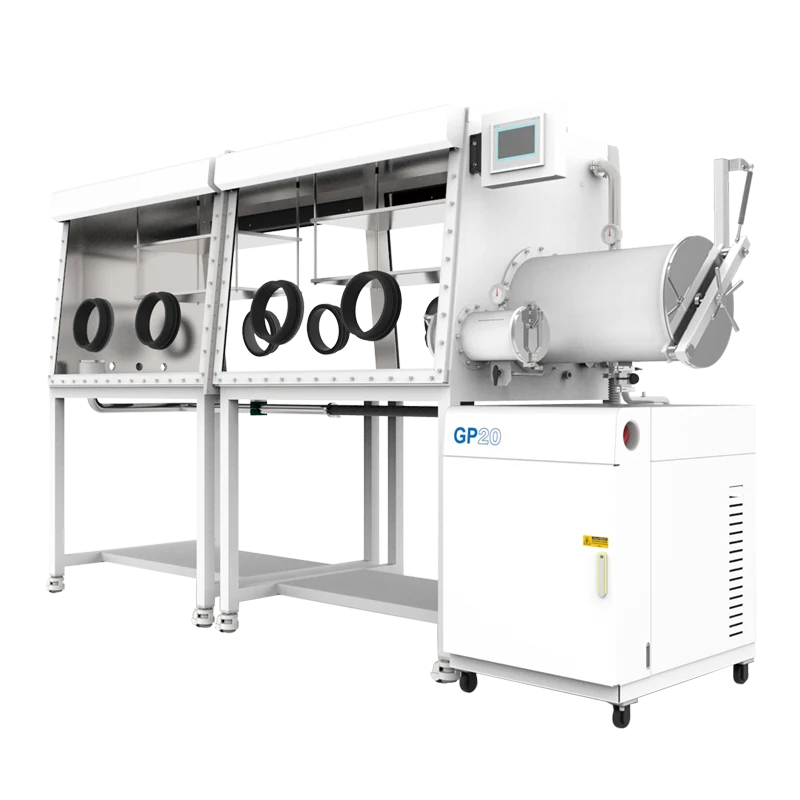
TENCAN's entry is a specific named configuration rather than a generic enclosure: the Four-Station Double-Sided Split-Type Glove Box with Gas Purification System. Four attributes in that name map directly onto powder work — four stations, double-sided access, an integrated purification system, and a split-type build — and each one answers a question that a powder laboratory asks sooner or later.
Selection focus
The configuration is aimed at the workflow where two people share one atmosphere. In a typical powder laboratory one operator weighs and subdivides material while a second seals vials, crimps cells, prepares crucibles or cleans tools. If both have to take turns at a two-port box, the box becomes the bottleneck and shortcuts appear — lids left ajar, samples parked outside, transfers batched into a single rushed session. Four stations, distributed over two working faces, are the structural answer to that bottleneck, and they are the reason this model heads the list for multi-user powder rooms rather than single-operator benchtop work.
Documented configuration
Four stations. Four glove ports let two operators work at the same time and let one operator switch between weighing, sealing and cleaning without waiting for a port to free up. The model designation documents the port count; the port diameter, glove size and cuff type, and whether the ports are split evenly across both faces, should still be read off the dimension drawing before the bench is built, because reach and shoulder position determine real working comfort more than any catalogue figure.
Double-sided access. Because the box is worked from both long faces, one side can carry the analytical balance and the spatula station while the other side carries sealing, storage and waste handling. That separation keeps powder dust away from crimping tools and reduces the number of times a container crosses the full width of the box. It also means the box depth and the bench height must be checked against the height of the operators who will actually use it; a double-sided box that is comfortable for one person can be a stretch for another.
Gas purification system. The integrated purification system is what separates this model from a purge box. A purifier continuously circulates the box atmosphere through a column that removes moisture and oxygen, so the atmosphere can recover after a transfer instead of being consumed once. The achieved levels depend on column capacity, the leak-tightness of the box, the water and oxygen load introduced with each sample, and how often the antechamber is cycled — so the number that belongs in a purchase order is a guaranteed figure at defined conditions, together with the measurement method and the test points. Purification is also not filtration: removing moisture and oxygen does nothing for airborne powder, and particle filtration does nothing for moisture. If fine dusty powders are handled, specify the two functions separately.
Split-type construction. The split-type build describes a box assembled in sections, which matters when a large double-sided unit has to pass through a standard laboratory door, a corridor corner or a goods lift. The practical questions are the section count, the joint and seal design, who performs site assembly, and whether a leak test is repeated after assembly on site. Those answers belong in the quotation and in the acceptance protocol.
Transfer details and accessory: the KF Vacuum Clamp
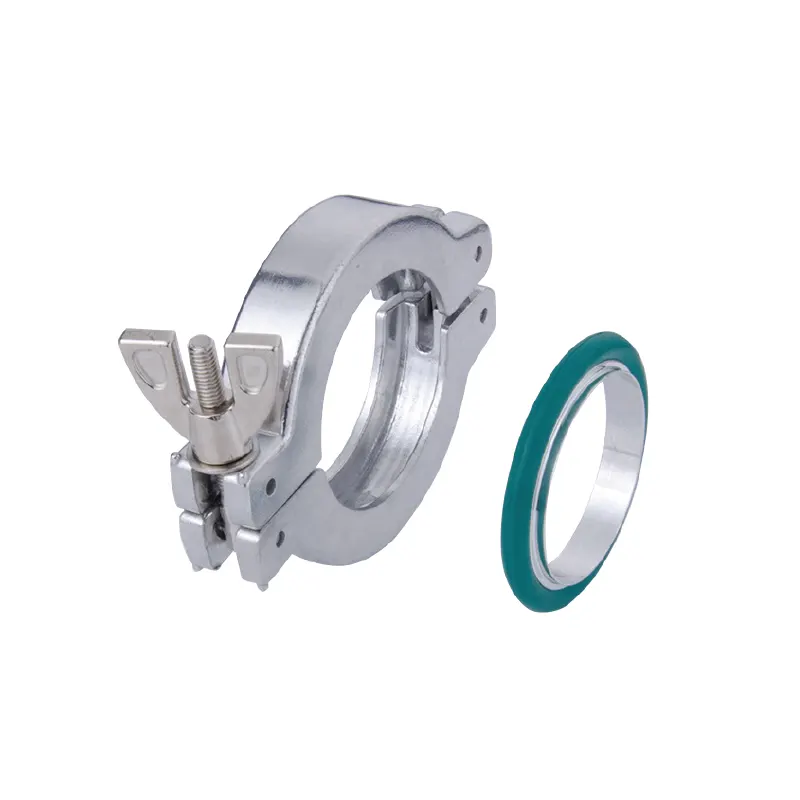
Powder work lives or dies on the transfer path. In this configuration the antechamber is the main route in and out, and its vacuum capability is a separate specification from the box's working pressure and from the purifier's moisture and oxygen figures; ask for all three individually. Vacuum-side connections — pump lines, gauge ports, a small vacuum oven or a flask connection — are typically made with KF-flanged components, and TENCAN lists a KF Vacuum Clamp among its glove box accessories for exactly that purpose. The clamp holds a flanged joint closed around a centering ring; the correct nominal KF size, the clamp material and the seal elastomer all have to match the flange on your box or pump line, and the seal must be checked against any solvent vapour that passes through that line. A clamp is a connection component: it does not change the vacuum specification of the box, and it should not be selected independently of it.
Workflow fit and boundaries
The natural fit is a two-operator powder room handling moisture- and oxygen-sensitive solids at moderate throughput: material enters through the antechamber, is weighed and subdivided on one face, is sealed or packed on the other, and leaves as a closed container. Solvent use, pyrophoric solids, toxic dusts and nanoscale powders each add requirements that a standard inert box does not automatically satisfy — solvent adsorption capacity, local exhaust, additional containment and a site risk assessment all sit outside the atmosphere specification and must be raised explicitly. An inert atmosphere is also not a biosafety certification and not an explosion-protection measure. The full product page for this model is the four-station double-sided split-type purification glove box; use its drawings as the starting point for a site check rather than as a substitute for one.
2. MBRAUN (Germany)
Selection focus
A long-established German supplier of inert-atmosphere glove box systems, relevant when the project needs a purification platform with a documented process-integration path rather than a standard enclosure.
Platform strengths to verify
The company publishes inert-atmosphere box platforms combined with purification units and solvent-adsorption options, and its products are widely used in battery, OLED and semiconductor research where both moisture and solvent load have to be managed. Published material also covers box-to-process integration, such as connecting analytical or coating equipment to the antechamber side. Current model ranges, guaranteed atmosphere figures and the regional service structure should be taken from the supplier's own current documentation and confirmed in writing for your site.
Workflow fit
A reasonable shortlist candidate when purification and solvent handling must be designed together, and when the box will later be connected to other equipment. Ask for the acceptance test protocol and for the response you can expect locally, not only at the factory.
3. Jacomex (France)
Selection focus
A French manufacturer whose product range spans inert-atmosphere glove boxes and containment isolators, useful when a project sits between materials research and controlled containment.
Platform strengths to verify
Jacomex publishes glove box and isolator families in stainless steel and other constructions, with configurations developed for sectors that demand documented containment as well as controlled atmosphere. That background is relevant for laboratories that handle sensitive powders alongside small quantities of hazardous material. Material of construction, containment classification and purification performance are project-specific; verify each against current official documentation.
Workflow fit
Worth considering where a single supplier is expected to cover both atmosphere control and operator protection, and where a custom isolator layout is more likely than a catalogue box.
4. Vigor (USA)
Selection focus
A US supplier of inert-atmosphere glove boxes built around purification, antechamber and custom-layout options, relevant for laboratories that expect to modify the box after the first year.
Platform strengths to verify
Vigor publishes glove box lines with integrated purification, vacuum antechambers and a strong emphasis on custom configuration, which suits research groups whose process changes faster than their capital budget. Leak testing and atmosphere commissioning procedures are the documents to request first; confirm the actual protocol, the guaranteed moisture and oxygen levels at stated conditions, and lead time for your specific layout.
Workflow fit
Appropriate for single-site research builds where the box is expected to grow — an extra port, a second antechamber, a vacuum oven connection — rather than for a fixed, repeat-order production cell.
5. Terra Universal (USA)
Selection focus
A US manufacturer with a broad catalogue of modular glove boxes in acrylic, polycarbonate and stainless steel, most relevant when the requirement is containment or dry-air purge rather than continuous purification.
Platform strengths to verify
The catalogue approach shortens specification: standard sizes, standard port layouts and vacuum antechamber options are published with dimensions, which is helpful for a first powder project or for a secondary box used for weighing non-critical material. Note the tier difference honestly — a purge box or an acrylic containment box is not a continuous purification system, and it should not be compared with one on atmosphere performance. Confirm whether purification is included in the specific model under consideration and what atmosphere it is actually rated to hold.
Workflow fit
Suited to dust containment and short-exposure handling, or as a dedicated box for a single non-hygroscopic powder, freeing the purified box for the genuinely air-sensitive work.
Comparative Overview
The table compares candidates at the same level — a complete glove box platform, not accessories or single components — using only documented or platform-level descriptions, with qualitative rather than invented figures.
| Brand or product | Documented strengths | Relevant application | Configuration to confirm |
|---|---|---|---|
| TENCAN — Four-Station Double-Sided Split-Type Glove Box with Gas Purification System | Four-station, double-sided layout with integrated purification named in the product; sectional build for site access; KF vacuum clamp listed as an accessory for vacuum-side joints | Two-operator powder weighing, subdividing and sealing in one atmosphere | Guaranteed moisture and oxygen figures with test method; port and glove dimensions; section joints and post-assembly leak test; solvent-adsorption option |
| MBRAUN (Germany) | Inert-atmosphere platform with purification and solvent-adsorption options; process integration described | Battery, OLED and semiconductor research with solvent load | Which platform and purifier combination; regional service coverage; acceptance protocol |
| Jacomex (France) | Glove box and isolator engineering, including containment-oriented builds | Work that combines inert atmosphere with containment requirements | Material of construction; containment classification; purification specification |
| Vigor (USA) | Inert-atmosphere boxes with purification, antechamber and custom-layout options | Custom research builds expected to be modified later | Leak-test protocol; purifier capacity; lead time for the custom layout |
| Terra Universal (USA) | Catalogue modular boxes in acrylic, polycarbonate and stainless steel; purge and vacuum antechamber options | Dust containment or dry-air purge where continuous purification is not required | Whether purification is included; atmosphere actually rated; port layout and dimensions |
Matching an Option to the Powder Workflow
Three powder workflows recur in materials laboratories, and each shifts the weight of the criteria above.
Sulfide solid electrolytes and other moisture-sensitive salts
Weighing, grinding and pellet pressing are all short operations repeated often, so recovery time between transfers matters more than peak atmosphere quality. A purifier-equipped, multi-station box is the better fit; a purge box will be fighting the transfer schedule by the second week. Moisture-sensitive sulfides can also release hazardous gas on exposure to humid air, which is a ventilation and risk-assessment matter for the room, not something the box specification alone resolves.
Perovskite precursors and hygroscopic halides
Small quantities, tight weighing tolerances and frequent opening of small vials. Here the balance position, the anti-vibration arrangement and the ability to keep a second operator sealing vials are the deciding factors, together with static control on gloves and panels. Confirm how the box is cleaned between campaigns, because halide dust carried over from one batch to the next is a chemical problem rather than an atmosphere one.
Catalysis and air-sensitive organometallics
Pyrophoric or highly reactive solids demand explicit risk assessment, suitable tooling and a clear rule about quantities inside the box. An inert atmosphere reduces exposure to moisture and oxygen; it does not make a pyrophoric solid safe and should never be described as explosion protection. Small, well-documented boxes with a short transfer path are usually preferable to large ones for this work.
Procurement Checklist Before Requesting a Quote
Suppliers can only confirm a configuration against a defined duty. Prepare the following before the first technical discussion, and expect the answers to change the model rather than only the price.
- Sample definition: chemistry, particle size range, hygroscopicity or pyrophoricity, toxicity, and whether solvents are present.
- Target atmosphere: the moisture and oxygen levels you actually need during work, at what load, measured by which method and at which test point.
- Throughput: transfers per day, number of operators, and the longest single task performed inside the box.
- Container and tool sizes: largest item through the antechamber, balance footprint, vial and crucible sizes, waste container.
- Vacuum requirement: the antechamber vacuum level needed for your powders, and any vacuum-side connections with their KF flange sizes.
- Site conditions: door width and route, floor loading, available power, gas supply purity, room ventilation and humidity.
- Documentation and spares: leak test and commissioning records, drawing set, glove and seal part numbers, and lead time for consumables.
A restrained next step: send TENCAN a representative sample description, the target moisture and oxygen figures, and your daily transfer count, and ask for a configuration proposal that states the guaranteed atmosphere values, the antechamber vacuum specification and the working pressure as three separate items. That single document will tell you more than any brochure comparison.
Sources and Further Reading
TENCAN product pages used for the configuration details in this article: Four-Station Double-Sided Split-Type Glove Box with Gas Purification System; KF Vacuum Clamp. For the international candidates, refer to the current official product documentation published by MBRAUN, Jacomex, Vigor and Terra Universal before specifying; no third-party reviews or test reports were used, and platform descriptions in this guide are limited to the type of equipment each supplier publishes.
