
A glove box is often judged by its purifier, antechamber, and oxygen analyzer. The gloves are treated as a consumable and discussed last. That order is misleading. Every time an operator reaches into the box, the glove is the only flexible polymer between the controlled atmosphere and the room. It must seal at the port, flex without cracking, resist the chemistry inside, and avoid becoming a source of contamination. A glove that permeates moisture, fits poorly, or degrades in solvent can undermine the atmosphere that the purifier is trying to hold.
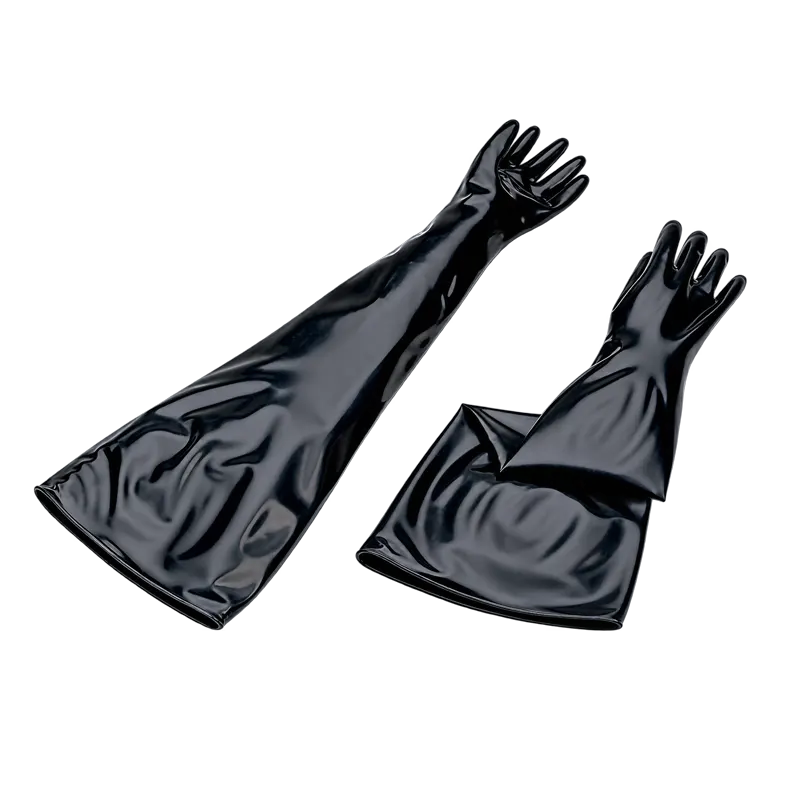
Butyl rubber is one material chosen for this boundary. It is generally associated with low gas permeability and useful resistance to many polar chemicals, which makes it a plausible candidate for glove boxes used in moisture- and oxygen-sensitive work. 'Plausible' is the correct word: a material name alone does not establish compatibility with a specific box, port, solvent, vacuum duty, or operator. The current TENCAN product entry identifies Glove Box Butyl Rubber Gloves as an accessory. It does not turn every butyl glove into a universal replacement, and it should not be read as a promise of identical performance in every atmosphere or chemical environment.
Why the glove belongs in the atmosphere-control discussion
Atmosphere control is usually described as a balance between gas supply, circulation, purification, and leakage. The glove is part of the leakage and permeation path, but it is also a moving mechanical component. It is stretched, compressed, folded, and pulled through the port hundreds of times. The cuff is compressed against an O-ring or clamping ring. The palm and fingers are exposed to the box atmosphere on one side and room air on the other. The result is not a static barrier; it is a flexible seal that changes shape with every task.
Three transport paths that are often confused
When oxygen or moisture rises, operators often say the glove 'leaks.' That word can hide three different mechanisms. A leak is a localized flow through a hole, crack, poor cuff seal, or damaged port surface. Permeation is molecular diffusion through the intact polymer. Outgassing or desorption is material released from the glove surface, talc, packaging, or cleaning residue. The first is a defect, the second is a material property, and the third is a contamination source. They require different tests and different corrective actions.
| Path | What is happening | Useful check |
|---|---|---|
| Leak | Localized flow through a pinhole, crack, damaged cuff, or poorly seated port seal | Inspect the glove and port; use the box manufacturer's leak-check procedure |
| Permeation | Gas or vapor diffuses through the intact glove material | Compare material, thickness, exposed area, and service conditions with supplier data |
| Outgassing | Volatiles or particles are released from the glove, coating, or packaging | Check cleaning, packaging, and pre-use conditioning; isolate new gloves as a variable |
A small pinhole can admit room air continuously, while a clean butyl glove may admit a much smaller amount by permeation. Conversely, a glove with excellent barrier properties can still fail at the cuff if the bead is the wrong size. Treating all three as 'bad gloves' leads to unnecessary replacement or, worse, repeated replacement of a good glove while the port seal remains the real problem.
Why butyl rubber is selected
Butyl rubber is a copolymer of isobutylene with a small amount of isoprene. Its polymer structure is relatively dense and nonpolar, which is why it is generally valued for low gas and vapor transmission and for resistance to many polar media. In a glove box, those general properties can be useful when the main concern is keeping moisture and oxygen from diffusing through the glove wall, or when the glove will contact aqueous or polar chemistry. The same structure is not a universal shield. Nonpolar solvents, some halogenated compounds, fuels, and certain oils can swell or soften butyl rubber, and compatibility depends on concentration, temperature, contact time, and the specific compound.
Material family is therefore a starting point, not a specification. A supplier may offer several butyl compounds with different fillers, curatives, and processing. Two gloves that both say 'butyl' can behave differently in permeation, flexibility, extractables, and solvent resistance. For a regulated or high-value process, ask for the exact compound or at least the compatibility data and quality controls behind the finished glove.
Moisture, oxygen, and solvent vapor: what a butyl glove can and cannot do
Permeation is a rate, not a yes-or-no property
Permeation depends on the difference in partial pressure across the glove, the solubility of the gas or vapor in the polymer, the diffusion coefficient, the exposed area, the thickness, and time. A thicker glove reduces transmission for a given material, but it also reduces dexterity and increases hand fatigue. That trade-off matters because a tired operator may grip tools harder, abrade the glove, or skip a proper transfer. Thickness is therefore not a free upgrade; it must be balanced against the task and the port geometry.
Temperature changes the rate as well. A warm glove generally permeates faster than a cool one, and a solvent that is benign at room temperature may soften the polymer in a heated process. The exposed area is also larger than the palm alone: the entire glove surface inside the box, including folds and the cuff, participates. This is why a glove that performs acceptably in a small single-port box may not be adequate in a large multi-port box with frequent handling, even if the material is the same.
Chemical compatibility has two directions
Compatibility is often reduced to 'Will the glove survive the solvent?' The more complete question runs in both directions. The chemical can change the glove through swelling, softening, hardening, cracking, or extraction of compounding ingredients. The glove can also change the process by releasing plasticizers, processing aids, particles, or absorbed contaminants into the box. A glove that remains physically intact can still add enough volatile material to disturb a sensitive experiment or load a solvent trap.
Butyl rubber's general resistance to many polar chemicals does not extend automatically to every solvent. Before adopting a glove for a process, request compatibility information for the exact chemicals, concentrations, and temperatures involved. If the supplier cannot provide it, run a controlled evaluation with representative coupons or gloves, using appropriate laboratory safeguards and the box manufacturer's procedures. Do not infer compatibility from a generic material chart alone, and do not use a glove after it has become tacky, swollen, stiff, discolored, or damaged.
Fit, port geometry, and the cuff seal
A glove can have excellent barrier properties and still be the wrong accessory. The port is a mechanical interface. The glove cuff must sit correctly on the port, the bead or flange must engage the retaining ring, and the O-ring or gasket must compress evenly. If the cuff is too loose, the glove can pull off or wrinkle under the ring. If it is too tight, installation may stretch or tear the cuff. If the glove is too short, the operator cannot reach the working area without overextending the shoulder and wrist; if it is too long, folds can trap powder, solvent, or particles and make cleaning difficult.
What to measure before ordering
Collect the port's internal and external diameter, the groove or bead dimensions, the retaining method, and the required glove length. Confirm whether the glove is intended for a bare port, a clamping ring, an O-ring seal, or a proprietary cuff. Check the available hand sizes and the thickness offered for that size. The best glove is not necessarily the thickest or the largest; it is the one that fits the operator's hand, reaches the work area without strain, and seals reliably with the existing hardware.
Operator fit deserves more attention than it usually receives. A glove that is too small increases force at the seams and cuff; one that is too large reduces tactility and can cause the operator to pinch the material. In a multi-user laboratory, one size may not serve everyone. Keep a small stock of the sizes actually needed and record which glove was installed on which port. That record helps distinguish a material problem from a handling problem when atmosphere readings change.
The cuff is a seal, not a decoration
Most atmosphere upsets attributed to 'bad gloves' begin at the cuff. Powder, lint, or dried solvent on the sealing surface can create a channel. A twisted glove can pull unevenly against the port. A retaining ring that is not seated can allow a slow leak that is invisible during a quick visual check. Replace gloves according to the manufacturer's instructions, inspect the port and seal, and confirm the glove is seated before closing the box. If the box uses a vacuum cycle, verify that the glove and support arrangement are approved for that pressure direction; a glove that is acceptable for a gently purged box is not automatically acceptable for vacuum service.
When the atmosphere recovers slowly: glove-related and non-glove causes
Operators often judge a glove by the oxygen or moisture display. A rise during a transfer is not automatically a glove failure. Reaching in and out displaces volume, moves the internal atmosphere, and can expose surfaces that were previously covered. An antechamber cycle introduces a pressure change and a new load. A sensor may respond more slowly than the atmosphere because of its location, flow path, or maintenance state. These effects can look like a leak if the operator watches only the final number and not the trend.
Slow recovery after a glove change can have several contributors: a new glove releasing volatiles, a cuff that is not seated, a damaged O-ring, a purifier that is loaded, a leak elsewhere in the box, or a sensor that needs calibration. The useful approach is to isolate variables. Confirm the port seal with the manufacturer's leak-check method. Compare the trend with a known-good glove if one is available. Check whether the rise began after a solvent task, a new package of gloves, or a change in transfer frequency. Do not conclude that the glove material is at fault until the seal and the rest of the system have been checked.
A diagnostic table for observations
| Observation | Plausible contributors | What to verify |
|---|---|---|
| Immediate rise when reaching in | Volume displacement, cuff movement, pinhole, or port-seal disturbance | Glove condition, cuff seating, port surface, and leak-check result |
| Gradual drift with no activity | Permeation, background leak, outgassing, or purification load | Material and thickness, seal integrity, new consumables, and purifier status |
| Rise after solvent use | Swelling or degradation, solvent vapor, contaminated seal | Chemical compatibility, glove appearance, cleaning method, and exposure time |
| Reading slow to fall after purge | Sensor response, dead volume, leak, or purifier condition | Sensor calibration and location, circulation path, and system leak rate |
The table is a starting point for investigation, not a diagnosis. A slow recovery can occur in a perfectly sealed box if the analyzer samples a dead zone or if the purification loop is not operating as expected. Likewise, a glove can be the source of a problem without being visibly damaged. The value of the table is that it separates the glove from the port, the purifier, the sensor, and the operator's transfer routine.
Vacuum, inert-gas, and purification contexts
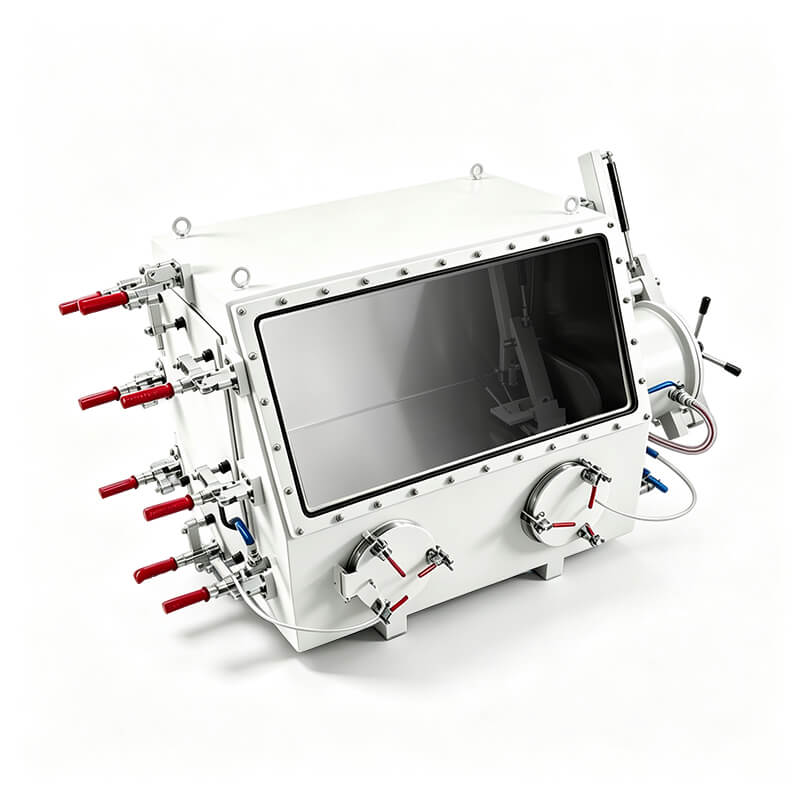
Glove selection must match the way the box establishes and holds its atmosphere. A continuously purified glove box uses circulation and a purification system to remove moisture and oxygen; the glove is part of the closed volume. A vacuum glove box uses a sealed chamber, evacuation, and inert-gas exchange; the glove may see a different pressure history. These are not the same duty, and a glove should not be moved from one context to the other without confirming the mechanical and permeation requirements. The GBV-2 stainless steel vacuum glove box is an example of a stainless steel vacuum glove box in the current TENCAN range; its page should be used to confirm the actual port and operating configuration rather than assuming that any butyl glove is compatible.
Do not confuse a glove with a purifier
A glove controls transmission and leakage; it does not remove oxygen or moisture from the gas stream, and it cannot replace a purification column, a vacuum cycle, or a gas-exchange procedure. Likewise, a solvent-adsorbing accessory does not substitute for water and oxygen removal, and a HEPA filter captures particles rather than dissolved water or oxygen. If the process requires low moisture and oxygen, the box needs an appropriate atmosphere-management strategy in addition to a suitable glove. The glove can reduce the load on that strategy, but it cannot define the specification by itself.
In a vacuum or pressure-cycled box, the glove may be pushed inward or outward. The mechanical consequence depends on the port design, the glove dimensions, the support, and the pressure difference. Follow the box manufacturer's instructions for evacuation, venting, and glove support. Do not test a glove's limits by applying an arbitrary vacuum or pressure, and do not assume that a glove sold for a purged box is rated for a full vacuum cycle.
A practical selection checklist for butyl rubber gloves
The TENCAN Glove Box Butyl Rubber Gloves listing identifies a butyl rubber glove option for glove box use. Because the product title alone does not establish thickness, length, cuff dimensions, compound, or ratings, a buyer should confirm those attributes against the intended box. The following checklist is a way to organize that conversation.
| Item | Why it matters | What to ask for |
|---|---|---|
| Port interface | Determines whether the cuff seals without distortion | Port drawing, bead or groove dimensions, and retaining method |
| Glove length and size | Affects reach, dexterity, fatigue, and fold formation | Size chart, length options, and recommended working range |
| Compound and thickness | Influences permeation, flexibility, and mechanical durability | Material designation, thickness, and available test data |
| Chemical compatibility | Prevents swelling, degradation, and extractable contamination | Compatibility information for the exact chemicals and conditions |
| Pressure or vacuum duty | Changes mechanical stress on the glove and cuff | Approved operating envelope and support requirements |
| Cleanliness | Affects particles, outgassing, and sensitive processes | Cleaning, packaging, and any relevant certification |
| Inspection and storage | Reduces the risk of using a damaged or aged glove | Inspection method, shelf life, and storage conditions |
Two further points are easy to miss. First, the glove is a wearable item, so the best specification is useless if the size is uncomfortable or the supply is inconsistent. Confirm that the same compound and dimensions will be available for replacement, not just for the first order. Second, record the installation date and the tasks performed. A glove exposed to a particular solvent should not be returned to general service merely because it looks clean; absorption and swelling can continue after the surface appears dry.
Supplier information should include the exact product designation, available sizes, construction, cuff style, and any recommended cleaning or inspection method. If the application involves a specific solvent, adhesive, powder, or elevated temperature, state it explicitly. A supplier cannot evaluate compatibility from the phrase 'general laboratory use.' Provide the box model or port drawing, the expected pressure or vacuum condition, the chemicals and contact duration, the required cleanliness level, and the frequency of glove changes. Those details turn a material name into a verifiable selection.
Configuration details to send with an inquiry
- Glove box model and port drawing, including seal type and retaining ring.
- Required glove size, length, thickness, and handedness if applicable.
- Process chemicals, concentrations, temperatures, and contact time.
- Whether the box is purged, continuously circulated, or vacuum-cycled, with pressure limits.
- Atmosphere targets and whether they are measured at the work zone or return line.
- Cleaning agents and change frequency.
- Any particle, extractable, or antistatic requirement that must be verified.
None of these details should be guessed from a photograph. A photograph can show the shape of a glove or the ports on a box, but it cannot confirm compound, thickness, or certification. Use images to orient the discussion, then rely on drawings and written specifications for the order.
The glove is a small part of the equipment budget and a large part of the atmosphere boundary. Start with the port and the process, then choose the polymer and the construction. A butyl glove can be a sound choice for the right duty, but the right duty must be demonstrated through dimensions, compatibility data, and a seal that works on the actual box. When those details are confirmed, the glove stops being a disposable afterthought and becomes a controlled part of the atmosphere-management plan.
