
An oxygen reading that climbs the moment a transfer chamber is opened, then takes far longer than usual to settle back, is one of the most frequently reported behaviors in multi-user glove box laboratories. It is also one of the most frequently misdiagnosed. The number on the display is the end of a chain that begins with air entering the box, passes through a circulation loop and a purification column, and only then reaches a sensor. Slow recovery can originate anywhere along that chain, and the correct response depends entirely on which link is responsible.
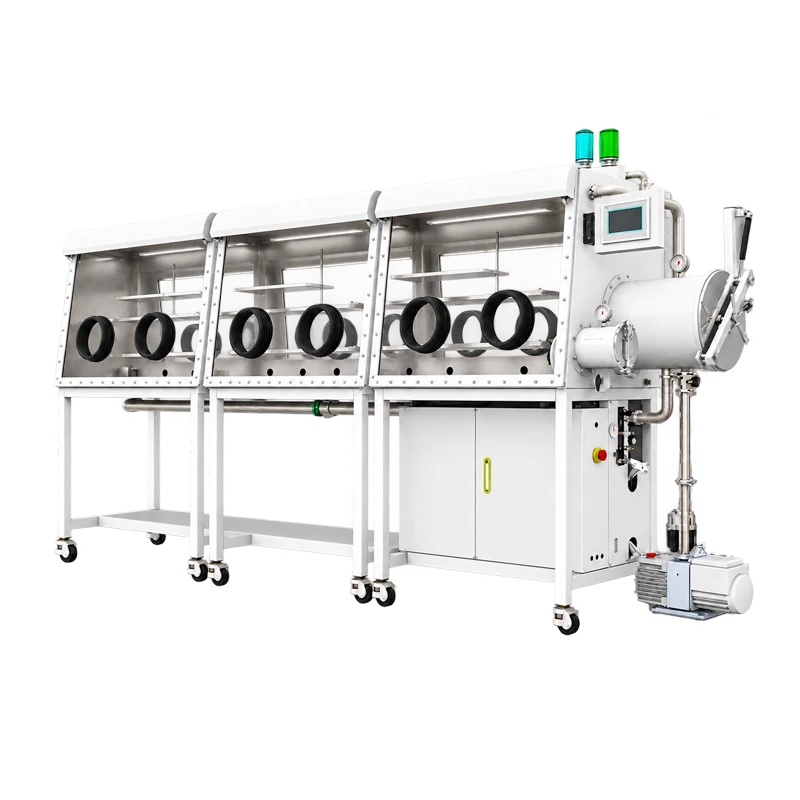
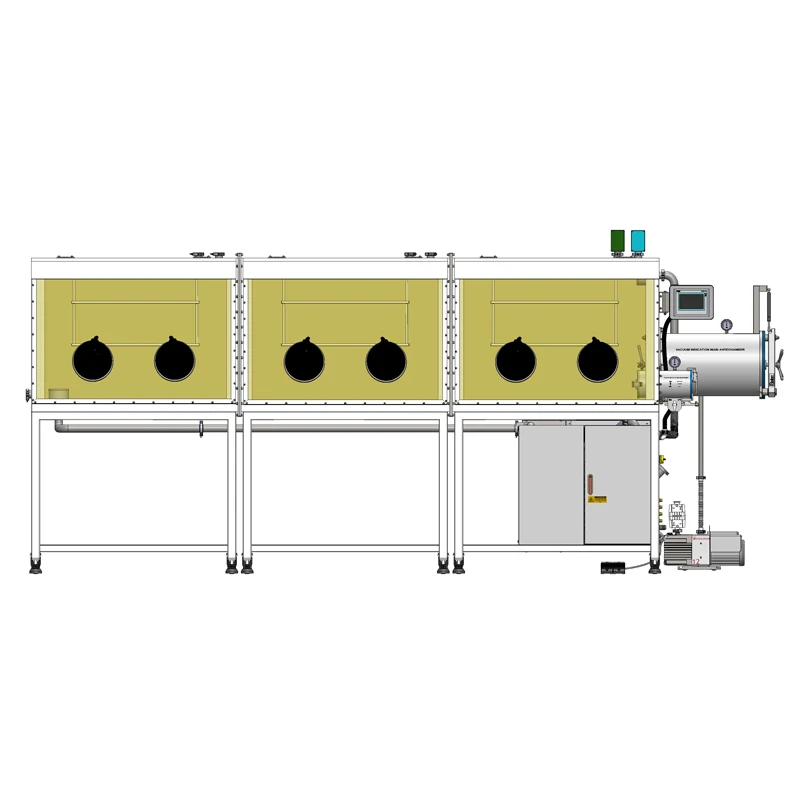
A six-station, double-sided, split-type glove box with an integrated gas purification system makes this question sharper than a single-user box does. Six working positions mean six opportunities for intrusion, two working faces mean two operators can act independently, and the split construction separates the purification cabinet from the box body so that the two can be placed where the laboratory needs them. Each of those choices affects how the atmosphere responds to a disturbance, and how quickly an analyzer can report that response.
Three Explanations, Only One of Which Is a Fault
Before any hardware is touched, it helps to separate three possibilities that look identical on a display.
The first is that more oxygen actually entered than the operator assumes. A transfer chamber that is cycled quickly, a port that stays open while both hands are inside, a glove with a pinhole, or a batch of porous samples carrying adsorbed air can all deliver a larger oxygen load than the previous transfer did. In that case the purification system is working correctly and simply has more to remove.
The second is that the removal rate has fallen. Circulation that has slowed, a column that is loaded or has not completed a proper regeneration, a partially closed valve, or a blocked flow path will all lengthen recovery without any visible change in procedure. This is a genuine performance issue, but it lives in the purification loop rather than in the box.
The third is that the displayed value lags the actual atmosphere. Sensors have their own response time, their own sample path, and their own calibration state. A reading that recovers slowly on the display may describe an atmosphere that recovered faster, or a sensor that is simply old, contaminated, or positioned in a stagnant corner of the box.
Distinguishing these three is the whole task. It is also the reason a diagnostic sequence matters more than a parts list.
What the Six-Station, Double-Sided, Split Layout Changes
Volume works as a buffer and as a liability
A larger internal volume dilutes a given quantity of intruded air more effectively, so a single transfer into a big box produces a smaller absolute rise in concentration than the same transfer into a small one. That is the buffer side. The liability side is that the same volume takes longer to sweep, because the loop must exchange the entire atmosphere several times before a locally elevated region is fully mixed and treated. Volume therefore improves the peak reading and worsens the tail. When an operator says the box used to recover in minutes and now takes much longer, the volume has not changed, which is a useful clue: something in the removal rate or the measurement chain has.
Two faces, six stations, and the statistics of intrusion
A double-sided box is usually chosen so that two people can work simultaneously without standing shoulder to shoulder, or so that one side can host a process while the other serves as a pass-through. Six stations mean more glove ports, more gloves, and more simultaneous activity. Every glove port is a sealed joint, every glove is a permeable membrane, and every open port is a direct connection between the controlled atmosphere and the room.
The practical consequence is statistical: with six stations in active use, the probability that at least one glove is slightly worn, one port seal is marginal, or one operator is working with an open port during a critical step rises sharply. A single-user box hides these faults. A shared box accumulates them. Slow recovery in a multi-station system is therefore often not one problem but a combination of small ones, each individually tolerable.
Why the split construction matters for diagnosis
In a split-type design, the purification cabinet and the box body are separate units connected by ducting or piping. This is an advantage for laboratory layout and for service access, but it introduces additional joints, additional length of flow path, and additional opportunities for a small leak or a pressure drop that was not present in a compact integrated unit. When recovery behavior changes without any change in operator procedure, the connections between cabinet and box belong on the inspection list alongside the box itself. The specific connection arrangement, duct routing, and service clearances should be confirmed against the actual product documentation rather than assumed from a photograph.
Purification Is a Closed Loop, Not a Filter in a Drawer
The purification system on a box of this type works by circulating the internal atmosphere continuously through a purification column, or set of columns, that removes moisture and oxygen. The treated gas returns to the box, mixes, and passes through the column again. This is a closed circuit: nothing is vented to the room in normal operation and no fresh gas is consumed except during make-up and regeneration. Because it is a loop, its performance depends on three things that are independent of the chemistry inside the column: how fast the gas moves, how well it mixes, and how much capacity remains.
Circulation rate and mixing
A column can only treat the gas that reaches it. If circulation is slower than the rate at which oxygen enters, the concentration rises even though the column material is perfectly good. Likewise, if the return path creates a stagnant zone — behind a baffle, inside an antecamber that is not part of the main circuit, in the lee of a large fixture — locally high readings can persist long after the bulk atmosphere has been cleaned. Mixing is a design property of the box, but it is also a usage property: the way samples, racks, and tools are arranged inside changes it.
Column capacity and regeneration state
Purification material has finite capacity and must be regenerated periodically. Regeneration is a distinct operating mode, not a continuation of normal purification: it involves heating the column and passing a regeneration gas through it, and the box atmosphere is normally isolated from the column during that time. A box that has just come out of regeneration, or that is due for one, will not behave like a box in steady purification. Regeneration parameters — gas composition, temperatures, durations, and the sequence of valve operations — must come from the documentation for the specific system. They should never be inferred from a general article, because the acceptable ranges differ between column designs and getting them wrong is both a performance risk and a safety risk.
What the purification system does not do
It does not remove particles. A HEPA element, if fitted, addresses particulate contamination and has no meaningful effect on water or oxygen levels. It does not remove solvent vapor, and a solvent trap does not substitute for water and oxygen removal. It does not sterilize, and it does not confer any cleanroom classification or biological containment rating. And it does not compensate for an open port: during an open transfer, the loop is removing oxygen at a fixed rate while the room is adding it at a rate set by the size of the opening. No purification capacity wins that contest.
The Analyzer Measures the Atmosphere; It Does Not Fix It
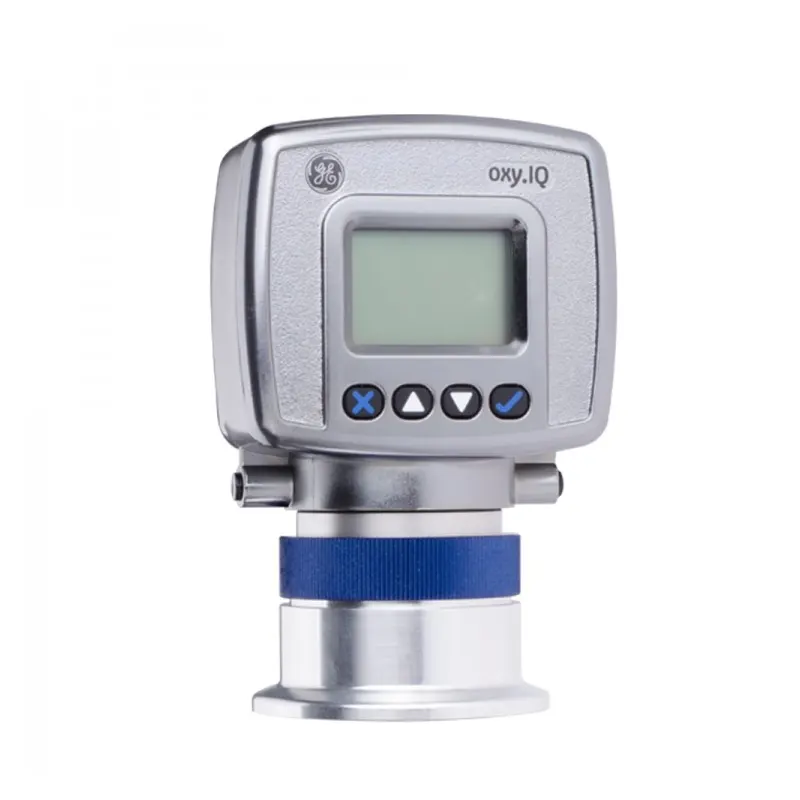
Oxygen in a controlled atmosphere is usually reported in parts per million or in percent, and the instrument that reports it is a separate subsystem with its own specifications. The glove box trace oxygen analyzer is an accessory in exactly this sense: it tells the operator what the atmosphere is doing. It does not remove oxygen, and fitting a better analyzer to a box with a saturated column will simply produce a more accurate description of a problem.
Resolution is not accuracy
These two numbers are frequently conflated in discussion and in procurement. Resolution is the smallest change the instrument can display; accuracy is how close the displayed value is to the true value. An analyzer that resolves to a very fine increment can still be wrong by a much larger margin if it is out of calibration or if its sample is contaminated. When recovery behavior is being judged, the calibration state and the calibration gas used matter more than the last digit on the display.
Sensor location changes the answer
Where the sensor samples from determines what it sees. A sensor sampling close to the circulation return reads the freshly purified gas and will look optimistic. A sensor in the working zone reads what the operator's hands are actually exposed to and will look pessimistic. Both can be correct and both can be useful, but the reported recovery time is only meaningful when the sampling point is known and has not changed. If a sensor was moved during maintenance, historical recovery times are no longer comparable.
Response time is part of the measurement
Sensors do not respond instantaneously, and the sample line adds its own delay. A slow recovery curve may be composed partly of real atmosphere change and partly of instrument lag. This is easy to check: a deliberate, brief, known disturbance — for example a short purge cycle on the antecamber with the analyzer watched throughout — will show how fast the instrument itself can move. If the display cannot follow a fast event, it cannot be used to time a slow one precisely.
A Practical Sequence for Slow Recovery
The order below moves from cheap and non-invasive to expensive and invasive. Following it prevents the common mistake of opening the box or replacing a column before the analyzer has been checked.
- Confirm the analyzer state. Check calibration date, calibration gas, zero and span behavior, and whether the sampling point was changed. Compare against an independent measurement if one is available.
- Review the transfer procedure. Count the purge cycles used on the antecamber, check that the inner door was closed before the outer was opened, and confirm that the pumps reached their expected vacuum before each refill. Most "sudden" recovery problems are procedural.
- Inspect gloves and ports. Look for pinholes, cuff damage, distorted O-rings, and gloves that no longer fit the operator's hands well enough to avoid stretching during use.
- Check the loop, not the box. Verify that circulation is running at its intended rate, that valves are in the normal operating position, and that the connections between the split purification cabinet and the box are sound.
- Assess column status. Determine when the last regeneration was performed and whether the current behavior is consistent with the expected capacity. Consult the system documentation for the regeneration criteria.
- Review what is going into the box. Porous materials, powders, solvents, and items with large surface area carry adsorbed air and moisture. A change in the material mix can change recovery time without any hardware fault.
| Observed pattern | Most likely first check | Reasoning |
|---|---|---|
| Rise only during transfers, steady otherwise | Antecamber purge procedure and glove integrity | The disturbance is introduced, not generated internally |
| Slow upward drift with no transfers | Leak path at ports, seals, or cabinet connections | Continuous ingress points to a seal rather than a procedure |
| Reading unstable immediately after regeneration | Valve sequence and settling time | The loop is not yet in its normal purification configuration |
| Large swings when gloves are moved | Glove material, fit, and port seals | Mechanical deformation of a permeable membrane moves gas |
| Analyzer disagrees with an independent check | Calibration, sampling point, sample line | The measurement chain, not the atmosphere, is in question |
Configuration Choices That Determine Recovery Behavior
Recovery time is largely designed in, which is why it is worth discussing before purchase rather than after. The six-station double-sided split-type glove box with gas purification system illustrates the trade-offs clearly.
Antecamber size versus transfer frequency
A larger transfer chamber accepts bigger items and reduces the number of cycles per experiment, but it also admits more air per cycle and takes longer to pump and refill. A small chamber cycled many times is not automatically better than a large one cycled few times; the comparison depends on the size and number of items actually transferred. The relevant specification is the chamber volume together with the achievable vacuum and the number of purge cycles the procedure requires.
Number of stations versus atmosphere stability
Six stations raise throughput substantially. They also raise the number of intrusion events per hour of productive work. A laboratory that genuinely runs six parallel tasks gains from the configuration; a laboratory that uses two stations and leaves four idle has paid for volume without gaining throughput, and has taken on more seals and more gloves to maintain.
Split construction versus serviceability
Separating the purification cabinet from the box body keeps heat, noise, and service access away from the working area, which matters in a shared laboratory. The corresponding obligation is that the interconnecting ducting and its joints become part of the routine leak and flow inspection. This is a maintenance commitment, not a defect.
Pressure, vacuum, and leak rate are different numbers
Box working pressure, antecamber vacuum, pump ultimate vacuum, and leak rate are four distinct specifications with four distinct units and four distinct meanings. A pump's ultimate vacuum says nothing about how fast an antecamber reaches a usable vacuum under a real load. A leak rate is not a concentration. When comparing configurations, keep each value attached to the object it describes, and where a figure is unclear or appears inconsistent with its unit, ask for clarification rather than averaging it into a purchasing decision.
Information Worth Preparing Before Contacting a Supplier
A supplier can only size a system against a described workload. The following information shortens the conversation considerably and reduces the risk of a configuration that recovers beautifully on paper and poorly in practice.
- The materials to be handled, their air and moisture sensitivity, and whether they are powders, foils, liquids, or assembled devices.
- The maximum item size and mass per transfer, and how many transfers per working day are expected.
- How many operators will work simultaneously, and whether they work from one face or both.
- Whether solvents will be used inside the box, and in what quantity, since this determines whether solvent adsorption is needed in addition to water and oxygen removal.
- The target atmosphere quality and, just as importantly, the acceptable recovery time after a transfer — these are different requirements and both should be stated.
- Which measurements the laboratory wants to see continuously, at what sampling point, and how the analyzer will be calibrated and by whom.
- Electrical and signal feedthrough requirements, including connector types and the number of lines.
- The available floor space and ceiling height, particularly for a split configuration with separate cabinet and box.
- Local requirements for regeneration gas supply and exhaust, as specified in the system documentation.
Slow oxygen recovery is rarely a single failed component. In a six-station shared box it is more often an accumulation of small contributions — a marginal seal, a slightly worn glove, a transfer procedure that has quietly drifted, a column approaching the end of its capacity, and an analyzer whose sampling point no longer reflects the working zone. Working through them in order, starting with the measurement and ending with the hardware, is faster than replacing parts on suspicion. The atmosphere is a system property; the reading is a measurement of it; and treating the two as separate questions is what makes a multi-user box manageable.
