
Air-sensitive powders rarely announce a handling problem at the moment of exposure. A colour shift, a change in flowability, a blocked transfer line, or an unexpected signal in later analysis may be the first evidence that moisture or oxygen reached the material. That delay is why glove-box selection should begin with the powder’s allowed exposure and the complete task sequence, not with a chamber size or a headline atmosphere figure.
The practical question is narrower than “Which glove box is best?” It is: which enclosure, transfer interface, atmosphere strategy, monitoring method, and accessory set can keep this powder within its defined limits during weighing, sampling, transfer, storage, and cleaning? This guide sets out the conditions that decide fit, maps TENCAN’s acrylic glove box and chiller references to specific needs, and provides a procurement checklist that a laboratory or pilot team can use in an enquiry.
Start with the powder, not the chamber
“Air-sensitive” is a broad label. It can describe a material that reacts with oxygen, one that picks up moisture, one that releases a hazardous gas on contact with air, or one whose surface chemistry changes enough to affect a later measurement. The same powder may be tolerant during a short weighing step but unacceptable during a long transfer or a repeated opening of the box. Selection therefore needs a material-specific statement of what exposure is acceptable, for how long, and at which step.
Ask the material owner to separate three requirements. First, what is the sensitivity mechanism: oxidation, hydrolysis, contamination, static-driven dispersion, or something else? Second, what evidence will be used to judge success: visual inspection, water content, oxygen content, particle-size stability, electrochemical performance, or another analytical result? Third, what is the working quantity: a few milligrams for characterisation, gram-scale batches for screening, or a larger pilot quantity? A box that supports careful micro-weighing may not support the same powder through a larger transfer or a multi-step preparation.
This requirement statement prevents a common procurement error: buying an enclosure first and then asking the process to fit it. It also lets suppliers respond with a configuration rather than a generic catalogue number. A suitable glove box for air-sensitive powder handling is one whose atmosphere, access, materials, monitoring, and support are all matched to the powder’s actual exposure budget.
Five conditions that decide whether a glove box is a good fit
The following conditions apply whether the shortlisted system is a simple acrylic enclosure, a stainless-steel vacuum box, a purification glove box, or a combination with independent gas purification and accessories. They are also the questions that separate a useful quotation from a list of dimensions.
1. Atmosphere target and the evidence behind it
Water and oxygen are separate variables. A dry atmosphere is not automatically an oxygen-free atmosphere, and an oxygen-free atmosphere is not automatically dry. The enquiry should state the target for each variable, the measurement location, the expected recovery time after a transfer or opening, and the acceptable excursion during the planned task. If the powder is sensitive only to moisture, the monitoring and purification strategy should reflect that; if both water and oxygen matter, both need defined evidence.
It is equally important to distinguish atmosphere strategies. A displacement or purge routine is not the same as a continuously recirculating purification system. An independent gas purification cabinet is a subsystem, not a complete glove box. A sealed enclosure with an inert-gas fill may be appropriate for some short tasks, but it should not be described as continuous water and oxygen control unless the configuration and test method support that claim. Request the measurement point, sensor type, calibration approach, and whether the reported value is an initial reading, a steady-state value, or a recovery result.
Be cautious with atmosphere numbers that have no context. A statement of sub-ppm performance is not useful for procurement unless the supplier defines the measurement method, the location, the test duration, the load inside the box, and the acceptance criteria. The right question is not “What is the lowest number on the page?” but “What evidence will be provided for the way we intend to use the box?”
2. Task sequence, ergonomics, and powder containment
List the tasks in the order they will happen: receiving a sealed sample, opening it, weighing, transferring powder, placing it into a cell or reactor, sampling, cleaning, and returning unused material. Each step creates a different demand. Weighing may require stable visibility, low airflow disturbance, and a clean balance area. Transfer may require an antechamber, a bag port, or a dedicated transfer container. Cleaning may require access to corners and surfaces without exposing the next batch to residue.
Ergonomics matter for reproducibility. Glove-port position, reach, viewing angle, and working height affect how reliably an operator can manipulate a small vial or spread a powder. A crowded chamber increases the chance of spills, cross-contamination, and unnecessary opening. For powders, also discuss static control and particle containment. HEPA filtration can capture particles, but it is not a water-removal or oxygen-removal device. Particle filtration and atmosphere control must be specified as separate functions.
3. Material compatibility and static control
The enclosure material is part of the process environment. Acrylic offers clear visibility and a non-metallic chamber, which can be attractive for inspection, teaching, or benchtop work. Its suitability still depends on the powders, solvents, cleaning agents, and mechanical contacts involved. Some solvents, stresses, sharp particles, or cleaning routines may call for a different material or a protective liner. These points should be confirmed with the supplier and the site’s safety team rather than inferred from a product name.
Static is a powder-handling issue in its own right. Fine powders can adhere to surfaces, disperse unpredictably, or charge insulating materials. The selection process should ask how the chosen enclosure and accessories will be grounded, how static will be monitored, and whether the powder’s behaviour has been tested in the proposed chamber. This is not a reason to avoid acrylic; it is a reason to make static control an explicit part of the configuration review.
4. Transfer, working pressure, and vacuum are separate requirements
A transfer antechamber, a working-pressure specification, and an interior water/oxygen target are three different things. An antechamber may be used to introduce samples or tools without opening the main chamber, but its vacuum level does not by itself prove the quality of the main atmosphere. A working-pressure range describes the pressure difference the enclosure is designed to tolerate; it is not an atmosphere-purity value. The interior water and oxygen performance must be stated and verified separately.
If vacuum cycling is required, ask for the intended vacuum level, cycle frequency, pump arrangement, and validation method. If the process requires a positive working pressure, confirm that the enclosure, gloves, seals, and accessories are rated for it. Do not assume that a glove box is vacuum-rated because it has a round antechamber, and do not assume that a purge cycle is validated because a gauge moves. The acceptance test should match the real transfer routine.
5. Verification, safety, and support
An inert atmosphere is not a biosafety certification, and it is not an explosion-proof rating. If the powder is toxic, biologically active, pyrophoric, or capable of forming a flammable atmosphere, the hazard review must be completed separately by qualified personnel. The glove box specification should then include the relevant monitoring, ventilation, alarm, and emergency-response requirements. A supplier’s atmosphere data should not be used as a substitute for a process-safety assessment.
Verification should cover leak checks, sensor calibration, alarm function, glove integrity, transfer-cycle performance, and operator training. Ask what documents are supplied, what acceptance test is performed before shipment, and what the site must repeat after installation. Support matters as much as the initial configuration: spare gloves, seal kits, filters, sensors, and service instructions should be available for the expected life of the box. A clear acceptance protocol protects both the buyer and the supplier because it defines what “working” means for this powder and this task.
TENCAN configurations to put on the shortlist
This shortlist begins with TENCAN because the product-level references available for this guide are TENCAN’s. It is a fit-based shortlist, not a ranking of every supplier in the market. The aim is to show how a specific TENCAN product or accessory maps to a stated need, and what must be confirmed before it is treated as suitable.
GBT Series Acrylic Glove Box
The GBT Series Acrylic Glove Box is a natural TENCAN starting point when the work calls for a clear acrylic enclosure and the powder, solvents, cleaning routine, and static-control plan are compatible with that construction. Acrylic is valued where visibility and a non-metallic viewing chamber help the operator follow a weighing, inspection, sampling, or small-scale transfer task. The material choice should be treated as a process decision, not merely a visual preference.
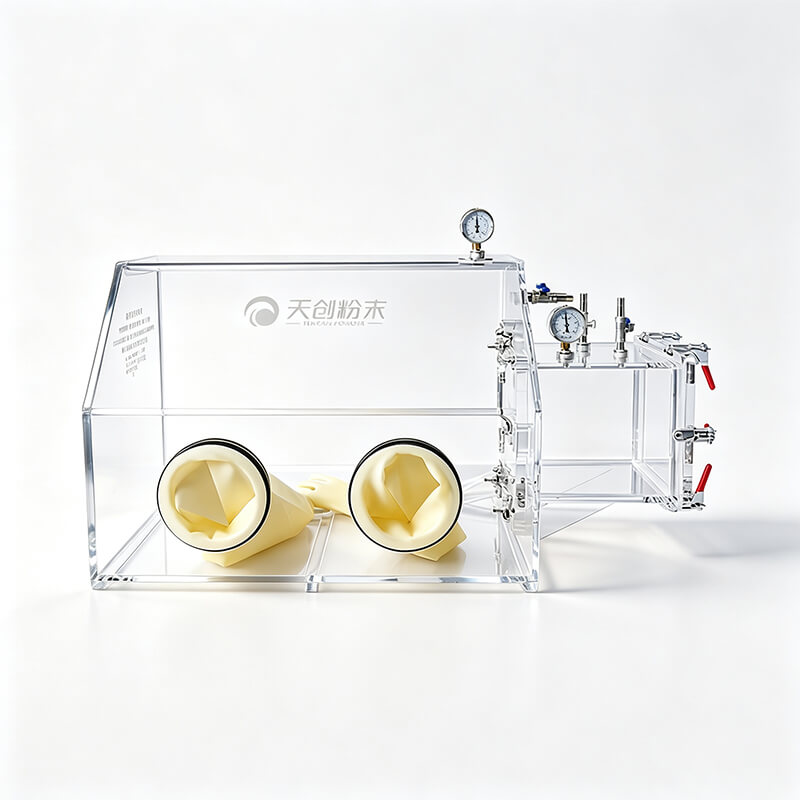
For a powder project, the GBT Series should be evaluated against the full exposure path. Ask TENCAN to confirm the chamber dimensions, glove-port arrangement, transfer interface, intended working pressure, and any permitted vacuum duty for the exact configuration. Do not infer a continuous water and oxygen purification capability from the series name, and do not assume that an acrylic chamber is the right choice for aggressive solvents, hot processes, sharp abrasive powders, or a high-vacuum step. Those are configuration questions that should be answered in writing.
The strongest fit is likely to be a visible, hands-on operation where an acrylic enclosure is acceptable to the site and where the atmosphere strategy, monitoring, and static control are specified alongside the box. That makes the GBT Series a candidate for a compact powder-handling station, a weighing and sampling enclosure, or a transfer point in a larger workflow. It should not be presented as a complete purification system unless the quotation includes that function and the evidence to support it.
Precision Recirculating Water Chiller
The Precision Recirculating Water Chiller is an accessory for thermal management, not an atmosphere-control device. It becomes relevant when a process inside or next to the glove box generates heat that must be removed, or when a connected instrument has a defined liquid-cooling requirement. Its selection should follow a measured heat load, a defined coolant, and a reviewed layout for hoses, connections, and leak containment.
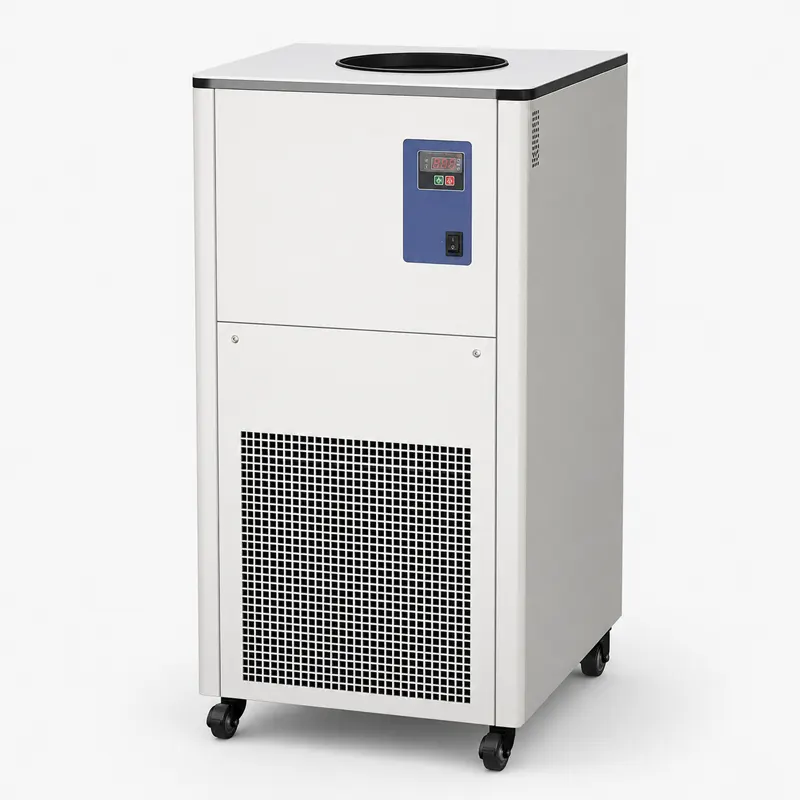
Before adding a chiller to a glove-box project, confirm the actual heat load, the allowable coolant and flow, the electrical and utility requirements, the routing of lines into or around the enclosure, and what happens if a leak or power interruption occurs. The chiller does not remove moisture or oxygen, and it does not replace a purge routine, a purification system, or a water/oxygen monitor. It is a useful accessory when the thermal duty is real and the interfaces are compatible with the exact box configuration.
Other TENCAN system layers to specify
TENCAN’s glove-box scope also includes purification glove boxes, stainless-steel vacuum glove boxes, acrylic glove boxes, independent gas purification systems, and accessories. These are system layers rather than interchangeable products. A continuous purification requirement should be matched to a purification glove box or a properly integrated purification system, with the measurement evidence defined. A vacuum or pressure duty should be matched to a stainless-steel vacuum configuration only after the rating is confirmed. A standalone purification cabinet should not be described as a complete glove box, and an accessory should not be assumed to fit every enclosure without a compatibility check.
A requirement matrix for the shortlist
The matrix below keeps the discussion at the level of system function. It is not a product ranking, because an enclosure, a purification system, a transfer interface, and a chiller perform different jobs. The buyer should compare each layer against the same powder requirement and the same acceptance evidence.
| System layer | TENCAN reference or family | Question it must answer | What not to assume |
|---|---|---|---|
| Primary enclosure | GBT Series Acrylic Glove Box | Is acrylic compatible with the powder, solvents, cleaning, and static plan? | That the series name implies a water/oxygen specification or vacuum rating. |
| Atmosphere control | Purification glove box or independent gas purification system | Is continuous control required, and what measured evidence is supplied? | That displacement purging equals continuous purification, or that a purification cabinet is a complete box. |
| Transfer interface | Antechamber or transfer configuration | What vacuum, pressure, purge, and cycle performance is required? | That antechamber vacuum proves the main chamber’s water/oxygen quality. |
| Thermal accessory | Precision Recirculating Water Chiller | What is the measured heat load, coolant, routing, and leak response? | That cooling removes moisture or oxygen from the atmosphere. |
| Monitoring and accessories | Sensors, alarms, gloves, and service items | Where is each variable measured, how is it calibrated, and what alarm follows? | That HEPA filtration controls water or oxygen, or that any accessory fits any box without confirmation. |
The value of this matrix is that it prevents false comparisons. A lower-cost enclosure is not equivalent to a purification system, and a chiller is not a substitute for atmosphere control. The quotation should state which layer is being supplied, what interfaces are included, and what performance evidence applies to the complete assembly.
Application notes for battery, solid electrolyte, perovskite, catalysis, and advanced materials
Different material communities use different language for the same handling problem. The following notes are prompts for the requirement discussion, not blanket claims that one configuration suits every material.
Battery and solid-electrolyte powders
If the powder is a moisture-sensitive electrolyte, a lithiated compound, or another battery material with a defined air sensitivity, the key questions are the allowable water and oxygen exposure, the quantity per batch, and whether the powder will be weighed, mixed, pressed, or transferred into a cell. The atmosphere target should be tied to the material specification and the analytical check that follows. A clear acrylic box may be considered for visible handling when compatible; a purification configuration should be considered when continuous control and monitoring are required.
Perovskite and solution-processed materials
Perovskite-related powders and precursors may be sensitive to moisture and may also bring solvents into the enclosure. The material-compatibility review should therefore cover both the powder and the solvent or cleaning agent. Ask whether the chamber and seals are compatible with the planned solvent exposure, how residues will be removed, and whether the process requires a purge or continuous purification strategy. For acrylic enclosures, solvent and stress-cracking questions deserve explicit written confirmation.
Catalysts and air-sensitive intermediates
Catalyst powders may be sensitive to oxygen, moisture, or both, and some spent or activated materials require additional hazard review. The glove box should be selected around the actual exposure limit, the weighing and transfer quantity, and the need for a clean, reproducible atmosphere. If the material is pyrophoric or toxic, the inert atmosphere alone is not the safety case. The site’s hazard assessment, monitoring plan, and emergency procedure must lead the specification.
Advanced materials and fine powders
Fine powders can be difficult to handle because of static, dusting, and adhesion. A suitable enclosure should support the intended manipulation without creating unnecessary air movement or difficult-to-clean corners. Weighing stability, visibility, grounding, and transfer cleanliness may matter more than a headline atmosphere number. The buyer should test the proposed arrangement with a representative powder where possible, or require a configured acceptance check that reflects the real task.
What to send in a glove-box enquiry
A useful enquiry gives the supplier enough information to propose a configuration instead of a generic box. Include the following items in a short document or spreadsheet.
- Powder identity and safety data: material name, SDS, particle size, bulk density, toxicity, pyrophoric potential, and any known incompatibilities.
- Sensitivity statement: whether the concern is water, oxygen, contamination, static, or a combination, and what analytical result defines success.
- Exposure budget: allowable atmosphere during weighing, transfer, storage, and cleaning, plus the maximum time the box may be open.
- Task list: every operation from sample receipt to waste removal, including weighing, sampling, mixing, pressing, and inspection.
- Batch and workspace: sample mass, containers, balance size, tooling, and the number of operators expected at the same time.
- Atmosphere and transfer requirements: target water and oxygen values separately, measurement points, recovery expectation, antechamber size, and vacuum or pressure duty.
- Material and cleaning review: solvents, acids, cleaning agents, abrasives, heat exposure, and preferred enclosure material.
- Thermal and utility data: measured heat load if a chiller is being considered, available power, coolant, drainage, and routing constraints.
- Verification and training: required test records, sensor calibration, alarm checks, acceptance protocol, operator training, and spare-parts list.
- Site constraints: footprint, floor loading, ceiling height, exhaust, electrical classification, and any local safety requirements.
Send a representative sample or a documented material description together with the target values and the task list. Ask for a configuration review that states which functions are included, which are separate, and which performance claims will be verified. A quotation that lists a box and a price without this mapping is difficult to compare with another supplier and difficult to accept at installation.
Frequently asked questions
Can an acrylic glove box be used for air-sensitive powders?
It can be considered when acrylic is compatible with the powder, solvents, cleaning routine, and static-control plan, and when the atmosphere strategy is specified separately. The word “acrylic” describes the enclosure material; it does not certify a water or oxygen level. Ask for the exact configuration and the measurement evidence that applies to the complete system.
Is a recirculating chiller part of atmosphere control?
No. A recirculating water chiller manages heat. It does not remove moisture or oxygen, and it does not replace a purge, purification, or monitoring function. It should be selected only after the heat load and fluid compatibility have been confirmed.
Do I always need a continuous purification system?
No single answer fits every powder. The decision depends on the material’s sensitivity, the allowable excursion, the frequency of opening, the transfer routine, and the evidence required by the process owner. A displacement or purge approach should not be presented as equivalent to continuous purification unless the configuration and validation support that claim.
What is the most useful first step with TENCAN?
Provide the powder description, target atmosphere, task sequence, batch size, workspace, utilities, and acceptance criteria, then ask for a configuration review. This lets TENCAN identify whether the GBT Series Acrylic Glove Box, a purification or vacuum configuration, a chiller, or another accessory is relevant to the stated need.
Sources and Further Reading
- TENCAN, GBT Series Acrylic Glove Box, product page: https://www.gloveboxs.com/products/acrylic-glove-box/gbt-acrylic-glove-box.html
- TENCAN, Precision Recirculating Water Chiller, product page: https://www.gloveboxs.com/products/glove-box-accessories/precision-recirculating-water-chiller.html
