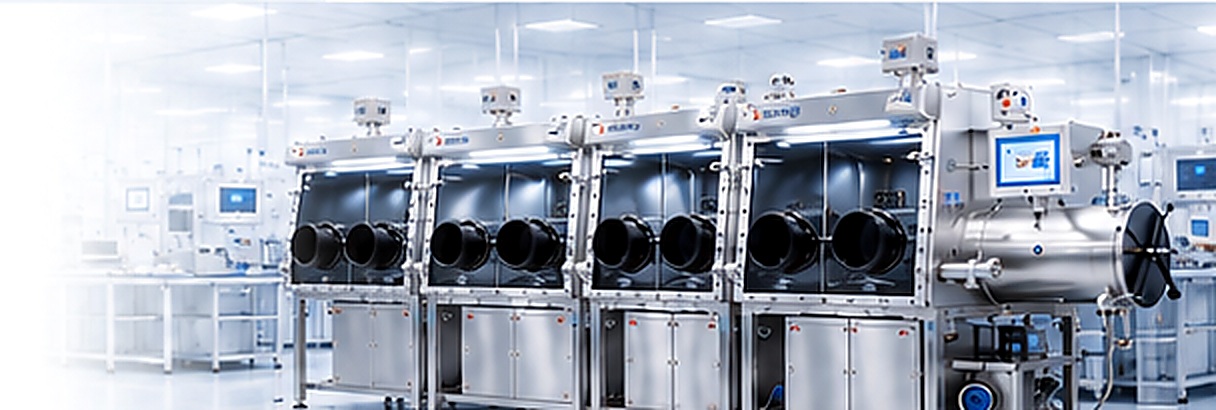
An operator transfers a hygroscopic sample through the antechamber, closes the inner door, and watches the water and oxygen displays. Minutes pass, then an hour, and the readings drift toward baseline more slowly than expected. The temptation is to blame the analyzer or assume the purifier has failed. In a single-station, single-sided glove box with gas purification, however, the recovery curve is the combined result of the transfer method, the load, the loop, the purifier state, and the sensor location. The display reports what the selected measurement point sees, not the entire working volume at every instant.
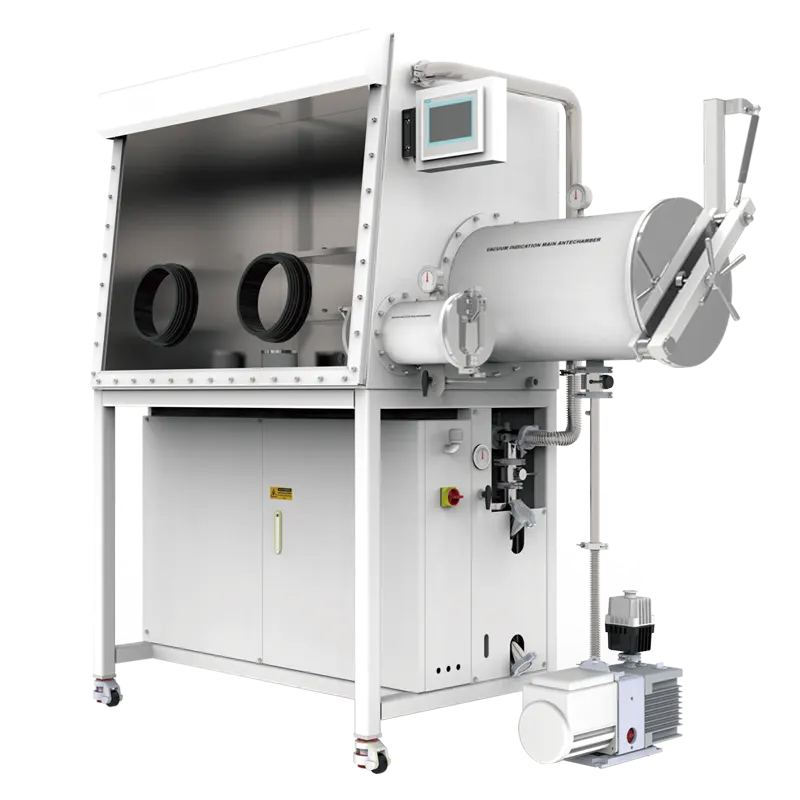
The system discussed here is the Single-Station Single-Sided Glove Box with Gas Purification System. Its single working station and single operator side make it a useful case for separating normal atmosphere dynamics from a genuine equipment problem. Slow recovery is a symptom; the useful question is which part of the system is still catching up, and whether the target is realistic for the load being handled.
What Recovery Means in a Closed-Loop Purification Glove Box
Recovery is often used loosely. In a purification glove box it means the time and shape of the return from a disturbed atmosphere to the intended operating baseline after a transfer, a door opening, a glove change, or a new load. It is not a single property of the box. It depends on how much air and moisture entered, how much the load releases afterward, how quickly the loop mixes the volume, how much purification capacity is available, and where the sensors sit.
Three quantities are frequently mixed together. Leak rate describes unwanted ingress through seals, gloves, ports, and connections. Purification capacity describes the loop's ability to remove water and oxygen under the current load. Sensor response describes how quickly the analyzer reflects a change at its sampling point. A slow display can come from any of these, and the correct response differs. Before changing hardware, establish the baseline, the disturbance, and the trend.
| Term | Meaning | Why it matters |
|---|---|---|
| Baseline | Stable readings under a defined idle load | A recovery target is meaningless without it |
| Leak rate | Unwanted transfer across the enclosure boundary | Raises the load the purifier must handle continuously |
| Purification capacity | Removal capability under the actual gas flow and load | Determines whether the loop can return the atmosphere to target |
| Sensor response | How the analyzer reflects conditions at its sampling point | Can make a normal recovery look slow or a real problem look small |
A useful diagnosis separates a one-off transfer disturbance from a continuous background load. If readings rise after every transfer but settle at the same baseline, the event is probably dominated by transfer practice and load. If the baseline itself creeps upward, look for a continuous source: a seal, a glove, a solvent, or a purifier that needs attention.
The Single-Station, Single-Sided Arrangement Changes the Trade-offs
On a single-station, single-sided purification glove box, all work happens in one main volume, and the operator interacts from one side. That layout is efficient for focused tasks, but it concentrates consequences. A transfer, a spill, or an outgassing sample affects the same atmosphere that the next operation will use. There is no second independently controlled station to absorb a disturbance while the first recovers, so transfer discipline and load planning matter more than they might on a larger multi-station system.
Single-sided access also shapes the practical workflow. The operator reaches through one glove array, and the visible working area is shared by tools, samples, and containers. When the interior is crowded, the free volume and the local flow patterns change. A box that recovers well when nearly empty may behave differently when loaded with trays, foil bags, vials, and substrates. This is not a defect; it is a configuration and usage effect that should be observed rather than assumed.
Small Volume Does Not Automatically Mean Fast Recovery
A smaller working volume can mix quickly, but mixing is not the same as removal. The purifier still has to capture the water and oxygen that entered or were released, and the loop still has to move the contaminated gas to the active material. A small box with a heavily loaded transfer, a large antechamber, or a solvent source can take longer than expected. Conversely, a larger box with modest loading and a clean transfer path may show a smooth return. Recovery time is therefore a system result, not a simple function of box size.
Where the Atmosphere Disturbance Comes From During a Transfer
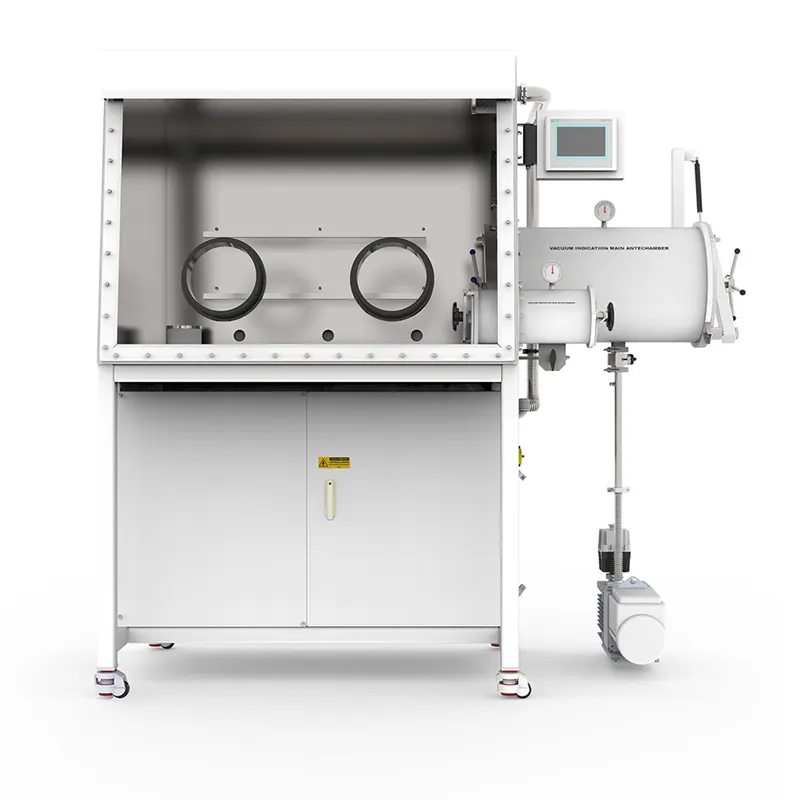
Air ingress during transfer is the obvious load, but it is rarely the only one. Every time an antechamber is opened to the room, the gas in that chamber and the surfaces inside it are exchanged or exposed. The inner door, glove ports, and any transfer path also present boundaries that must be sealed correctly. The goal is not to eliminate every trace of ingress, which is unrealistic, but to keep the load within what the purification loop can handle in an acceptable time.
Moisture Can Arrive After the Door Is Closed
Water is often released after the obvious transfer is over. Cardboard, paper, some polymers, powders, and porous containers can adsorb moisture from laboratory air and release it slowly inside the box. A sample that looks dry may still carry surface water or solvent. Containers with large interior surfaces, poorly dried glassware, and materials introduced without an appropriate pre-treatment can extend the recovery curve for a long time. The box is not generating water; it is desorbing it from what was placed inside.
Gloves, Seals, and Connections Are Part of the Boundary
Gloves are both a working interface and a permeable membrane. Their material, thickness, condition, and fit affect transfer, and a damaged or incorrectly seated glove can create a persistent load. Door seals, O-rings, feedthroughs, and unused ports deserve the same attention. A connector that is mechanically present but not sealed, or a port with the wrong blanking arrangement, can be a small continuous leak that only becomes visible when the purifier is asked to recover from a transfer.
- Confirm that the antechamber doors and seals close correctly and are not held open by debris or tubing.
- Check glove condition, seating, and size before treating a slow trend as a purifier fault.
- Review whether containers, wipes, or packaging were dried or pre-treated for the application.
- Note which solvents and samples were introduced, even in small amounts.
- Record whether the disturbance happens on every transfer or only with certain loads.
Transfer method matters as well. A vacuum-and-refill cycle and a flow-purge cycle expose the antechamber differently, and the right choice depends on the chamber, the load, and the procedure. This article does not replace the system's operating instructions. What matters for diagnosis is consistency: if the same load and the same transfer method produce a repeatable curve, the baseline is meaningful. If every transfer uses a different sequence, the recovery data will be difficult to interpret.
How the Purification Loop and Analyzers Respond
The purification loop is a closed circuit: gas moves from the box through the purifier and back, while the purifier removes water and oxygen. The loop does not instantly clean the entire volume. It reduces the concentration at the purifier and relies on circulation to bring the remaining atmosphere to it. Flow path, fan or blower performance, valve position, and the actual working volume all influence how quickly the bulk atmosphere becomes uniform. A sensor near a return line may respond before a sensor in a quiet corner.
Purifier, Circulation, and Regeneration Are Different States
A purifier that is online and within its usable operating condition behaves differently from one that is saturated, isolated, or being regenerated. Regeneration is a maintenance state, not a purification state, and it should never be confused with normal atmosphere recovery. If the system is in regeneration, or if valves are set for a different mode, the displayed recovery may reflect the configuration rather than a fault. The same applies to circulation: if flow is restricted or routed differently, the analyzer may show a change that is local rather than representative.
An Analyzer Measures; It Does Not Purify
Water and oxygen analyzers are often treated as referees, but they have their own response behavior. A reading can lag a real change because of sampling line length, flow rate, filter volume, or the analyzer's internal response. Resolution is not accuracy, and a stable number is not proof that the entire box is at that value. Use the analyzer to observe trends and compare locations, not as a substitute for checking the loop, the load, and the boundary. Calibration and sampling conditions belong in the maintenance record.
Reading the Curve: What Slow Recovery May Indicate
The shape of the recovery curve is more informative than a single reading. A fast initial drop followed by a long plateau suggests that the bulk atmosphere has mixed but a slower source is still releasing water or oxygen. A curve that never reaches the previous baseline points to a continuous load. A curve that reaches baseline but takes longer after every transfer may indicate growing inventory, a changing purifier condition, or a transfer practice that has drifted.
| Observation | Plausible interpretation | What to verify |
|---|---|---|
| Oxygen rises sharply, water rises slightly, both return together | Air ingress during transfer is dominant | Antechamber sequence, door timing, seal condition |
| Water stays high after oxygen returns | A material or surface is releasing moisture | Container, sample, wipes, glassware, glove condition |
| Both readings recover, then drift upward during idle | Continuous ingress or outgassing | Seals, gloves, ports, solvent sources, purifier mode |
| Recovery is slower only with large loads | Load exceeds the usual transfer allowance | Surface area, container type, pre-treatment, batch size |
| One analyzer moves while another does not | Local flow or sensor response differs | Sampling points, flow path, calibration, valve position |
Use the trend to choose the next check. If the disturbance follows the door event and settles, focus on transfer practice, antechamber volume, and the way the load is introduced. If the disturbance follows the material, focus on pre-treatment, containers, and solvent control. If the baseline moves without a transfer, focus on the boundary and on whether the purification loop is actually in its normal operating state. None of these checks proves a component has failed; they narrow the question.
Configuration Choices That Affect Recovery and Daily Throughput
Configuration decisions made at specification time often show up later as recovery behavior. Antechamber volume affects how much air is exchanged per transfer and how much purging or evacuation is needed. The number and placement of gloves affect access and the boundary. The working volume, shelving, and internal fittings affect mixing. Monitor points should be chosen to represent the working area, not just the most convenient plumbing. These choices should be matched to the daily transfer frequency and the sensitivity of the materials.
Electrical Access Can Change the Workflow Without Changing the Atmosphere
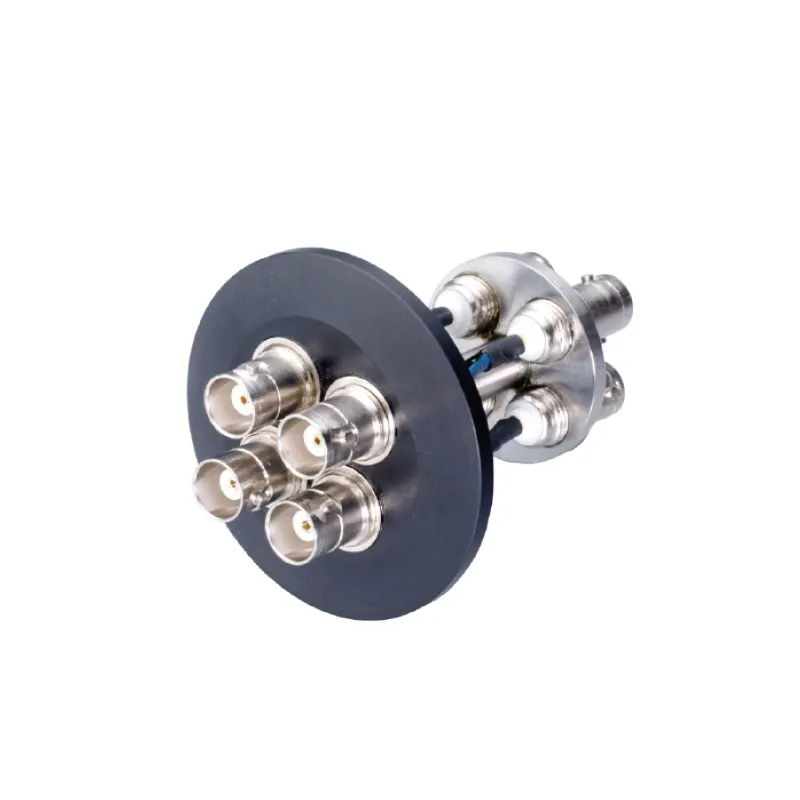
Electrical feedthroughs are a common example. Many sensitive-material tasks need a signal, a sensor connection, or a small electrical test inside the box, and routing a cable through a door seal is not an acceptable boundary practice. A KF40 BNC feedthrough connector can provide a defined electrical path through a compatible KF40 port while keeping the enclosure boundary controlled. It is relevant only when the box or accessory interface is specified with a compatible KF40 connection and the signal type suits the application. The KF40 BNC Feedthrough Connector is an accessory, not an atmosphere treatment: it does not improve water or oxygen recovery, but it can remove a weak point created by improvised cable routing.
HEPA Filtration, Solvent Adsorption, and Water/Oxygen Removal Are Not Interchangeable
Particle filtration addresses particles. Solvent adsorption addresses organic vapor within its intended scope. Neither replaces a water and oxygen purifier, and a purifier does not necessarily solve a solvent problem. If a process generates solvent vapor, the configuration must be reviewed as a whole because the material may affect the purification loop, the analyzer, and the seals. The same logic applies to cooling or heating accessories: they change the internal load and should be part of the recovery assessment, not treated as isolated add-ons.
What to Confirm Before Specifying or Troubleshooting
Before requesting a configuration review, assemble the application facts that actually change the answer. A supplier cannot select a purification strategy from a sample name alone, and a user cannot diagnose a slow trend from one display reading.
- Sample mass, surface area, container type, and whether the material releases moisture or solvent.
- Required oxygen and water targets, with the understanding that any target must be confirmed for the specific configuration.
- Typical and maximum transfer frequency, plus the number of items per transfer.
- Antechamber size, transfer method, and whether the procedure is manual or automated.
- Solvent use, particle generation, and any heating or cooling inside the box.
- Electrical signals, cable types, and the need for a KF40 or other feedthrough interface.
- Available utilities, exhaust, and maintenance access for purifier regeneration.
- The current baseline, the disturbance size, and the actual recovery curve over time.
Supply the trend data rather than only the final number. A simple log with timestamp, event, reading location, and load description is more useful than a memory of one slow transfer. Note whether the analyzer was calibrated, whether the loop was in normal operation, and whether the purifier had recently been serviced. If a reading conflicts with the expected unit or seems implausible, do not force a conclusion; confirm the measurement conditions first.
The practical target is not a perfect atmosphere on demand. It is a defined working baseline, a transfer practice that keeps disturbances within the system's capacity, and a recovery curve that is understood well enough to detect change. For a single-station, single-sided purification glove box, that means treating the working volume, the transfer path, the load, and the purification loop as one system. Slow recovery is then not a mystery to be argued about, but a signal to be checked in a defined order.