
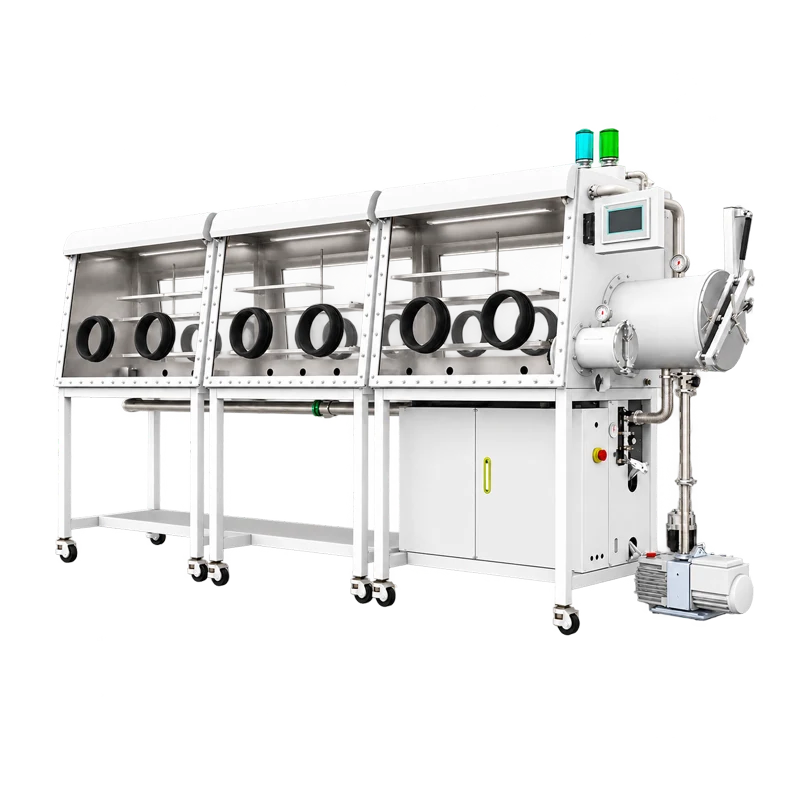
A laboratory rarely outgrows its glove box in a single step. The pressure usually appears as a queue at the transfer chamber, two researchers scheduling the same afternoon, or a long-running experiment that cannot be disturbed for a routine sample exchange. A six-station double-sided split-type glove box with a gas purification system addresses that pressure by increasing the number of access positions and arranging them on both faces of the cabinet. The TENCAN listing is a useful reference because its name states three design decisions at once: six working positions, two-sided access, and a split cabinet served by a purification loop. Those decisions interact. More positions can improve concurrency, but they also create more sealing interfaces and more opportunities to disturb the atmosphere. The question is not whether six stations are better than two. It is whether the laboratory can use six stations without turning them into six sources of variability.
This article looks at that fit. It explains how a purification system should be understood in a multi-station cabinet, why split and double-sided construction affect installation and service, how transfers and pressure readings differ, and why a small component such as a glove port sealing ring deserves attention. Product-specific values such as achievable oxygen and moisture levels, leak rate, chamber dimensions, and recovery time must come from the current quotation and acceptance documentation for the exact configuration. The product name alone does not establish them.
Six Stations Are a Workflow Decision Before They Are a Specification
The first useful step is to map a normal week rather than a peak day. How many people need independent access? Which processes must run at the same time, and which can be scheduled? Does one group prepare samples while another performs measurements, or does every user follow the same sequence? A six-station cabinet can reduce scheduling conflicts when several researchers need frequent, short access. It can also become a liability if the work is intermittent, because the same cabinet must be maintained, monitored, and kept under control even when most positions sit idle.
Double-sided access changes the social geometry of the lab. Work can be divided between two faces, so one side can be used for preparation and the other for inspection or assembly, provided the internal layout supports that separation. This is a layout choice, not an atmospheric partition. Both sides share the same controlled volume unless the design includes separate compartments, and the product name alone does not establish that. Researchers may also find it easier to pass a sample between colleagues without walking around the cabinet, but the benefit depends on where the antechambers, feedthroughs, and service panels are placed.
Six working positions also impose discipline. Every glove port is a potential leak path, every opening changes the local atmosphere, and every object brought inside carries adsorbed moisture, oxygen, or solvent vapor. A larger cabinet does not remove those loads; it distributes them across a larger working volume and, often, a larger number of users. The laboratory needs a material-entry rule, a transfer schedule, a clean-up standard, and a named person responsible for the atmosphere log. Without those controls, a six-station system can generate more throughput and more uncertainty at the same time.
The product category is therefore most convincing when at least three conditions hold: several users genuinely need access during the same period, the work benefits from two-sided handling or observation, and the organization can support routine monitoring and maintenance. If the real bottleneck is sample transfer rather than glove access, a different antechamber arrangement or a smaller cabinet may be more appropriate. If the bottleneck is analytical turnaround, a larger box will not solve it. The six-station double-sided split-type purification glove box is a candidate for the first scenario, not a universal upgrade.
How the Purification Loop Fits a Multi-Station Cabinet
A gas purification system is an atmosphere-management loop, not a one-time purge. In a typical closed-loop design, a blower circulates the box atmosphere through purifier columns that remove water and oxygen. The columns are regenerated according to the manufacturer's procedure, using the specified gases and conditions. Control gas, working gas, and regeneration gas have different roles and must not be treated as interchangeable. The loop also needs sensors, valves, and a controller to decide when circulation or regeneration is required. The exact media, capacities, and sequences are configuration details.
Purification is not the same as analysis
An oxygen or moisture analyzer reports the condition of the atmosphere at its sampling point. It does not remove contaminants, and its display does not by itself prove that every part of a six-station cabinet is at the same condition. Sensor location, sample flow, calibration, and response time matter. Resolution is not accuracy. A reading that looks stable may reflect a slow response or a poorly placed sample point rather than a well-mixed atmosphere. Ask where the sensors sit, how they are calibrated, and whether the control system uses them for alarms, interlocks, or only for display.
Purification is not particle filtration or solvent removal
HEPA filtration addresses particles. Solvent adsorption addresses organic vapors. Neither replaces the water and oxygen removal step, and a purification column should not be described as a sterilizer or a cleanroom-grade particle barrier. If the process produces solvent vapor, fine powder, or corrosive species, those loads need a separate engineering review. The purifier may be protected by appropriate filters or traps, but the need and the compatibility must be confirmed. The same principle applies to material choice: a gas that is inert toward one sample may react with another, and 'inert atmosphere' is not a universal guarantee.
The six-station layout changes the load profile
More access points and more users usually mean more door openings, more transfers, and more opportunities for a glove to be damaged. The purification loop may have enough nominal capacity for the cabinet volume, yet the practical recovery behavior depends on how the box is used. It also depends on the number of compartments and whether the split configuration uses one shared loop or separate circuits. The current product listing does not provide those details. Confirm the loop architecture, the number and location of sampling points, the regeneration procedure, and the alarm strategy before treating a headline performance figure as an operating guarantee. A purification system should be selected with the working schedule in mind, not only with the empty-box volume.
A performance number needs a test basis
Statements about oxygen or moisture levels are meaningful only when the measurement conditions are stated: sensor type and calibration, sample location, circulation state, material load, transfer history, and the duration of the test. A value achieved in a clean, closed, undisturbed box is not the same as a continuous guarantee at every port during a busy day. The product name confirms that a gas purification system is part of the architecture. It does not establish a specific purity level for every application. That distinction protects both the buyer and the supplier, because it turns a vague claim into an acceptance criterion that can be checked.
Why Split-Type and Double-Sided Construction Change Installation
Split-type construction generally means the cabinet is arranged in sections that can be manufactured, transported, and assembled separately rather than as one monolithic shell. That can make access to a laboratory easier, reduce the size of the largest component that must pass through a door or lift, and simplify some service tasks. It also creates interfaces. Each joint, gasket, and connection must be designed and verified so that the assembled cabinet behaves as one controlled volume. A split cabinet is not automatically more flexible or more leak-tight than a one-piece cabinet. The quality of the interface design and the commissioning procedure determine the outcome.
Double-sided access adds a second set of ergonomic decisions. The working height, reach distance, window angle, lighting, and glove port spacing must suit both sides. If one side is intended for delicate assembly and the other for material preparation, the internal layout should keep those activities from competing for the same space. The antechambers should be positioned where they reduce travel and cross-traffic. Feedthroughs, vacuum lines, and electrical connections need service access without forcing users to reach across an active workspace. These are not cosmetic details. A poorly placed port encourages awkward posture, increases glove stress, and makes accidental contact with sensitive equipment more likely.
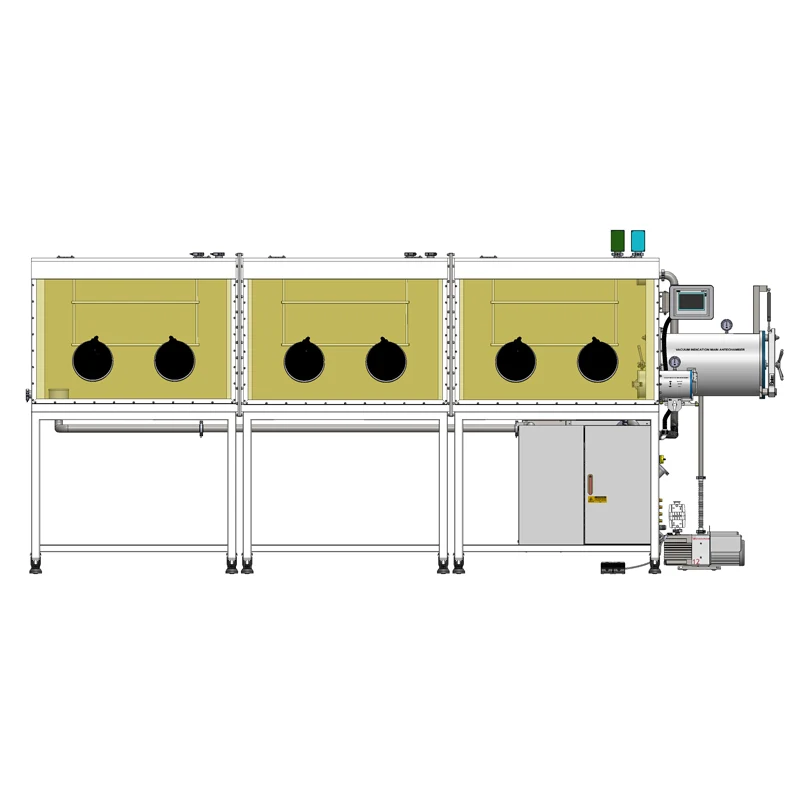
The product name does not specify the number of antechambers, the port diameter, the control architecture, or whether the split sections can be isolated from one another. Those omissions matter. Ask for a dimensioned layout, a piping and instrumentation diagram, a list of interfaces, and a description of how the sections are joined and tested. If the laboratory corridor, doorway, or floor loading cannot accommodate the assembled sections, the installation plan changes the project schedule. If the split line crosses a controlled atmosphere path, the seal design and leak-test method become part of acceptance. The procurement question is not simply 'split or not split,' but 'which split, with which interfaces, and how will they be proven?'
Two-sided work also affects supervision and material flow. A shared atmosphere means that contamination or a spill on one side is not confined by the fact that the other side looks clean. Users need a common standard for what may enter, where it is stored, and how waste is removed. If the cabinet serves different research groups, the access rules should be agreed before installation. A six-station cabinet can support collaboration, but it can also expose every group to every other group's habits.
Transfers, Pressure Readings, and Slow Recovery
Sample transfer is the most common disturbance in any glove box, and a six-station cabinet creates more transfer events rather than fewer. An antechamber reduces the exchange with the outside atmosphere through a sequence of door operations, evacuation, and inert-gas admission. The useful questions are how many items can be transferred at once, whether the chamber is large enough for the usual containers, how the doors are interlocked, and how the purge or evacuation cycle is controlled. A large antechamber that is opened frequently can be less helpful than a smaller chamber used with disciplined staging. The transfer path should be designed around the actual carriers, tools, and waste streams, not around an abstract sample size.
The word 'pressure' covers several different measurements. Cabinet working pressure describes the controlled condition inside the glove box. Antechamber vacuum describes the evacuation level in a transfer chamber. Pump ultimate vacuum describes the capability of a pump under specified conditions. Leak rate describes the integrity of the enclosure over a test interval. Oxygen and moisture readings describe the atmosphere at the sensor location. None of these is a substitute for another, and a single number without its reference point is easy to misread. Preserve the original units and the object being measured. If a specification is ambiguous, ask for clarification rather than converting it into an assumed guarantee.
| Reading | What it describes | What it does not establish |
|---|---|---|
| Cabinet working pressure | Controlled pressure condition of the glove box enclosure | Antechamber vacuum or leak rate |
| Antechamber vacuum | Evacuation level in the transfer chamber | Pump ultimate vacuum or box atmosphere quality |
| Pump ultimate vacuum | Pump capability under specified test conditions | System leak rate or recovery time |
| Leak rate | Enclosure integrity over a defined test | Oxygen or moisture concentration at every port |
| Oxygen or moisture reading | Atmosphere at the sensor location | Uniformity throughout a multi-station box |
Slow recovery after a transfer can have several explanations. The transfer may have introduced a large moisture load through packaging, gloves, or wet equipment. A door or glove port may not be sealing correctly. A valve seat may be contaminated. The purifier may be due for regeneration or replacement. The circulation path may be obstructed. The sensor may be slow, miscalibrated, or located in a stagnant zone. A leak path at a feedthrough or a split interface may also contribute. Without a leak check, a sensor verification, a review of the transfer sequence, and a maintenance history, it is not responsible to assert that one component has failed. The useful output of an investigation is a ranked list of checks and a record of what changed.
Because a six-station cabinet has more glove ports, doors, and joints than a small box, trend logging is more valuable than a single spot reading. Record the reading before a transfer, the peak after the transfer, and the time to return to the normal operating band. Note what was transferred and which port was used. Over several weeks, the pattern can distinguish a user-practice issue from a hardware issue. It can also show whether the purification loop is keeping up with the real schedule. The right acceptance test for the system is therefore tied to the intended workflow, not only to an empty-chamber demonstration.
Glove Ports and Sealing Rings: The Repeated Interface
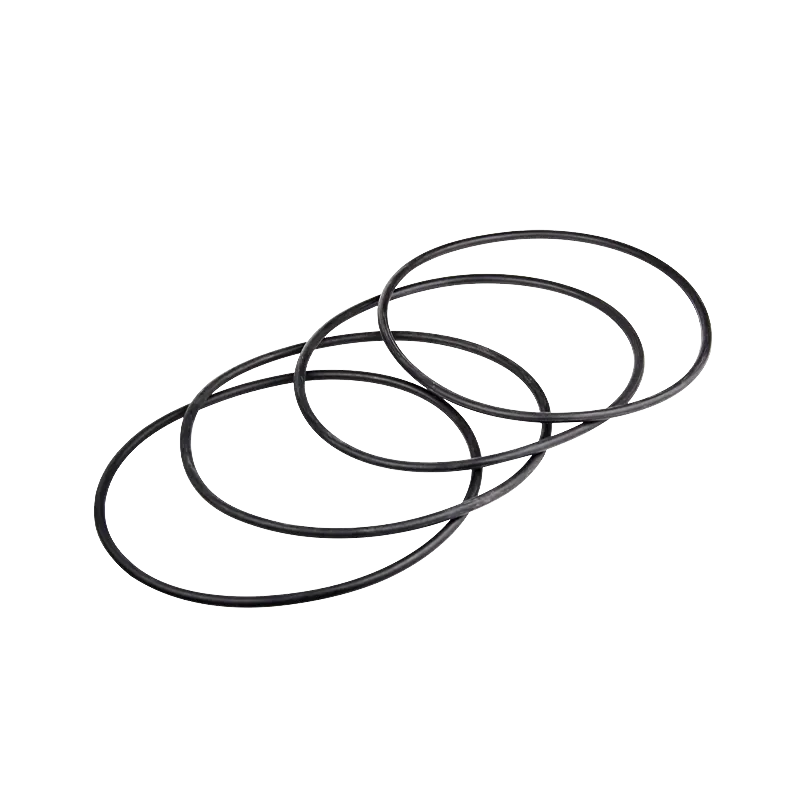
A glove port is a controlled opening that must remain sealed around a flexible glove while the glove moves. The sealing ring is the component that retains the glove cuff and closes the glove-to-port interface. It may look minor compared with the cabinet or the purifier, but it is repeated at every port. On a six-station cabinet, that repetition matters. A ring that is the wrong thickness, too hard, chemically incompatible, or incorrectly seated can create a slow leak or allow the glove to shift during use. The result may appear as an unexplained rise in moisture, a glove that will not stay in place, or a port that fails a leak check.
The glove port sealing ring should be selected against the actual port geometry, glove cuff, and operating environment. Useful information includes the port diameter, groove or flange design, ring cross-section, material, hardness, temperature range, and chemical exposure. Solvents, acids, and cleaning agents can change the properties of an elastomer. A ring that suits one glove material may not suit another. The accessory listing is a starting point for the correct part family, not proof that one ring fits every cabinet. Confirm compatibility with the selected TENCAN glove box and the glove being used.
Inspection should be part of routine maintenance, not only a response to a bad reading. Check that the ring is seated evenly, that the glove cuff is not twisted or pinched, and that the port surface is clean and free of cuts or residue. Replace damaged rings rather than attempting to compensate with extra force or sealant. The manufacturer's installation method and leak-test procedure should govern the work. If a port is unused for long periods, a proper cap or closure may reduce unnecessary exposure, but the closure itself must be compatible and must not hide a leak. Good sealing practice is mostly repetition: the same correct inspection, the same correct replacement part, and the same record for every port.
Configuration Checklist and Acceptance Plan
Use a structured request for quotation so that the supplier can respond to the real application rather than a generic model name. The table below lists the decisions that most often change the cost, layout, or operating result of a six-station double-sided split purification cabinet.
| Decision | Why it matters | What to request |
|---|---|---|
| Number and use of work positions | Concurrent users, process types, and access frequency affect disturbance and scheduling | Port layout, side allocation, and intended use for each position |
| Split configuration | Transport, assembly, service access, and joint integrity affect installation | Dimensioned sections, joint details, and leak-test plan |
| Purification architecture | Shared or separate circuits change monitoring and maintenance requirements | Loop diagram, sampling points, regeneration procedure, and alarm strategy |
| Antechamber arrangement | Size, number, and cycle control determine transfer capacity and atmosphere disturbance | Chamber volumes, door interlocks, and cycle control details |
| Instrumentation | Sensor location and calibration determine what a reading represents | Ranges, calibration method, sensor locations, and alarm functions |
| Material and solvent loads | Corrosives, particles, and solvents may require protection or a different design | Compatibility review and any required traps or filters |
| Glove and port sealing | Glove material, port geometry, and ring specification affect repeated seals | Port dimensions, ring material, spare parts, and inspection guidance |
| Utilities and installation | Power, gas supply, exhaust, floor loading, and clearance affect site readiness | Utility schedule, weight, dimensions, and clearance requirements |
| Acceptance | Integrity and workflow performance must be checked before routine use | Test method, acceptance criteria, documentation, and training |
Specific values should be filled in only after the supplier confirms the exact configuration. The current product listing is the correct place to start for the model, but it does not replace a formal specification. A six-station cabinet may need a larger gas supply, more rigorous scheduling, or a different maintenance routine than a small box. Those implications should be visible before the purchase order, not discovered after commissioning.
Acceptance should combine a static integrity check with a workflow-based check. The static check establishes that the assembled enclosure and transfer chambers meet the agreed leak and function criteria. The workflow check confirms that the purification loop, sensors, interlocks, and alarms behave as expected during representative transfers. Record a baseline after commissioning: the normal reading band, the response to a standard transfer, the regeneration schedule, and the spare-parts inventory. Train every user on the same entry rules, glove inspection, and alarm response. A six-station system is a shared instrument, and its atmosphere is only as consistent as the least disciplined access habit.
Before asking for a quotation, prepare a short application brief: the materials and processes to be handled, expected simultaneous users, daily transfer count, solvents or particles released, required analytical connections, available floor space and access route, and the utilities that can be supplied. Ask the supplier to identify which items are fixed by the product design and which remain configurable. Ask for the documents that will be used at acceptance and for the maintenance tasks that must be performed by the laboratory. That package is more useful than a comparison of model names, because it shows whether the six-station double-sided split purification concept actually matches the work.
