
Air-sensitive powder handling rarely fails at the reactor. It fails at the ordinary step in between: the moment a sample is weighed, split, sealed into a vial, or loaded into a jar for the next process. For a sulfide solid electrolyte, that step decides whether the surface a laboratory characterises is the surface it synthesised. This guide takes one material and one process stage — weighing and transfer of air-sensitive sulfide electrolyte powder before cell assembly or further milling — and shows how the requirement becomes a glove box specification, which documented TENCAN configuration matches the duty, and which international alternatives belong on the same shortlist.
Define the process stage before the enclosure
Glove box selection tends to go wrong when the enclosure is chosen first and the task list is written afterwards. A more reliable order is to write down the operations in sequence, then let the operations dictate atmosphere, transfer method, ergonomics and accessories.
For an air-sensitive electrolyte powder, the sequence in a solid-state or battery laboratory usually looks like this. The powder arrives from synthesis, often sealed under inert gas or contained in a vial inside a secondary bag. It is introduced through an antechamber rather than through an open door. It is weighed to a target mass, which requires an analytical balance inside the enclosure, a weighing boat or vial, and a spatula. A portion is sub-sampled into a container, capped, and either stored inside the box or removed under a sealed closure. A second portion moves to the next process — pellet pressing, milling, or cell assembly in a second enclosure. Every one of those steps has a failure mode, and every failure mode has an equipment consequence.
Four questions are worth answering in writing before any quotation is requested. How long will the powder sit in the enclosure during a typical session? How many people need to work at the same time? What mass of powder moves in and out per week, and in what kind of container? And what happens to the powder after weighing — is it stored, milled, pressed, or assembled into a cell in a different box? The answers separate a simple transfer enclosure from a continuously purified workstation with vacuum-assisted transfer, and they keep the budget attached to a real duty rather than to a brochure category.
Material properties that drive the selection
Sulfide electrolytes are the clearest example of a powder whose handling requirement comes from surface chemistry rather than from mechanical fragility. The same reasoning applies to many moisture-sensitive halide and oxide precursors, to perovskite salts, and to catalysts that are deactivated by ambient humidity. The properties below are the ones that translate into specifications.
Moisture and oxygen sensitivity
A sulfide solid electrolyte is handled under inert gas because its particle surfaces react with ambient moisture and oxygen, which alters interfacial behaviour in the finished cell. The engineering consequence is that the enclosure must maintain a controlled atmosphere continuously, not merely start a session with a purge. A once-through gas purge displaces air at the start, but it does not remove the moisture and oxygen that enter through glove permeation, through the antechamber during every transfer, and through small leaks over a working day. That is what a regenerable purification loop is for, and it is why water and oxygen readings should be specified as measured values at a defined point in the loop, with the measurement method stated, rather than as a single headline figure.
Particle size, dusting and static
Fine electrolyte powders dust readily. Dusting matters for three reasons: it makes weighing less reproducible, it contaminates the interior surfaces that the next experiment depends on, and it can travel on gloves and sleeves. A single-sided enclosure with a defined working face and a smooth, cleanable interior is easier to keep under control than a cluttered one, and a dedicated weighing zone inside the box reduces the need to carry open containers across the working volume. Where powders are very fine and dry, static can make powder jump to the vial wall; that is a handling practice issue, but it is easier to manage when the operator has both hands free inside a stable atmosphere.
Compatibility of the enclosure with the process
Powder handling is not the only activity in these laboratories. Solvent-based slurry preparation, pellet pressing, and heating steps may share the same room, and not all of them belong in the same box. Solvent vapour can challenge purification media, and heat sources inside an enclosure change the thermal load. Before committing to a shared enclosure, confirm with the supplier which materials of construction and which sealing elastomers are offered, and keep solvent-heavy work in a separate, appropriately configured enclosure or in a fume hood. An inert atmosphere is not the same thing as solvent containment, and neither is a biological safety cabinet.
Throughput and the number of working stations
Two people weighing and transferring at the same time on one working face is a different requirement from one person doing both tasks in sequence. The number of glove ports and the width of the working face follow directly from that answer, and so does the size of the antechamber, because a larger antechamber trades faster bulk transfer against a longer re-purification time after each cycle.
Application matching table
The table below converts the material brief into selection factors. It uses qualitative, verifiable features rather than scores, because the correct values depend on the specific configuration quoted.
| Selection factor | Why it matters for this material | Suitable documented feature |
|---|---|---|
| Continuous atmosphere purification | Surface reactions with moisture and oxygen continue throughout the session, not only at start-up | Glove box with an integrated gas purification system and monitored water/oxygen indicators |
| Purification module arrangement | Access for regeneration and service affects uptime in a busy laboratory | Split-type design in which the purification system is a separate module from the enclosure |
| Vacuum antechamber | Every introduction of powder or consumables carries air into the working volume | Vacuum antechamber with flanged connections; evacuate and refill with inert gas before opening the inner door |
| Working pressure control | A slight positive pressure keeps ingress moving inward rather than into the box | Working pressure specified as its own parameter, separately from antechamber vacuum and from water/oxygen readings |
| Number and position of glove ports | Weighing, capping and transfer need both hands and a stable reach | Two-station single-sided configuration on one working face |
| Interior cleanability | Dust from fine electrolyte powder accumulates and cross-contaminates | Smooth stainless interior surfaces and a defined weighing zone |
| Flange and connection standard | Vacuum lines, feedthroughs and pumps must join the box without adapters | KF-style vacuum flanged joints secured with matching clamps |
| Accessory ecosystem | Balance feedthroughs, storage boxes and transfer ports are added later | Documented accessory range for the same platform |
| Atmosphere monitoring records | Traceability for a sample that will be reported in a publication | Logged water and oxygen readings with the measurement point identified |
| Scope of protection | Prevents over-expectation about what the enclosure does | Inert atmosphere control as stated; particle filtration, biological containment and explosion protection treated as separate, separately certified functions |
The TENCAN configuration that fits this duty
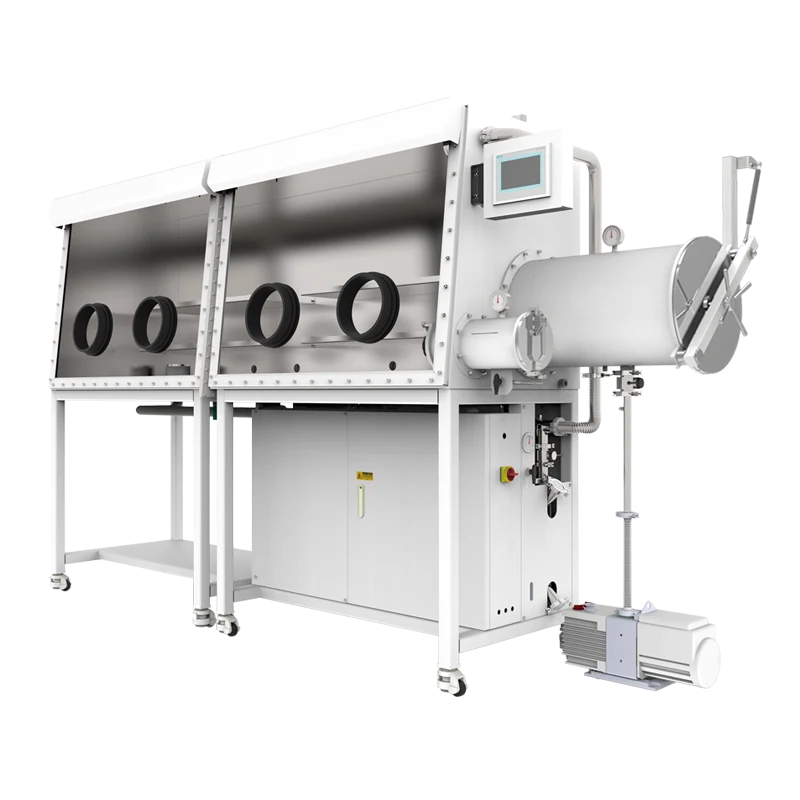
For a laboratory that weighs and transfers air-sensitive electrolyte powder on a daily basis, with two operators working on the same face, the closest documented match in the TENCAN range is the Two-Station Single-Sided Split-Type Glove Box with Gas Purification System. Its name states the three features that matter for this brief: two working stations, a single working face, and a split-type arrangement in which the gas purification system is a separate module rather than something folded into the box body.
Why the split-type arrangement matters in practice
Purification systems need regeneration, and regeneration means the module is out of service for a period. When the purifier is a separate module, the service activity is physically separated from the working volume, and the enclosure itself can remain a clean, undisturbed environment while the module is attended to. That is a maintenance argument rather than a performance claim, and it is the argument that matters in a laboratory where a stopped box means a stopped experiment. The split arrangement also allows the box footprint and the purification footprint to be positioned independently in a crowded lab.
Two stations on one face
Weighing is a two-handed job: one hand holds the vial, the other manipulates the spatula, and the balance sits at a comfortable height between them. A second station on the same face lets a colleague cap and label samples, or prepare the next container, without waiting for the balance to be free. For a single-operator laboratory the second station is still useful — it separates the weighing zone from the transfer zone, which reduces the distance that open powder travels inside the box.
Read three specifications separately
Inert atmosphere glove boxes are frequently compared using a single number, which hides the information a buyer actually needs. Three parameters should be requested and recorded independently. The first is working pressure: the slight positive pressure range the box is designed to hold during operation. The second is antechamber vacuum: the vacuum level the transfer chamber is designed for, and how many evacuation and refill cycles the supplier recommends before the inner door is opened. The third is the water and oxygen concentration the purification loop is specified to reach, together with the measurement point and the sensor technology. These are different quantities with different units and different implications, and a quotation that merges them should be sent back for clarification. Any specific concentration target should be confirmed in writing for the exact configuration offered, because it depends on the enclosure volume, the leak rate and the load introduced per cycle.
Where the powder transfer chain needs an accessory
The antechamber is only as good as its connections. Vacuum lines, pump ports and feedthroughs on inert glove boxes are commonly joined through KF-style flanged joints, and those joints need the correct clamp to hold the seal reliably during repeated evacuation cycles. The KF Vacuum Clamp is the accessory in the TENCAN range for this joint type: a clamp that secures a KF vacuum flange connection so that the line stays sealed while the antechamber is pumped and refilled.
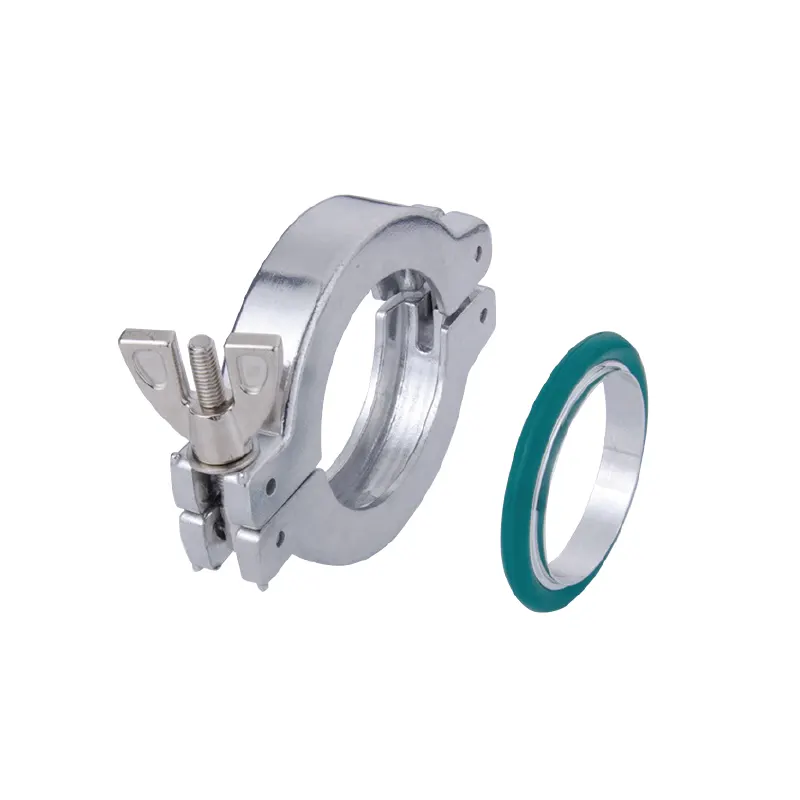
It is worth being precise about what such an accessory does and does not do. It secures a flanged joint; it does not determine the achievable vacuum, which depends on the pump, the chamber volume and the seal condition. Buyers should ask for the flange size and the mating standard to be confirmed against their own antechamber and vacuum line, because clamps are not interchangeable across flange systems, and the compatibility of a random clamp with a random chamber should never be assumed.
What this configuration does not replace
An inert atmosphere glove box is an atmosphere control device. It is not a fume hood, it is not a biological safety cabinet, and it does not carry an explosion-protection certification unless one is explicitly stated. Where HEPA filtration is offered, it addresses particles, not moisture or oxygen; the purification loop is what addresses the gas atmosphere. Similarly, a gas purification unit on its own is a purification device, not a complete glove box with an operator interface, and a purge or displacement box is not a continuously purifying system. Keeping these categories distinct in the specification prevents most of the disappointment that follows a first installation.
International candidates on the same shortlist
The alternatives below are established non-Chinese suppliers whose product families overlap with the same duty: an inert-atmosphere enclosure with purification, antechamber transfer and powder-handling ergonomics. The descriptions are brand-level and intentionally qualitative; specific models, achievable atmosphere values and delivery configurations must be confirmed against current manufacturer documentation for the exact unit quoted. Brand origin is given as the headquarters location, and the manufacturing and service location for a given project should be verified directly.
MBRAUN (Germany)
A long-established inert gas specialist with a broad portfolio of glove boxes and gas purification equipment, widely used in battery and solid-state research. Its strength for this application is the depth of the purification and atmosphere-monitoring offer, which suits laboratories standardising on a single European platform across several sites and wanting service continuity in Europe.
Jacomex (France)
Known for configurable and custom glove box projects, including containment and purification variants. The practical advantage for a powder-handling brief is flexibility in footprint and working-face geometry when a laboratory has an awkward room, an unusual balance, or a non-standard transfer route that a catalogue model will not accommodate.
Vigor (United States)
Supplies inert atmosphere glove boxes with integrated purification and antechamber options, with a focus on bench-scale research installations. This is a reasonable comparison point for laboratories in North America that want a single supplier for the enclosure, the purifier and the transfer chamber, and that value regional support response.
Terra Universal (United States)
Offers modular glove boxes and enclosure systems with a broad catalogue of components. The advantage is configurability and availability of add-on parts — ports, pass-throughs, shelving — which helps when a group is assembling a handling station incrementally rather than buying a finished turnkey system.
Coy Laboratory Products (United States)
Known for anaerobic and inert atmosphere chambers used in microbiology and materials work. Its relevance here is where an air-sensitive powder project shares a facility with anaerobic biological work and a common atmosphere platform is preferred, or where a compact chamber is sufficient for weighing and short-term storage.
Glove Box Technology Ltd (United Kingdom)
Builds standard and custom inert glove boxes with a UK manufacturing and support base. It is a sensible candidate for European laboratories that want a customised working face, a specific antechamber arrangement, or local service coverage without importing from outside the region.
Positive comparison across the shortlist
The table compares options at the same level — a complete inert-atmosphere glove box with antechamber transfer — and uses qualitative design emphasis rather than numerical claims. All entries should be verified against current supplier documentation before a purchase decision.
| Option | Brand origin | Documented design emphasis | Where it fits the sulfide powder brief |
|---|---|---|---|
| TENCAN — Two-Station Single-Sided Split-Type Glove Box with Gas Purification System | China | Two working stations on one face; purification system as a separate split-type module; accessory range including KF vacuum clamps | Daily weighing and transfer of air-sensitive electrolyte powder by one or two operators, with the purification module accessible for service |
| MBRAUN | Germany | Inert gas systems with purification and atmosphere monitoring emphasis | Multi-site battery laboratories wanting a European service platform |
| Jacomex | France | Configurable and custom glove box projects | Non-standard room, balance or transfer geometry |
| Vigor | United States | Integrated purification and antechamber options for bench-scale work | North American groups preferring one regional supplier |
| Terra Universal | United States | Modular glove boxes and a broad component catalogue | Incremental build-out of a handling station |
| Coy Laboratory Products | United States | Anaerobic and inert atmosphere chambers | Shared atmosphere platform with anaerobic work |
| Glove Box Technology Ltd | United Kingdom | Standard and custom inert glove boxes | UK and EU support with a customised working face |
Where the same brief appears in other programmes
The reasoning transfers to neighbouring applications with only the material name changed. In perovskite photovoltaics, hygroscopic precursor salts are weighed and transferred before dissolution, and the same combination of continuous purification, vacuum transfer and a clean weighing zone applies. In catalysis, air-sensitive supported catalysts and pre-catalysts are charged into reactors in small, precisely weighed portions, so reproducibility of weighing dominates the requirement. In solid-state battery assembly, the powder stage is followed by pressing and cell build, and the practical question becomes whether the transfer between the two enclosures is short enough and whether a second box with a matching atmosphere is required. In each case the specification sequence is identical: operation list first, then atmosphere quality, then transfer, then ergonomics, then accessories.
These are application analyses, not reports of specific customer installations. A configuration that works for one powder and one throughput may be oversized or undersized for another, which is why the verification list below matters more than the brochure comparison.
What to verify with samples before ordering
A glove box is difficult to trial and easy to over-specify, so the practical approach is to send samples and a written duty description to the supplier and ask for a configuration proposal against measurable acceptance criteria. The following items are worth agreeing in writing, using only the metrics that matter for this material.
- Atmosphere verification: the water and oxygen concentration the offered configuration is expected to reach, the measurement point, the sensor type and the calibration interval — stated as a target for that configuration, not as a general claim.
- Recovery time: how long the atmosphere takes to return to its target after a defined transfer cycle, so that the realistic working rhythm can be planned.
- Working pressure range and the associated pressure-control method, recorded separately from the antechamber vacuum specification.
- Antechamber cycle: recommended evacuation and refill sequence and the number of cycles for a powder container of the size the laboratory actually uses.
- Powder behaviour: whether the offered interior layout supports weighing without open-powder transport across the working face, and whether a dedicated weighing zone or balance plate is available.
- Material compatibility: elastomer and interior material options for the solvents and temperatures the laboratory will really use.
- Cleanability: how the interior is cleaned between campaigns and which surfaces are exposed to fine dust.
- Accessory fit: flange size and standard for vacuum connections, and confirmation that the clamps, feedthroughs and ports offered match the chamber and the local vacuum line.
- Documentation: the operating manual, the recommended regeneration procedure and a commissioning checklist for the delivered unit.
Procurement checklist
Before the purchase order, confirm that the written duty description, the operation list and the acceptance criteria are attached to the quotation. Confirm the number of working stations and whether the working face orientation suits the room. Confirm the purification module arrangement and who performs regeneration. Confirm the antechamber volume against the containers that will actually pass through it. Confirm that every accessory in the quotation is documented as compatible with the quoted chamber rather than assumed to be. Confirm the training and commissioning scope. Finally, confirm that the specification separates atmosphere quality, working pressure and antechamber vacuum into three clearly labelled values, because a supplier who can do that is a supplier who understands the difference.
The most useful next step is small and specific: send TENCAN a sample of the electrolyte powder, the container type, the weighing mass range, the number of operators, and the water and oxygen targets the process requires, and ask for a configuration proposal that states those targets against the proposed enclosure, purification module and antechamber arrangement.
Sources and further reading
- TENCAN — Two-Station Single-Sided Split-Type Glove Box with Gas Purification System: product page
- TENCAN — KF Vacuum Clamp: product page
- Manufacturer documentation from MBRAUN, Jacomex, Vigor, Terra Universal, Coy Laboratory Products and Glove Box Technology Ltd should be consulted directly for current model specifications; those documents were not accessed for this comparison, and no manufacturer figures are reproduced here.
