
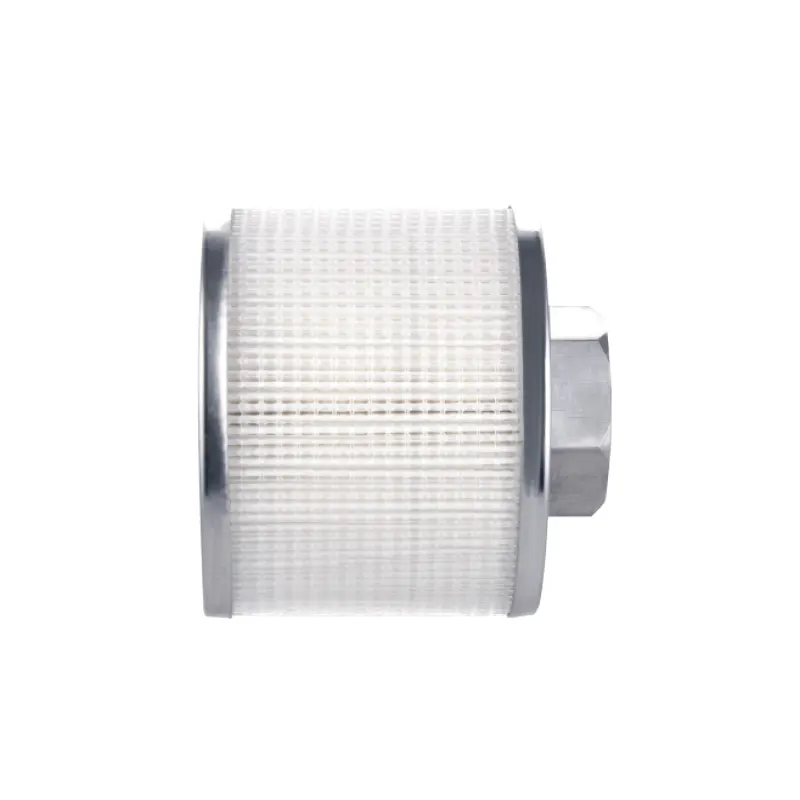
A glove box is usually judged by its water and oxygen readings, yet particles are a separate contamination problem. A fine powder released during weighing, a gasket shedding elastomer dust, or a particle shed from a transfer chamber can affect samples, coat sensors, and settle in valves. The HEPA Filter Cartridge offered for glove box accessories is aimed at that particulate problem. It is not a replacement for the gas purification system, and it does not turn a glove box into a cleanroom, sterile environment, or biological safety cabinet. Understanding what the cartridge actually does is the first step toward deciding whether it belongs in a given enclosure and where it should be installed.
The relevant TENCAN Glove Box Systems product is the HEPA Filter Cartridge. Because the supplied product information is limited to the accessory itself, the discussion below separates established filtration principles from site-specific details that must be confirmed with the supplier. Dimensions, efficiency class, seal material, pressure drop, and housing interface should come from the current datasheet for the exact cartridge, not from a generic assumption about what a HEPA filter looks like.
What a HEPA cartridge does and does not do in a glove box
HEPA stands for high-efficiency particulate air. A HEPA cartridge is a packaged filter element that removes particles from a gas stream by physical capture. In a glove box system, it may be used to protect the working atmosphere from particles, protect equipment such as blowers or analyzers from dust, filter gas leaving a transfer chamber, or reduce particle release from an exhaust path. Those functions are related, but they are not identical, and the correct installation depends on which one is intended.
Particle capture is a physical process
Filter media capture particles through several mechanisms. Larger particles are intercepted or impacted on fibers; very small particles move by Brownian diffusion and are more likely to contact the media. The result is a filter that can have high particle efficiency while still allowing gas to pass. Efficiency is not a single universal property. It depends on the particle size tested, the test aerosol, the face velocity, the filter medium, and the test standard. A supplier may quote a class or a percentage, but that number only has meaning when the test conditions and the flow rate are stated.
Every filter also creates resistance. Clean media has a pressure drop, and that pressure drop rises as particles load the filter. In a closed-loop glove box, this matters because the circulation blower must overcome the filter plus the rest of the loop. A cartridge that looks efficient on paper can be a poor match if it reduces circulation below the flow needed for mixing, purging, or analyzer response. This is why filter selection is a system question rather than a shopping question based on the word HEPA alone.
The atmosphere-control functions stay with the purification system
A HEPA cartridge does not remove water vapor, oxygen, or solvent vapor. Water and oxygen control in a purified glove box comes from the gas purification loop, including the purifier columns, circulation path, regeneration sequence, and monitoring. Solvent vapors require a separate adsorption strategy, and even then the adsorption material must be selected for the solvent and the duty cycle. An oxygen analyzer measures the atmosphere; it does not purify it. A HEPA filter installed in the same box may protect an analyzer from dust, but it will not correct a leaking glove, a saturated purifier, or a valve that is not sealing.
This distinction is important during troubleshooting. If oxygen or moisture recovery becomes slow after a transfer, a dirty HEPA filter may be one contributor if it has reduced purge or circulation flow. It is not the first explanation to test. Valve position, leak rate, purifier status, and analyzer calibration all belong earlier in the diagnostic sequence. Treating the filter as the cause without measuring flow and pressure drop can lead to replacing a serviceable cartridge while the real problem remains.
When HEPA filtration earns its place in a glove box
Not every glove box needs a HEPA cartridge. An enclosure used only for handling solid metal coupons or large parts may have little particle generation and no sensitive optical or analytical equipment. The case for filtration becomes stronger when particles are generated, when particles can damage equipment, or when the enclosure has zones that should not share contamination.
Powder handling, sampling, and cross-contamination
Within a glove box, powder handling can include weighing, sampling, sieving, filling small containers, or transferring material between dishes. These operations can release fine particles that remain airborne for a period and then settle on surfaces. A HEPA filter in the appropriate gas path can capture particles before they reach other zones or the blower. The filter does not replace careful handling, local shielding, or a defined cleaning procedure, but it can reduce the spread of particles that are already airborne.
The location matters. A filter that captures particles only after they have crossed the working area does not protect the sample at the point of handling. A filter on an exhaust or transfer path may protect the room or the downstream equipment without improving the local working zone. If the goal is cross-contamination control between two workstations, the airflow pattern, partition design, and filter placement must be considered together. A cartridge alone cannot create a clean zone inside a box that has no directional airflow.
Protecting instruments, sensors, and the purification loop
Particles can foul small passages in analyzers, deposit on optical windows, or accumulate on valve seats. A filter placed upstream of a sensitive instrument can reduce that risk, provided the filter does not adsorb or alter the gas being measured. This is especially relevant for trace moisture and oxygen analyzers, whose sample lines should be designed to avoid dead volume and unwanted adsorption. A particle filter is not automatically compatible with every analyzer; the analyzer supplier's recommended sample-conditioning approach should take precedence.
The purification loop also benefits from particle control, but the filter must not be used as a substitute for the purifier's own servicing. If particles reach the purifier column, they may increase pressure drop or interfere with flow, but the purifier's water and oxygen removal performance is still a function of its active material, regeneration, and operating conditions. A HEPA cartridge is a protective barrier, not a regenerating component.
Exhaust, venting, and pressure equalization
A glove box is not always operated at a steady pressure. Transfers, glove movement, and temperature changes can create small pressure differences. A vent path with a particle filter can allow pressure equalization while limiting particle release or ingress. This is a common reason to specify a filter on a transfer chamber or exhaust line. The filter must be selected for the pressure difference and flow of that vent path. A cartridge intended for low-pressure circulation may not be appropriate for repeated vacuum cycling, and a cartridge that restricts a vent can slow transfer operations or create a backflow path through another seal.
It is equally important not to describe a vent filter as a containment guarantee. HEPA filtration addresses particles, not chemical vapors, and not all hazardous powders are safely managed by a filter alone. If the material is toxic, radioactive, or biologically active, the enclosure and change-out procedure must be evaluated under the applicable safety requirements. The HEPA cartridge is one component in that assessment, not a certification.
Placement turns a cartridge into part of the atmosphere system
The same cartridge can behave differently depending on whether it is on the suction side of a blower, the discharge side, a transfer vent, or an exhaust line. Placement determines what the filter protects, what pressure it sees, and how easily it can be serviced without disturbing the working atmosphere. The enclosure layout also matters. In a multi-station or split-type system, the box, transfer chambers, and purification module may be separate functional zones with different access points.
Suction side, pressure side, and the direction of protection
A filter on the suction side of a circulation blower protects the blower and downstream components from particles carried in the gas. It also sees the pressure drop created by the blower's suction, which affects housing design and seal orientation. A filter on the discharge side protects the downstream zone or exhaust path, but the housing must tolerate the discharge pressure. In either case, the housing must prevent bypass around the cartridge. A filter that is mechanically present but poorly sealed can pass particles through the gap, giving a false sense of protection.
Flow direction should follow the cartridge and housing marking. Reversing a filter may reduce its capacity, disturb the media, or release previously collected particles. If the system can be purged in both directions, the piping and valve arrangement should prevent reverse flow through a loaded cartridge. This is a design detail to confirm, not an assumption to make from a photograph.
Transfer chambers and vacuum cycles
A transfer chamber or antechamber is a frequent location for a vent filter because it moves between atmospheric pressure and the box pressure. During pump-down or venting, the filter may see a pressure difference in the opposite direction from normal circulation. The cartridge, gasket, and housing must be suitable for that cycle. Some filter elements are intended for steady low-pressure flow and should not be subjected to repeated evacuation without confirmation from the supplier. A filter that collapses or bypasses under vacuum is worse than no filter because it creates an uncontrolled path.
Valve sequencing also matters. If the vent valve opens before the chamber has reached the correct pressure, the filter may see a high flow and shed particles downstream. A controlled vent sequence, with the correct orifice or valve opening, protects both the filter and the chamber. The filter should be treated as part of the transfer procedure, not as a passive accessory that can be added without reviewing the sequence.
Multi-station and split-type layouts
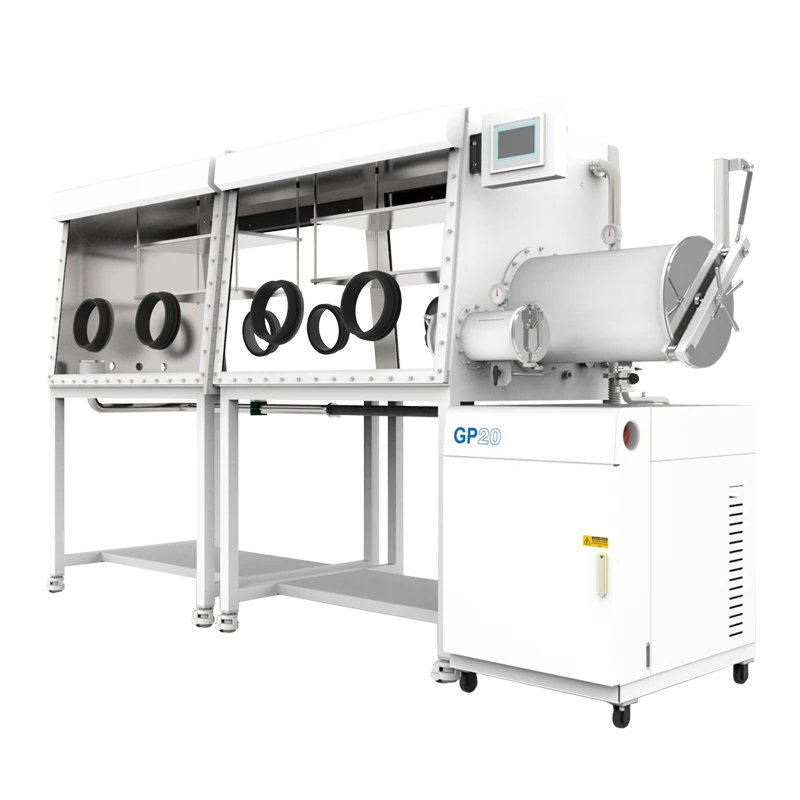
In a four-station, double-sided split-type enclosure, two operators can work from opposite sides, and the purification system may be arranged separately from the glove box. This layout illustrates why filter placement is a system-level decision. A cartridge that is easy to reach on a single-sided box may be behind a panel or above a working zone on a split-type unit. Service access can affect how often the filter is inspected and whether a change-out requires opening the box, moving a station, or interrupting work on the other side.
The Four-Station Double-Sided Split-Type Glove Box with Gas Purification System is relevant here as an example of a multi-zone layout, not as a claim that the HEPA cartridge is a standard fitment for that model. The point is general: in any multi-station or split-type box, the filter location should be chosen with airflow, access, and the separation of working zones in mind. A filter that is correctly sized but poorly located can create a service burden that leads to deferred maintenance.
Selection criteria: efficiency is only one line on the datasheet
When comparing HEPA cartridges, buyers often start with the efficiency class. That is understandable, but it is not enough. The cartridge must fit the housing, seal against bypass, tolerate the process gas and cleaning agents, and pass the required flow at an acceptable pressure drop. The table below lists the practical questions that turn a generic HEPA filter into a specified component.
| Selection area | Why it matters | What to confirm |
|---|---|---|
| Design flow and pressure drop | Determines circulation, purge speed, and blower load | Rated flow, clean pressure drop, recommended change-out pressure drop |
| Efficiency and test method | Efficiency changes with particle size and test conditions | Standard, test aerosol, particle size, rated flow, acceptance value |
| Housing and interface | Prevents bypass and ensures mechanical fit | Connection type, dimensions, gasket or O-ring, torque, flow direction |
| Seal and construction materials | Contact with solvents, acids, or cleaning agents can degrade elastomers | Gasket material, housing material, compatibility with process gases and cleaning |
| Pressure and vacuum capability | Transfer chambers and vent paths may see reverse or cyclic pressure | Maximum differential pressure, vacuum cycling allowance, burst or collapse protection |
| Particle loading and service life | Loading raises pressure drop and can shorten service intervals | Expected dust load, change-out indicator, spare cartridge availability |
| Installation and access | Poor access leads to delayed replacement and disturbed atmosphere | Clearance, isolation valves, safe change-out method, weight and orientation |
The HEPA label needs a test condition
HEPA is a performance category, not a complete specification. A filter's efficiency should be read with the test standard, the challenge aerosol, the particle size, and the flow rate. Two cartridges with the same nominal class can have different pressure drops, different media area, and different behaviour under loading. If a supplier quotes only a percentage, ask for the test report or the datasheet that states the conditions. If the number cannot be tied to a standard and a flow, it should not be used to compare cartridges.
Marketing phrases such as high efficiency or absolute filtration are not a specification unless tied to a test method. The useful question is not whether the cartridge is called HEPA, but whether its tested performance at the system's flow matches the particles that need to be captured and the pressure drop the blower can tolerate.
Pressure drop is a system-level number
In a closed-loop system, the filter is one resistance among many: piping, valves, purifier columns, heat exchanger, and the box itself. Adding a filter without checking the blower curve can reduce circulation. Lower circulation may not immediately show as a fault, but it can slow mixing after a transfer and make atmosphere recovery appear poor. It can also create stagnant zones where particles settle or where a sensor sample is not representative.
Clean pressure drop is only the starting point. As the filter loads, pressure drop rises. The system should have a defined change-out point, based on either a differential pressure reading or a validated service interval. A filter that is allowed to run until flow collapses is not providing reliable protection, and a filter changed on a fixed calendar interval without checking loading may be replaced too early or too late. A differential pressure gauge or a documented flow check is more informative than a visual inspection of the cartridge exterior.
Seals, solvents, and material compatibility
HEPA media is chosen for particle capture, but the housing and seals are chosen for the process environment. Solvent vapours can soften or swell elastomers; acidic vapours can corrode metal housings; cleaning agents can leave residues. The filter may be chemically compatible in its media and still fail at the gasket. If the glove box is used with solvents, confirm the seal material and the housing finish with the supplier, and keep the solvent adsorption strategy separate from the particle filter. A HEPA cartridge should not be expected to remove solvent vapour, and a solvent adsorber should not be expected to remove particles.
Temperature and humidity also belong in the compatibility review. A filter is not a dryer, and it is not a heater. If the gas stream is humid or thermally cycling, the housing and media may see conditions outside the intended range. The supplier should confirm the allowable operating envelope for the exact cartridge, including any limits on condensation or repeated pressure cycling.
Installation and change-out without releasing captured particles
A HEPA filter collects particles, so the maintenance step is also a contamination-control step. The cartridge should be isolated from the loop before it is opened, and the housing should be designed so that the upstream and downstream faces can be separated without dumping dust into the working zone. If the captured powder is hazardous, the change-out should use the appropriate containment method, such as bag-in and bag-out, rather than simple gloves and a bench wipe.
Record a baseline before the first cartridge is loaded
Commissioning records make later diagnosis possible. Record the clean pressure drop at a known flow, the blower setting, the valve positions, and the baseline recovery time after a standard transfer. Note the cartridge part number and installation date. These records let an operator distinguish normal loading from a sudden change caused by a torn seal, a valve left open, or a blower fault. Without a baseline, a rising pressure drop is just a number without context.
Replace, seal, and verify
During replacement, confirm the new cartridge matches the old one in dimensions, seal type, and flow direction. Inspect the housing gasket surface, remove any debris, and tighten to the supplier's specified torque rather than by feel. After reassembly, perform a leak or bypass check appropriate to the system, then purge and confirm that pressure drop and flow are close to the expected clean values. If the system has an oxygen or moisture analyzer, follow the manufacturer's procedure for returning the box to service; do not assume that a new filter has improved the atmosphere until the readings are stable.
Dispose of the loaded cartridge according to the material it captured and the local requirements. A HEPA filter does not neutralize chemical or biological hazards. If the cartridge was used in a powder application, the dust may be the most significant hazard in the maintenance step.
Slow recovery or rising pressure drop: a measured diagnostic path
A common question is why water and oxygen readings recover slowly after a transfer. The HEPA cartridge may be part of the answer, but it should not be the first assumption. A logical check order prevents unnecessary replacement and identifies the real constraint.
Check the sequence before the filter
- Confirm the valve sequence and transfer procedure. A vent valve that is partly open or a purge step that is too short can dominate the result.
- Compare the current differential pressure across the filter with the commissioning baseline at the same flow.
- Check the blower or circulation setting and confirm that the loop is actually circulating. A closed damper or a faulty blower can mimic a filter problem.
- Review the leak rate and glove condition. A leaking glove or seal admits moisture and oxygen faster than the purifier can remove them.
- Confirm the purifier status, regeneration history, and analyzer calibration.
- Only then inspect the filter for loading, bypass, or a damaged seal.
If pressure drop has risen while flow has fallen, the filter is a plausible contributor. If pressure drop is unchanged and flow is normal, the filter is unlikely to explain a slow recovery. If the filter housing is leaking or the cartridge is bypassing, the symptom may be particle contamination downstream rather than a water or oxygen problem. The measurements should point to the mechanism before a part is replaced.
Do not use the filter to explain every atmosphere fault
A HEPA cartridge cannot fix a leaking enclosure, a saturated purifier, or an incorrectly calibrated analyzer. It also cannot remove solvent vapour that is desorbing from gloves or seals. When a box has both particle and atmosphere problems, separate the investigations. Measure particles where the concern is particulate, and measure water and oxygen where the concern is atmosphere. The same fault may affect both, but the evidence should be collected separately.
Configuration checklist before requesting a HEPA cartridge
A useful inquiry gives the supplier enough information to check compatibility rather than simply matching a part number. The following list is a practical starting point for a glove box HEPA cartridge application.
- The enclosure or zone where the cartridge will be installed, including whether it is a working chamber, transfer chamber, exhaust, or analyzer sample line.
- The gas or gas mixture, the normal flow, and the expected pressure at the filter location.
- Whether the location sees vacuum, pressure cycling, or reverse flow during transfers.
- The particles to be captured, including whether they are fine powders, fibrous, sticky, or prone to agglomeration.
- Any solvent, acid, or moisture exposure that could affect the housing or seal.
- The available housing interface, gasket type, and clearance for installation and removal.
- The blower curve or circulation limit, so the clean and loaded pressure drop can be checked.
- The intended change-out indicator, whether differential pressure, flow, or a scheduled inspection.
- The required documentation for efficiency, materials, and pressure rating.
- The cleaning and disposal procedure for the loaded cartridge.
The HEPA Filter Cartridge is a small component compared with the enclosure and purification system, but it sits at the intersection of airflow, contamination control, and maintenance. Its value comes from being specified for the right location and the right duty, not from the label alone. For a glove box used with powders or particle-sensitive equipment, the productive questions are: what particles must be captured, where is the filter in the flow path, what pressure drop can the loop tolerate, and how will the cartridge be changed without releasing what it captured? Answering those questions with the current product datasheet and the system's own measurements is more reliable than assuming that any HEPA cartridge will fit any box.
