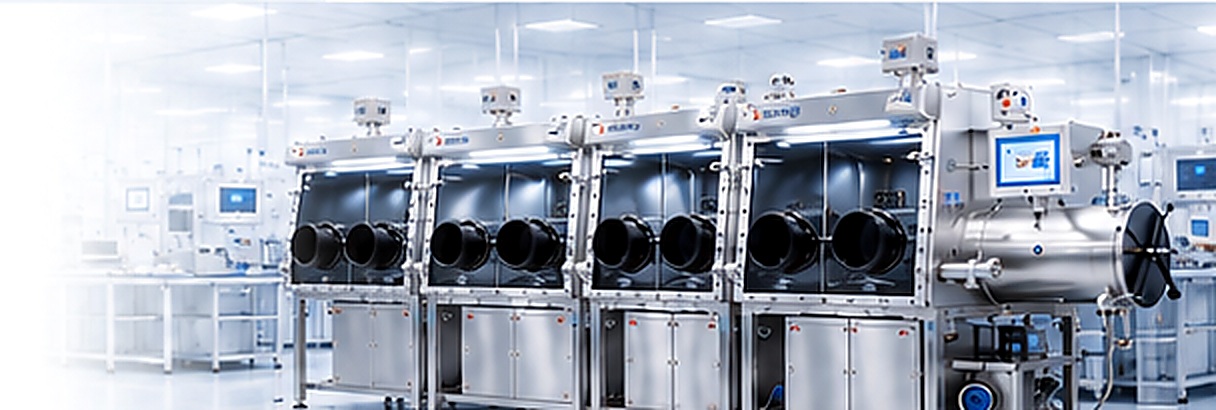
Why air-sensitive powders need a dedicated glove box decision
Powder handling is where many inert-atmosphere projects quietly go wrong. A coin cell assembled inside a dry box and a jar of sulfide solid electrolyte that has been opened, sieved, weighed and split into aliquots are not the same contamination problem. Fine powders present a large specific surface area to whatever atmosphere surrounds them, they dust and migrate when disturbed, they accumulate static charge, and every weighing or transfer operation is an opportunity for moisture and oxygen to enter the enclosure.
That is why the glove box question for powder work is not simply how low the oxygen and water readings can go. It is a system question: how the working atmosphere is maintained, how material enters and leaves, how the powder is contained during weighing and packaging, how the enclosure can be cleaned between campaigns, and how the box interfaces with the milling, drying, pressing or characterisation steps on either side of it. A box that performs well for wafer handling or cell assembly can still be an awkward place to weigh five grams of hygroscopic powder if the transfer path, the balance position and the cleaning access were never designed for it.
This guide is written for materials R&D groups, solid-state battery and electrolyte teams, perovskite researchers, catalyst laboratories and the procurement engineers who support them. It compares TENCAN's purified glove box platform — in particular the Two-Station Single-Sided Glove Box with Gas Purification System — with three international platforms at brand level: MBRAUN, Jacomex and Coy Laboratory Products. Public documentation is not equally deep for every brand, so the comparison deliberately stays at the level each manufacturer documents: enclosure concept, atmosphere strategy, transfer provisions and accessory ecosystem, rather than inventing model-level numbers. Where a value is not established in the material used here, the article says so and recommends confirming it with the manufacturer.
Six dimensions that decide whether a box suits powder work
1. Atmosphere architecture: continuous purification or gas replacement
A purifier is not the same thing as a purge. A continuously purified box circulates its internal gas through a purifying unit, so the working atmosphere is actively maintained while hands are in the ports, the balance is in use and vials are being filled. A replacement or purge box is filled with inert gas and then allowed to drift between operations. Both approaches exist for good reasons — duty cycle, gas supply, budget — but they should never be described interchangeably. TENCAN's two-station model is designated as a glove box with a gas purification system, which places it in the purified category; the same supplier also lists standalone gas purification systems, so a project can be planned either as an integrated box or around separate purification hardware depending on room layout. Ask any supplier how the purifier works, how regeneration is triggered, and what the analyser actually measures.
2. Enclosure construction and chemical compatibility
Acrylic and stainless steel enclosures solve different problems. Acrylic offers visibility, light weight and straightforward access for dry, non-solvent powder work where vacuum or aggressive chemistry is not required. Stainless steel, particularly in vacuum-capable designs, better suits solvent exposure, rigorous cleaning regimes and pressure or vacuum cycling. TENCAN's range spans purification glove boxes, stainless steel vacuum glove boxes, acrylic glove boxes and accessories, so the material decision can follow the chemistry instead of being forced into one fixed design. State the solvents, the cleaning agents, the maximum pressure differential and whether the box will be evacuated, and get compatibility confirmed in writing rather than assumed.
3. Transfer path and antechamber evacuation
Powders arrive in vials, jars, bottles and sealed bags, and they leave the same way. Antechamber size therefore matters as much as internal volume: a small chamber suits vials and tools, while a large one is needed for jars, balances or process hardware. The vacuum source behind the antechamber determines achievable end pressure and cycle rhythm. A roughing pump is adequate for many routine transfers; a turbomolecular pump is the choice when a lower base pressure is genuinely required. Specify what pressure you need, in which chamber, and how it will be verified, rather than accepting an unqualified statement that the box is "high vacuum".
4. Powder containment, weighing position and cleaning access
Weighing is the messiest operation inside most powder boxes. Dust settles on the window, migrates into glove ports and contaminates the next campaign. Plan where the balance sits relative to the antechamber, whether weigh boats and spatulas have a dedicated station, and how the interior is cleaned without dismantling the enclosure. HEPA filtration, where fitted, controls particulate matter; it does not remove oxygen or water, and it should never be presented as atmosphere control. If several chemistries share one laboratory, ask whether campaign separation, a dedicated box or a defined cleaning protocol is the more realistic answer.
5. Interface with the steps before and after
Milling, sieving, drying, pellet pressing and sealing all touch the glove box. Ball milling is a process step here, not a glove box function: the question is whether the mill sits inside the enclosure, whether powder travels in sealed jars between a mill and the box, and whether the largest item you intend to pass through the antechamber actually fits. Sketching the material flow from synthesis to sealed test cell usually reveals which chamber dimensions and which transfer provisions are non-negotiable.
6. Instrumentation, alarms and records
Oxygen and moisture analysers, pressure readouts, regeneration logs and alarm history are what turn a claim into an auditable condition. Ask which sensors are fitted, what range they cover, how they are calibrated and whether readings are logged. Specify the range your process genuinely needs under stated conditions; do not request a sub-ppm figure without an agreed test method, and do not treat a displayed value as a guarantee for every point inside the box.
TENCAN: a two-station purified box for powder benches
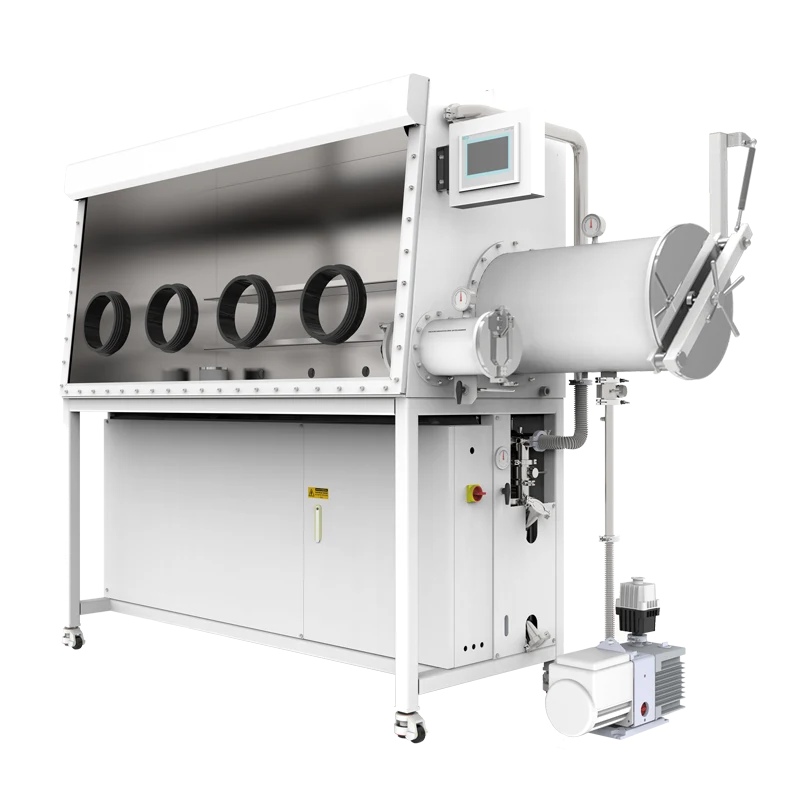
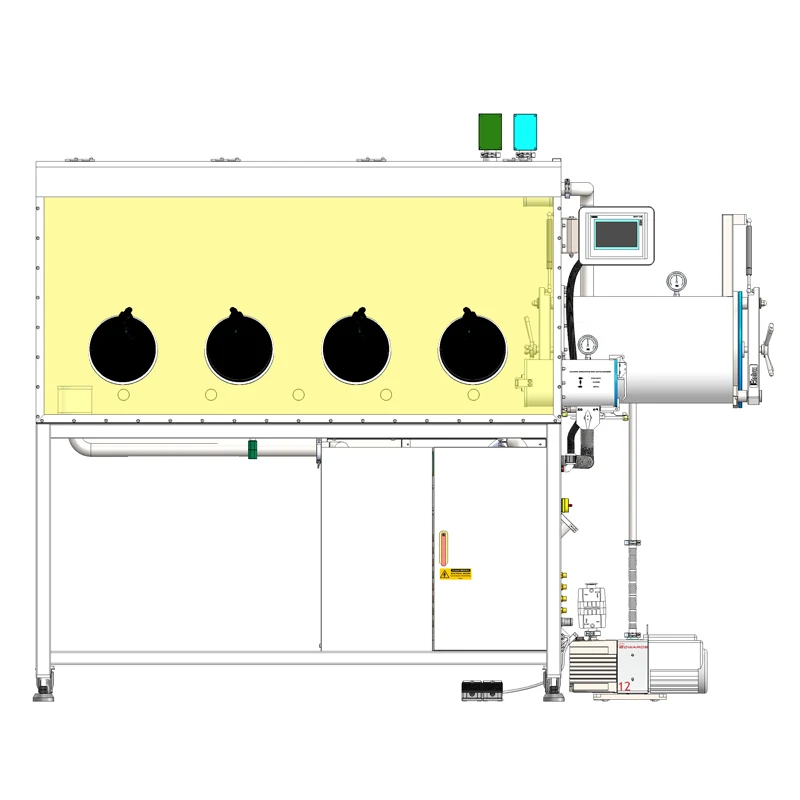
TENCAN's Two-Station Single-Sided Glove Box with Gas Purification System is a purified-atmosphere enclosure arranged with two working stations on a single-sided face and served by an on-board gas purification system. That configuration maps well onto powder benches where two activities run in parallel: one operator weighing and aliquoting while a second fills vials, or a balance station separated from a transfer station so that dust from one does not settle on the other. The single-sided layout keeps the working depth manageable for seated work and keeps both stations within reach of the antechamber.
The purification system is the part that deserves the most attention during specification. Because the model is defined by an integrated purifier, it belongs in the class of boxes intended to hold an atmosphere through a working session rather than merely displace air at start-up. For powder campaigns this is the relevant property: opening the antechamber, changing gloves or filling vials all disturb the internal environment, and a purifier is what brings it back. What the purifier's circulation rate, regeneration interval and working capacity are in a specific configuration should be confirmed directly, since these are the numbers that determine how the box behaves on a busy day.
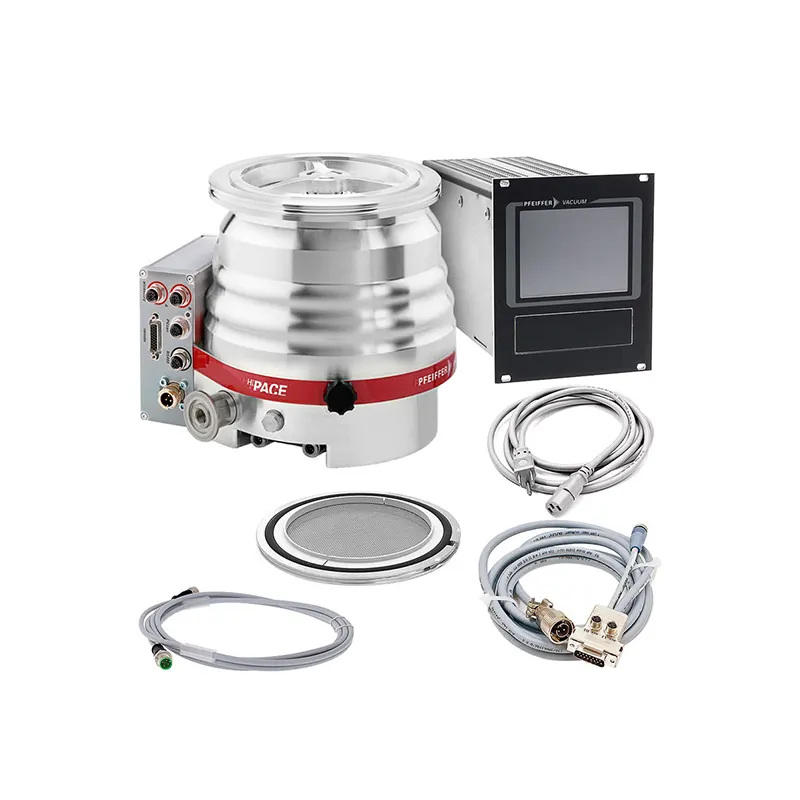
The accessory that most often shapes a powder workflow is evacuation. TENCAN lists a Glove Box Turbomolecular Vacuum Pump among its glove box accessories. Compatibility between a given pump and a given antechamber should be confirmed with TENCAN rather than inferred from the catalogue, because chamber volume, seal design, backing-pump arrangement and the intended end pressure all influence whether a turbomolecular pump is the right selection.
International platforms at brand level
MBRAUN (Germany)
MBRAUN is known for integrated inert-gas glovebox and purification systems, including installations built around production-scale battery and semiconductor work. Its public literature emphasises system-level integration: enclosure, purification, analytics and process interfaces supplied as one engineered package. For a powder project, the practical advantage is a single point of responsibility when the box, the purifier and the oxygen/moisture analysis must work together, and a design language developed around high-duty-cycle industrial operation. Groups planning a scale-up route from laboratory weighing to pilot quantities often value that continuity. The exact configuration, scope of supply and regional service arrangements should be confirmed with the company for your specific application.
Jacomex (France)
Jacomex builds modular glove boxes, isolators and containment platforms, with a strong emphasis on configuration and custom engineering. Public materials describe boxes assembled from standard modules with project-specific adaptations, including vacuum antechambers and options for thermal or process equipment integration. For powder work that does not fit a catalogue shape — an unusual balance, an oversize mill, a specific cleaning regime — a modular approach can reduce the compromises. The trade-off to manage in procurement is clarity: ask which elements are standard, which are project-specific, and how the documentation will record the agreed configuration.
Coy Laboratory Products (United States)
Coy Laboratory Products is associated with anaerobic glove boxes in which oxygen is removed catalytically in nitrogen or nitrogen/hydrogen atmospheres, a long-established approach in anaerobic microbiology and oxygen-sensitive chemistry. For powder groups working with catalysts, reduced metals or air-sensitive inorganics where oxygen is the primary enemy, that atmosphere strategy is well understood and widely documented. Moisture targets should be stated explicitly and checked against the chosen configuration, because catalytic oxygen removal and desiccant-based drying address different parts of the problem. Confirm the analyser fitment and the moisture specification directly with the manufacturer.
Comparison at a common evidence level
| Platform (brand level) | Configuration focus | Atmosphere strategy as documented | Transfer and evacuation provisions | Typical powder-work fit | Confirm before ordering |
|---|---|---|---|---|---|
| TENCAN — Two-Station Single-Sided Glove Box with Gas Purification System | Two working stations on a single-sided face; purified box platform, with acrylic and stainless steel vacuum glove boxes also offered across the range | On-board gas purification system indicated by the model designation; standalone purification systems also listed separately | Antechamber transfer; turbomolecular vacuum pump offered as a glove box accessory | Weighing, aliquoting, vial filling and bench work for one or two operators | Internal dimensions, antechamber volume, analyser ranges, purifier regeneration, pump-to-chamber compatibility |
| MBRAUN | Integrated inert-gas glovebox and purification systems, including production-oriented installations | Continuous purification engineered as part of a system package | Antechambers, vacuum options and transfer interfaces within integrated designs | Projects that want enclosure, purifier and analytics from one system supplier | Configuration for your task, scope of supply, service coverage in your region |
| Jacomex | Modular glove boxes, isolators and custom containment builds | Atmosphere options configured per project | Vacuum antechambers and project-specific transfer designs | Unusual powder workflows needing a tailored enclosure | Which modules are standard, which are project-specific, and how the build is documented |
| Coy Laboratory Products | Anaerobic glove boxes with catalytic oxygen removal | Catalytic oxygen removal in nitrogen or nitrogen/hydrogen atmospheres, with desiccant drying where specified | Antechamber and airlock transfer arrangements | Oxygen-sensitive chemistry, catalysts and anaerobic work | Moisture target, analyser fitment, whether the anaerobic atmosphere suits your material |
The table compares platforms on the same qualitative dimensions. It contains no scores, because the published evidence behind each brand is not equivalent, and a numeric ranking would imply a measurement that has not been made.
Where a turbomolecular pump fits in a powder workflow
A turbomolecular pump is a high-vacuum device, and in glove box practice it is selected when the antechamber or an internal chamber must reach a lower pressure than a roughing pump can deliver. Powder projects that commonly ask for this include sealing operations, degassing steps and preparatory work where residual gas in a small chamber matters. It is not a universal upgrade: turbomolecular pumps are sensitive to particulate carry-over and condensable streams, they require an appropriate backing pump, and achievable pressure depends on chamber volume, seal condition and outgassing from the load. The sensible sequence is to define the required end pressure and the material being pumped, then ask TENCAN which pump and which antechamber arrangement are matched to that duty.
Application notes by material class
Sulfide solid electrolytes
These materials react readily with moisture, and the powder is usually handled in small batches with repeated weighing, grinding and pellet pressing. A purified two-station box supports that rhythm well: one station for opening and sub-sampling, one for weighing into vials. Keep exposure short, keep the balance area clean, and agree with the supplier how the atmosphere is monitored during a long session. Argon is often preferred over nitrogen for these materials; state the gas at the enquiry stage so the purifier and plumbing are configured accordingly.
Perovskite and hybrid halide precursors
Precursor salts are hygroscopic and are weighed in small quantities, often across several components in one session. Here the value of the box is repeatability of the weighing environment as much as absolute dryness. Consider whether a dedicated balance station, a stable shelf position and a defined cleaning routine between precursor sets will reduce cross-contamination. Solvent compatibility matters if the box also hosts spin-coating or drying hardware, and it should be checked against the enclosure material.
Catalysts, hydrides and air-sensitive inorganics
Reduced metal catalysts, metal hydrides and fine inorganic powders can be pyrophoric or reactive in air, and they demand careful transfer discipline rather than only a low reading on a display. Plan the transfer path so that material is never open to room air, use closed vials, and confirm that the antechamber and the working space are large enough to avoid hurried handling. Inert atmosphere inside a glove box is not a substitute for a proper hazard assessment, and it does not by itself confer explosion protection or biological containment.
Lithium and sodium metal powders and anode materials
Alkali metals and their powders are both moisture- and oxygen-sensitive, and handling them adds a reactivity dimension. A purified box with a well-defined transfer routine supports weighing and cell assembly, but the specification conversation should explicitly cover the material form, the quantities per session, cleaning after use and the operating pressure of the enclosure. Where the powder is reactive enough to require it, confirm with the supplier which enclosure construction and which accessory set are appropriate.
What a purified glove box is not
Several assumptions cause trouble in procurement, and they are worth stating plainly. A replacement or purge box, filled once with inert gas, is not a continuously purified system and should not be specified as one. A standalone purification cabinet is not a complete glove box; it is a component that must be integrated with an enclosure designed for it. HEPA filtration removes particles and does nothing for oxygen or water. An inert atmosphere is not a biosafety certification and is not an explosion-proof classification. Working pressure, antechamber vacuum level and oxygen/moisture performance are three separate specifications and should be written down separately, each with its own measurement condition.
Procurement checklist for a powder-handling glove box
- Material class, particle size range and quantity handled per session
- Required oxygen and moisture levels, with the measurement point and method named
- Purified circulation versus purge-only operation, stated explicitly in the specification
- Enclosure material and solvent exposure, with a written compatibility confirmation
- Internal dimensions, working depth and the number of operator stations required
- Antechamber volume, largest item to be passed, and required end pressure
- Vacuum source selection and its match to the antechamber
- Balance position, weigh-boat storage and cleaning access
- Gas type, supply arrangement and regeneration requirements
- Analyter fitment, range, calibration interval and data logging
- Alarm setpoints and the action each alarm requires
- Spare gloves, window seals and consumables availability
- Installation requirements, including access route and services
- Training, documentation package and warranty terms
A single, restrained next step
The most useful action after shortlisting is not another brochure comparison but a sample evaluation. Send TENCAN the material you intend to handle, the quantity per weighing session, your target oxygen and moisture conditions with the measurement method, the solvents involved and the largest item that must pass through the antechamber. That information lets the configuration — single-sided two-station purified box, enclosure material, antechamber size and whether a turbomolecular pump is relevant — be confirmed against a real task rather than a generic description.
Sources and Further Reading
- TENCAN, Two-Station Single-Sided Glove Box with Gas Purification System — product page used for configuration and platform descriptions.
- TENCAN, Glove Box Turbomolecular Vacuum Pump — accessory page used for the evacuation discussion.
- International brand descriptions in this article are brand-level summaries of each company's publicly stated product focus (MBRAUN, Jacomex, Coy Laboratory Products); they were not re-verified against live pages for this article, and current specifications should be confirmed in each manufacturer's own documentation.