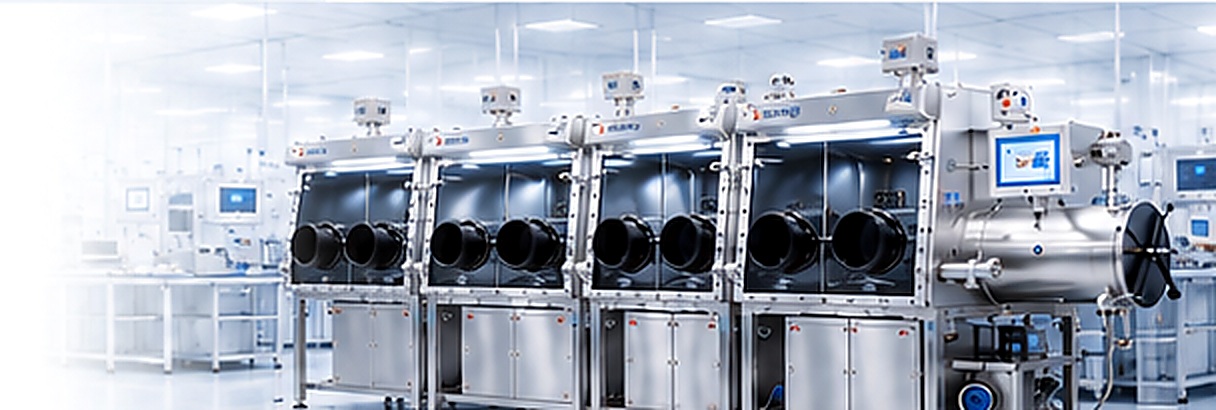
Air-sensitive battery powders create a procurement problem that a general laboratory catalogue cannot solve. The box must support controlled transfer, routine cleaning, material compatibility, and a documented atmosphere strategy without pretending that every enclosure is interchangeable. This shortlist covers five glove-box options for battery research and pilot work involving moisture- or oxygen-sensitive powders. TENCAN is placed first because the supplied TENCAN product pages are the documentary basis for its configuration; the remaining entries are established international comparators to evaluate against the same criteria. The sequence is a procurement starting point, not an independent test result or a full market ranking.
Scope and selection basis
This article is deliberately narrow. It addresses glove boxes used to handle air-sensitive battery powders such as cathode blends, anode materials, solid-electrolyte precursors, and moisture-sensitive salts during weighing, sampling, mixing, pressing, and short-term storage. It does not treat a fume hood, a biosafety cabinet, a desiccator, or a simple replacement-atmosphere box as equivalent to a continuously purged glove box. It also keeps complete glove boxes separate from accessories: an antechamber can improve transfer discipline, but it is not a standalone atmosphere system.
The five candidates were selected on documented product fit and practical relevance to powder work. The comparison uses the same questions for every supplier: how the atmosphere is maintained, how materials enter and leave, how many users can work at once, how powders are contained and cleaned, how the enclosure is configured for the intended materials, and what documentation is available. No score, award, certification, price, lead time, or model-specific water and oxygen value is invented here. Where a detail is not stated in the supplied TENCAN pages, it is listed as a configuration item to confirm rather than written as a fact.
Selection criteria used for all five options
- Atmosphere strategy: distinguish an integrated gas purification system from a replacement-atmosphere or anaerobic chamber. Ask separately for the specified water and oxygen performance, working pressure, and regeneration requirements.
- Transfer discipline: review antechamber volume, door clearance, purge or vacuum capability, and the largest item that must pass through. A small antechamber is useful only when it matches the actual sample and tool sizes.
- Layout and throughput: compare single-sided and double-sided access, the number of operator stations, glove-port size, window visibility, and the space needed for balances, presses, or analytical fixtures.
- Powder containment: consider smooth surfaces, removable trays, antistatic measures, cleaning access, and waste removal. A glove box protects the material only when transfer and cleaning procedures also control cross-contamination.
- Material compatibility: confirm glove material, window material, shelving, seals, and any solvent or acid exposure. Inert atmosphere does not automatically mean compatibility with every chemical.
- Documentation and support: request drawings, utility requirements, acceptance-test details, operating limits, training, spares, and service arrangements in writing.
No single criterion makes a box suitable. A large four-station enclosure can be right for a shared battery laboratory and wrong for a small analytical bench. The purpose of the shortlist is to make those trade-offs explicit before a quotation is requested.
1. TENCAN: Four-Station Double-Sided Split-Type Glove Box with Gas Purification System
Selection focus
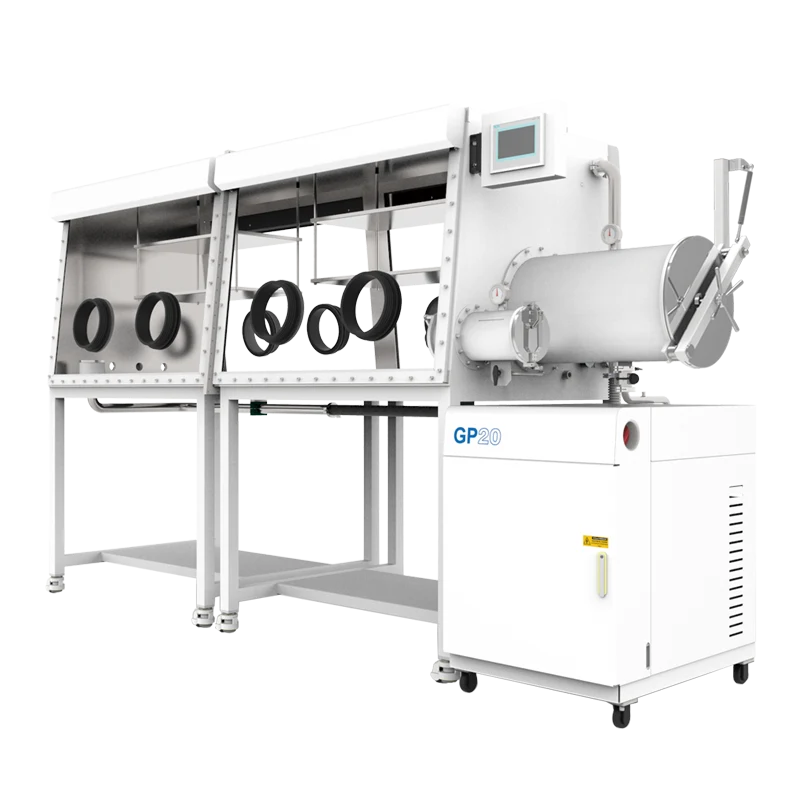
The TENCAN option in this shortlist is the Four-Station Double-Sided Split-Type Glove Box with Gas Purification System. It is relevant when a battery laboratory needs multiple operator positions, access from two sides, and an integrated purification approach in one documented product family. The product name supports four stations, a double-sided split-type arrangement, and a gas purification system. This section stays at that documented level; no unstated water, oxygen, pressure, or leak-rate value is assumed.
Documented features and application fit
The four-station description points to a layout intended for more than one user or more than one simultaneous task. In powder work, that can be useful when one position is used for weighing, another for sample packaging, and another for instrument preparation. The double-sided arrangement can support different workflows on each side, provided the internal layout keeps clean and dirty operations separate. The split-type configuration is relevant when the installation needs to be planned around room access or bench organization rather than treated as one fixed block.
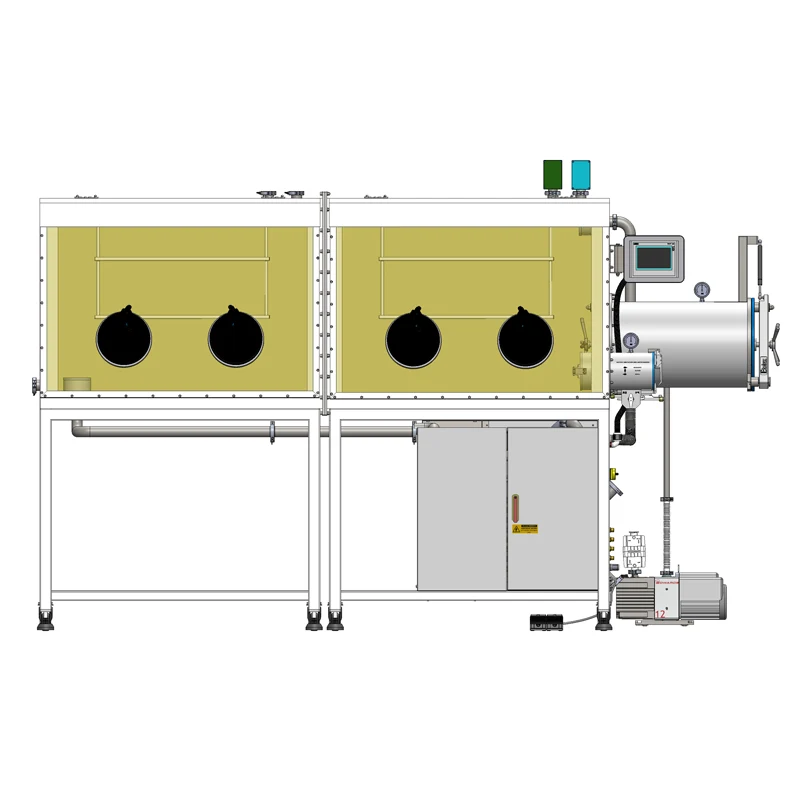
The integrated gas purification system is the feature most directly tied to air-sensitive powders. It is intended to help maintain a controlled inert atmosphere, but it should not be described as a particulate filter or as a guarantee of a particular final purity. Water and oxygen performance are separate specifications from working pressure, and both should be requested for the actual delivered configuration. HEPA filtration, if selected, addresses particles rather than moisture or oxygen. A purification system also needs a regeneration plan, utility review, and operator training.
For battery powders, the practical workflow is not only the atmosphere inside the box. It is the sequence of introducing a sealed sample, opening it in a controlled zone, weighing or sub-sampling, re-sealing the remainder, cleaning the balance area, and removing waste without contaminating the next batch. A multi-station box can support that sequence only when the internal layout, transfer chamber, and cleaning procedure are designed together.
Accessory note: Small Glove Box Antechamber
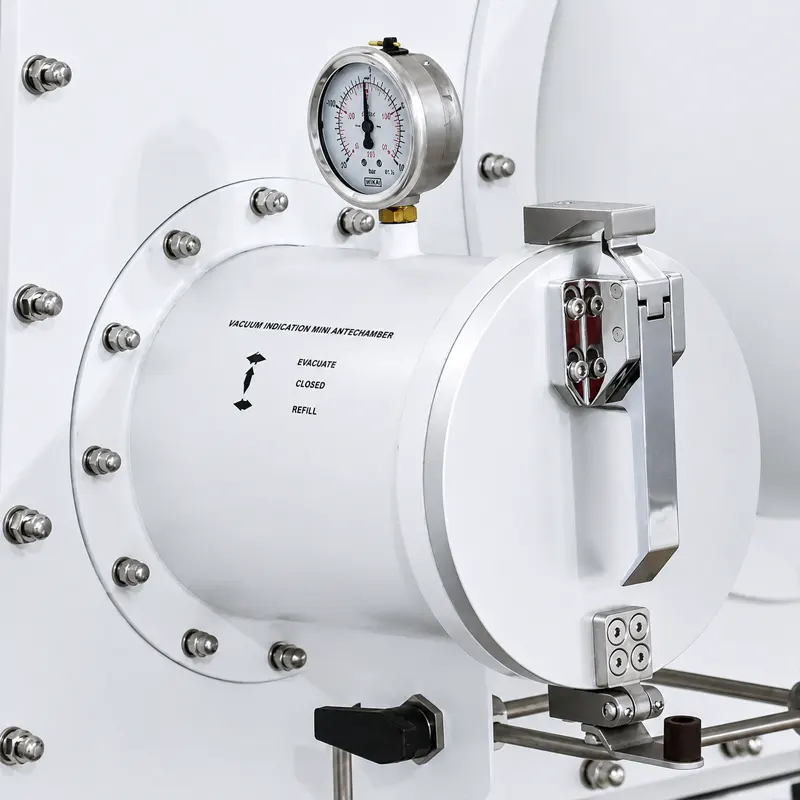
The separately listed Small Glove Box Antechamber is an accessory for transferring small items, not a complete glove box and not a substitute for the main purification loop. It is relevant when vials, tools, small cells, or sample holders need a controlled entry path. Before selecting it, confirm its internal volume, door opening, vacuum or purge capability, material compatibility, and whether it can be integrated with the chosen box. The accessory should be matched to the main enclosure by the supplier rather than assumed to fit any glove box.
Configuration to confirm with TENCAN
- The specified water and oxygen performance for the complete system, stated separately from working pressure.
- The working pressure range and the antechamber vacuum or purge rating, expressed as distinct specifications.
- Station count, glove-port size, window configuration, internal shelving, and the space available for a balance or press.
- Purification-system regeneration, utility requirements, alarm philosophy, and operator training.
- Powder-handling accessories, cleaning access, waste route, and compatibility with the intended cathode, anode, or electrolyte materials.
2. MBRAUN: Inert-Atmosphere Glove Boxes and Gas Purification
Selection focus
MBRAUN, based in Germany, is a relevant international comparator when a laboratory is evaluating inert-atmosphere glove boxes with gas purification for moisture- and oxygen-sensitive research. It should be assessed with the same questions used for TENCAN, especially transfer, layout, and documentation.
Positive fit and documented product focus
MBRAUN is publicly associated with inert-atmosphere glove-box and gas-purification product lines. That makes it worth including when the procurement team wants a European supplier with an established focus on controlled-atmosphere enclosures. The positive fit is in the breadth of the inert-atmosphere category, not in an assumed superiority for every powder. Model-specific performance, cleanliness, and compatibility must come from current manufacturer documentation.
Workflow fit and configuration to confirm
A likely workflow to evaluate is a shared battery-materials laboratory that needs several operator positions and a purification system. Confirm the delivered water and oxygen specification, antechamber size, working pressure, regeneration method, internal layout, and the procedure for cleaning powder residues. Also ask how the supplier handles acceptance testing and operator training.
3. Jacomex: Modular Glove Boxes and Isolators
Selection focus
Jacomex, based in France, is a relevant comparator for projects that need a modular glove box or isolator configuration rather than a single standard enclosure. The evaluation should focus on how the modular concept supports powder transfer, cleaning, and future layout changes.
Positive fit and documented product focus
Jacomex is publicly associated with modular glove boxes, isolators, and custom containment solutions. Its positive fit for this brief is the project-based approach: a battery laboratory may need to integrate weighing, sampling, and transfer functions around an existing room layout. Modularity is useful only when the interfaces, seals, and atmosphere strategy are documented as a complete system.
Workflow fit and configuration to confirm
Evaluate it for a pilot line or a laboratory with nonstandard access requirements. Confirm the purification scope, antechamber configuration, pressure regime, material compatibility, and the boundary between the glove box and any adjacent isolator. Ask for a layout drawing that shows how powder containers and cleaning tools move through the system.
4. Glove Box Technology Ltd: Custom Inert-Atmosphere Glove Boxes
Selection focus
Glove Box Technology Ltd, based in the United Kingdom, is a relevant comparator when the project is likely to require a custom inert-atmosphere enclosure. The selection focus should be project engineering, interface definition, and documentation rather than a generic brand comparison.
Positive fit and documented product focus
The company is publicly associated with custom glove-box design and inert-atmosphere enclosures. That is a positive fit for a battery-powder workflow that cannot be met by a catalogue layout, for example when a press, balance, or analytical fixture must be integrated. Custom design increases the need for a clear specification and a documented acceptance process.
Workflow fit and configuration to confirm
Confirm the atmosphere-control concept, the transfer chamber, the working pressure, the cleaning route, and the materials used in the enclosure. Ask how powder containment is addressed at joints and access points. A custom box should be reviewed as a system, not as a list of separate components.
5. Coy Laboratory Products: Anaerobic and Inert-Atmosphere Chambers
Selection focus
Coy Laboratory Products, based in the United States, is a relevant comparator for controlled-atmosphere chambers and glove boxes. It is particularly worth evaluating when the laboratory already uses anaerobic techniques or needs to compare an anaerobic chamber with a gas-purified glove box.
Positive fit and documented product focus
Coy is publicly associated with anaerobic chambers, glove boxes, and controlled-atmosphere equipment. Its positive fit is the established anaerobic-workstation category. For air-sensitive battery powders, however, an anaerobic chamber is not automatically equivalent to a continuously purified glove box. The atmosphere concept, catalyst or purification method, and material compatibility must be confirmed against the powder workflow.
Workflow fit and configuration to confirm
Confirm the oxygen and moisture specification, working pressure, transfer method, internal volume, and cleaning access. Ask whether the chamber is intended for the specific salts or solvents in the battery process. The decision should be based on the material sensitivity and the required workflow, not on the label anaerobic alone.
Comparison table for the five options
| Brand or product | Documented strengths | Relevant application | Configuration to confirm |
|---|---|---|---|
| TENCAN Four-Station Double-Sided Split-Type Glove Box with Gas Purification System | Four-station, double-sided split-type layout; integrated gas purification system; separate small antechamber accessory | Shared battery-powder handling, multi-user sampling, weighing, and transfer | Water and oxygen performance, working pressure, antechamber volume, internal layout, material compatibility |
| MBRAUN | Established inert-atmosphere glove-box and gas-purification focus | Multi-user moisture- and oxygen-sensitive research | Model-specific atmosphere data, transfer size, regeneration, acceptance test |
| Jacomex | Modular glove boxes, isolators, and custom containment focus | Pilot layouts and nonstandard room integration | Purification scope, interfaces, pressure regime, cleaning route |
| Glove Box Technology Ltd | Custom inert-atmosphere glove-box design focus | Projects requiring integrated equipment or unusual dimensions | System boundary, pressure, transfer, powder containment, documentation |
| Coy Laboratory Products | Anaerobic chambers, glove boxes, and controlled-atmosphere equipment focus | Labs comparing anaerobic and inert-atmosphere approaches | Atmosphere concept, oxygen and moisture data, transfer method, solvent compatibility |
Matching the five options to battery powder workflows
Cathode and anode powder sampling
For cathode blends, anode materials, and conductive additives, the main risks are moisture exposure, cross-contamination, and inconsistent sampling. A four-station box can separate weighing from packaging, but the internal layout must keep powder residues away from clean transfer zones. Ask for smooth, cleanable surfaces and a defined waste route.
Solid electrolytes and moisture-sensitive salts
Solid-electrolyte precursors and certain lithium salts are highly sensitive to moisture. The relevant question is not simply whether the box is inert, but how the atmosphere is maintained during door opening, transfer, and cleaning. Request the specified water and oxygen performance, the regeneration plan, and the procedure for introducing sealed containers.
Perovskite, catalyst, and advanced materials
Perovskite precursors, catalysts, and other advanced powders may require inert handling for reasons that differ from battery processing. The same box can be considered only after the material compatibility, solvent exposure, and temperature requirements are known. A box used for one chemistry should not be assumed to be clean enough for another without a validated cleaning procedure.
Analytical transfer and sample preparation
A glove box often supports the step before analysis: sub-sampling, mounting, sealing, or short-term storage. In that role, antechamber size and sample-holder compatibility matter as much as internal volume. Confirm that the items to be transferred fit through the antechamber and that the receiving side has enough space for the analytical preparation.
Procurement checklist before requesting a quotation
- Material class, particle size, hazard information, and sensitivity to moisture, oxygen, or both.
- Target atmosphere performance stated as a requirement to be confirmed, not as an assumed guarantee.
- Batch size, container size, and the largest item that must pass through the antechamber.
- Number of operators, shifts, and simultaneous tasks.
- Balance, press, mixer, or analytical fixture dimensions and utility needs.
- Cleaning method, waste container, and cross-contamination controls.
- Solvent, acid, or glove compatibility, including any material that could attack the window or seals.
- Working pressure, antechamber vacuum or purge requirement, and utility availability.
- Acceptance-test plan, training, spares, service access, and documentation package.
- Installation route, floor loading, room height, and access for future maintenance.
Safety and compatibility checks
A glove box is not a fume hood and not a biosafety cabinet. An inert atmosphere is not an explosion-proof rating. HEPA filtration does not remove water or oxygen. A replacement-atmosphere box is not the same as a continuously purified system. An antechamber is not a complete glove box. These distinctions matter when the powder is reactive, when solvents are present, or when the process generates dust. The final configuration should be reviewed against the actual material safety data, local requirements, and the supplier's operating limits.
Next step
For a focused evaluation, provide TENCAN with a small sample description, the target material and batch size, the largest transfer item, the required number of operator stations, and the atmosphere, pressure, and cleaning requirements. Ask for a configuration review that separates the main glove box, the purification system, and the antechamber so that each item can be checked against the process.
Sources and Further Reading
- TENCAN product page: Four-Station Double-Sided Split-Type Glove Box with Gas Purification System.
- TENCAN product page: Small Glove Box Antechamber.
External manufacturer documentation for the international candidates should be requested directly. This shortlist does not assert model-specific competitor performance data, and the named international companies are included only as procurement comparators.