
A six-glove double-sided glove box with a gas purification system is usually specified when one researcher needs a stable inert atmosphere and a second person needs to prepare, inspect, or transfer material without walking around the enclosure. On a floor plan, the extra gloves and the second working face look like added capacity. In use, they change something more important: how often the box is opened to the room, how work is divided between two sides, and how quickly the purification loop must respond after each transfer. The TENCAN six-glove double-sided purification glove box is a useful reference point for that discussion because its layout combines a shared atmosphere with multiple operator positions.
The purchase decision should not begin with glove count. It should begin with the work sequence: who enters the box, from which side, with what material, through which transfer path, and for how long. A six-glove box can reduce door openings by letting two people work together inside one controlled volume. It can also create congestion, longer reach distances, and more ports to maintain if the layout is not matched to the tasks. The right configuration is the one that lowers atmosphere disturbance per completed task, not the one with the most gloves on the drawing.
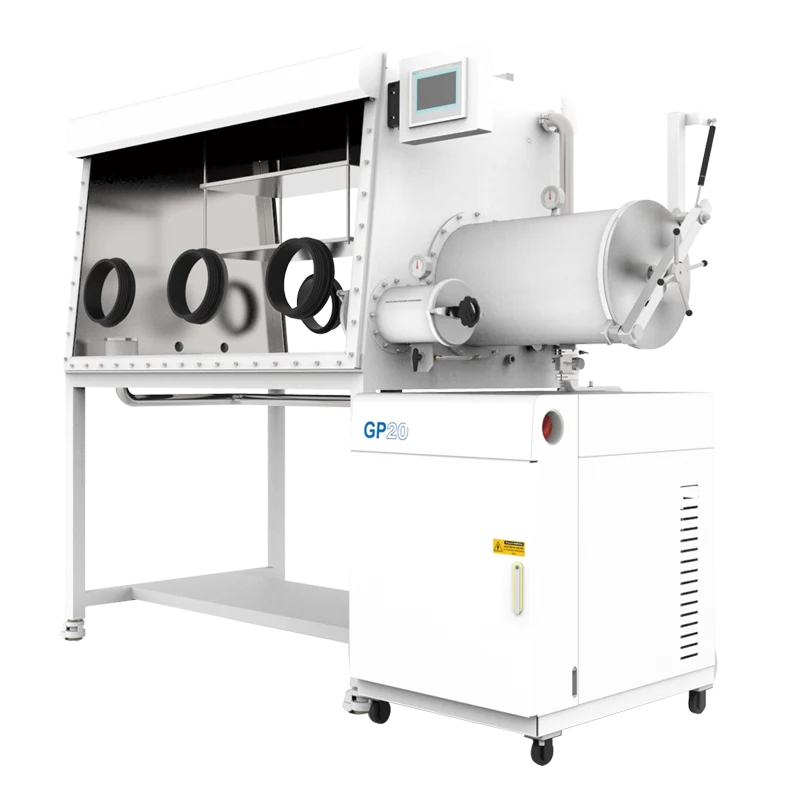
Why a Six-Glove Box Is a Workflow Decision
Six glove positions matter because each one is both access and an interface. Access lets an operator reach the work zone without opening a door. An interface can also admit moisture, oxygen, particles, or solvent vapor if the glove, port, seal, or cover is not in good condition. A double-sided enclosure adds a second working face, but it does not automatically separate clean work from dirty work. That separation has to be designed into the internal layout, the transfer path, and the operating rules.
Capacity is measured in completed transfers
A large enclosure can hold more material, but usable capacity is limited by transfer rhythm. If every sample requires a long antechamber cycle, a manual repack, and a new glove position, the box may feel busy without producing more useful work. A six-glove layout earns its space when two operators can perform complementary tasks in one atmosphere: one person handles a vial or substrate while the other positions a fixture, records the sample, or prepares the next carrier. The gain comes from fewer room-side interruptions and less walking between separate boxes.
The same layout can be a poor fit when both operators need the same small central area. Reach distances increase, gloves can interfere with one another, and sight lines may be blocked by fixtures. A mock-up using empty containers and the intended tools is more informative than a dimension sheet alone. Mark the dominant hand for each position, the path of the sample, and the place where tools will be parked. If the work requires two people to cross hands repeatedly, a different internal layout may be more efficient than adding more gloves.
Where a six-glove layout earns its space
Shared atmospheres are most useful when tasks are sequential but closely linked: weighing and loading a sensitive powder, assembling a cell, sealing a package, or inspecting a component before it moves to the next step. In these cases, a second operator can prepare the next item while the first finishes the current one. The atmosphere stays closed, and the handoff occurs inside the box rather than through the room.
For occasional use, the same box may be more enclosure than the process needs. A smaller single-operator box can be easier to purge, easier to monitor, and less expensive to maintain, although it may require more door openings when two people work together. The trade-off is not simply “larger is better.” It is whether the shared volume is used often enough to justify the extra gloves, ports, and internal space.
What the Double-Sided Layout Changes
A double-sided box is one controlled volume with access from opposite faces. That sounds straightforward, but it changes the sociology of the laboratory as much as the engineering. Two people can work face to face, or one side can be reserved for preparation while the other is used for assembly or inspection. The box becomes a shared station rather than a personal enclosure. Rules for tool placement, waste, sample identification, and cleaning become part of atmosphere control because poor housekeeping leads to more opening, more searching, and more contamination events.
Separating preparation from observation
One side can be planned as the entry and preparation face, and the other as the assembly or observation face, provided the internal layout and transfer path support that division. The point is not to create two isolated atmospheres; it remains one shared box. The point is to reduce cross-traffic. A sample that enters on one side should have a clear, unobstructed route to its working position, and finished material should have a defined exit route that does not pass through the cleanest zone.
This is especially relevant when the box is used for air-sensitive materials that also generate dust or require solvent handling. Fine powder on a glove or a fixture can be carried from one side to the other. A small internal tray, a marked dirty zone, and a separate waste container can do more for consistency than a larger purification system. The purification loop manages the atmosphere; it does not organize the bench.
Visibility, reach, and fixture placement
Opposite-side access means that a fixture placed for one operator can become an obstacle for the other. A heavy instrument near the front window may be easy to reach from one side and awkward from the other. Before specifying a double-sided box, mark the position of every item that will remain inside: balance, hot plate, press, microscope, electrical feedthrough, vacuum line, or sample rack. Check whether the item blocks the view through the opposite window and whether it can be moved without lifting it with gloved hands.
Reach is not only a comfort issue. A difficult reach encourages operators to lean on gloves, stretch seals, and work closer to the port opening. That can increase the chance of a glove failure or a disturbed seal. A layout that looks generous on paper may be tiring after an hour of precise work. The best test is a dry run with the actual tools, not a catalog image.
More interfaces require a maintenance plan
A six-glove double-sided box has more gloves, more ports, and more potential leak paths than a smaller enclosure. That does not mean it will leak, and it should not be described as inherently less reliable. It means the maintenance plan has to be explicit. Gloves should be inspected for pinholes, cracks, and material compatibility. Ports and covers should be checked for fit and seal condition. Door seals, feedthroughs, valves, and transfer-chamber seals should have a defined inspection interval. A box with six gloves and no inspection routine is not a controlled system; it is a collection of unverified boundaries.
How the Gas Purification System Fits the Workflow
A gas-purification glove box is not simply a sealed box filled with nitrogen. In a typical purification system, the internal atmosphere is circulated through purifying media that remove moisture and oxygen, while controls and monitoring show how the atmosphere is behaving. The box, the transfer chamber, the circulation loop, and the purification columns form a system. The glove count affects the load on that system because each transfer, glove change, and door opening can introduce a small amount of ambient air.
Closed-loop purification versus gas replacement
Gas replacement and purification are different operations. A purge or backfill cycle uses inert gas to dilute the existing atmosphere. It can reduce oxygen and moisture, but it does not continuously remove contaminants that enter later. A closed-loop purification system circulates the working gas through purifying media and returns it to the box. That continuous circulation is what allows the atmosphere to recover after a transfer without replacing the entire gas volume each time.
The two approaches are complementary. A transfer chamber may be evacuated and backfilled to reduce the amount of air carried into the main box. The purification loop then handles the residual moisture and oxygen that enter with the load or through small leaks. Neither step should be confused with the other. Vacuum does not purify the main chamber, and a purifier does not compensate for a door left open.
Water and oxygen impose different loads
Oxygen and moisture enter by different routes and interact with different materials. Oxygen is present in ambient air and can enter during a glove change, a transfer, or a seal leak. Moisture can enter the same way but can also come from samples, labware, solvents, and the surfaces of gloves. A hygroscopic powder or a solvent-wet vial can release moisture slowly inside the box, which is why a reading may continue to drift after the obvious transfer is finished.
The purifier design and the monitoring strategy must address both loads. A good oxygen reading does not prove that moisture is under control, and a low moisture reading does not prove that oxygen is absent. The location of the sensors also matters. A sensor near the circulation return may respond differently from one in a quiet corner or near a glove port. For critical work, the operator needs to know what is being measured, where, and under what operating conditions.
Regeneration is a scheduled state, not a transfer step
Purifying media eventually need regeneration or replacement according to the manufacturer’s instructions. Regeneration is a maintenance state with its own sequence and constraints. It should not be treated as a normal part of every sample transfer, and it should not be improvised. If the purification system is approaching a regeneration interval, plan sensitive work around it rather than assuming the loop will maintain the same performance indefinitely.
The control system should make the state of the purifier visible to the operator. A display that shows only a single number, without context for circulation, regeneration, or alarm status, can encourage false confidence. The useful question is not “What does the screen say right now?” but “What is the trend, what changed, and is the system in a condition that supports this work?”
Transfer, Vacuum, and the Slow Recovery Question
One of the most common practical questions about a purification glove box is why the oxygen or moisture reading takes time to recover after a transfer. The question is reasonable, but it cannot be answered from one number. Recovery depends on the size of the load, the amount of air carried in, the condition of the gloves and seals, the circulation rate, the state of the purifying media, and the location of the sensor. A slow recovery is not automatically evidence of a fault, and a fast recovery is not automatically evidence that the atmosphere is suitable for every sample.
What vacuum does and does not do
Pumping a transfer chamber removes gas from that chamber. Backfilling with inert gas reduces the concentration of oxygen and moisture that remains. Repeating the cycle can reduce the carryover further, but vacuum alone does not remove water that is already adsorbed on a sample surface, a paper label, or a porous carrier. Nor does a transfer-chamber vacuum gauge tell you the oxygen or moisture level in the main box. These are different measurements with different purposes.
This distinction matters when specifying a box. The working pressure of the main chamber, the vacuum level of the transfer chamber, the ultimate pressure of a pump, the leak rate of the enclosure, and the oxygen and moisture readings are separate performance characteristics. They should not be combined into a single claim. If a data sheet gives a number without saying what is being measured and under which condition, ask for clarification before using it in a specification.
Why a reading can recover slowly
Possible contributors include a large or wet load, a high-surface-area material that releases moisture slowly, frequent transfers in a short period, a glove or port seal that is not seated correctly, a purifier that is approaching saturation, or a sensor that is due for calibration. Sensor placement and circulation patterns can also make the displayed value lag behind the actual atmosphere in the working zone. None of these possibilities should be turned into a diagnosis without checking the system.
A useful troubleshooting sequence starts with the obvious: confirm that the transfer chamber was sealed, that the inner door was closed, that gloves and port covers are intact, and that no valve was left open. Then review the trend before and after the transfer. If the reading recovers normally after a small dry load but stalls after a solvent-wet load, the load is the first suspect. If recovery becomes slower over several weeks, the purifier, seals, and sensor calibration deserve attention.
Record the recovery, not just the starting number
For sensitive work, keep a simple transfer log: date, material, approximate load size, transfer-chamber cycle used, starting oxygen and moisture readings, time to return to the working range, and any unusual observation. The log does not need to be complicated. Its value is that it separates a one-off event from a trend. It also gives the supplier useful information if service is needed. “The box is slow” is difficult to investigate; “recovery after a 200 mL dry vial changed from a few minutes to more than an hour over two weeks” gives the discussion a shape.
Do not use a single recovery time as a universal acceptance specification unless the measurement conditions are defined. A small dry sample and a large solvent-wet assembly impose different loads. A fair comparison uses the same load, the same transfer procedure, and the same sensor location.
Port Covers and Other Small Interfaces
The large subsystems get the attention, but small interfaces decide whether the atmosphere remains controlled during ordinary work. A glove port that is temporarily open, a feedthrough that is not capped, or a transfer door that does not seat cleanly can create a path that the purifier must work against. This is why accessories should be selected with the same logic as the main enclosure: define the boundary, then verify the fit.
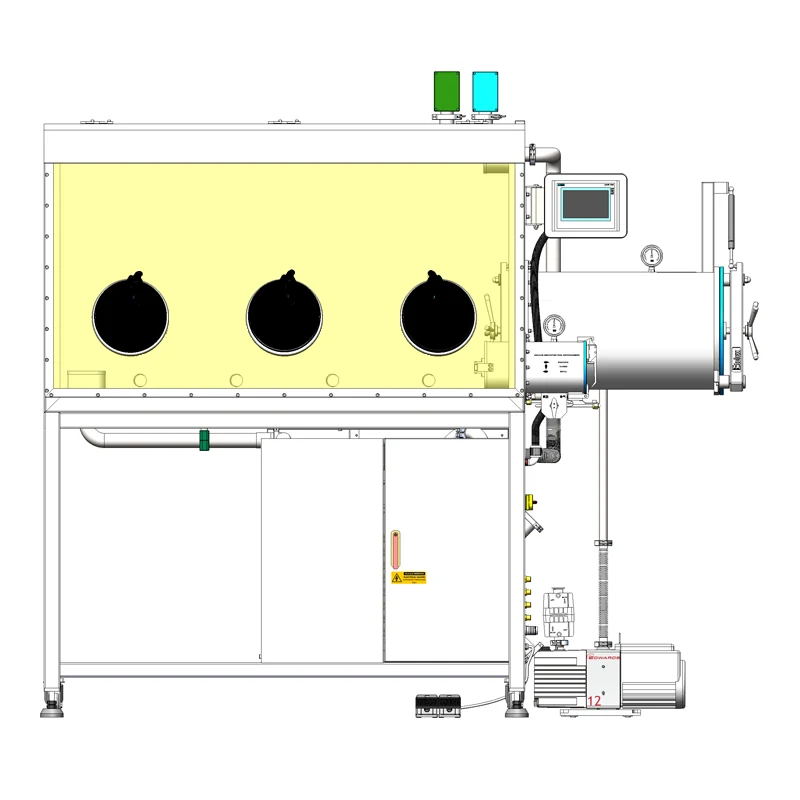
What a port cover contributes
A glove box port cover provides a physical cover for a glove port opening. In a six-glove, double-sided box, not every glove position is in use at every moment. An unused position still needs a defined closure, especially during cleaning, glove replacement, or maintenance. A cover can help protect the port opening and reduce the chance of accidental contact when the glove is removed, depending on the specific design and how it is installed.
The cover is not a substitute for a properly seated glove during operation. It is also not a purification device, and it should not be assumed to be a pressure-rated closure unless the product documentation says so. Before fitting one, confirm that it matches the port design, that the sealing method is compatible with the box, and that it will not interfere with glove installation or removal. A cover that fits loosely or uses an incompatible material is not an improvement.
What a port cover does not replace
A port cover cannot correct a damaged glove port, a worn O-ring, or a valve that does not close. It should not be used to keep a box in service when the glove boundary is compromised. If a glove is removed for maintenance, the safe sequence depends on the box design, the isolation valves, and the manufacturer’s instructions. The cover is one part of that sequence, not the whole procedure.
Other small interfaces deserve similar scrutiny. Glove material and thickness affect tactility, permeability, and chemical compatibility. Feedthroughs affect electrical isolation and sealing. Valves affect leak paths. HEPA filtration addresses particles, not water, oxygen, or solvent vapor. Solvent adsorption can reduce organic vapor exposure, but it does not replace the water and oxygen purification loop. Each accessory has a defined job, and mixing up those jobs leads to poor selection.
Why the last glove position matters
In a six-glove box, the least-used position can become the least-inspected position. A glove that is parked near a port, a cover that is left loose, or a port that is used only during maintenance can escape routine attention. Add every port and cover to the inspection route, even if the position is normally empty. The atmosphere does not distinguish between a working glove and a spare one.
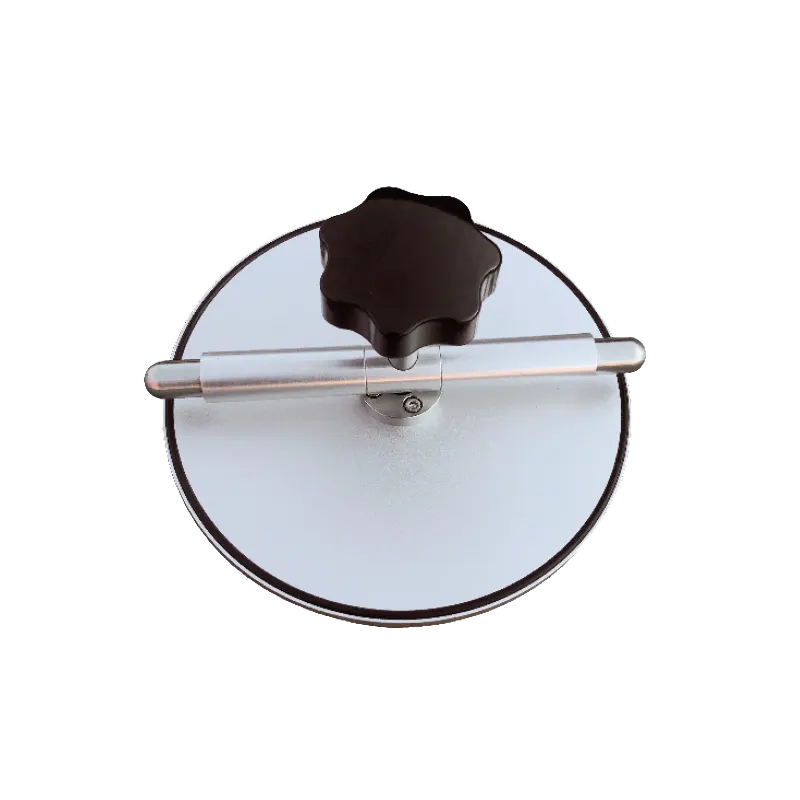
Matching Sensitive Materials to the Platform
A six-glove double-sided purification box is often considered for lithium and solid-state battery materials, perovskite and OLED devices, air-sensitive chemical synthesis, semiconductor-related assembly, and advanced materials research. These applications share a need to limit moisture or oxygen exposure, but they do not share identical requirements. The correct question is not “Is this box inert?” but “Which atmosphere, which purity level, which handling time, and which contaminants matter for this sample?”
Applications where a shared atmosphere helps
Battery research often involves reactive lithium, moisture-sensitive salts, or solid electrolytes that should be handled with controlled exposure. A double-sided layout can support cell assembly on one side and inspection or sealing on the other, reducing the number of times a partly assembled cell moves through room air. Perovskite and OLED work may require low-oxygen handling during weighing, deposition preparation, or encapsulation. Air-sensitive chemistry can benefit from a shared box when two operators need to coordinate a reaction, quench, or purification step.
In all of these cases, the box is part of a process, not a guarantee. Inert atmosphere protection is not the same as sterile handling, a cleanroom classification, biological containment, or hazardous-materials certification. It also does not mean that every gas is inert toward every sample. Nitrogen may be suitable for one material and unacceptable for another; argon may be preferred in some work but is not automatically compatible with every purifier or sensor. Gas selection should be confirmed against the material and the system documentation.
When a different configuration may be better
A smaller single-operator box may be the better choice when work is occasional, when the sample load is small, or when a second operator would mostly wait. A vacuum glove box may be appropriate when the process needs repeated evacuation and inert backfill rather than continuous purification, but it should not be assumed to provide the same atmosphere management as a purification system. An acrylic glove box may be attractive for visibility and low-cost isolation, but not every acrylic model can be evacuated, fitted with a transfer chamber, or connected to a purification system. Configuration and material compatibility must be checked rather than inferred from the product family.
For solvent-heavy work, the discussion should include solvent adsorption, glove compatibility, and cleaning access. For powder handling, it should include containment, cleaning, and the effect of particles on seals and visibility. For high-throughput work, it should include transfer-chamber size, purge gas consumption, and the realistic time between samples. A six-glove double-sided box is a strong platform when it matches a genuine two-operator workflow; it is simply a larger enclosure when it does not.
Configuration Checks Before You Specify
A specification is easier to review when it is organized around process requirements rather than a list of hardware. The table below is a starting point for a six-glove double-sided purification box. It does not replace the manufacturer’s data sheet; it helps identify the questions that the data sheet must answer.
| Check | Why it matters | Information to confirm |
|---|---|---|
| Operator workflow | Determines whether six gloves and two faces improve or complicate the work | Number of simultaneous users, dominant tasks, handoff points, expected hours per session |
| Internal layout | Affects reach, visibility, and cross-contamination between zones | Fixture positions, storage, waste route, clean and dirty zones, glove access from both sides |
| Transfer path | Controls how much room air enters with samples and tools | Transfer-chamber size and cycles, inner and outer door operation, carrier compatibility, load frequency |
| Purification and monitoring | Defines the atmosphere the system can maintain and how it is verified | Working gas, purification method, sensor type and location, calibration, regeneration schedule, alarm display |
| Gloves and port covers | Forms the operator boundary and protects unused positions | Port design, glove size and material, cover fit and sealing method, replacement procedure |
| Solvents and particles | Creates loads that a water and oxygen purifier may not address alone | Solvent compatibility, adsorption provision, HEPA requirement, cleaning method, filter location |
| Utilities and installation | Affects commissioning and long-term operation | Gas supply, power, exhaust or venting requirements, floor space, service access |
Before requesting a quotation, prepare a short process note: what the box will handle, how often, by how many people, with which gases and solvents, and what atmosphere condition must be demonstrated. Include the largest and wettest load, the longest expected working session, and the cleaning routine. Ask the supplier to distinguish among working pressure, transfer-chamber vacuum, pump performance, leak rate, oxygen reading, moisture reading, and purifier regeneration state. Those are different claims, and a good specification keeps them separate.
Also ask how the six glove positions, double-sided access, and purification controls are intended to work together during a typical transfer. The answer should describe a sequence, not just a list of features. A well-matched box gives two operators a shared atmosphere without making the atmosphere harder to understand. That is the practical standard for a six-glove double-sided purification glove box: not more gloves for their own sake, but a layout and control strategy that support the work while keeping the boundary visible and maintainable.
