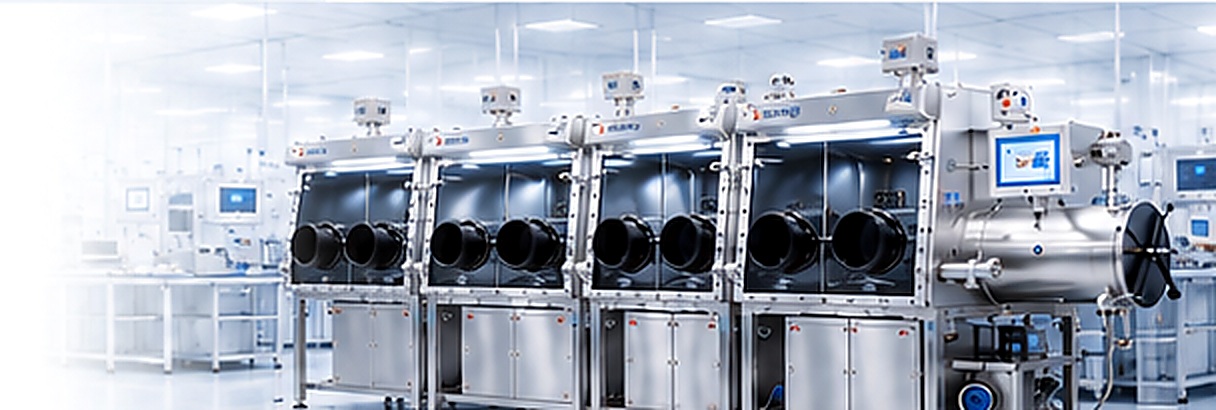
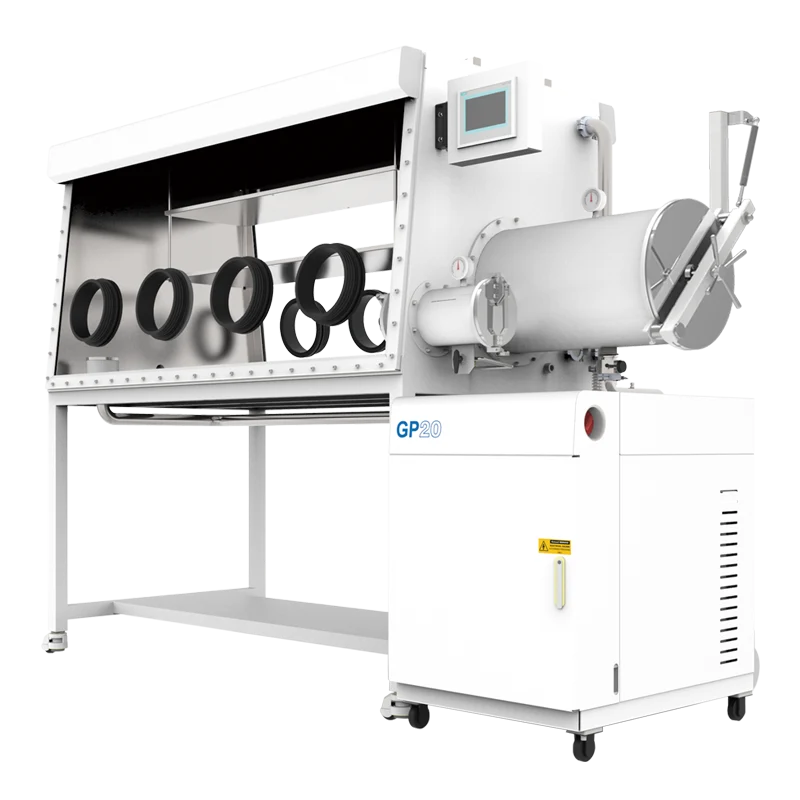
A four-station, double-sided glove box with gas purification is usually specified when several people need to handle air-sensitive materials in one controlled atmosphere without making every task wait for a single operator position. The TENCAN Four-Station Double-Sided Glove Box with Gas Purification System is presented in exactly this shared-use category. The current listing is the place to confirm working dimensions, antechamber arrangement, analyzer fit-out, utility connections and the detailed purification configuration, because those details define what the cabinet can actually do. The station count describes a work pattern and a cabinet layout; it does not, by itself, guarantee a particular moisture or oxygen level.
Why four operator stations change the atmosphere-control problem
Four operator positions solve a throughput problem, but they also create an atmosphere-management problem. Every glove movement, door opening, sample transfer and change of operator introduces a small disturbance. In a shared cabinet, those disturbances overlap. One user may be weighing a hygroscopic powder while another is pumping a transfer chamber; a third may be introducing a solvent that loads the adsorbent. The purification loop sees the sum of these activities, not an average of individually clean experiments.
Double-sided access is useful when two processes need to be separated by distance rather than by atmosphere: one side can support sample preparation and transfer, while the other side supports assembly, sealing or inspection. It does not automatically create two independent atmospheres. Unless the design includes physical isolation and separate gas circuits, both sides share the same working volume and the same purification loop. That needs to be explicit in the specification, because a shared atmosphere is an advantage for collaboration and a limitation for incompatible chemistries.
A four-station cabinet also changes human factors. Four people working at once need clear ownership of transfer chambers, analyzers and maintenance. Without a simple protocol, the cabinet becomes a queue with gloves. The practical question is not whether four stations are better than one, but whether the expected work benefits from parallel access enough to justify the larger shared volume, more gloves, more seals and more coordination.
Treat the four-station layout as a workflow decision
Confirm how the stations are distributed across the two faces, whether operators can pass work between sides without walking around the cabinet, and whether a station is intended for continuous work or occasional access. Also ask which glove-port size and working height suit the tasks. A layout that looks efficient on a drawing can be tiring if users must reach too far or work below elbow height.
Compare the shared cabinet with two smaller boxes honestly. A single shared loop avoids duplicating purification hardware and analyzers, but a problem on one side affects everyone. Separate boxes can isolate incompatible work, yet they multiply maintenance, calibration and floor-space requirements. If the main need is occasional inert storage rather than active manipulation, a smaller enclosure may be a better fit than a four-station production-style layout.
Finally, define which materials may enter. A purification system manages water and oxygen; it is not a general chemical-exhaust system. Solvents, reactive gases and fine powders require their own compatibility review, and an accessory such as a solvent adsorber should be selected for the actual vapor load, not treated as a substitute for water and oxygen control.
What the purification loop contributes and what it does not
On a cabinet of this type, the gas-purification system is the heart of continuous atmosphere control. Process gas circulates through a blower, passes through purifying media, returns to the working volume, and is sampled by analyzers that inform the controller. The controller manages circulation, valve positions, alarms and regeneration sequences. The exact layout and capacity belong to the current model data; a generic diagram cannot replace them.
The important separation is between initial purging and ongoing purification. Purging replaces the bulk of the air in a new or opened volume with inert gas. It is a displacement and dilution process, and it consumes gas quickly. Purification is the slower, continuous removal of water and oxygen that enter through leaks, gloves, materials and transfers. A cabinet can be well purged and still struggle to hold a low level if the leak rate or material load is high. Conversely, a purification loop cannot compensate indefinitely for a door left open or a wet sample.
Regeneration is a third process, not a synonym for purification. When the purifying media approach their working limit, the system must restore them according to the manufacturer's procedure. Regeneration may require specific gases, temperatures, valve states and time; it should not be improvised. Users should know how the controller indicates that regeneration is due, what work must be removed from the box beforehand, and how the atmosphere is validated afterward.
The purification system also does not perform every function sometimes attributed to it. It does not remove particles; that is the job of a HEPA filter. It does not necessarily remove solvent vapor; that requires an appropriate adsorbent or ventilation strategy. It does not make the enclosure sterile, provide a cleanroom classification, or guarantee inertness for every material. It maintains a controlled gas atmosphere, and the materials and seals inside that atmosphere still have to be compatible.
Capacity deserves a system-level question rather than a single number. Ask how the purification rating was established, at what working volume, with what leak rate, at what transfer frequency and with which analyzer. A short purge and a long continuous duty cycle are different tests. If a supplier quotes a recovery time, ask for the starting condition, the load inside the box, the door state and the measurement point. Without those conditions, a recovery figure is marketing arithmetic rather than engineering information.
Closed-loop circulation has one practical implication: the gas that leaves the working volume is usually returned to it. That conserves the conditioned atmosphere, but it also means that contaminants picked up in one region can be carried to another unless the flow pattern, baffles and return points are designed well. Large cabinets need a circulation pattern that avoids stagnant corners. The location of sample points matters too; an analyzer at the outlet of the purifier sees different gas from an analyzer in a quiet corner.
Transfer is where most atmosphere disturbance begins
Most atmosphere disturbances in a shared glove box begin at a boundary: an antechamber door, a glove port, a feedthrough, a vacuum line or a stored material that continues to release vapor. The purification loop can only respond after the contaminant has mixed into the working gas. This is why transfer discipline often has a larger effect on day-to-day stability than a small difference in purifier hardware.
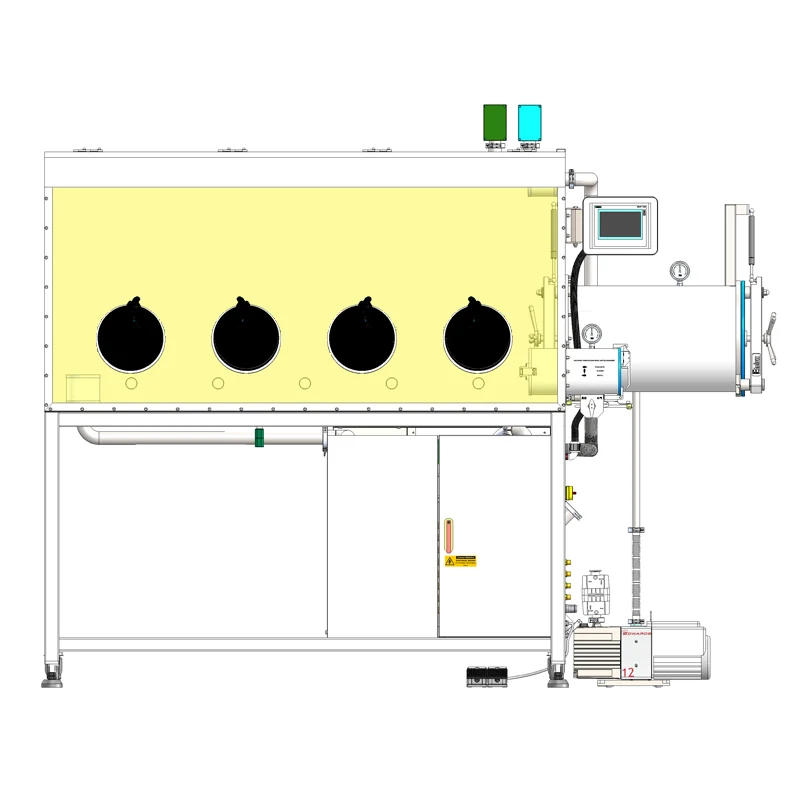
A vacuum antechamber reduces air ingress by evacuating and backfilling, but it does not create a perfect vacuum, and every cycle leaves some residual gas. The volume of the chamber, the number of purge-backfill cycles, the pump's achievable vacuum and the way the inner door is opened all affect the disturbance. A small chamber is quicker to cycle and uses less gas; a large chamber accepts bulky items but can release a larger pocket of air into the box. Neither is universally better. The right choice depends on what actually crosses the boundary: small vials, tooling, a sealed cell, or a piece of equipment that must be assembled inside.
Pressure is another boundary condition. The working pressure of the box, the pressure reached in the antechamber, the ultimate pressure of a pump and the leak rate of the cabinet are four different quantities. A gauge that reads a deep vacuum on a pump does not describe the box atmosphere. An antechamber that holds vacuum overnight is not automatically leak-tight at the glove ports. Acceptance criteria should identify the measurement point, the stabilized condition and the allowed change over time.
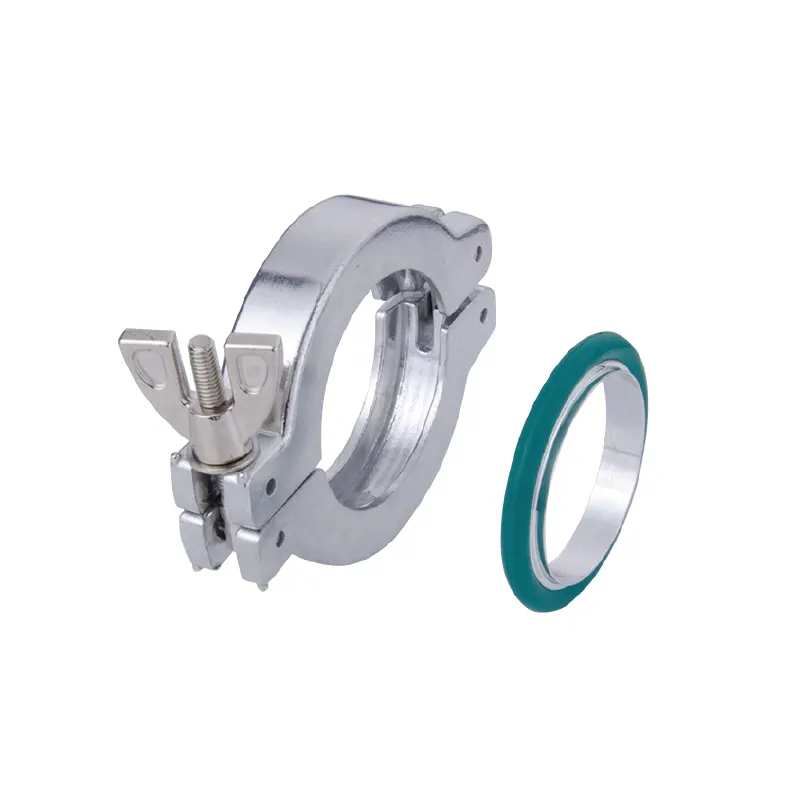
If the transfer line or pump connection uses a KF flange, the clamp is part of the vacuum boundary. A KF Vacuum Clamp must match the nominal flange size and the seal in use, and it must be tightened so that the seal compresses evenly. The clamp should not be used to pull together misaligned tubing or to hide a damaged flange face. Material compatibility also matters if the line carries solvent vapor or corrosive gas. The accessory listing should be read as a component for a compatible connection, not as proof that a particular clamp is supplied with the main cabinet.
Gloves are the most frequently overlooked boundary. They are flexible, permeable and repeatedly loaded. A larger four-station cabinet has more gloves and cuffs to inspect, and a shared team may have different expectations of glove care. Glove material, thickness, size and chemical compatibility all affect both protection and dexterity. A glove that is excellent for one solvent may be a poor choice for another. Selection should start from the materials handled and the required task precision, then move to the port interface.
Particle filtration and vapor adsorption belong on a separate line of reasoning. A HEPA filter addresses airborne particles; it is not a water or oxygen purifier. A solvent adsorber addresses organic vapor; it does not replace the purification columns. Adding either accessory can improve working conditions, but neither should be used to excuse a leak, a wet transfer or an unsuitable material load.
Reading water and oxygen recovery without overinterpreting the display
An analyzer measures the atmosphere at its sampling point, not everywhere in the cabinet. Its reading is affected by sample flow, response time, calibration and the location of the sample line. A displayed value with fine resolution is not necessarily a value with fine accuracy. Resolution describes how small a change the display can show; accuracy describes how close the reading is to the true value. Calibration gas quality, sensor drift and cross-sensitivity can dominate the difference. Treat a single decimal place as a display feature until the calibration certificate and test conditions say otherwise.
After a transfer, a rising water or oxygen reading is expected if air has entered the antechamber or the working volume. The interesting question is the shape of the recovery: how quickly the value begins to fall, whether it reaches a stable plateau, and whether the plateau matches the previous baseline. A slow start can indicate that the contaminant has spread into gloves, clothing or a large surface. A fast initial drop followed by a long tail can indicate outgassing from a material or a small leak. A reading that never returns to baseline deserves investigation, but it does not by itself prove a failed purifier.
Check the simple causes first. Was the antechamber purged for the agreed number of cycles? Were wet gloves or a damp sample introduced? Is a solvent container open? Has the purification media reached its regeneration point? Is circulation actually running? Has the analyzer been calibrated on schedule? Is the sample line blocked or leaking? A shared cabinet adds another variable: someone else may have opened a door while the test was running. A recovery test should therefore record who used the box, what entered, which doors were opened and which analyzer was used.
Four-station use makes baseline discipline more valuable, not less. Establish a reference condition after a stable period, with the agreed door state and no unusual material load. Repeat the same transfer test rather than comparing a busy Monday with a quiet weekend. If the cabinet has multiple analyzer points, record which one is authoritative for the acceptance criterion. If it has only one, confirm that it is exposed to a representative return flow rather than a dead zone.
Water and oxygen are also not the only variables. Total pressure, temperature, solvent vapor and particulate load can change the behavior of a sample. A low water reading does not make a hygroscopic material safe if it is exposed to air during transfer. A low oxygen reading does not make every reactive material compatible with every inert gas. The process window is defined by the material, the gas, the enclosure and the handling procedure together.
| Measurement | What it describes | Common misreading |
|---|---|---|
| Box working pressure | Controlled pressure inside the working volume | Using it as a measure of antechamber vacuum |
| Antechamber vacuum | Pressure achieved in the transfer chamber during a cycle | Assuming it equals the box atmosphere |
| Pump ultimate vacuum | The pump's own achievable limit under stated conditions | Treating it as the cabinet's leak rate |
| Leak rate | Gas exchange between the cabinet and room under a defined test | Comparing values taken at different pressures |
| O2 and H2O concentration | Analyte level at the sample point at that moment | Treating resolution as accuracy |
Configuration choices that matter for a double-sided cabinet
The main configuration decision is not a single option but a set of linked choices. Station distribution determines reach and collaboration. Antechamber volume and type determine transfer rhythm. Analyzer fit-out determines what can be verified and how often calibration is needed. Feedthroughs determine what can be powered, sensed or connected without opening the box. Interior lighting and shelving determine whether the working space is usable for the intended tasks. None of these should be selected from a picture alone.
Consider the antechamber as a workflow tool. If most transfers are small vials, a large chamber wastes gas and time. If the work requires tooling, fixturing or a small instrument, a chamber that is too small forces partial disassembly at the door, which is worse than a larger purge volume. Ask whether the chamber has a tray, shelves, a vacuum path and an interlock that prevents both doors from being open at once. Ask how the inner door is operated and whether a user can do it without contaminating gloves.
Then map the utilities. Electrical and signal feedthroughs should be specified for the cables and connectors actually used, with strain relief and sealing considered. Gas and vacuum lines need compatible fittings and a clear distinction between process gas, control gas and regeneration gas. If a KF connection is part of the plan, confirm flange size, seal material and clamp type together. A clamp is a small item, but a mismatch at a vacuum connection can undermine a transfer procedure that otherwise looks sound.
Instrumentation deserves the same specificity. Ask which analyzers are fitted, where they sample, whether they can be calibrated in place, what alarm thresholds are configurable and whether readings are logged. For a shared cabinet, a visible status display and a simple alarm hierarchy reduce the chance that one user ignores a condition that affects the next user. Data logging is useful for comparing recovery after a change in procedure, provided the sample point and calibration status are recorded too.
A four-station, double-sided purification cabinet is a strong fit when several trained users need simultaneous or alternating access to one well-defined atmosphere, when transfer frequency is high enough to justify an organized antechamber protocol, and when the materials are compatible with the selected seals, gloves and purification media. It is a weaker fit when the work involves incompatible chemistries that should never share a loop, when the actual workload is one occasional user, or when there is no plan for calibration, leak checks and regeneration. In those cases, a smaller enclosure or a different separation strategy may be more honest than a larger cabinet used below its capacity.
What to verify before specifying or accepting the system
Before specification, provide the supplier with the application rather than a model number alone: materials to be handled, required atmosphere, maximum moisture and oxygen targets with the conditions under which they must be met, transfer items and frequency, solvent or vapor loads, heat sources, electrical and signal connections, available utilities and the number of simultaneous users. State whether the targets are continuous guarantees or best achievable values, and ask for the test method behind each one.
| Item to confirm | Why it affects the selection |
|---|---|
| Station and glove-port layout | Reach, dexterity and simultaneous use |
| Working volume and shelf arrangement | Material capacity, circulation and ergonomics |
| Antechamber type and volume | Transfer time, gas use and air ingress |
| Purification capacity and regeneration method | Recovery after transfer and maintenance planning |
| Analyzer type, sample points and calibration | What can be verified and how |
| Seal and glove materials | Chemical compatibility and permeation |
| KF connections and accessories | Vacuum-line fit and seal compatibility |
| Alarm, logging and interlocks | Shared-use discipline and traceability |
| Leak-test and acceptance method | Comparable performance evidence |
At acceptance, use the agreed method rather than a quick demonstration. Record the starting conditions, the analyzer used, the stabilization time and every opening of the box during the test. Verify that the alarm limits and interlocks behave as described, that spare seals and gloves are identifiable, and that the regeneration procedure is documented for the people who will actually perform it. A four-station cabinet is a long-term shared asset; its useful performance depends as much on these operating details as on the purification hardware itself.