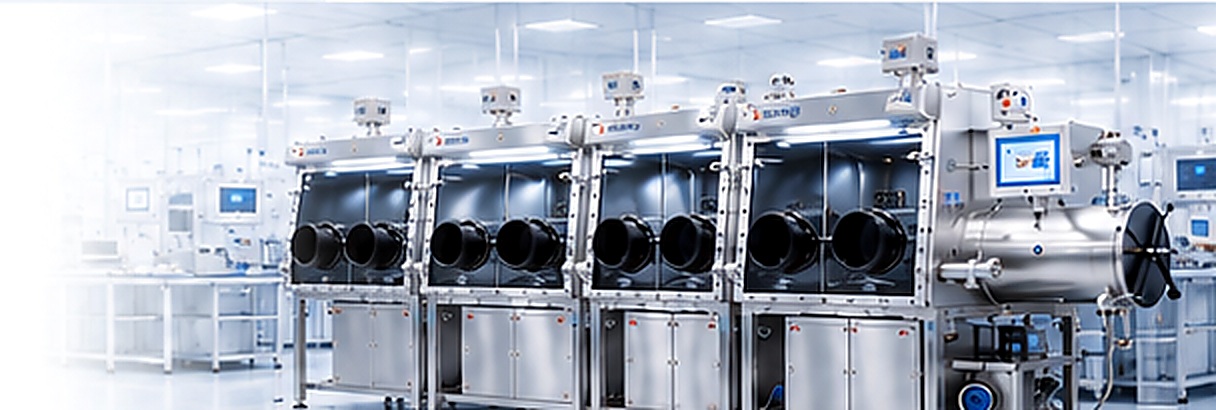
The Hidden Threat: Particulate Contamination in Your Glove Box
When you work with air-sensitive materials in a glove box, you focus on keeping water and oxygen levels below 1 ppm. But there is another contaminant that can silently compromise your experiments: airborne particles. Dust, fiber fragments, powder residues from previous operations, and even degraded glove material can circulate inside the chamber. These particles not only contaminate sensitive samples – they can also clog the gas purification system, reduce the efficiency of the catalyst, and shorten the life of your analyzers.
A HEPA filter cartridge installed in the glove box gas circulation loop is the most effective way to remove sub-micron particles from the atmosphere. By trapping particles as small as 0.3 micrometers with an efficiency of 99.97% or higher, it ensures that the inert gas circulating through your box remains clean. This is not just about protecting your lithium metal, perovskite precursors, or OLED materials – it is about maintaining the long-term stability of your entire glove box system.
In this article, we will look at why a HEPA filter cartridge is a critical component of any professional glove box setup, how it works, and what you should consider when selecting or replacing one.
How a HEPA Filter Cartridge Works in a Glove Box
The glove box HEPA filter cartridge is typically placed in the gas return line, just before the gas enters the purification column. The fan continuously draws the box atmosphere through the filter, capturing particles by four mechanisms: inertial impaction, interception, diffusion, and electrostatic attraction. For particles around 0.3 µm – the most penetrating particle size (MPPS) – the filter achieves the highest capture efficiency.
Unlike a standard HVAC filter, a HEPA filter for glove boxes must be compatible with inert gas environments. The media is usually made of fine glass fibers or ePTFE, bonded to a rigid frame. The filter cartridge is designed to be easily replaced without breaking the glove box seal. Many modern glove boxes use a quick-change housing with a bag-in/bag-out option to safely remove contaminated filters when handling radioactive or toxic materials.
Why HEPA and Not Just a Pre-Filter?
Some operators think that the gas purification column itself will remove particles. In reality, the copper catalyst and molecular sieve in the purification column are designed to adsorb water and oxygen, not to trap solid particles. Over time, dust accumulation on the catalyst surface reduces its active area, increasing the regeneration frequency and shortening the column life. A HEPA filter placed upstream of the column protects your costly purification system.
Key Applications That Demand a HEPA Filter Cartridge
Any glove box used for handling fine powders, nanomaterials, or hazardous substances requires a HEPA filter. Let us examine a few common scenarios:
Lithium Battery and Solid-State Battery Research
When you grind, mix, or coat cathode and anode materials, fine particles are generated. Lithium metal itself can form dust. Without a HEPA cartridge, these particles can settle on the chamber walls, gloves, and instruments. They may also be carried into the purification column, where they can react with the catalyst. For solid-state electrolyte processing, even trace dust can cause short circuits in the final cell.
Perovskite Solar Cell Fabrication
Perovskite precursors are sensitive to both moisture and oxygen. But they are also sensitive to physical contamination. Dust particles on the substrate can create pinholes in the thin film, reducing device efficiency. A HEPA filter helps maintain a clean environment, which is critical for achieving reproducible device performance.
OLED and Organic Electronics
Organic light-emitting materials are extremely sensitive to particles. A single dust speck can cause a dark spot in the display. Glove boxes used for OLED research almost always incorporate HEPA filtration to meet the cleanliness levels required for device fabrication.
Nuclear and Radioactive Material Handling
In glove boxes used for handling radioactive powders, the HEPA filter is not just a cleanliness device – it is a safety barrier. Regulations often require HEPA filters with certified efficiency to prevent the release of radioactive particles into the environment. In such applications, the filter housing may include a bag-in/bag-out system for safe replacement.
Selecting the Right HEPA Filter Cartridge for Your Glove Box
Not all HEPA filters are the same. When choosing a replacement cartridge, consider the following factors:
Filter Grade and Efficiency
HEPA filters are classified by their efficiency at the MPPS. The most common grade for glove box applications is H13 (99.95% efficiency) or H14 (99.995%). For ultra-clean environments, ULPA (U15, U16, U17) filters may be used, but they have higher pressure drop and may require a stronger circulation fan. For most glove box operations, H13 or H14 is sufficient.
Frame Material and Seal
The frame should be made of corrosion-resistant material, such as stainless steel or anodized aluminum. The gasket should provide a tight seal to prevent bypass. Many glove box HEPA cartridges use a gel seal or a closed-cell foam gasket to ensure zero leakage.
Dimensions and Compatibility
Check the dimensions of your existing filter housing. Common sizes include 305×305 mm, 610×610 mm, and custom sizes. The depth also varies. Always verify the nominal face velocity and maximum airflow rating to ensure the filter does not restrict the glove box circulation.
Chemical Compatibility
If your glove box handles organic solvents or corrosive gases, the filter media and frame must resist chemical attack. Glass fiber media is generally inert, but the binder and sealant materials should be checked. For solvent vapor applications, a carbon pre-filter may be needed upstream of the HEPA to protect the media.
Installation, Maintenance, and Replacement Best Practices
Installing a HEPA filter cartridge in a glove box is a straightforward procedure, but it requires care to avoid introducing contaminants. Here are some practical guidelines:
- Always wear clean gloves when handling the new filter to avoid transferring oils or particles.
- Inspect the gasket for any damage before installation. A damaged seal will allow unfiltered air to bypass.
- Record the installation date and the initial pressure drop across the filter. This helps you track when it needs replacement.
- Check the pressure drop regularly using a differential pressure gauge. When the pressure drop increases by more than 50% of the initial value, it is time to replace the filter.
- Replace the filter during a scheduled maintenance when the glove box is not in use. If the box atmosphere is critical, you can perform a quick purge after replacement to restore low H₂O/O₂ levels.
How Often Should You Replace the HEPA Filter Cartridge?
The replacement frequency depends on the amount of particulate generated inside the box. For a light-duty glove box used for sample storage and solution preparation, the filter may last 1–2 years. For a heavy-duty box used for powder grinding, ball milling, or solvent evaporation, the filter may need replacement every 3–6 months. A good practice is to replace the filter annually or whenever the pressure drop indicates loading.
Common Questions About Glove Box HEPA Filters
Can I wash and reuse a HEPA filter?
No. HEPA filters are not washable. Washing destroys the fine fiber structure and reduces efficiency. Always replace with a new cartridge.
Do I need a HEPA filter if my glove box is only used for liquid handling?
Even liquid operations can generate aerosol droplets or accidental spills that produce particles. A HEPA filter is still recommended to protect the purification system and maintain a clean atmosphere.
What is the difference between a HEPA filter and a vacuum pump oil mist filter?
A vacuum pump oil mist filter is designed to capture oil aerosols from the pump exhaust, not to clean the glove box atmosphere. The HEPA filter is for the internal circulation loop. Both are important, but they serve different purposes.
Conclusion: A Small Component with a Big Impact
The HEPA filter cartridge may seem like a minor accessory, but it plays a vital role in protecting your glove box investment and ensuring the quality of your work. By removing particles down to 0.3 µm, it prevents contamination of sensitive materials, extends the life of the purification column, and helps you maintain compliance with cleanroom standards. Whether you are working on next-generation batteries, solar cells, or advanced materials, a reliable HEPA filter is a simple and cost-effective way to keep your inert atmosphere clean.
When selecting a replacement, always choose a cartridge that matches your glove box model and your application requirements. For a wide selection of compatible HEPA filter cartridges, visit the TENCAN accessories page. If you are unsure about the correct size or grade, consulting with an experienced glove box engineer can save you time and prevent costly mistakes.
Remember: a clean atmosphere is not just about low water and oxygen – it is also about low particulate levels. Make the HEPA filter cartridge a standard part of your glove box maintenance routine.