Why the Atmosphere Question Comes Before the Model Number
Most glove box enquiries begin with a model name and a price request. A more useful starting point is the mechanism: how does the box remove the air that was inside it, and how does it keep air out once work begins? Answer that and the model, the accessories and the operating procedure usually follow. Skip it, and a perfectly serviceable box ends up on an application it was never meant to carry.
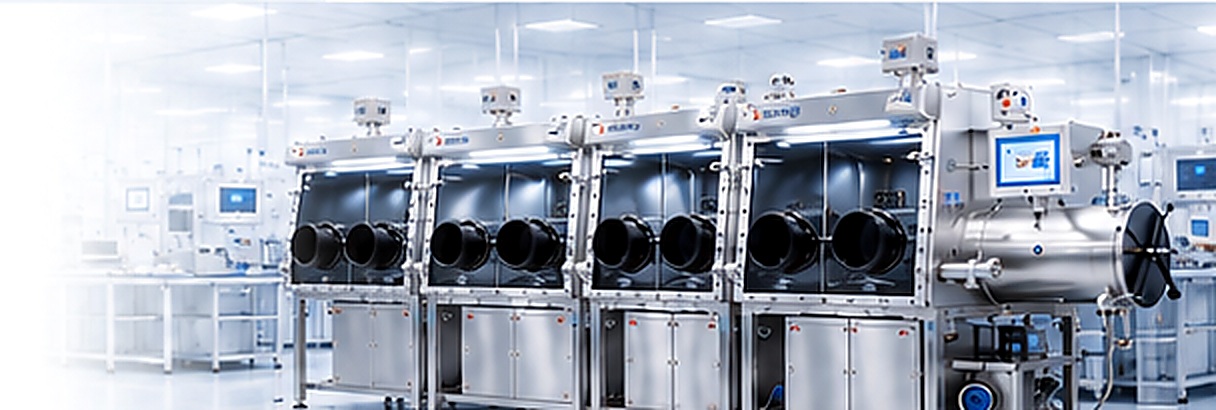
Two mechanisms dominate inert-atmosphere work. The first is continuous recirculating purification: the enclosure stays closed, gas is drawn through purifier columns that remove water and oxygen, and cleaned gas returns to the chamber. The second is vacuum and gas replacement: the chamber is evacuated, refilled with inert gas, and the cycle is repeated until the residual air fraction is low enough for the samples inside. The GBV-2 stainless steel vacuum glove box belongs to the second family. That single fact shapes how it is specified, operated and judged.
The distinction is not a marketing detail. It changes cycle times, consumable costs, the atmosphere you can realistically hold, the samples you can handle, and the questions worth asking before ordering. Vacuum replacement is a batch process; purification is a continuous one. Confusing the two leads to two opposite failures — buying a purifier for work that only ever needed a sealed, evacuated box, or buying a replacement-only box and expecting it to hold a low oxygen reading indefinitely without intervention.
How a Vacuum Glove Box Reaches a Controlled Atmosphere
Seal, evacuate, backfill
The working principle is dilution. With the chamber sealed and gloves in place, a pump removes part of the internal gas, and inert gas is admitted until the chamber returns to a usable working pressure. Each cycle reduces the share of the original air. If a chamber is pumped from ambient down to roughly a tenth of atmospheric pressure and then refilled, the residual air fraction is about 10%. A second identical cycle brings it near 1%, a third near 0.1%. The arithmetic is simple, and it explains why cycle count matters far more than the elegance of the hardware.
Two consequences follow. First, the achievable atmosphere is a function of how many cycles you are willing to run and how low the pump can take each cycle — not of a single number printed on a datasheet. Second, gas consumption scales with chamber volume and cycle count together, so a large box used for small samples pays for atmosphere it does not need. Both points argue for matching internal volume to actual workflow rather than buying the biggest chamber the budget allows.
Why real performance falls short of the arithmetic
Textbook dilution assumes a clean, empty, perfectly sealed chamber. Real boxes have dead volumes in corners and port recesses, adsorbed moisture on metal surfaces, gloves that permeate slowly, and seals that leak at a finite rate. Each of these adds a parasitic source of water and oxygen that the next cycle has to remove again. This is why a freshly installed vacuum glove box often needs several conditioning cycles before readings settle, and why the same box can behave differently after a week of solvent work than it did when new.
Leak rate deserves separate attention because it is frequently confused with pump performance. A pump that reaches a low ultimate vacuum tells you the pump is capable; it does not tell you the chamber holds pressure. Those are different measurements taken at different places, and a box can pass one and fail the other. When a supplier reports a leak rate, ask for the method: pressure rise over time, starting pressure, chamber volume, and whether gloves and ports were installed during the test.
What the GBV-2 Vacuum Glove Box Is Built to Do
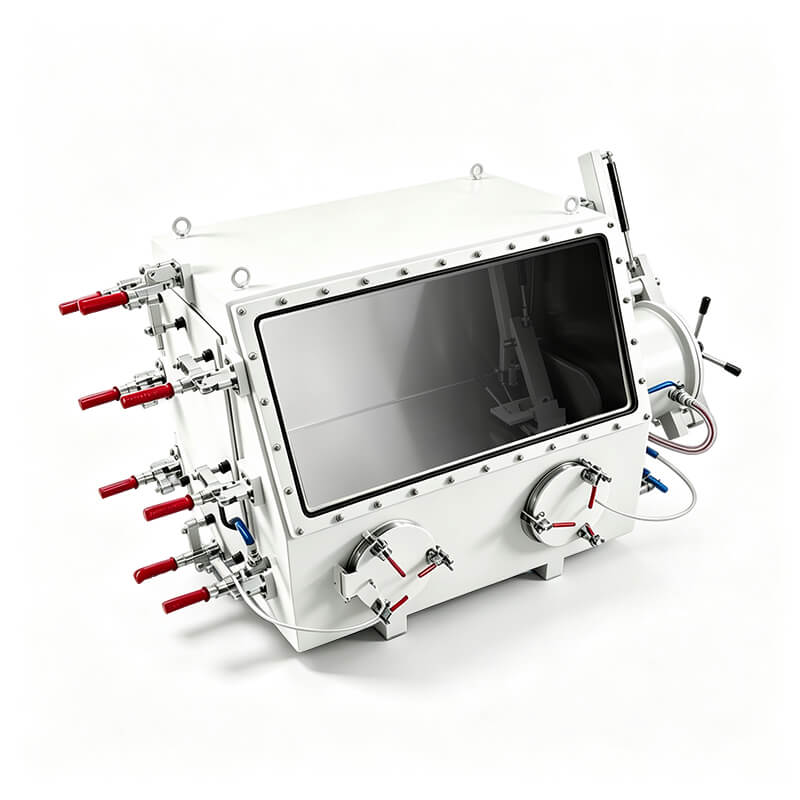
The GBV-2 is a stainless steel vacuum glove box: a sealed metal enclosure with glove ports, brought to a controlled atmosphere by evacuation and inert gas replacement. It is designed around batch atmosphere preparation rather than continuous gas circulation. Whether a particular build includes any purification hardware, and at what measured performance, is a configuration question for the supplier — it should never be assumed from the product family name.
Stainless steel as a material choice
Stainless steel is the natural shell material when vacuum is involved. It has the stiffness to resist pressure differentials without the wall thickness that acrylic needs, it releases comparatively little moisture and hydrocarbon compared with polymer surfaces, and it tolerates the solvents and cleaning agents that appear in air-sensitive chemistry. For work involving lithium or sodium compounds, organometallics, or fine hygroscopic powders, that combination matters more than appearance.
The trade-off is visibility and cost. A metal chamber means looking through a window rather than through the walls, and inspection of a sample from several angles takes planning. If your task is inspection-heavy and the atmosphere requirement is modest, an acrylic enclosure may serve better and cost less; if the task involves vacuum cycles, solvent exposure or long-term atmosphere stability, the metal shell earns its price.
Questions worth asking about purification and verification
Because vacuum replacement and continuous purification are different technologies, the first question for any vacuum box supplier is whether the unit is intended for replacement-only operation or whether a purifier loop can be integrated. A second question is what atmosphere the supplier verifies, and under what conditions: chamber size, cycle procedure, sample load, measurement point, and how long the reading is held. A number without those conditions attached is not a specification, it is an aspiration.
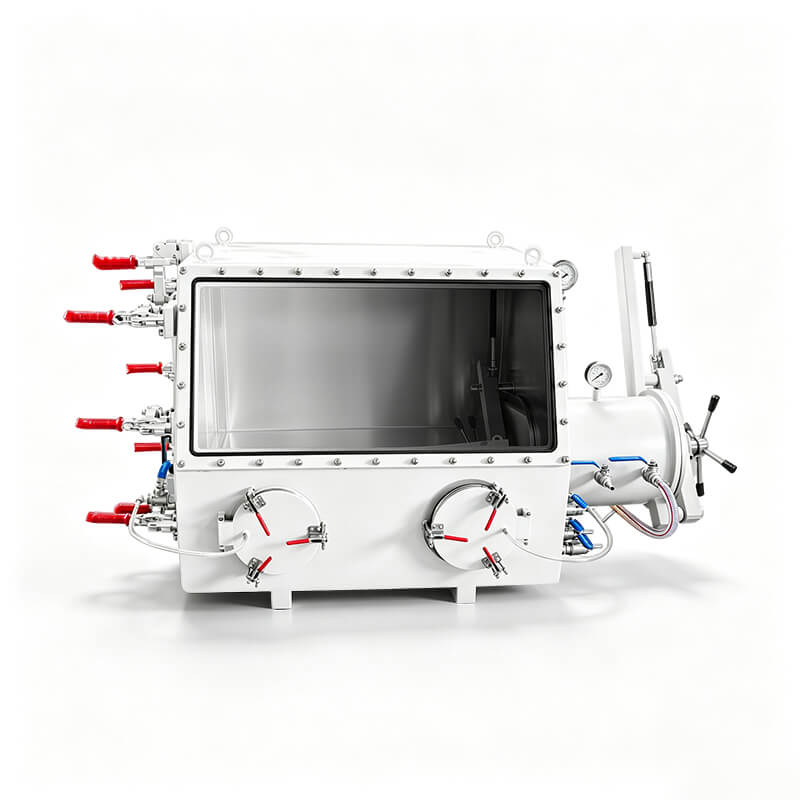
Ask also about the antechamber — its volume, whether it is independently evacuable, and how it is ported — about glove material, thickness and port diameter, and about the feedthroughs available for power, signal, gas line or thermocouple connections. These are the parts that determine whether the box fits your experiment or forces your experiment to fit the box.
Transferring Samples Without Undoing the Atmosphere
Almost all atmosphere damage in a vacuum glove box arrives through the antechamber. A sample, a tool, a bottle of solvent, or a cable brought in through a single-cycle transfer carries its own adsorbed air and moisture with it. The chamber then needs recovery cycles that cost time and gas. Treating the antechamber as a small airlock with its own discipline — its own pump-down, its own backfill, and a pause before the inner door opens — is more effective than any single piece of hardware.
Sample form matters here. Loose, fine powders can be disturbed by rapid evacuation and can carry a large adsorbed moisture load into the chamber; dense solids and sealed containers carry far less. Porous materials, filter papers, and textiles are effectively atmosphere sponges. Where the sample permits, pre-drying or pre-evacuation outside the box reduces the number of recovery cycles needed afterwards, and where it does not, that constraint belongs in the operating procedure rather than being discovered later.
Reading oxygen and moisture instruments correctly
An analyzer measures the atmosphere; it does not improve it. Two consequences follow. First, a slow recovery after a transfer may reflect sensor response time, sensor location in a quiet corner of the chamber, or a small leak, just as easily as an inadequate cycle — the reading alone does not identify the cause. Second, resolution and accuracy are different quantities: a display that resolves to a fine increment is not thereby accurate to that increment, and calibration status determines what the number is worth.
When readings do not return to expectation after a normal cycle sequence, work through causes in order of likelihood: an incomplete seal at a glove or port, a transfer that admitted more air than usual, outgassing from a newly introduced material, or a pump that is no longer reaching its usual pressure. Documenting the reading before and after each transfer builds the baseline you need to tell a real trend from normal scatter.
Vacuum Replacement or Continuous Purification?
The choice follows from how the box will be used, not from which specification looks more impressive. If your work involves short, occasional sessions, sealed samples, or processes where a defined number of replacement cycles is acceptable, a vacuum box is efficient and simple. If the requirement is a continuously maintained low-level atmosphere while work proceeds for hours, with frequent glove use and repeated transfers, a circulating purifier is the appropriate tool, and a replacement-only box will keep you busy chasing recovery cycles.
There is a middle ground worth naming: many laboratories run a vacuum box for preparation and transfer work and reserve purified enclosures for the most sensitive steps. Splitting the workflow this way often costs less than forcing one box to do both jobs, and it keeps solvent-heavy preparation away from purifier media that would otherwise be consumed by it.
| Consideration | Vacuum / gas replacement | Continuous purification |
|---|---|---|
| Mechanism | Evacuate and backfill in repeated cycles | Closed-loop circulation through regenerable purifier media |
| Typical fit | Batch work, sealed samples, preparation and transfer | Sustained work sessions with frequent access |
| Consumables | Inert gas per cycle; pump maintenance | Purifier media, regeneration gas, circulation power |
| Recovery after transfer | Repeat cycles; time scales with chamber volume | Circulation continues; recovery depends on load and media condition |
| Solvent handling | Vapor largely removed with each evacuation, subject to pump compatibility | Requires dedicated adsorbent protection for media and loop |
| Main limits | Leak rate, outgassing, cycle count tolerance | Media capacity, regeneration schedule, loop leak tightness |
Solvent Vapors, Adsorbents and Material Compatibility
Solvent use is where the two technologies diverge most sharply, and where vacuum boxes have a practical advantage that is easy to overlook. During evacuation, organic vapors leave with the gas being pumped out — provided the pump and its exhaust path are suited to the vapor load. In a closed purification loop, the same vapors circulate until they reach the purifier, where they can occupy adsorption sites intended for water and oxygen and shorten media life.
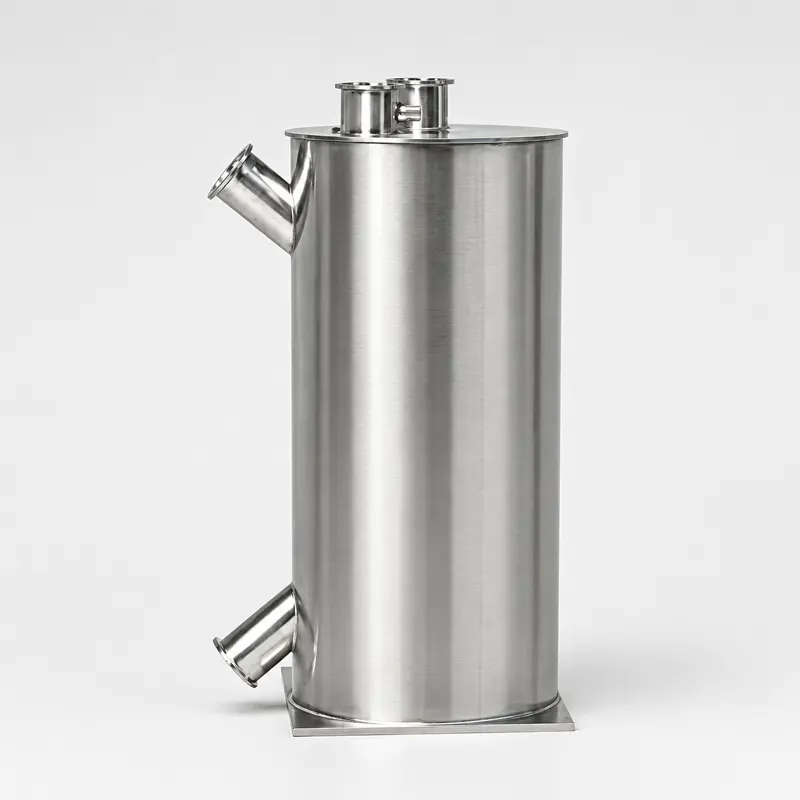
That is the logic behind a dedicated accessory such as the organic solvent vapor adsorption system: it captures organic vapors at a chosen point in the gas path so they do not travel further into the system. It is a vapor-management device, not an atmosphere-control device. It does not remove water or oxygen, and it does not substitute for purifier media or for evacuation cycles. Where a box handles both solvents and moisture-sensitive samples, each function needs its own component, sized for its own load.
Compatibility questions multiply from there. Adsorbent media differ in what they capture and how they are regenerated, so the choice depends on the solvent class, the concentration, and whether the stream is continuous or intermittent. Connection point matters as well: an adsorber on an evacuation path, on a circulation loop, or on a dedicated purge line behaves differently, and the correct position depends on the host system rather than on the accessory alone. Glove material is the other half of the question — elastomers that tolerate one solvent may swell or harden in another, and permeation through a glove is a continuous, quiet source of contamination that no cycle will fix.
Configuration Checklist Before Requesting a Quote
A supplier can only size a system against a described application. The following points are the ones that most often change the recommendation, and the ones most often left out of a first enquiry.
- Target atmosphere and duration: what oxygen and moisture levels you need, measured where, and for how long they must hold during work.
- Operating mode: replacement-only cycles, or a requirement for continuous circulation — stated explicitly rather than assumed.
- Cycle time tolerance: how long a transfer or recovery may take before it disrupts the experiment.
- Chamber and antechamber: internal volume, single or multiple work stations, single or double-sided access, antechamber size and whether it is evacuable.
- Gloves and ports: material, thickness, port diameter, and the solvents or reagents they will contact.
- Feedthroughs: power, signal, gas, vacuum or thermocouple connections, with the sealing method for each.
- Sample characteristics: powders, films, sealed cells, porous materials, and the moisture each is likely to carry in.
- Gas supply: available inert gas purity, delivery pressure, and whether regeneration gas is available if a purifier is involved.
- Verification: leak test method and documentation, atmosphere test conditions, and calibration status of any installed analyzer.
Describing the workflow — what goes in, how often, how long it stays, what leaves with it — gives a supplier far more to work with than a list of desired readings. For a vacuum-replacement box like the GBV-2, the honest conversation is about cycles, seals, volume and transfer discipline, and about whether any part of the process genuinely needs continuous purification instead. Getting that boundary right at the specification stage is cheaper than discovering it during the first sensitive experiment.