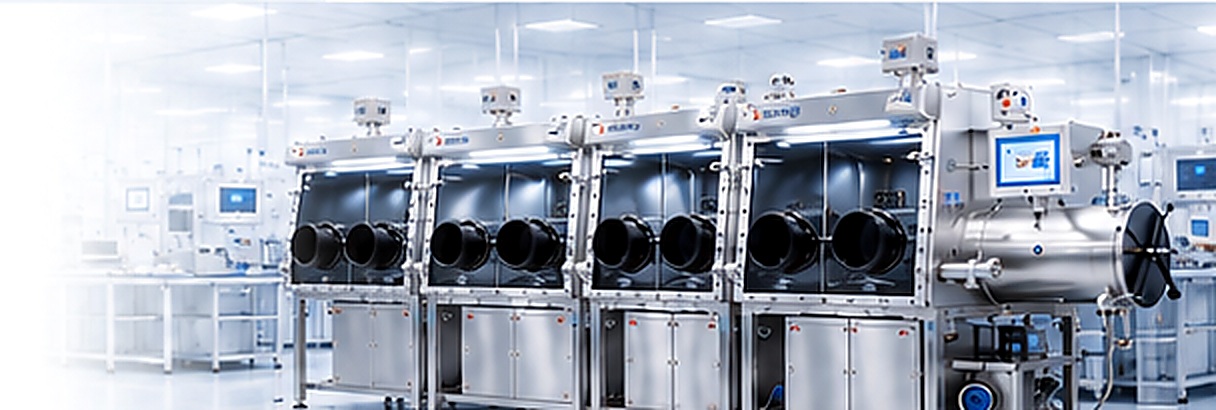
Why Recovery Time Is the Real Question in a Multi-Station Box
A sample goes in through the antechamber. The oxygen reading lifts, then drifts back over some interval — minutes, tens of minutes, occasionally much longer. Everyone watching has the same question, and it is rarely "does this glove box purify?" It is "how much disturbance can this configuration absorb, and how quickly does the working atmosphere return to the number our process requires?"
Three things answer that question together: how the enclosure is laid out, how much traffic it sees, and how much purification capacity is attached to it. In an eight-station double-sided split-type box, all three are larger than on a bench unit, and each scales differently. A recovery curve that looks disappointing is often not a fault at all — it is the arithmetic of a big interior, several operators and a fixed circulation rate. Separating those contributions is the whole exercise.
This article works from the mechanism outward: what the configuration physically is, where moisture and oxygen enter, how the instruments report what they see, and which specification items deserve a second look before an order is placed.
What "Eight Stations, Double-Sided, Split" Actually Changes
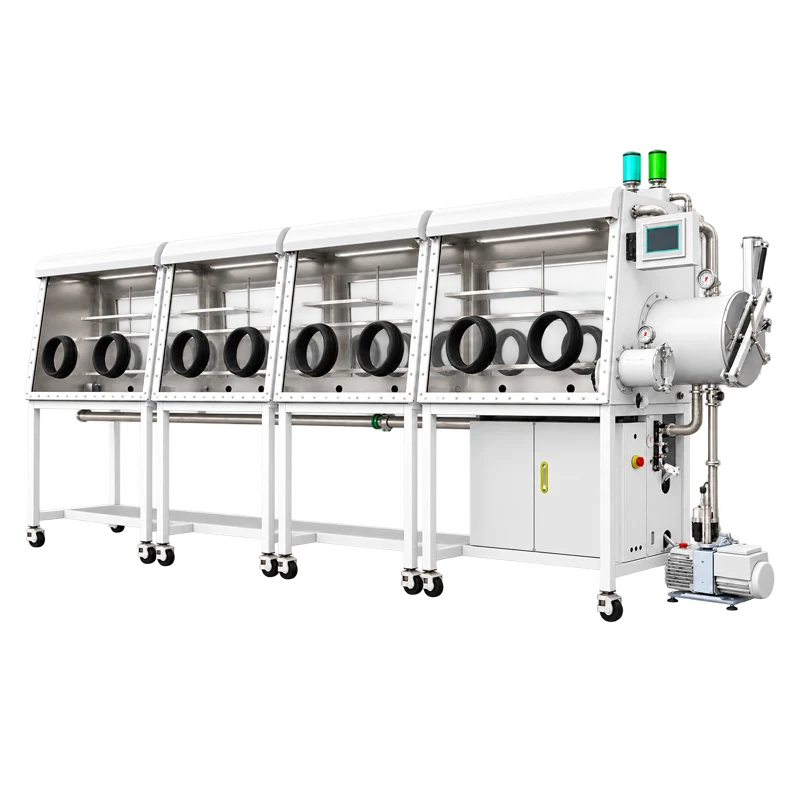
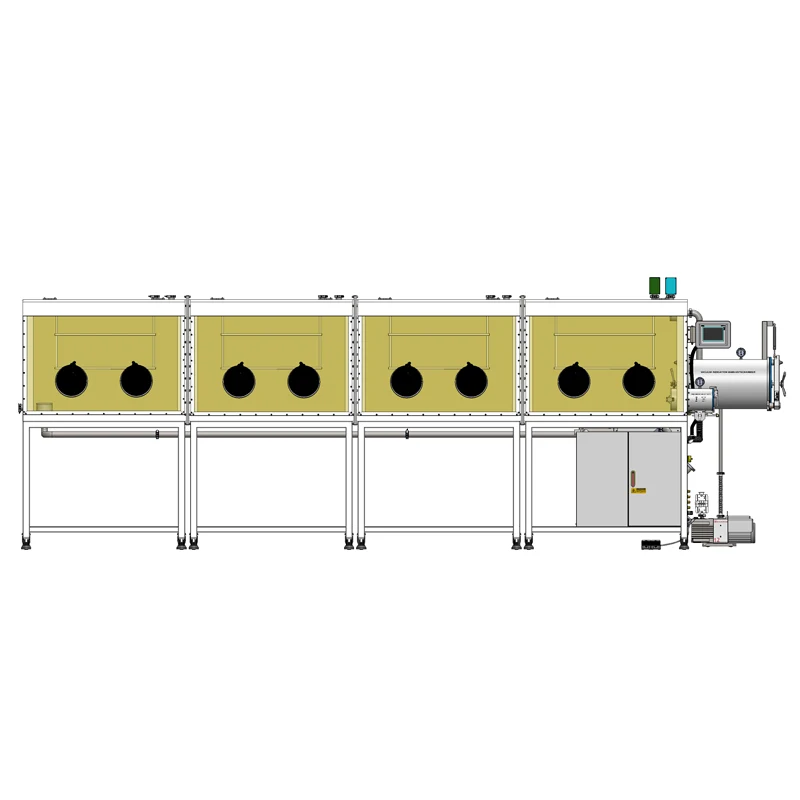
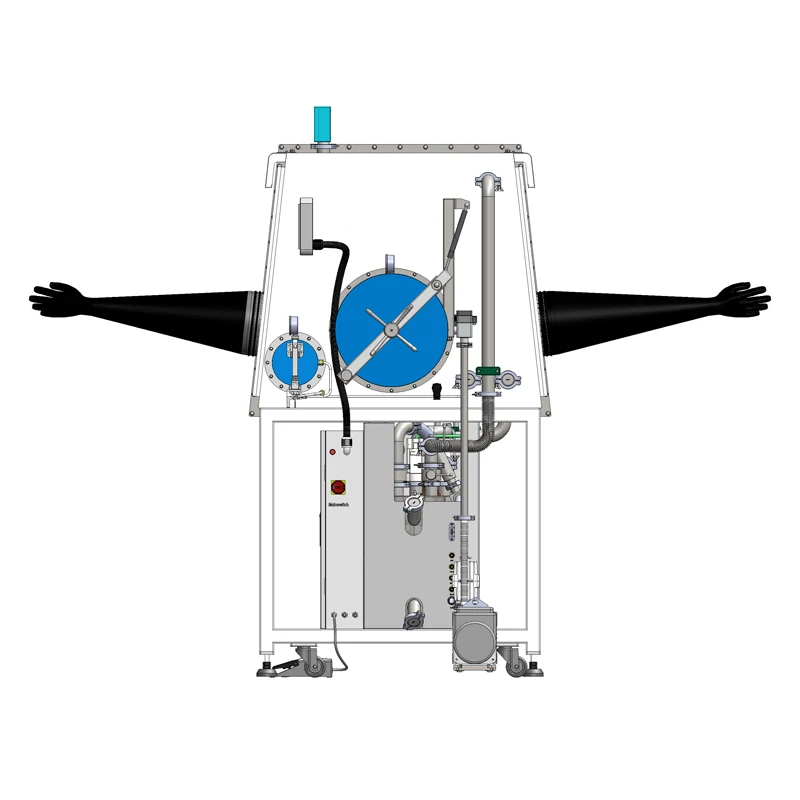
The Eight-Station Double-Sided Split-Type Glove Box with Gas Purification System is a closed-loop enclosure: the box, an antechamber arrangement for passing material in and out, a purification column set, a circulation blower and the monitoring that ties them together. The description sounds like any purification box, but each adjective in the name carries a consequence.
Station count is a people-and-time variable, not just a port count
Eight glove ports means eight places where a gloved hand crosses the enclosure boundary, and — depending on how the ports are distributed — probably four working positions across the two faces. That has two effects. First, surface area: every port is an elastomer seal and a flexible membrane, and both permeate slowly. Second, occupancy: a box that seats several operators simultaneously is a box that is opened, loaded, wiped and adjusted more often per hour than a single-operator unit. Purification capacity that is comfortable for one person working alone can look marginal when three or four people share the same atmosphere.
How the ports are divided between the two faces, where the antechambers sit along the length, and whether the interior is one continuous volume or partitioned into zones are all configuration items to confirm from the drawing. They change the answer to almost every question that follows.
Double-sided access changes the traffic pattern
A double-sided box is usually bought to serve two functions at once: process work on one side, inspection, packaging or analytical handoff on the other. The benefit is real — material crosses the box instead of leaving and re-entering it, which removes an entire antechamber cycle from the workflow. The cost is that both faces now have their own traffic, their own glove inventory and their own habits. Instrumentation placed on one face may be monitored from the other, so the question of where the oxygen and moisture sample points actually sit inside the volume becomes important rather than academic.
Split construction: joints, modules and installation reality
A split-type enclosure is assembled from sections rather than manufactured as a single welded shell. That is what makes a very long box shippable, installable through ordinary doors and corridors, and in some cases reconfigurable later. It also means the enclosure has flanged or framed joints that a monolithic box does not, and those joints are part of the leak-tight boundary. When a large box shows a slow, persistent drift that never quite settles, the joint faces and their seals belong on the inspection list alongside gloves and antechamber doors. Ask for the joint sealing method and the leak-check procedure at commissioning; that is a specification conversation, not a troubleshooting guess.
| Configuration choice | What it changes | What to confirm |
|---|---|---|
| Number and distribution of glove ports | Simultaneous occupancy, membrane area, leak-check surface | Ports per face, glove size and material options |
| Single versus double-sided working | Material path, sample-point placement, operator sightlines | Which face carries the process and which the handoff |
| Split/modular enclosure | Transport, installation route, number of sealed joints | Joint design, seal replacement access, commissioning leak check |
| Antechamber size and count | Transfer throughput, pump-down volume, atmosphere disturbance per cycle | Chamber volume, vacuum capability, door interlocks |
| Purification capacity | Recovery slope after each disturbance | Circulation rate, column material, regeneration interval |
Where Moisture and Oxygen Enter During a Working Day
A purification box is not sealed against the world; it is sealed against the world slowly. The loop removes what comes in, and the readings you see are the balance between ingress and removal. Ingress has four recurring sources.
The antechamber is the busiest valve on the box
Every transfer displaces the atmosphere in the small chamber with air from the room, and the chamber is then cycled back to the working condition before the inner door opens. If the inner door opens early, the remaining air in the chamber — including the moisture that came in with it — goes straight into the main volume. A large box tolerates this better than a small one because the dilution volume is bigger, but it also takes longer to mix and therefore longer for a sample point to register the disturbance. Multi-operator boxes go through this cycle many times a day. The practical variables are chamber volume, the vacuum level used for each cycle, the number of gas-refill cycles used, and above all whether the transfer protocol is actually followed when the queue is long.
Gloves and ports as a continuous exchange surface
Eight ports mean a meaningful area of elastomer membrane in permanent contact with both the working atmosphere and room air. Permeation through gloves and seals is continuous and unglamorous, and it is one of the reasons a large box holds its own against a small one: the loop is running anyway. A pinhole or a tired seal from repeated use changes the character of the ingress from steady to localised, which usually shows up as a value that recovers to a plateau and then stalls rather than a value that never moves.
Materials and solvents carried inside
Samples, containers, wipes, tools and especially solvents release vapour into the box. Water vapour from a poorly dried solvent or a damp container is functionally identical to a leak from the outside — the purification loop has to remove it either way. Solvent vapour is a different problem: it is handled by dedicated adsorption media rather than by the water/oxygen columns, and it can degrade column performance if it reaches them. Decide early whether your process brings solvents inside, because the answer changes the accessory list, not just the operating habit.
Process gas and equipment connections
Any line, feedthrough, thermocouple, gas inlet or power connection that crosses the wall is a potential exchange path. Splitting the box into sections increases the number of wall penetrations simply because there is more wall. Keeping a penetrations schedule — what goes through where, and with what fitting — is one of the cheapest reliability habits in a large installation.
Reading the Water and Oxygen Numbers Correctly
Before blaming the purification system for a slow recovery, make sure the number being read is the number that matters.
- Sample point location. A sensor mounted near the loop return sees a different value from one mounted at the far end of an eight-station enclosure. On a long box, mixing matters, and both sensors can be correct.
- Resolution is not accuracy. A display that resolves the last digit finely does not thereby measure to that fineness. Calibration, sensor drift and the reference gas used all sit between the real atmosphere and the digits.
- Response time is a property of the sensor and of the installation. A sluggish reading may be a slow sensor, or a sensor in a dead pocket of the volume with little flow past it.
- Recovery is a curve, not a value. Record the reading at a fixed interval after each transfer — say every minute for the first fifteen — instead of glancing at the display and moving on. Trends over a week tell you far more than any single number.
- Water and oxygen are separate measurements of separate problems. They usually move together after a transfer and separately when the source is specific, such as a wet material or an outgassing solvent.
This is diagnostic bookkeeping, not fault-finding. If a box genuinely does not hold atmosphere, the numbers will not merely recover slowly; they will keep climbing with the doors closed and nobody working. That distinction is worth writing down before a service conversation begins.
Purification Capacity: The Item Most Often Underspecified
The purification side of the system is a closed circuit with three jobs: move atmosphere through the column material, hold the water and oxygen it captures, and reverse that capture periodically so the material can be used again. These are three different capabilities and buying on the strength of one of them leaves the other two unexamined.
Circulation is a loop, not a filter on the inlet
Removal rate depends on how much gas passes over the purifying material per unit time relative to the volume it is treating. That ratio — not the box size alone — sets how fast a disturbance is erased. In a large split enclosure the interior volume is significant, and the atmosphere has to physically reach the loop before it can be cleaned. Flow patterns inside an eight-station box are not uniform: corners, partitioned sections and areas behind equipment exchange more slowly. This is why a box can display an acceptable steady-state value while two workstations behave quite differently after a transfer, and why circulation, ducting and return-path geometry deserve a look at the design stage rather than after installation.
Working gas, control gas and regeneration gas are not the same thing
These terms get used interchangeably in conversation and should not be. The working gas is the atmosphere the process sees. Control gas is what instruments and valves use to operate. Regeneration gas is the heated stream used to drive captured moisture and oxygen off the purifying material so it can be reused. When a supplier asks about gas supply, purity and consumption, they are usually sizing the regeneration side, because that is where the steady demand sits. Confirm the required supply, the regeneration schedule and what the box does during that period — whether it remains at condition or must be worked around. Do not treat regeneration as an emergency procedure; it is routine, and the workflow should accommodate it.
Column life is a working-habit outcome
How long the purifying material lasts depends on how much water and oxygen it is asked to remove. A disciplined transfer protocol, dry solvents, clean gloves and prompt door closure extend it; a busy eight-station box with a generous antechamber and no transfer discipline consumes it. Regeneration frequency and material replacement interval are therefore operating parameters to plan, not surprises to absorb.
Heat Inside a Sealed Box: Where an Accessory Belongs
Not every accessory belongs on every box, and the ones that do should be justified by something the process actually does. Heat is the clearest example on a large installation. Any equipment inside the enclosure that generates heat — a hot stage, a sealing tool, a heated sample holder, a continuously running instrument — adds a load that the atmosphere cannot shed to the room the way it would in open air. The consequences are ordinary: the interior warms, elastomer seals at ports and joints work at a higher temperature than intended, and the process itself may be the thing that suffers.
A precision recirculating water chiller addresses that load by removing heat from the equipment through a closed coolant loop rather than trying to condition the box atmosphere. It is a supporting accessory, not an atmosphere-control device: it does not remove water, oxygen or solvent vapour, and it does not substitute for purification. Whether it belongs in this installation depends on what is being run inside and on how the coolant lines enter and leave — which means line routing, feedthrough fittings, coolant choice and leak risk in an inert, often oxygen-sensitive environment all need to be settled with the supplier before the accessory list is fixed. Treat chiller compatibility as a design question with the box vendor, not as a catalogue add-on.
Application Fit: What the Big Box Is Good For, and What It Is Not
A multi-station double-sided enclosure earns its cost where several people or several process steps share one controlled atmosphere: air-sensitive chemistry at scale, battery and solid-state electrolyte material handling, perovskite and OLED device work, semiconductor and advanced-material preparation, and metal or polymer processing steps that must not see ambient moisture. The shared-atmosphere argument is strong when material genuinely moves between steps without reconditioning.
It is a weaker argument when the process needs something the box is not. Inert atmosphere is not sterility, not a cleanroom classification, not biological containment and not hazardous-material certification. Nor is every material indifferent to every inert gas; "oxygen-free" and "chemically inert toward my sample" are separate claims. If the application depends on any of these properties, they need to be addressed by the appropriate equipment and verification, not assumed from the atmosphere control.
Configuration Checklist Before You Specify
The most useful thing a buyer can send a supplier is not a model number but a description of the working day. The following items resolve most of the ambiguity in a large split-box project.
- People and hours: how many operators, on which face, and how many hours per day the box is occupied.
- Transfer profile: how many antechamber cycles per shift, typical load size, and whether a second or larger chamber is needed.
- Materials entering: solvents, powders, liquids, heated samples — with quantities and containers.
- Process heat: any equipment inside that generates heat, and the coolant route if one is required.
- Zoning: whether one shared atmosphere is acceptable or whether a partition is needed between process types.
- Instrumentation: where oxygen and moisture sample points should sit, and who records the readings and how often.
- Gas supply: available working gas purity, pressure and flow, plus the intended regeneration schedule.
- Access and installation: door widths, corridor turns and floor loading for a sectional enclosure, and the leak-check procedure expected at commissioning.
- Targets stated as conditions: the required water and oxygen values, over what period, at which sample point, with how many operators working — a target without those qualifiers is not a specification.
Recovery time in a large box is designed, not discovered. Station count, joint count, antechamber volume, circulation geometry and purification capacity all push on it, and each one can be traded against the others at the quotation stage. Once the box is installed, the same variables show up as a curve on a display after every transfer — which is exactly where the design conversation should have started.