
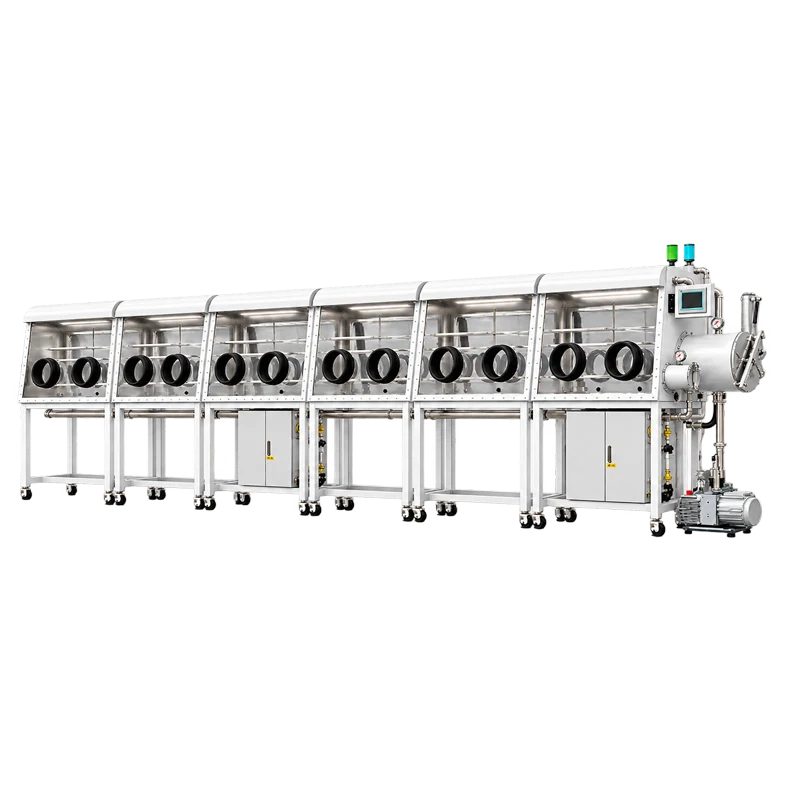
A twelve-station double-sided split glove box with a gas purification system is a sealed inert-atmosphere workspace built for teams that must handle air- and moisture-sensitive materials at several positions at the same time. The purification system is the part that keeps it viable: instead of filling the box with inert gas and hoping the atmosphere holds, the system continuously circulates the internal gas through purifying media that strip out moisture and oxygen, then returns conditioned gas to the enclosure. The result is an atmosphere that can be maintained across a working day, a week or a long experimental campaign rather than drifting upward the moment the box is closed. This article explains how such an installation is put together, which configuration choices genuinely change its behaviour, which specifications are worth checking before you commit, and where a twelve-station layout earns its cost — and where it does not. The reference product here is the twelve-station double-sided split-type glove box with gas purification system from TENCAN Glove Box Systems.
What does the purification side of the system actually do?
A glove box without purification is essentially a sealed container. It can be filled with nitrogen or argon, and as long as nothing enters or leaves, the atmosphere stays reasonably stable. In practice, things always enter and leave: samples, tools, solvents, parts, hands in gloves, and every transfer through an antechamber drags in a little air and a little moisture. Left alone, oxygen and water content creep upward, and for many materials even trace levels are enough to oxidise a surface, degrade a precursor or spoil a measurement.
The purification loop solves that problem by treating the box atmosphere as a continuously recycled stream rather than a fixed charge of gas. A blower pulls gas from the enclosure, passes it through one or more purification columns containing regenerable media, and returns it to the box. Oxygen is removed catalytically and moisture is adsorbed; the media eventually saturate and are regenerated, which is why the loop needs a regeneration cycle and a supply of a suitable gas mixture. Because the loop runs continuously, the box is always correcting the small intrusions that occur during normal work, which is the difference between a glove box that is clean on Monday morning and one that stays clean all week.
Monitoring is part of the same subsystem, not an optional extra bolted on afterwards. Moisture and oxygen analysers sample the circulating gas and show what the loop is actually achieving. Without them there is no way to know whether a slow rise in contamination comes from a leak, a heavy load of wet solvent, saturated purification media or a tired blower. With them, the trend tells you what to fix.
Why the circulation loop matters more than the box walls
Buyers often focus on the enclosure, but the enclosure is the simpler part of the problem. The loop determines how quickly the atmosphere recovers after a transfer, how large a load of outgassing material the system can absorb before performance degrades, and how long the box can run between regenerations. When comparing proposals, compare the purification subsystem on those terms — recovery behaviour, load tolerance, regeneration interval, and how the analysers are positioned and calibrated — rather than on enclosure dimensions alone.
Which configuration choices matter in a twelve-station system?
Twelve stations is a scale decision, and at that scale three structural choices dominate everything else.
Number and distribution of glove ports
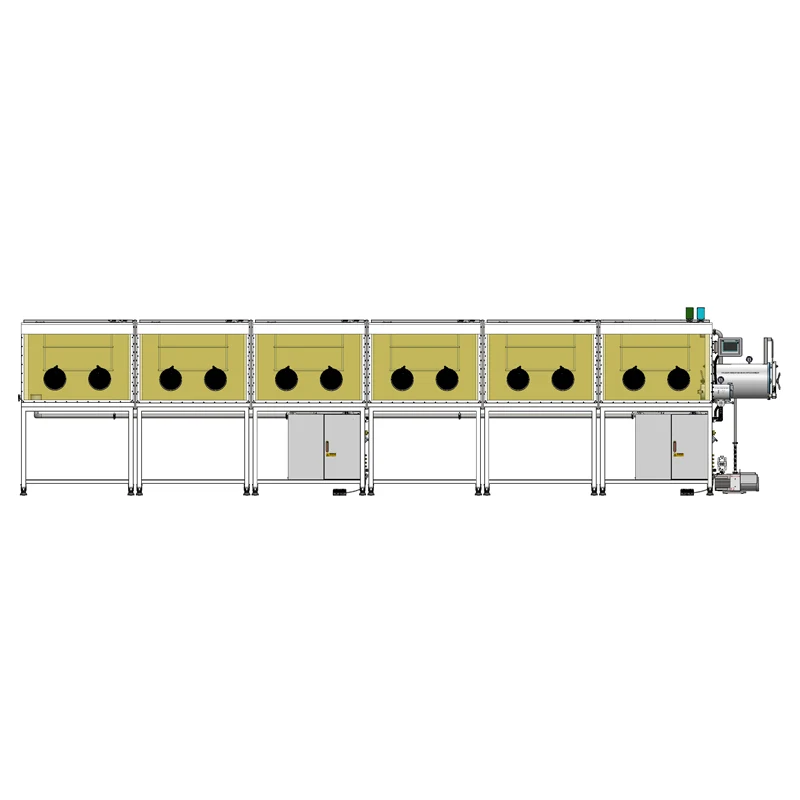
Twelve ports can be arranged in many ways: as one long run on a single working face, as two rows back to back, or as shorter groups separated by internal features. The distribution determines how many people can work simultaneously without interfering with each other, how far a sample must travel from an antechamber to a station, and whether a piece of equipment can be installed permanently at one station while routine work continues elsewhere. Two boxes with the same port count but different spacing can behave very differently in daily use.
Single-sided versus double-sided
A double-sided box has working faces on both long sides. That is not merely a way to fit more ports into the same floor area; it changes the logistical layout of a laboratory. Two groups can work on the same controlled atmosphere from opposite sides, one group can prepare samples while another runs measurements, and equipment can be installed against one face without blocking access from the other. The trade-off is a wide footprint with clear walking space required on both sides, which is a room-planning constraint as much as a technical one.
Split-type construction
Split-type means the enclosure is built and shipped as separate modules that are joined on site rather than as one monolithic vessel. For a twelve-station box this is often the only practical approach: a single welded enclosure of that size may not fit through a laboratory door, an elevator or a corridor. Modular delivery also allows installation to be phased and lets a section be serviced or modified without replacing the whole enclosure. The cost is that joints must be sealed and verified during installation, so the quality of assembly and the leak-check procedure matter as much as the factory build. Ask how the joints are designed, how they are tested and what the acceptance criteria are before signing off the installation.
Which specifications should you check before you buy?
Working space, port layout and equipment integration
For a multi-station box, the meaningful space question is not total volume but usable space per station: interior width, height and depth at each position, port spacing and diameter, and the distance from each working position to the nearest antechamber. Then check integration — how much internal electrical and signal capacity is available for instruments, whether there are mounting provisions for analysers or process equipment inside the box, and whether feedthroughs can be added later at the positions where they will be needed.
Atmosphere performance and monitoring
Keep the following quantities strictly separate, because datasheets and quotations frequently blur them:
- Box atmosphere levels — the oxygen and moisture content of the working gas, and whether a figure is an attainable best case or a level the system can hold continuously under a defined load.
- Leak rate of the enclosure — a property of the box and its joints, measured by a defined method.
- Antechamber vacuum — how far the transfer chamber can be evacuated, which is not the same as the box working pressure.
- Pump ultimate vacuum — a property of the pump, not of the box.
Analyser specifications deserve the same care. A displayed resolution is not the same as measurement accuracy, and an accuracy figure is only meaningful when the calibration gas, calibration interval and sampling point are stated. If a quotation gives a pressure or vacuum figure without saying what it applies to, treat it as unresolved until the supplier states the condition and the unit.
Transfer, sealing and accessory interfaces
Transfers are where most atmosphere contamination enters a box, so antechamber size, number and rating deserve real attention. Ask how large a part each chamber accepts, how many transfer cycles a typical day involves, and whether the chambers are rated for vacuum or only for purging. Then look at the accessory layer, since it decides what the box can do beyond simple handling: glove ports and gloves matched to the tasks performed, seals and door mechanisms, vacuum pumps sized to the chambers and to the gas being handled, feedthroughs for power and signals, particle filtration, solvent vapour management and cooling provisions.
Exhaust-side accessories: the vacuum pump oil mist filter
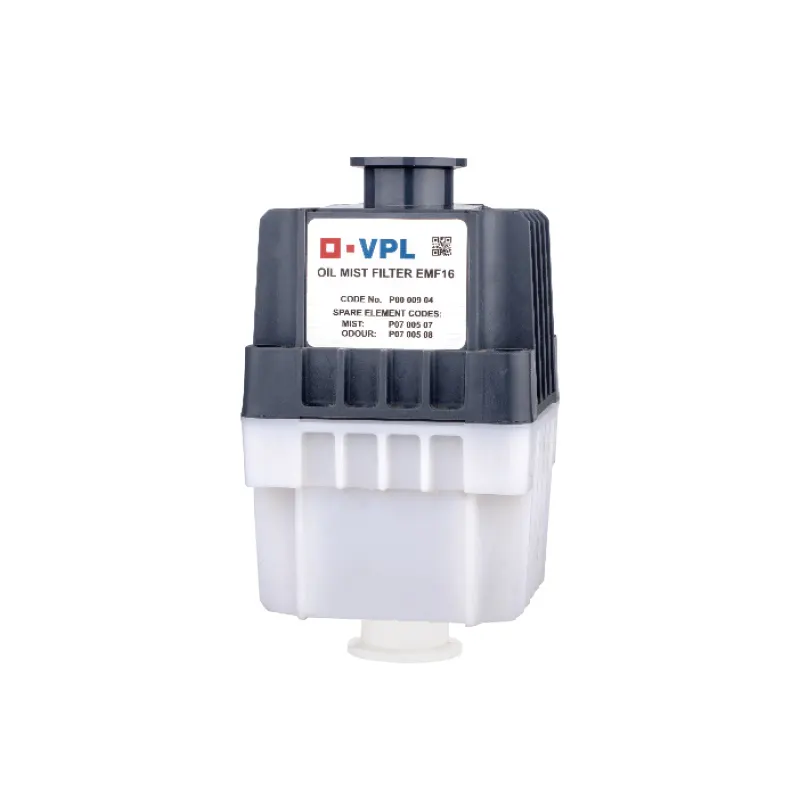
One accessory worth considering in any laboratory that evacuates antechambers with oil-lubricated pumps is the vacuum pump oil mist filter. Oil-sealed pumps release a fine oil mist in their exhaust stream; in a closed laboratory this mist settles on surfaces, can be drawn into nearby equipment, and adds an avoidable air-quality issue in a room where people are working. A mist filter fitted to the pump exhaust traps that aerosol before it reaches the room. It does not improve the atmosphere inside the glove box in any way — it addresses the pump exhaust, not the internal gas — and it should be selected for flange or connection size, flow capacity relative to the pump, and element replacement interval rather than for any claimed purification benefit. In short, it is an exhaust-side accessory, and it is only relevant if oil-lubricated pumps are part of the installation.
Where is a twelve-station purification box suitable, and where is it not?
A box of this scale fits research groups and pilot facilities where inert-atmosphere work is continuous and shared: lithium metal and solid-state battery materials, perovskite and OLED device fabrication, semiconductor-related processing, air-sensitive synthesis and catalysis, advanced materials, and additive manufacturing powder handling or post-processing. In those settings the value comes from combining a stable atmosphere with enough working positions that preparation, assembly and testing can all happen inside the same environment.
The limits matter just as much. An inert-atmosphere glove box is not a sterile environment, is not a cleanroom classification, and is not a biosafety or hazardous-material containment certification. Inertness is also not absolute: whether a given gas is protective for a given sample depends on the chemistry involved, and some materials react with nitrogen or need a different working gas. A twelve-station box is also a large volume with many ports, many seals and heavy traffic — the more material moved in and out, and the more solvent evaporated inside, the harder the purification system has to work. If a project only needs two or three working positions, a smaller box using the same purification approach is usually cheaper to run and easier to keep clean.
How should you select or integrate one?
Work backwards from the task. Define what happens at each station, how many people work simultaneously, which materials and solvents enter the box, and how large and how frequent the transfers are. Those answers set the required interior layout, the number and position of glove ports, the number and size of antechambers, and the load the purification system has to absorb.
Then plan the infrastructure around the box: power and signal routing, inert gas supply and purity, vacuum routing, exhaust and ventilation, the installation route for the split sections, and space for regeneration and maintenance. Decide in advance which accessories are genuinely required — antechambers, pumps, an exhaust mist filter if oil-lubricated pumps are used, feedthroughs, analysers, particle filtration, solvent management, cooling — and check each one against the interface it must connect to.
Finally, ask the supplier to separate what is guaranteed from what depends on your operation: the enclosure leak-test criteria, the analysers' calibration and sampling arrangement, the purification system's recovery and regeneration figures, and the interface list for everything you intend to connect. The page for the twelve-station double-sided split-type purification glove box is a sensible place to start that conversation with concrete requirements rather than generalities.
FAQ
Does every twelve-station glove box include a purification system?
No. Purification is a separate subsystem. Some large enclosures are only purge-and-vacuum designs, which suit short, low-sensitivity work but do not continuously remove water and oxygen. Confirm explicitly whether a quoted box includes a gas purification loop and what its regeneration requirements are.
Can this type of box hold very low oxygen and moisture levels?
It depends on the whole installation, not just the purification unit: enclosure leak rate, joint quality, the volume and moisture content of what is transferred in, solvent load, purge discipline and maintenance. Ask for the conditions under which any quoted figure applies, and whether it is an attainable value or a level the system can sustain with your workload.
Can stations or chambers be added later?
Modular split construction makes later expansion more feasible than a single welded enclosure, but it depends on how the modules and the purification loop were sized originally. Ask about purification capacity headroom and available connection points before assuming an upgrade is straightforward.
Do accessories improve the box atmosphere?
Generally, no — each accessory does its own job. Analysers measure the atmosphere, particle filters remove particulates, solvent traps manage solvent vapour, pumps move gas, and an exhaust mist filter cleans the pump exhaust. Only the purifying media in the purification loop remove water and oxygen, and regenerating that media is a separate procedure from any of these accessories.
What maintenance does a purification system need?
The routine items are regeneration of saturated purifying media, analyser calibration and verification, seal and glove inspection, and leak checking of joints, doors and antechambers. The correct intervals come from the manufacturer's documentation and from your own logged trends in oxygen and moisture rather than from a fixed rule of thumb.
Choosing a twelve-station double-sided split glove box is really a decision about workflow: how many people need to work in the same controlled atmosphere, how material moves in and out, and how the purification loop will be kept in condition over years of use. Get those three things right, and the rest of the specification follows.
