
A six-glove double-sided glove box with a gas purification system is a sealed inert-atmosphere workstation built around two elements: a chamber with two rows of glove ports, and a closed purification loop that continuously removes moisture and oxygen from the gas inside it. The chamber provides the barrier — the operator stays outside and works through the gloves, while the sample stays inside a controlled atmosphere. The purification assembly, whether integrated into the frame or connected to the box as a separate unit, holds that atmosphere at the level the process requires instead of letting it drift each time the box is loaded, opened, or used. In a laboratory workflow, the equipment sits between incoming material and the analysis or assembly step it feeds.
Its purpose is practical rather than abstract: to let an air-sensitive sample remain open to the working atmosphere — being weighed, mixed, pressed, coated, or assembled into a test cell — without the oxidation and hydrolysis that begin within minutes in ambient air. The six-glove, double-sided arrangement is a capacity decision as much as a convenience one, because two rows of ports allow work from opposite sides of one chamber, and the extra ports allow several hands, several tools, or a longer working area than a single row can support. A configuration of this type is described on the six-glove double-sided purification glove box product page.
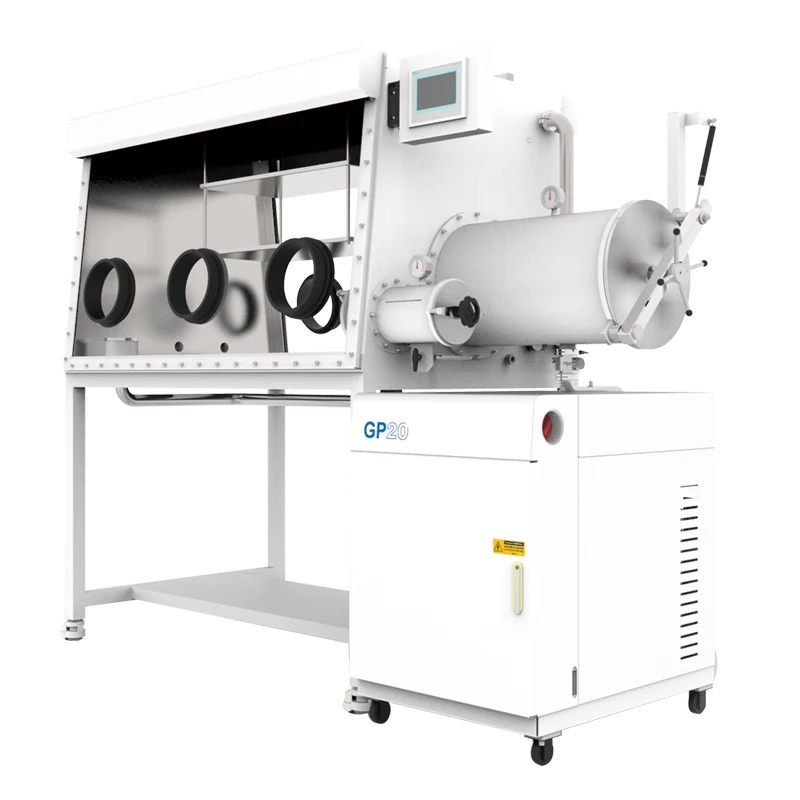
How the Purification Loop Works
In this class of equipment, purification is a loop rather than a single filter at the inlet. Gas is drawn out of the chamber, passed through purification media, and returned. Because the same volume of gas circulates many times, the loop can reach conditions well beyond what one purge could produce: each pass removes a fraction of the moisture and oxygen present, and the accumulated effect defines the working atmosphere. That is the practical difference between continuous purification and vacuum-and-refill gas replacement, where the result depends mainly on the purity of the supply gas and the number of exchange cycles rather than on continuous removal.
Two contaminants, two removal mechanisms
Moisture and oxygen are not removed by the same material. In most recirculating designs, water is captured by adsorption on a regenerable desiccant, while oxygen is bound chemically by a catalytic or getter medium, with the media typically arranged in series inside the purification column. The loop therefore has a defined gas path with an inlet and a return side, a circulator that maintains flow, and often a cooler that manages the temperature of the gas coming back into the chamber. Flow rate, media volume, and the free volume of the connected chamber together determine how quickly the atmosphere recovers after a transfer or after a long period of work through the gloves. This is why purification capacity should be matched to chamber size rather than judged on its own, and why connecting a much larger box to a fixed purification unit can quietly reduce performance.
Regeneration is a separate operating step
Purification media saturate over time, and performance declines before the media are exhausted. Recovery is achieved by regeneration: the column is heated while a gas stream carries away the released moisture and the products of the oxygen-removal reaction. The gas composition, heating profile, and duration belong to the specific medium installed, so they should be taken from the manufacturer's documentation for that unit rather than from general laboratory habit — a procedure that suits one column can damage another. While regeneration is running, the box atmosphere is not being purified, so demanding work is best scheduled around it. Regeneration restores the medium; it does not clean the chamber, and it has nothing to do with particle filtration.
Measurement is part of the loop
Without measurement, "purified" remains an assumption. The readout tells you whether the atmosphere recovers as expected after a transfer, whether the media are approaching saturation, and whether a leak has appeared at a glove, a seal, or a feedthrough. Slow degradation inside a sealed box produces no visible sign, so an instrument placed in the gas path is often the first warning available. Location matters as well: a sensor sampling the return line sees a different condition from one sampling the working zone near the gloves, and the two readings are not interchangeable.
What the Double-Sided, Six-Glove Layout Changes
Port count and side configuration are among the few decisions that cannot be changed later without rebuilding the chamber, so they deserve more attention than purification capacity, which can in some cases be expanded afterwards.
Working from two sides of one chamber
A double-sided box places glove ports on opposite walls of the same interior. One operator can move a sample or a tool across the chamber without walking around it, and two operators can work face to face on the same task — useful when a component must be held steady while a second operation is performed. The cost is footprint: the box now occupies the depth of two working positions plus clear space behind each face for glove changes, cleaning, and service access. A chamber specified without checking aisle width and ceiling height often ends up installed where nobody can reach the rear ports comfortably.
Six ports and several operators
Six ports on a double-sided chamber usually indicate more than one operator station and a wider working area than a single row of gloves can serve. Reach, however, sets the real limit: an operator can only work within the arc the arms describe through a fixed port, so interior volume beyond that arc is storage rather than workspace. Before fixing the port count, map the actual tasks — loading, weighing, sealing, tool changes — and check whether each needs its own access point or whether one port can serve several. Ports that are rarely used still require gloves, sealing rings, and periodic inspection. A team that only occasionally needs a second pair of hands may be better served by a smaller box with a well-planned layout than by a large chamber with idle ports.
Configurations to Compare Before Specifying
Port size and glove compatibility
Glove port diameter determines which glove sizes and materials can be fitted, and the glove itself is a consumable that must match both the port and the chemistry in the box. Thickness affects dexterity and permeation behavior; the polymer family affects resistance to the solvents and vapors present in the work. A port that accepts only one glove type restricts future options, so the interface is worth confirming before the chamber is built. Sealing rings and their replacement interval belong in the same conversation.
Purification capacity against chamber volume
The purification unit should be sized for the volume it serves and for how that volume will be used. A chamber opened frequently, or one used for procedures that release moisture or solvent vapor, places a heavier load on the loop than the same chamber used occasionally to mount sealed samples. Where a large glove box runs continuously, the capacity of the purification column and the recovery behavior after transfers matter more than a headline figure obtained under ideal conditions.
Transfer, sealing, and integration
How material enters and leaves the box is a design decision in itself. An antechamber lets a sample be introduced without exposing the whole chamber to ambient air, but it carries its own limits: internal dimensions decide what fits, and its evacuation and refill behavior decide how long a transfer takes. Feedthroughs for electrical, signal, or gas lines, and connections for pumps, analyzers, or cooling devices, must be specified at build time. Each added interface is also a potential leak path, which is why integration is best planned as a whole rather than as a list of separate additions.
Which Specifications Deserve Verification
Chamber, transfer, and sealing conditions
Several different pressures are involved in a glove box installation, and they are not interchangeable: the working pressure of the chamber, the vacuum achieved inside the antechamber, the ultimate vacuum of the pump connected to it, and the leak rate of the assembled system. A glove box that is not intended for vacuum service should not be judged by an antechamber's evacuation performance, and an antechamber figure says nothing about the atmosphere the purification loop can hold. Where documentation is incomplete, or a figure is quoted with unclear units or conditions, the practical response is to ask for the test conditions rather than to compare numbers taken from different contexts.
Atmosphere readings and the instrument behind them
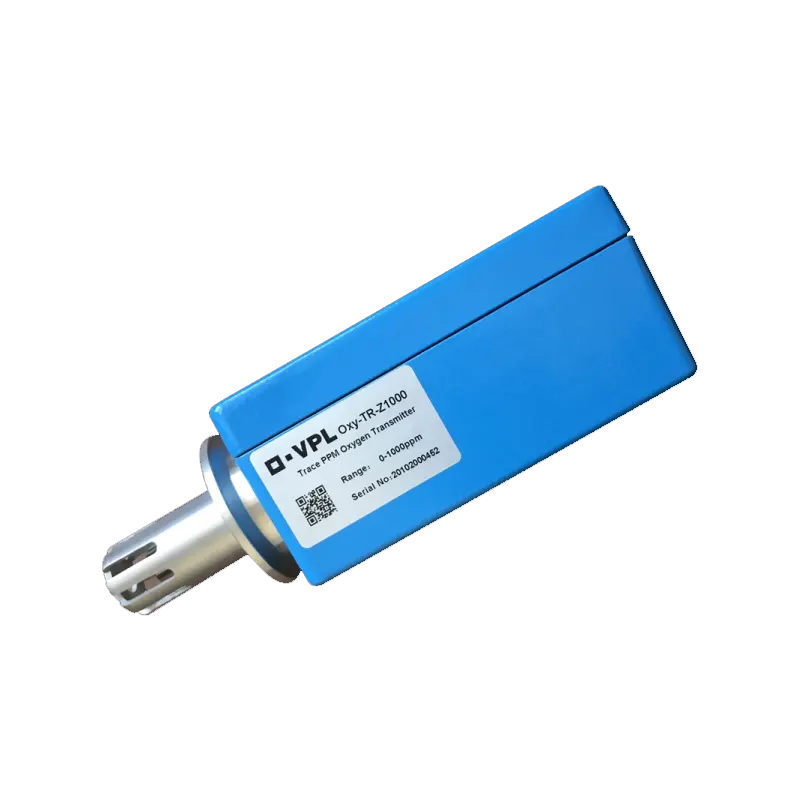
Atmosphere data deserve the same care. Whatever value is quoted should come with its measurement location, the instrument used, and whether it represents a steady-state condition or a recovery curve after a defined event. Resolution is not accuracy, and a display that reads to a fine increment says nothing about whether the reading is correct unless the sensor has been calibrated against a known reference. For oxygen specifically, a glove box zirconia oxygen analyzer measures oxygen partial pressure in the sampled gas; it reports the condition inside the box and does not remove oxygen itself. Such an accessory is only as useful as its placement and calibration, because sampling from a stagnant corner, or calibrating rarely, will produce consistent numbers that do not describe the working zone.
Where This Configuration Fits, and Where It Does Not
A recirculating box of this size suits work where several people handle air-sensitive material at once: lithium and solid-state battery materials, perovskite and OLED precursors, semiconductor and electronic materials, air-sensitive organometallic and inorganic chemistry, advanced materials development, and metal powders handled before or after additive manufacturing. It is also a common configuration in shared research facilities, where a single large chamber serves several groups and the atmosphere must survive a steady stream of transfers.
The boundaries are just as important. Inert-atmosphere protection is not sterility, a cleanroom classification, biological containment, or hazardous-material certification, and none of those properties should be inferred from a purified atmosphere. Nor is every gas inert toward every sample: nitrogen is the usual working gas, but some materials react with it, and the choice of working gas belongs to the process, not to the box. A glove box does not replace a fume hood for handling large volumes of solvent, and a solvent-adsorption accessory, where fitted, manages vapors rather than serving as a substitute for water and oxygen removal. Finally, a larger chamber does not increase throughput by itself; without a plan for transfers, the loop will spend more time recovering from each opening.
How to Select and Integrate the System
Selection starts from the process rather than the hardware list. Define the atmosphere the material actually needs, how long samples stay inside, how often the box will be opened, and how many people must work at the same time. Those four answers determine chamber volume, port count, side configuration, antechamber size, and purification capacity — in that order. Integration then follows: gas supply and venting, electrical and signal feedthroughs, pump connections, and instrument placement should all be resolved against the chamber drawing before manufacture.
Questions worth settling before purchase
- What chamber free volume and working height do the planned tasks require, and can each operator reach the whole working zone?
- What atmosphere condition must be maintained during active work, and at what point is it measured?
- How is the purification medium regenerated for this specific unit, and what does that procedure require on site?
- Which interfaces — antechamber, feedthroughs, gas lines, analyzer ports — must be built in rather than added later?
- Which consumables (gloves, sealing rings, media) are specific to this model, and how are they replaced?
- What evidence is provided for leak testing and for the measurement conditions behind any quoted atmosphere figure?
Short Answers to Common Questions
Does the box purify its own atmosphere?
Yes, when it is supplied with a purification system. The loop circulates chamber gas through purification media and returns it, which is what separates this configuration from a box that relies only on vacuum and gas refill. The purification column itself is not a working space; it is the equipment that supports the chamber.
Can an oxygen analyzer lower the oxygen level?
No. An analyzer measures; it does not purify. It tells you what the loop is achieving and whether the medium needs regeneration or the box needs leak checking. Expecting an instrument to change the atmosphere leads to misreading a rising oxygen level as an equipment failure rather than a leak or a saturated column.
Do six glove ports mean six operators?
Not necessarily. The ports define available access points, not staffing. Reach, task design, and glove size decide how many of them can be used comfortably at the same time, and several ports may serve one operator performing different operations across a wide working area.
Is a double-sided box automatically more productive?
Only if the workflow uses both faces. Two operators working on the same sample benefit clearly, as does any procedure that requires passing material across the chamber. If the second row of ports is unused, the added footprint and the extra gloves, seals, and service access may simply raise the cost of ownership.
When is an accessory the right answer instead of a larger box?
When the constraint is local rather than atmospheric. Better monitoring, a larger antechamber, an additional feedthrough, or a different glove compound can solve a specific problem without changing the chamber. A larger chamber is justified only when the working area itself has become the bottleneck.
