
What the six-station double-sided split-type glove box does
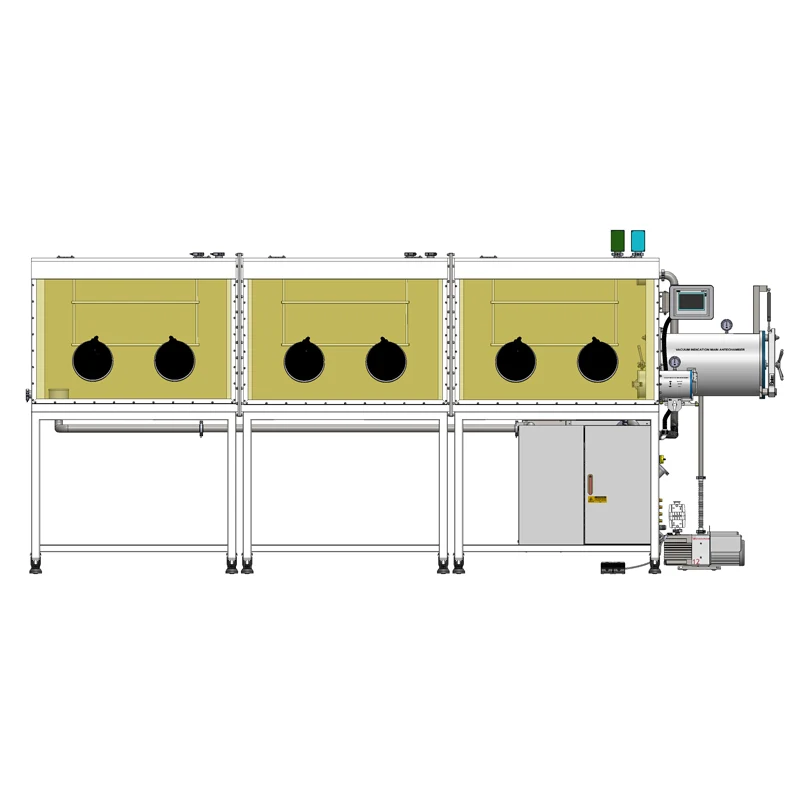
A six-station double-sided split-type glove box with gas purification system is a closed working enclosure that gives up to six operator positions, arranged on two opposite sides, access to the same controlled atmosphere. The split-type part means the enclosure is built in sections rather than as one uninterrupted box; those sections can be joined, isolated, or configured around transfer chambers and service zones. The gas purification system is a separate closed loop that continuously circulates the box atmosphere through purification media to remove moisture and oxygen. Together, the enclosure and the purification loop solve a specific problem: how to let several people handle air-sensitive materials in a shared low-oxygen, low-moisture environment without opening the box to ambient air.
The reference product for this article is the Six-Station Double-Sided Split-Type Glove Box with Gas Purification System. Its name already tells you the three main design decisions: six work stations, two-sided access, and a split enclosure with an integrated purification system. What the name does not tell you is the exact internal volume, the achievable oxygen and moisture levels, the antechamber size, or the purification column capacity. Those values must come from the current specification sheet for the configured unit, not from a generic assumption. The important selection questions are how such a system works, which parts matter, and what to verify before purchase.
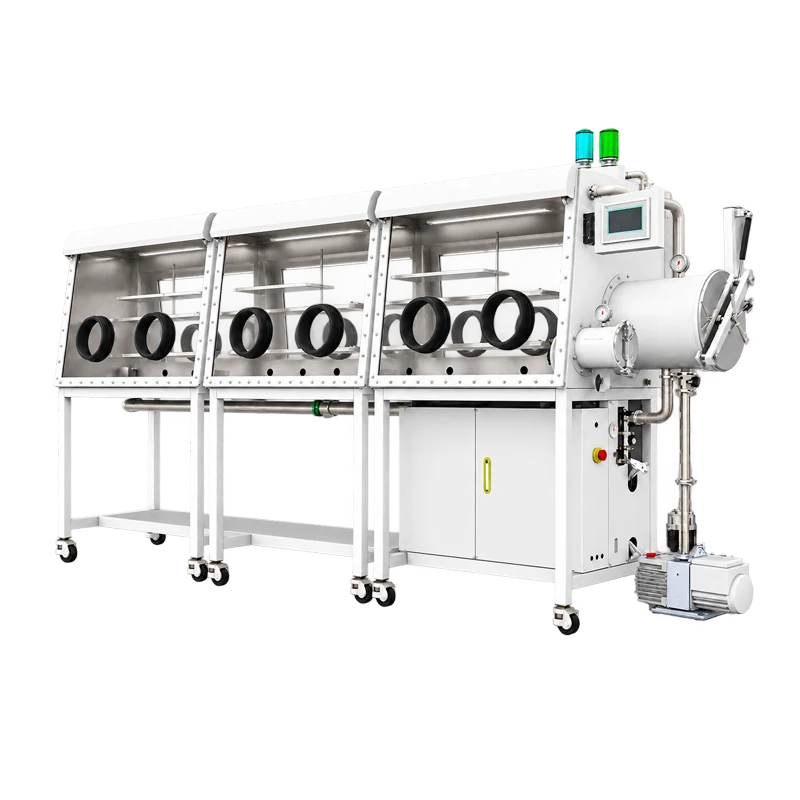
How the gas purification loop works with the enclosure
In a purified glove box, the enclosure is only half of the system. The other half is the gas purification loop. The loop pulls gas from the box, passes it through one or more purification columns, and returns it to the box. Moisture is typically removed by an adsorbent such as molecular sieve or activated alumina. Oxygen is typically removed by a catalyst that reacts with oxygen in the presence of a reducing gas, often hydrogen or a forming gas mixture. During normal operation, the loop circulates continuously or intermittently, depending on the control strategy and the load inside the box.
The purification media eventually become saturated. Regeneration is the process that restores them, usually by heating the column and passing a regeneration gas through it. Regeneration is not the same as normal circulation, and it is not the same as purging an antechamber. The box atmosphere may need to be isolated during regeneration, or a second column may take over. This is one reason a split-type, multi-station system needs a clear control philosophy: the purification loop, the analyzers, the antechambers, and the isolation valves all have to work together.
Oxygen and moisture analyzers measure the atmosphere; they do not purify it. A reading of low oxygen or low moisture is only meaningful if the analyzer is calibrated, if the sample point is representative, and if the box is leak-tight. Resolution and accuracy are different specifications. A display that reads to 0.1 ppm does not necessarily measure to 0.1 ppm accuracy. When evaluating a supplier's data, ask what was measured, where, under what load, and over what stabilization time.
Why the six-station, double-sided, split-type layout matters
These three words are not marketing decoration. They change how the box is used, how it is installed, and how the atmosphere is managed.
Six stations
Six stations usually mean six glove ports or six defined working positions. That can support multiple operators at once, or it can support one operator moving along a longer process line. More stations increase the internal surface area, the number of gloves, the number of potential leak paths, and the volume of gas that must be kept clean. A larger box is not automatically better; it is better only if the process needs the space and the purification loop is sized for the load.
Double-sided access
Double-sided means operators can work from both long sides of the enclosure. This is useful for collaboration, for handing samples across, or for separating preparation and inspection tasks. It also means the box may need to be placed away from a wall so people can stand on both sides. Layout, aisle width, and service access become part of the design.
Split-type construction
A split-type enclosure is made of sections rather than a single welded or bonded box. The split can allow a longer working length to be shipped, installed, and expanded more easily. It can also provide isolation between zones, so a transfer or a cleaning task in one section does not immediately disturb the whole atmosphere. The trade-off is complexity: joints, seals, and section-to-section connections must be leak-tight, and the control system must define whether the sections share one purification loop or have independent atmosphere management. That is a question to confirm with the manufacturer.
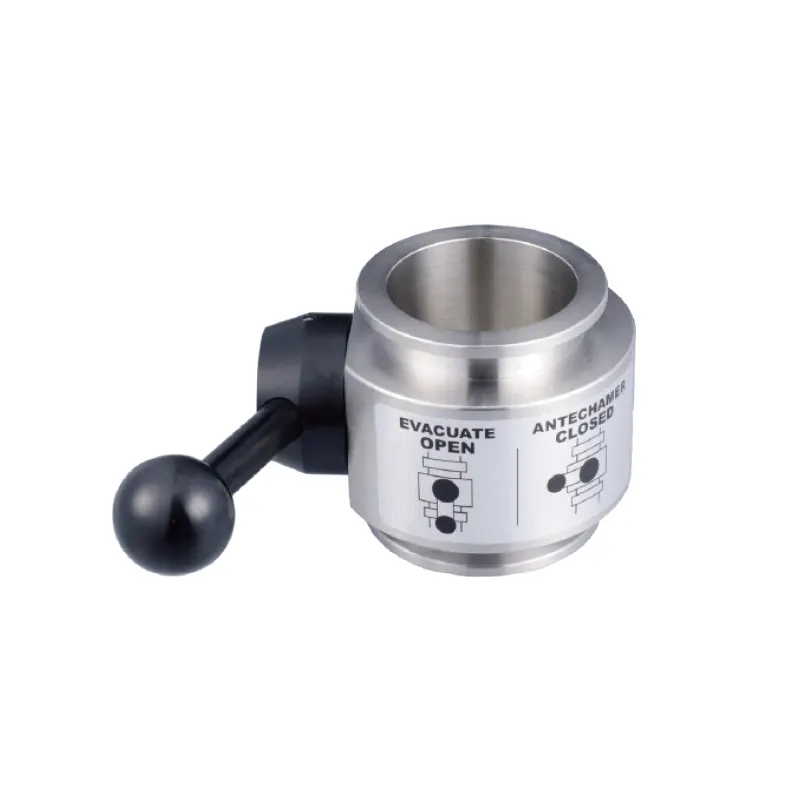
Where the accessory fits: KF vacuum butterfly valve
A glove box is not only a box and a purifier. It also has a vacuum and gas routing system. The KF Vacuum Butterfly Valve is an accessory for that side of the system. A butterfly valve is a quarter-turn valve that opens or closes a flow path. In a KF (Klein Flange) vacuum connection, it is used to isolate a vacuum pump, control evacuation of an antechamber or a vacuum line, or separate sections of a gas/vacuum circuit.
It is important not to overstate what an accessory does. A KF vacuum butterfly valve does not remove moisture or oxygen. It does not replace a purification column. It controls flow and isolation. If you need to protect the box from pump oil backstreaming, to hold vacuum on a transfer chamber, or to service a pump without breaking the box atmosphere, the valve is part of the solution. The valve's compatibility depends on the KF flange size, the seal material, the required vacuum level, and the gas or vapor it will contact. Those details must be matched to the specific box and pump; the name alone does not prove compatibility.
Which specifications should you check before selecting a system?
Because the reference product page provides the product name and images but not a full datasheet in this context, the safest approach is to treat the following as a verification checklist. Ask for the exact current values for the configured unit.
Working space and ergonomics
- Internal dimensions per station: width, depth, and usable height.
- Glove port diameter, spacing, and height above the work surface.
- Whether the six stations are all equally usable or whether some are intended for transfer and service.
- Floor space and aisle requirements for double-sided access.
Atmosphere performance
- Target oxygen and moisture levels for the actual process, not a marketing reachable value.
- Recovery time after a transfer, a glove change, or a door opening.
- Leak rate test method and acceptance criterion.
- Working pressure range and the pressure control strategy.
- Analyzer range, resolution, accuracy, calibration interval, and sample location.
Purification system
- Number of purification columns and whether one can operate while the other regenerates.
- Purification capacity for the expected load and the expected frequency of transfers.
- Regeneration gas type, supply requirements, and regeneration cycle time.
- Whether the system uses continuous circulation or intermittent circulation.
- Replacement interval for purification media and filters.
Transfer and vacuum
- Antechamber volume, door size, and whether it is a vacuum antechamber or a purge antechamber.
- Pump type and its compatibility with the required vacuum level and gas load.
- Valve and line layout, including KF connections, isolation valves, and vent paths.
- Whether the antechamber is shared by all six stations or dedicated to a zone.
Integration and safety
- Electrical and signal feedthroughs: quantity, type, and sealing method.
- HEPA filtration for particles, and separate solvent adsorption if solvents are used.
- Cooling or heating provisions if the process requires temperature control.
- Exhaust, utility, and service access requirements.
- Compatibility of seal materials with the solvents and gases in use.
Do not treat these categories as interchangeable. Box working pressure, antechamber vacuum, pump ultimate vacuum, leak rate, oxygen content, and moisture content are different measurements with different units and different purposes. A value that applies to one model under one condition is not automatically a continuous guarantee for every configuration.
Where the system is suitable — and where it is not
A six-station purified glove box is suitable for work where air-sensitive materials must be handled repeatedly by more than one person, or where a longer process needs multiple work positions. Typical applications include lithium metal and solid-state battery materials, perovskite and OLED device fabrication, semiconductor and electronic materials, air-sensitive chemical synthesis, advanced materials research, and additive manufacturing operations that require controlled atmosphere before or after processing.
The limits matter just as much. Inert atmosphere control is not the same as sterilization, cleanroom classification, biological safety, or hazardous-material containment certification. A HEPA filter removes particles; it does not remove moisture, oxygen, or solvent vapor. Solvent adsorption can help with organic vapors, but it does not replace the water and oxygen purification loop. An oxygen analyzer measures oxygen; it does not remove it. And no single inert gas is guaranteed to be inert to every sample. Material compatibility must be checked sample by sample.
There are also practical limits. A larger enclosure takes longer to purge, uses more gas, and may need a larger purification loop. Regeneration consumes time and gas. Gloves are a consumable and a potential leak path. Transfer through an antechamber is slower than opening a door, but opening a door is exactly what the system is designed to avoid. The right size is the smallest enclosure that comfortably supports the process, not the largest one that fits the room.
How to select and integrate a six-station purification glove box
Start with the process, not the product name. Write down the number of operators, the size and number of items transferred per day, the required oxygen and moisture limits, the solvents and gases used, the temperature range, and whether vacuum is needed at the workstation or only at the antechamber. Then match the enclosure configuration to those requirements.
For a split-type system, ask whether the sections share one purification loop or whether each section has independent atmosphere control. Shared purification is simpler and often more economical, but a problem in one section can affect the others. Independent zones offer more isolation but add cost, controls, and maintenance. For a double-sided box, confirm the aisle and service clearance on both sides. For six stations, confirm that the purification loop and antechamber can handle the expected transfer frequency, not just the static volume.
Then review the accessory architecture. If the system uses vacuum antechambers and a vacuum pump, the KF vacuum butterfly valve may be part of the isolation and control scheme. Check the flange size, seal material, actuation method, and vacuum compatibility against the actual pump and line. If the box needs electrical feedthroughs, gas lines, or solvent adsorption, plan those interfaces before installation, because adding them later can mean breaking the atmosphere and requalifying the box.
Finally, ask for documented performance data for the exact configuration: leak rate, oxygen and moisture recovery after a defined transfer, analyzer calibration, and regeneration procedure. The gas-purified six-station glove box page is the starting point for the product definition; the final specification should be confirmed in writing with the supplier. If a value is missing, unclear, or appears to use the wrong unit, leave it out of the decision until it is confirmed. A controlled atmosphere is built from verified details, not from a list of absolute claims.
Quick answers to common questions
Does a six-station double-sided split-type glove box include gas purification?
The product referenced here includes a gas purification system in its name and description. Confirm the number of columns, the circulation strategy, and the analyzer package for the specific unit.
Can a KF vacuum butterfly valve reduce oxygen and moisture on its own?
No. It controls vacuum and gas flow. Moisture and oxygen removal happens in the purification columns. The valve supports isolation, evacuation, and service tasks.
How do I know whether a KF valve is compatible with my glove box?
Compare the KF flange size, seal material, vacuum rating, and connection standard with the box and pump. Compatibility should be confirmed by the supplier or by the system integrator, not assumed from the product name.
When should I choose a split-type enclosure instead of a single-section box?
Choose split-type when you need a longer working length, multiple zones, future expansion, or isolation between sections. Confirm how the split affects atmosphere control, sealing, and purification sharing.
Is a purified glove box a cleanroom or a sterile environment?
No. It controls moisture, oxygen, and sometimes solvent vapor. It does not provide cleanroom particle classification, sterilization, or biological containment unless those features are separately specified and verified.
What is the most important specification to verify first?
The required oxygen and moisture levels for your process, followed by the recovery time after transfer. Those two determine whether the purification loop and antechamber design can actually support the work.
