
A three-station single-sided split-type glove box with gas purification system is a closed working enclosure that gives three operator positions on one face and uses a circulating purification loop to maintain a controlled inert atmosphere. The purification system is not a separate accessory bolted on for convenience; it is the part of the installation that continuously treats the box atmosphere by removing moisture and oxygen and returning it to the enclosure. The box solves a specific problem: how to handle air-sensitive materials with gloved access while keeping the working volume isolated from ambient air. The TENCAN three-station single-sided split-type purification glove box is the reference product for this article, and its exact dimensions, guaranteed atmosphere values, and scope of supply should be confirmed against the current product data and quotation.
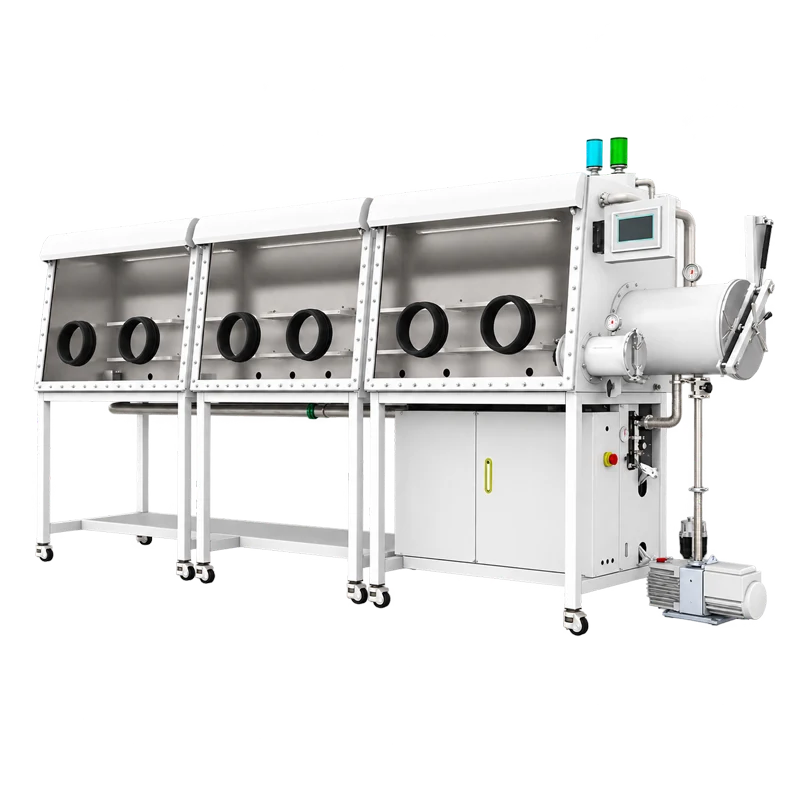
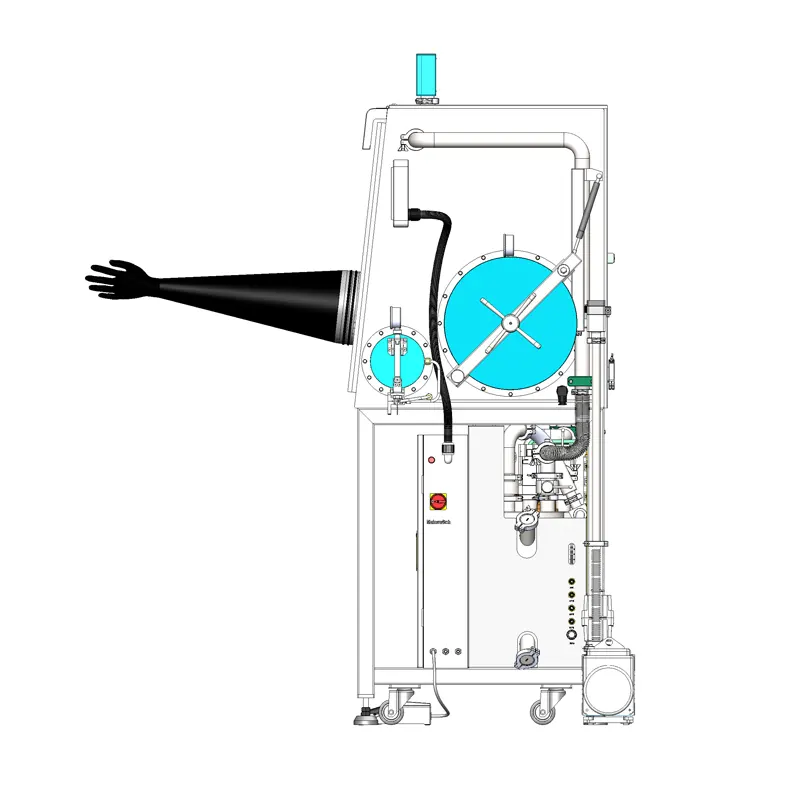
Inside the enclosure, the operator sees a working volume, a front window, glove ports, and at least one transfer antechamber. Behind or beside that volume sits the purification circuit: a blower or circulator, one or more purification columns, valves, piping, sensors, and a controller. The loop takes gas from the box, passes it through material that adsorbs or reacts with water and oxygen, and returns treated gas to the box. Because the loop is closed, the same inventory of inert gas is cleaned repeatedly rather than being replaced continuously. That is the basic difference between purification and simple gas purging.
Purging and purification answer different questions. Purging uses inert gas to displace ambient air after loading or during start-up. Purification maintains the atmosphere during operation by removing contaminants that enter through gloves, materials, small leaks, or the transfer path. Regeneration is a third process: it restores the purification material, typically by heating it while sweeping with a suitable gas. Regeneration is not the same as normal circulation, and the temperature, gas, and sequence for it must come from the manufacturer's procedure for the exact model; a general explanation cannot replace that procedure.
Gas roles should be kept separate. Work gas is the inert atmosphere inside the box. Control gas may operate valves or instruments. Regeneration gas is used during column regeneration. A site that treats all three as one gas supply can create both safety and performance problems. The required gas purity, supply pressure, and connections belong on the utility schedule and must be verified with TENCAN for the supplied configuration.
What the three-station, single-sided, split-type layout changes
The product name carries three design decisions, and each has an operational consequence.
Three stations
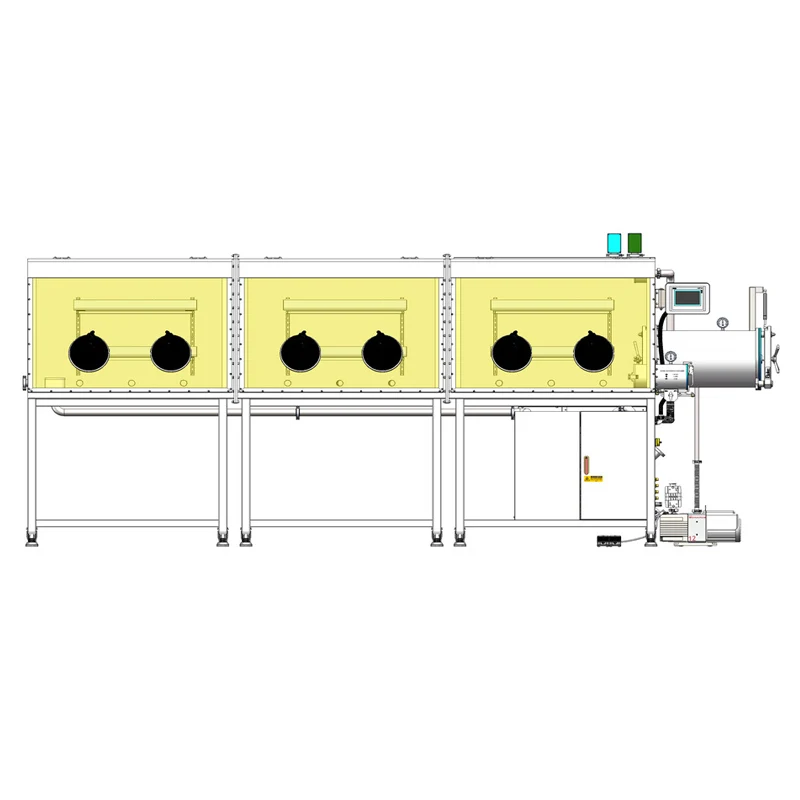
The three-station designation points to three working positions along the glove face. That arrangement can let two or three operators share a process, or let one operator stage a sequence across several positions. More stations also mean a larger working volume, more glove ports, and more opportunities for leakage or contamination at seals. The benefit is not automatic: a three-station box used by one person can be harder to keep stable than a smaller box because the volume and internal surfaces are larger. The number of stations should follow the workflow, not the other way around.
Single-sided access
A single-sided box places all glove access on one face. This generally gives a clear wall-side footprint and a straightforward sightline from the operator side. It also means the opposite side is not a working face; if the process requires two-sided collaboration, a single-sided model is the wrong architecture. The choice is about how the team works, not about which configuration sounds more advanced.
Split-type construction
Split-type is an installation and construction label. It generally indicates that the system is arranged in more than one major section rather than as one monolithic enclosure. The practical consequences include transport, doorway clearance, lifting, alignment, and the number of sealed joints that must be checked after assembly. The exact division, including how the box sections and purification section are separated, must be confirmed from the current drawing. Do not assume that a split-type unit can be moved or reconfigured without revalidation, or that its joints are less critical than a one-piece shell.
What the purification system includes and what it does not do
At the system level, a purified glove box should be discussed as a chain: enclosure and seals, transfer antechamber, circulation loop, purification columns, sensors and controller, and the gas supply. The analyzer measures the atmosphere; it does not clean it. The column removes water and oxygen; it does not remove every solvent vapor or particle. A HEPA filter traps particles; it does not lower moisture or oxygen. A solvent adsorber can protect the purification material from solvent load, but it does not replace water and oxygen removal. These distinctions matter when a process introduces solvents, powders, or reactive gases.
The purification cabinet is not an independent glove box. It has no operator working volume of its own; it supports a compatible enclosure. Conversely, a box shell without a purification loop is not a continuously purified system. For this product, the purification function is part of the supplied system, but the guaranteed performance and the exact components, including the blower, column set, analyzer, and regeneration controls, must be read from the specification and quotation rather than inferred from the model name.
Atmosphere control also depends on the transfer path. Every time a door opens, the box sees a disturbance. An antechamber reduces that disturbance by allowing an object to be brought to an intermediate pressure or atmosphere before the inner door opens. The antechamber does not eliminate the need for purge cycles, and its vacuum rating is not the same as the box working pressure. Those are separate specifications.
Which specifications should you check?
The model name is a starting point, not a specification. For a three-station purified box, the following categories matter. Use the current product page and drawing to obtain values for the actual unit; do not transfer a number from one configuration to another.
| Area | What to establish | Why it matters |
|---|---|---|
| Working space | Internal dimensions, usable depth and height, window opening, station spacing, and equipment load. | A three-station enclosure must fit the process and the people without crowding the glove path. |
| Atmosphere | Guaranteed oxygen and moisture limits, measurement location, stabilization time, and test conditions. | A low oxygen reading is not a specification; the guarantee, measurement point, and recovery behavior are. |
| Purification loop | Circulation arrangement, column capacity, regeneration requirements, and service access. | The loop must match the box volume, material load, and available gas supply. |
| Transfer | Antechamber volume, door size, vacuum or purge capability, and interface to the box. | The transfer path often sets the practical cycle time and contamination load. |
| Sealing | Leak-test method, test pressure, glove-port sealing, and joint details. | Leak rate, box pressure, and antechamber vacuum are different quantities. |
| Monitoring | Sensor type, range, resolution, accuracy, calibration, and alarm logic. | Resolution is not accuracy; an analyzer measures the atmosphere, it does not purify it. |
| Utilities and installation | Power, gas supply, exhaust, footprint, doorway clearance, and service clearance. | A split-type system must pass through the building and be reassembled and checked. |
Keep units and reference objects intact. A pump's ultimate vacuum, an antechamber's vacuum level, the box's working pressure, and a leak rate are not interchangeable. If a value is missing, contradictory, or unclear in the available data, leave it out and ask for the condition under which it was measured.
Where is it suitable, and what are its limits?
This architecture fits work where several related operations must stay under inert atmosphere and one-sided access is sufficient. Typical settings include lithium and solid-state battery material preparation, perovskite and OLED device work, semiconductor and air-sensitive chemistry, advanced materials research, and additive-manufacturing pre- or post-processing where the material is sensitive to ambient moisture or oxygen. In a three-station single-sided box, the intended fit is a small team or a sequence of tasks that benefits from adjacent positions without requiring two-sided access.
The limits are just as important. A purified glove box is not a sterile enclosure, a certified cleanroom, a biological safety cabinet, or a hazardous-materials containment system unless a separate qualification says so. Inert atmosphere is not automatically safe for every material; some gases react with some samples, and some solvents attack gloves, seals, or purification media. The system should not be presented as achieving a guaranteed zero level without a defined measurement and guarantee. A box with a purification loop is also not a vacuum chamber; it may include vacuum-capable antechambers, but that does not make the whole working volume a vacuum vessel.
Process loads deserve special attention. Solvent vapor, fine powders, and reactive by-products can shorten purification material life or pass through paths that a particle filter does not address. If solvents are part of the process, ask about solvent adsorption and material compatibility rather than assuming the standard column will handle the load. If the process generates particles, use particle filtration where appropriate, but do not expect it to remove water or oxygen. If the process needs frequent material transfer, the antechamber and inner-door strategy may matter more than a small difference in column size.
How should you select or integrate the system?
Start with the work, not the model number. List the materials, the largest item that must pass through the antechamber, the number of operators, the solvents or particles involved, the required atmosphere, and how often the box will be opened. Then check that the three-station working volume, single-sided access, and split-type installation match that workflow. A three-station box is a poor choice if the real need is two-sided collaboration; a single-sided box is a poor choice if equipment must be serviced from the rear.
Next, verify the interface chain. The enclosure, antechamber, purification loop, gas supply, exhaust, and monitoring must be designed as one system. Ask for the actual guaranteed atmosphere values, the measurement point, the leak-test method, the regeneration procedure, and the recommended spare parts. Confirm the building route for a split-type unit and the clearance needed to assemble and service it. For a three-station unit, check glove size and port spacing against the people who will use it, and confirm that the window and internal fixtures do not reduce the usable workspace.
Transfer is often the practical bottleneck. If a smaller chamber is being considered as part of the transfer strategy, review the Small Glove Box Antechamber page as a reference point, then confirm flange geometry, chamber volume, door arrangement, vacuum or purge capability, and sealing method with TENCAN before assuming it fits the main box. An accessory is not compatible merely because both items are sold for glove boxes.
Finally, plan operation and maintenance. A purified box needs a start-up purge, routine monitoring, regeneration when the purification material requires it, leak checks, glove inspection, and replacement of consumables. The operating procedure should state who can change settings, how alarms are handled, and what to do before opening the box after a fault. Those are not optional details added after purchase; they determine whether the atmosphere remains useful.
Short answers to common questions
Does this product include gas purification?
Yes, the supplied product is identified as a three-station single-sided split-type glove box with a gas purification system. The exact scope, including the purification cabinet, blower, columns, sensors, and controls, should be confirmed on the quotation and current data sheet.
Can it guarantee sub-ppm oxygen and moisture?
Do not infer a guaranteed value from the product name. Ask for the guaranteed limit, the measurement location, the stabilization time, and the test conditions. Resolution on a display is not the same as measurement accuracy.
Is it the same as a vacuum glove box?
No. A vacuum glove box uses a sealed chamber and vacuum or inert-gas exchange to create a controlled environment; it does not necessarily have a continuous purification loop. A purified glove box uses circulation through purification material. The two approaches can be combined in an installation, but they are not the same function.
Can a HEPA filter replace the purification system?
No. HEPA filtration addresses particles. It does not remove water vapor or oxygen. Likewise, solvent adsorption may protect the purification material, but it does not replace water and oxygen removal.
When is an antechamber needed?
Whenever materials must move into the box without opening the main working volume directly to room air. The right size and type depend on the object, transfer frequency, vacuum or purge requirements, and the interface to the box. Confirm compatibility rather than assuming a small chamber fits every model.
What should be confirmed before ordering?
Working dimensions, station layout, guaranteed atmosphere, antechamber size and function, leak-test method, gas supply requirements, regeneration procedure, utilities, installation route, and service access. Use the product page as the starting document, then close the remaining gaps in writing.
