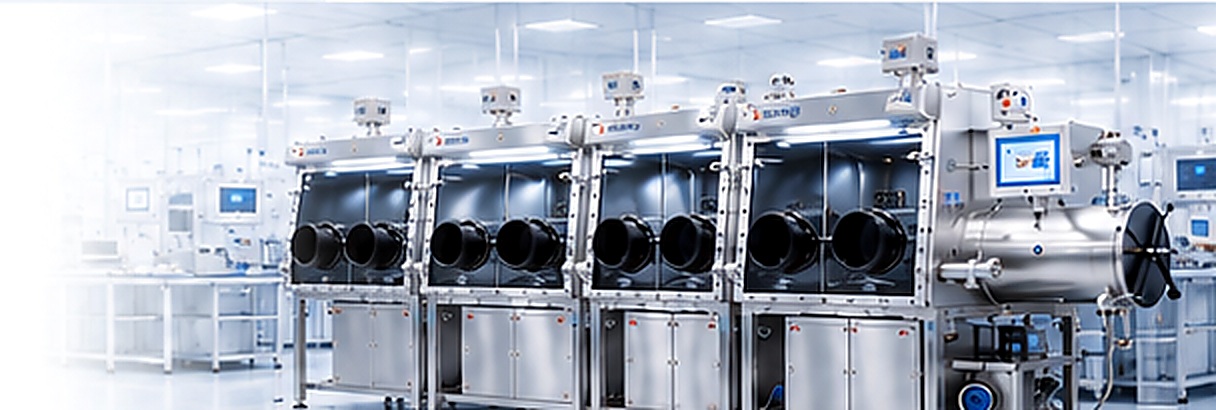
Why Consider a Three-Glove Single-Sided Glove Box?
When your laboratory work involves moisture- or oxygen-sensitive materials, you need a controlled environment that keeps contamination at bay. Many researchers start with a single-station glove box, but as experiments grow more complex, you may find yourself needing extra hand access without sacrificing the purity of the inert atmosphere. That is where the Three-Glove Single-Sided Glove Box with Gas Purification System comes in. This configuration offers a middle ground between a standard two-glove workstation and a multi-station system, providing three glove ports on a single side of the chamber. It allows one or two operators to handle tasks that require more manipulation, such as assembling battery cells, transferring moisture-sensitive powders, or performing delicate sample preparation, all while maintaining a stable, low-contamination environment.
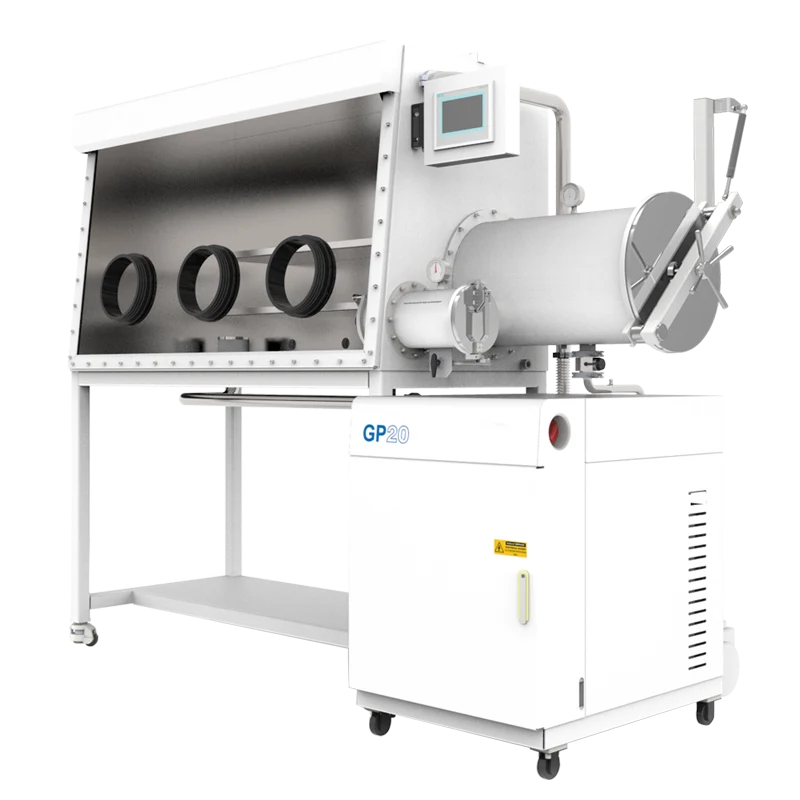
How the Gas Purification System Works
The heart of this glove box is its integrated gas purification system. The system continuously circulates the inert gas inside the chamber through a purification column, which contains materials such as copper catalyst and molecular sieves. These materials chemically adsorb oxygen and physically adsorb moisture, reducing both H₂O and O₂ levels to typically below 1 ppm under proper conditions. The purified gas is then returned to the chamber, maintaining the ultra-low contaminant levels required for sensitive processes.
The purification system operates automatically, with a PLC-controlled circulation loop. When the column becomes saturated, it can be regenerated by heating it to a specified temperature (typically 200–300 °C for copper catalyst) while purging with a mixture of hydrogen and inert gas or with pure hydrogen, depending on the design. After regeneration, the column is ready for another cycle of purification. This closed-loop design minimizes gas consumption, as the same inert gas is reused over and over.
Key Features of the Three-Glove Single-Sided Design
Three Glove Ports for Enhanced Flexibility
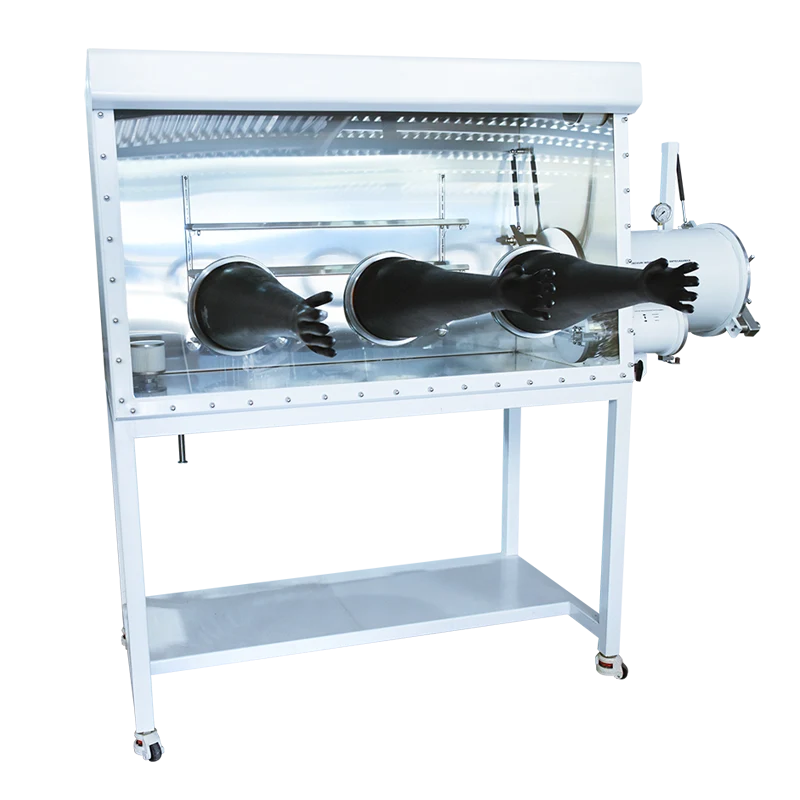
Unlike a standard two-glove configuration, the three-glove arrangement provides an extra opening. This is particularly useful when you need to pass large objects between hands or when two operators need to collaborate on the same task. For example, one researcher can hold a substrate while the other performs a coating step, all within the same sealed environment. The extra glove can also be used as a dedicated port for tools or for a second operator during long procedures.
Single-Sided Operation Space Saving
A single-sided glove box occupies less floor space than a double-sided unit, making it ideal for labs where bench area is limited. All glove ports are on the front face, so operators work from one side. This design also simplifies the layout of additional equipment, such as microscopes, balances, or solvent purification systems, which can be placed on the rear or side of the chamber.
Gas Purification System Integrated
The built-in purification system eliminates the need for an external or separate purifier. It is sized to match the chamber volume, ensuring efficient contaminant removal. Typical circulation flow rates for this class of glove box are in the range of 60–120 m³/h, depending on the specific model. The system includes a water and oxygen analyzer to monitor the atmosphere in real time, giving you continuous feedback on the environment quality.
Applications That Benefit from This Configuration
The three-glove single-sided gas purification glove box is widely used in research and small-scale production. Common applications include:
- Lithium battery research: Handling lithium metal, electrolyte filling, and cell assembly under argon or nitrogen atmosphere.
- Perovskite solar cell fabrication: Spin-coating, thermal evaporation, and encapsulation of moisture-sensitive perovskite layers.
- OLED and display materials: Processing organic semiconductors that degrade rapidly in air.
- Nanomaterials synthesis: Preparing and handling air-sensitive nanoparticles, quantum dots, or metal-organic frameworks (MOFs).
- Pharmaceutical and chemical synthesis: Working with air-sensitive catalysts, reagents, or intermediates.
For each of these applications, maintaining a consistent low‑moisture and low‑oxygen environment is critical to achieving reproducible results. The three-glove design allows you to perform more complex manipulations without constantly opening the chamber, which helps preserve the atmosphere.
Selecting the Right Glove Box for Your Lab
When considering a Three-Glove Single-Sided Glove Box with Gas Purification System, there are several factors to evaluate:
Chamber Dimensions and Internal Volume
The size of the chamber directly affects the workspace and the gas purification load. Typical lengths for single-sided glove boxes range from 1200 mm to 1800 mm, with a standard depth of 750 mm or 1000 mm. Make sure the internal height is sufficient for your equipment, such as a spin coater or a small furnace.
Glove Material and Chemical Compatibility
Gloves are available in different materials, each offering different levels of chemical resistance and tactile sensitivity. Common options include:
- Butyl rubber: Excellent resistance to moisture and many organic solvents, but less flexible.
- Neoprene (chloroprene): Good general-purpose chemical resistance.
- EPDM: Suitable for ketones and some acids.
Select a glove material that matches the chemicals you will handle. For most battery and perovskite applications, butyl rubber gloves are a popular choice.
Purification System Capacity
The purification column’s adsorption capacity determines how often regeneration is needed. A higher capacity column can run longer between regenerations, which is beneficial for continuous operations. The regeneration process typically takes several hours and requires a hydrogen gas supply (or a nitrogen/hydrogen mixture). Verify that your facility can provide the necessary gas for regeneration.
Transition Chamber (Antechamber) Configuration
Most glove boxes come with at least one transition chamber (also called an antechamber or load lock) for transferring materials in and out without contaminating the main chamber. The size and number of transition chambers should match your workflow. A large transition chamber (e.g., 390 mm diameter × 600 mm length) is useful for larger items, while a small one (e.g., 150 mm diameter × 300 mm length) can be used for tools and small samples. The vacuum/tightness cycle of the transition chamber is critical for maintaining low contamination levels.
Control System and Monitoring
Modern glove boxes are equipped with PLC or HMI touch-screen controllers that allow you to set and monitor parameters such as H₂O, O₂, pressure, and regeneration status. Some systems also offer data logging and remote access. Ensure the controller is intuitive and provides real-time alerts if contaminant levels rise above your set limits.
Maintaining Atmosphere Purity
Even with a high-quality gas purification system, the actual H₂O and O₂ levels in your glove box depend on operational factors:
- Leak rate of the chamber: A well-maintained glove box should have a leak rate typically below 0.05 vol%/h. Regular leak testing is recommended.
- Integrity of gloves: Gloves are the most vulnerable part. Inspect them regularly for pinholes and replace them as needed.
- Transition chamber procedure: Always perform the recommended number of vacuum/purge cycles (usually 3–5 cycles) before moving materials into the main chamber.
- Quality of incoming inert gas: Use high-purity argon or nitrogen (≥99.999%) to minimize initial contamination.
By following these best practices, you can achieve and maintain H₂O and O₂ concentrations below 1 ppm, which is sufficient for most air-sensitive applications.
Why Choose a Three-Glove Configuration?
If your lab routinely handles tasks that require two hands but also need a third hand for holding tools or samples, the three-glove design offers a practical solution. It is also a cost-effective alternative to purchasing a larger multi-station box when you only need a moderate increase in access. The single-sided layout keeps the footprint compact, and the integrated gas purification system ensures you do not have to worry about additional external purification units.
For teams that anticipate future expansion, some manufacturers offer modular designs that allow you to connect multiple glove boxes together. However, the three-glove single-sided model is often a perfect standalone unit for dedicated research projects.
What to Prepare Before Requesting a Quote
When you are ready to discuss specifications with a supplier, having the following information ready will help them recommend the right configuration:
- Type of materials to be handled and their sensitivity to moisture/oxygen.
- Target H₂O and O₂ levels (e.g., < 1 ppm, < 10 ppm).
- Desired chamber internal dimensions (length, depth, height).
- Number of glove ports and preferred glove material.
- Single-sided vs. double-sided operation.
- Type of transition chamber(s) needed.
- Inert gas preference (argon, nitrogen, or helium).
- Local voltage and frequency (e.g., 220 V/50 Hz or 110 V/60 Hz).
- Available floor space and any special installation requirements.
Sharing these details will allow the supplier to tailor the system to your exact needs, ensuring optimal performance and value.
If you are searching for a reliable Three-Glove Single-Sided Glove Box with Gas Purification System, consider evaluating the design, build quality, and after-sales support. A well-engineered glove box will serve your lab for years, providing the stable inert atmosphere your sensitive materials require.