
A purification glove box is judged less by what is printed on its nameplate than by how quickly it returns to its working setpoint after you disturb it. Every sample transfer, every glove change, every port opened and re-sealed pushes water vapour and oxygen into a volume that was deliberately kept low in both. What happens next depends on two separate processes: how quickly the incoming contamination mixes through the working volume, and how quickly the purification loop removes it.
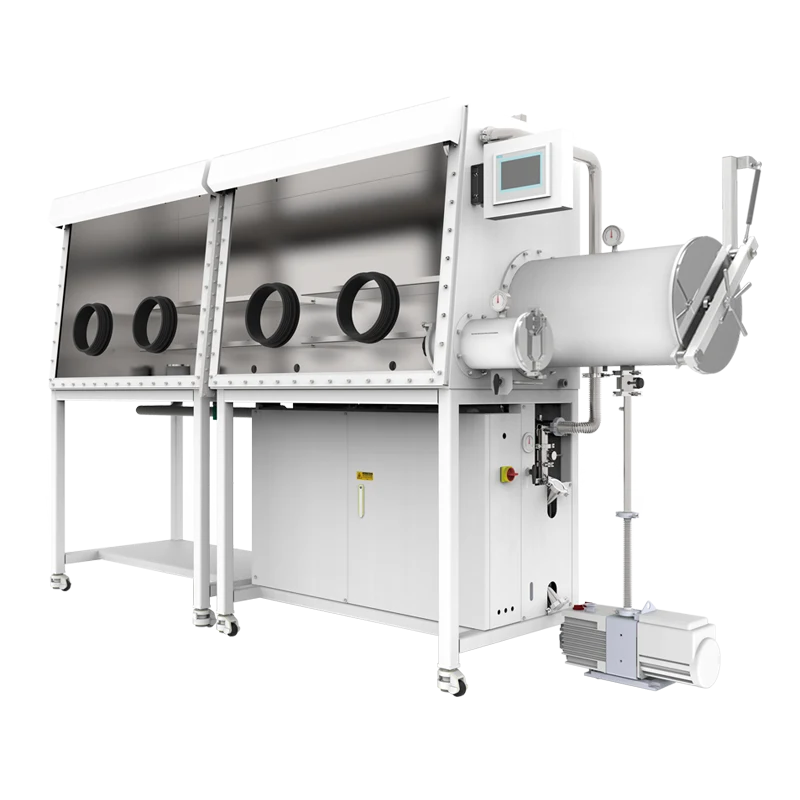
Slow recovery is therefore one of the most common complaints in inert-atmosphere laboratories and also one of the most frequently misdiagnosed. The first instinct is to blame the purifier; more often the purifier is doing what it was sized to do, while the delay comes from the box layout, the transfer routine, or a small sealing path that keeps admitting ambient air. Those three questions — layout, routine and sealing path — become clearer when examined through one configuration: the two-station single-sided split-type glove box with gas purification system, whose geometry separates them more visibly than a single-station box does.
What the Two-Station, Single-Sided, Split-Type Layout Changes
Three terms in the product name describe three independent design decisions, and each has a different effect on atmosphere behaviour. “Two-station” describes capacity, “single-sided” describes access geometry, and “split-type” describes how the cabinet relates to the purification hardware. Treating them as a single label hides most of the useful engineering information.
Working volume: dilution versus removal
When contamination enters a glove box, two things happen at once. The incoming air mixes into the existing atmosphere and raises the measured water and oxygen concentration, while the purification loop removes both species from the circulating gas. The reading you see is the result of both processes running together. A larger working volume takes longer for a given ingress event to spread evenly, which can make the reading rise more slowly at the sensor, but it also takes longer for the loop to sweep the whole volume clean afterwards.
A second station therefore cuts both ways. It gives a second operator a place to work, and it distributes the volume so that a local disturbance at one port is diluted before it reaches the analyser. But the loop also has more gas to process per pass, and a transfer at one station can be felt briefly at the other. Two-station boxes reward users who plan which station is used for what: keeping routine transfers and anything that opens the box at the station closest to the antechamber, and reserving the second station for work that keeps gloves sealed and materials inside, produces steadier readings than treating the two stations as interchangeable.
Why a split layout adds joints worth auditing
In a split-type system the working cabinet and the purification unit are separate assemblies connected by piping and, usually, a control interface. This has real advantages: the purification column and blower can be serviced without opening the working volume, the cabinet can be placed where bench space exists, and the noise and heat of the circulation hardware can sit away from the operator. The trade-off is a longer circulation path with more connections — flanges, valves, flexible sections and instrument ports — each of which is a potential sealing point.
None of these connections is inherently problematic. What matters is that a leak in the interconnecting path is often invisible from the working volume. The operator sees a stubborn rise in water and oxygen that the purifier never quite finishes off, and concludes that the purification material is exhausted. A leak check of the interconnecting piping and its joints is a more informative first step, because it separates air entering the system from water being released inside it.
Single-sided access and shared atmosphere
A single-sided box places all glove ports on one face, which suits a bench against a wall and keeps the working area within reach. In a two-station single-sided box, the operators share one atmosphere and typically one antechamber. That is efficient, but it means the two users are not fully independent: a long transfer at one port draws on the same gas inventory and purification capacity the other station depends on.
Double-sided boxes give the second operator a separate face and usually separate access to the antechamber, so work continues on the other side while a transfer is under way. Where two people expect to work continuously and independently, that is a workflow argument rather than an atmosphere argument; where the second station is used intermittently, a single-sided two-station layout often delivers the same practical benefit in less bench space.
Purge, Vacuum Exchange, Circulation and Regeneration Are Not Interchangeable
Most confusion about recovery times traces back to four operations that are described with overlapping language but do different things. Separating them makes a slow-recovery problem easier to reason about, because each acts on a different part of the system and has a different effect on the analyser reading.
Inert gas purge
A purge replaces the gas already present in a volume with inert gas. It is a displacement operation, and it lowers water and oxygen by diluting and expelling the atmosphere that was there before. Purges are most effective on small, well-mixed volumes such as an antechamber, a transfer container or an interlock, rather than on a large working volume, where simple dilution costs a great deal of gas and takes a long time. A purge does not remove water adsorbed on internal surfaces; it changes what is in the gas phase.
Vacuum-assisted exchange
Pulling a vacuum on an isolated volume and then refilling it with inert gas is a more efficient form of exchange than purging, because evacuation removes a large fraction of the original atmosphere in one step rather than diluting it. That is the logic behind an antechamber: the chamber is isolated from the working volume, evacuated, refilled, and only then opened to the inside. The important boundary condition is that the vacuum acts on the antechamber, not on the working volume. A glove box interior is not designed to be evacuated, and a vacuum step on the main chamber would be an entirely different procedure, not a routine one.
Closed-loop circulation
Circulation is what holds the working volume at its setpoint between events. A blower moves gas from the cabinet through the purification unit and back, passing it over material that adsorbs water and, separately, material that removes oxygen. Circulation runs continuously in normal operation, and it is the reason a well-sealed box can hold a low reading for long periods without operator intervention. It does not create a low reading from nothing: it removes contaminants at a rate set by gas flow, the condition of the purification material, and how well the loop is sealed.
Regeneration of the purification material
Purification material has a finite capacity, and regeneration is the process that restores it — typically by heating the column while a flow of gas carries away the released water, after which the column is cooled and returned to service. Regeneration is a maintenance operation with its own cycle; it is not purging and not circulation. Confusing the two leads to a familiar mistake: watching the water reading stay high, deciding the box needs regeneration, and running a cycle when the real problem was a sealing path that will simply re-contaminate the freshly regenerated material.
| Operation | What it acts on | Effect on the analyser reading | Common misunderstanding |
|---|---|---|---|
| Purge | Gas phase in an isolated volume | Rapid drop during the operation, then partial rebound | Assumed to remove adsorbed moisture from surfaces |
| Vacuum exchange | An isolated antechamber or transfer container | Reduces the contamination carried into the box | Assumed to apply to the working volume itself |
| Circulation | Continually recirculated working gas | Holds or restores the setpoint after an event | Treated as a substitute for regeneration |
| Regeneration | Purification material capacity | Restores the removal rate for later operation | Used as a first response to any slow recovery |
Where Atmosphere Disturbance Actually Enters: Antechamber, Seals and Gloves
If the purifier, circulation and regeneration are behaving as intended, the remaining sources of a slow recovery are physical: the transfer path, the seals and the gloves. These are also the areas where a two-station single-sided box accumulates the most wear, simply because more people use the same ports and the same antechamber.
Reading a transfer sequence
A transfer is a short sequence of steps that should be repeatable. The item goes into the antechamber while the outer door is open and the inner door is closed. The outer door is sealed. The chamber is evacuated and refilled, often more than once, with the number of cycles matched to the item's surface area and to how much air it can trap. The inner door is then opened to the working volume, the item is moved in, and the inner door is closed again before the next operation. Every step matters: a single cycle on a bulky item, an incompletely closed outer door, or an inner door left open while the operator reaches for something else all extend the recovery time that follows.
Antechamber volume and cycle practice
Antechamber size is a compromise between convenience and gas cost. A large chamber accepts bulky equipment, but it has more internal surface and more residual air to remove, so it needs more cycles and consumes more inert gas per transfer. A small chamber is quick and economical but restrictive. For a two-station box, a useful rule is to size the antechamber for the largest routine item rather than the largest conceivable one, and to handle exceptional items by other means. It is also worth confirming which surfaces inside the chamber will be exposed during evacuation, since porous, coated or loosely assembled items release gas more slowly than solid metal ones.
The glove port sealing ring and the seal path around each port
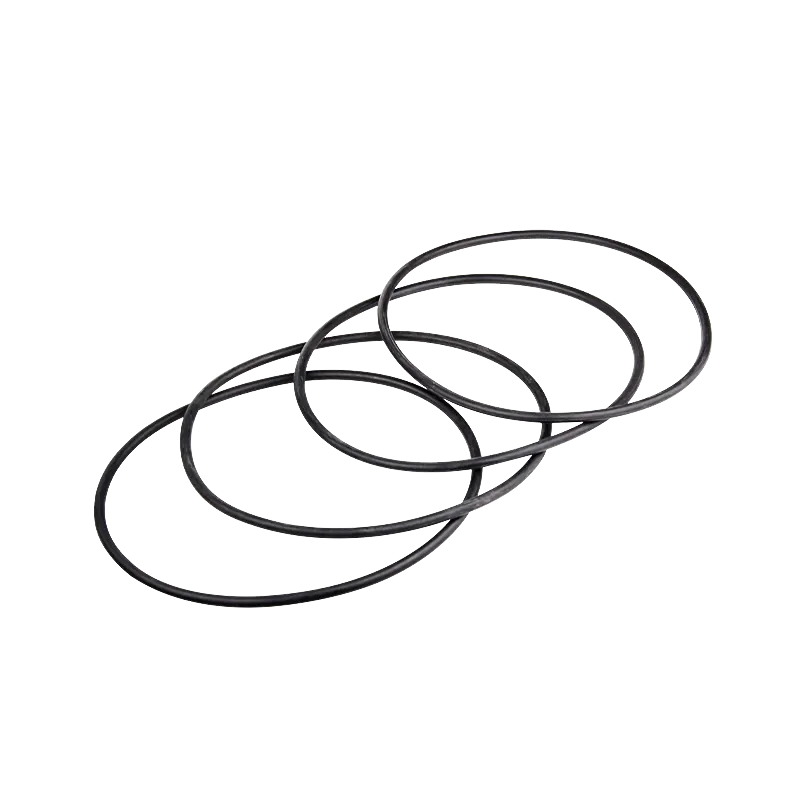
Gloves are the most frequently replaced component on any box, and each change disturbs the seal at the port. The glove port sealing ring captures the glove bead or cuff at the port and compresses it against the port flange or ring so the joint is gas-tight. The job sounds simple, but it is one of the few places where two requirements meet: the seal must be tight enough to prevent ambient air ingress, and it must not cut, stretch or chemically attack the glove material.
On a two-station single-sided box, a marginal sealing ring produces a recognisable pattern. The analyser reading drifts upward slowly and never quite stabilises, the drift is worse after a glove change, and it does not respond to regeneration the way a genuine capacity problem would. A ring that is compressed unevenly, seated with a twist, or made from a material incompatible with the solvent or vapour present inside the box can produce exactly this behaviour. Because the ring is inexpensive relative to everything else in the system, replacing it at routine glove changes — and confirming the correct size and material for the glove and port actually installed — is a cheap way to remove one variable from the diagnosis.
The same discipline applies to other seal paths. Glove cuffs, vacuum line connections, feedthroughs, sensor ports and the door gaskets on both sides of the antechamber all age, and what matters is checking them as a set rather than chasing whichever one is easiest to reach.
What Water and Oxygen Analyzers Can and Cannot Tell You
Analysers are the instrument the whole diagnosis depends on, which makes it important to know what they measure and what they do not.
Where the sensor sits
A sensor in the return line from the cabinet to the purification unit sees gas after it has passed through the working volume. That makes it sensitive to disturbances in the box, but it also means it may respond later than the disturbance itself. A sensor placed elsewhere in the loop will have a different response time to the same event. The reading is a measurement at a point in a flowing system, not an average of the entire volume, so a local disturbance near one glove port can be visible at one moment and diluted a few minutes later without any purifier action having occurred.
Resolution, accuracy and calibration are three different things
Resolution describes the smallest change an instrument can display. Accuracy describes how close the displayed value is to the true value. Calibration is what connects the two. An instrument with fine resolution can display a small number confidently but not necessarily correctly, and an uncalibrated sensor can be precise and wrong at the same time. For diagnostic purposes what matters most is repeatability — whether the same physical situation produces the same reading. If a sensor has drifted, the box may be better or worse than the display suggests, so periodic calibration checks against a reference gas, where the instrument supports them, keep the readings meaningful.
A slow sensor versus a slow system
When a reading recovers slowly, the cause can be the sensor's own response rather than the box. A useful test is to compare the direction and timing of change at two points in the loop, or to observe whether the reading responds promptly to a deliberate, well-understood event such as an antechamber cycle. If the number barely moves during a procedure that clearly changes the gas composition, the instrument is a candidate. If it moves promptly and then recovers slowly, the system is the more likely area.
A Diagnostic Checklist for Slow Recovery
The table below organises common patterns by what the operator actually observes. It is a starting point for ordering checks, not a substitute for manufacturer procedures, and any measurement should be confirmed using the method the system documentation specifies.
| Observation | Most likely area to check first | What to confirm |
|---|---|---|
| Reading rises after every transfer and recovers slowly | Antechamber procedure | Number of evacuation and refill cycles relative to the item and chamber size; outer door fully sealed before cycling |
| Slow upward drift with no transfer activity | Seal paths | Glove port sealing rings, glove cuffs, door gaskets, feedthroughs and joints in the split-type interconnecting piping |
| Drift begins after a glove change | Glove installation | Ring seating, even compression, correct ring size and material for the glove and port |
| Recovery is slow even with minimal activity | Circulation and purification capacity | Whether flow is reaching the cabinet, and whether the material is due for regeneration rather than assumed exhausted |
| Reading changes regardless of what is done | Instrumentation | Sensor location, calibration history and whether the reading repeats under identical conditions |
One pattern is worth calling out because it is so often misread. A box that recovers slowly after a transfer but holds a steady low reading overnight is usually not suffering from exhausted purification material. It is suffering from something that happens during the transfer or at the seal, and the quiet periods simply give the loop time to catch up. A box that drifts upward continuously even when idle points instead toward a continuous leak path or toward outgassing from materials left inside.
What to Confirm Before You Configure, Retrofit or Reorder
Most of the decisions that determine recovery behaviour are made before the box is ordered, and revisiting them is easier than correcting them afterwards.
Volume, station count and access geometry
Confirm how many people will work simultaneously and for how long. A two-station single-sided split-type configuration suits a laboratory where two operators alternate or share tasks, and where separating the purification hardware from the working bench is useful. If two people must work continuously and independently, the access geometry deserves closer scrutiny before the layout is fixed.
Purification and circulation capacity relative to the real workload
Capacity should be matched to the expected frequency and size of transfers rather than to a best case in which the box is rarely opened. Frequent large transfers require more removal capacity and faster circulation than occasional small ones, and the number of glove ports, the presence of an antechamber and the type of materials handled all affect the load.
Consumables and accessories planned in advance
Sealing rings, gloves, door gaskets and filters are consumables, and they are also diagnostic variables. Holding correct spares for the ports actually installed avoids the situation where an incompatible ring is fitted because it was the one available. When specifying, it helps to record the glove size and material, the port type, and the intended atmosphere and solvents in use, so the correct seal material can be selected.
Information worth preparing for a supplier conversation
- The largest and most frequent items transferred, with approximate dimensions and surface characteristics.
- How many operators use the box, and whether they work at the same time.
- Target water and oxygen levels for the actual process, stated as working values rather than aspirational ones.
- Materials and solvents that will be present inside the box, including any that could attack seal or glove materials.
- For a box already in service: when the reading rises, how long it takes to fall, and what changed before the behaviour started.
- Available bench space, and whether a split layout is preferred for servicing or noise reasons.
Slow recovery is rarely a single fault. It is usually the sum of a transfer routine that admits more air than necessary, a seal that has aged, and a circulation loop working exactly as designed against a load it was not sized for. Separating those three — transfer, seal, loop — turns a vague complaint about unstable readings into a specific, checkable condition, and it is the fastest route to a glove box that holds its setpoint between events instead of drifting away from it.
