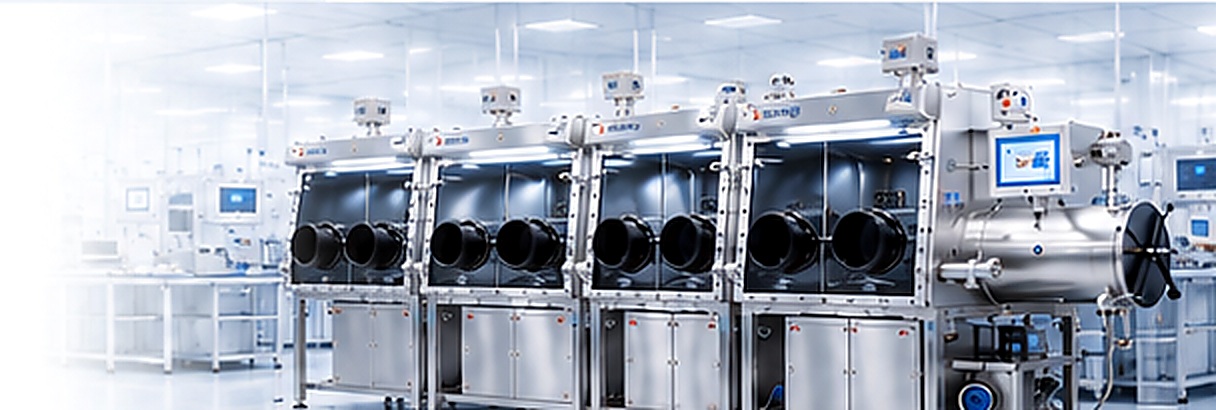
Why Choose a Six-Station Double-Sided Split-Type Glove Box?
When your laboratory or production line demands both high throughput and uncompromising inert atmosphere control, a six-station double-sided split-type glove box with gas purification system becomes an essential piece of equipment. Whether you are handling moisture-sensitive materials for lithium-ion battery assembly, synthesizing air-sensitive organometallic compounds, or packaging OLED devices, the ability to have multiple operators working simultaneously from both sides of the chamber can dramatically increase workflow efficiency while maintaining water and oxygen concentrations well below 1 ppm.
The split-type design offers additional advantages: the main chamber and the purification unit are separated, which reduces vibration transmission, simplifies maintenance, and allows the purification system to be placed in a location that best fits your lab layout. For large-scale operations—such as six-station, four-station, or even twelve-station configurations—the split-type architecture is especially beneficial because the purification column can be sized independently of the chamber volume, ensuring optimal circulation flow and regeneration cycles.
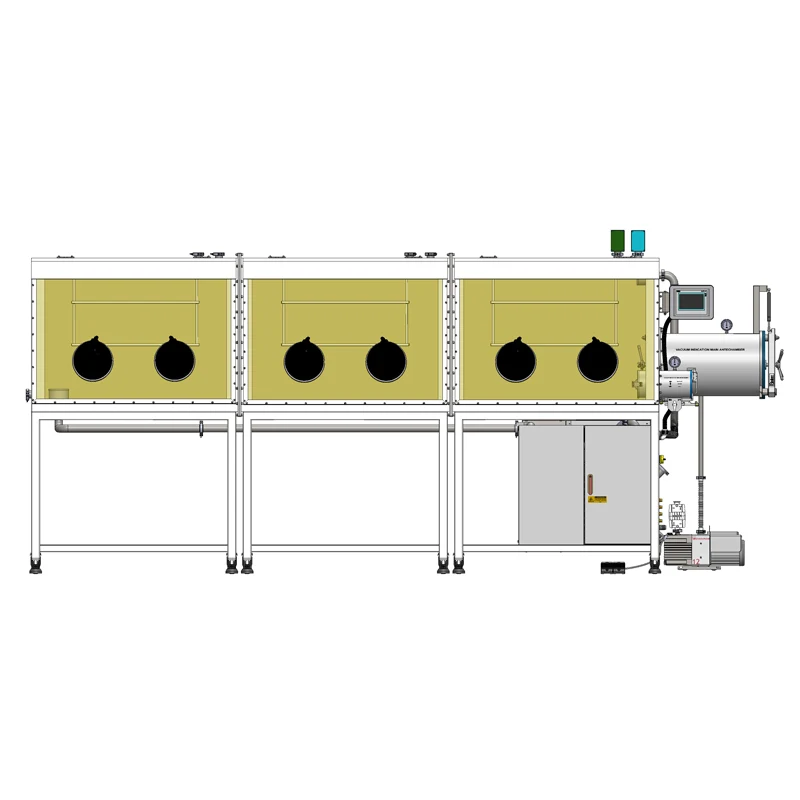
Key Technical Features That Define Performance
Ultra-Low Water and Oxygen Control
In a properly sealed glove box, the gas purification system continuously circulates the internal atmosphere through a column filled with high-capacity adsorbents—typically copper-based catalysts for oxygen removal and molecular sieves for moisture adsorption. With a typical circulation flow rate of 60–120 m³/h, the system can reduce H₂O and O₂ levels to <1 ppm each, provided the box leakage rate remains below 0.05 vol%/h and the gloves are intact. It is important to note that actual steady-state levels depend on many factors: the frequency of antechamber operations, the quality of the inert gas supply, ambient humidity, and operator discipline. A well-maintained six-station double-sided glove box can maintain these ultra-low levels for extended periods, making it suitable for the most demanding applications like lithium metal handling and perovskite solar cell fabrication.
Double-Sided Ergonomic Access
With three stations on each side (six total), operators can work face-to-face, which is ideal for collaborative tasks such as assembling battery cells, transferring samples between vessels, or conducting simultaneous experiments. Each station is equipped with durable butyl rubber gloves that provide excellent resistance to common solvents and maintain low permeability to moisture and oxygen. The double-sided layout also reduces the distance that operators need to reach, minimizing fatigue during long sessions.
Split-Type Modular Configuration
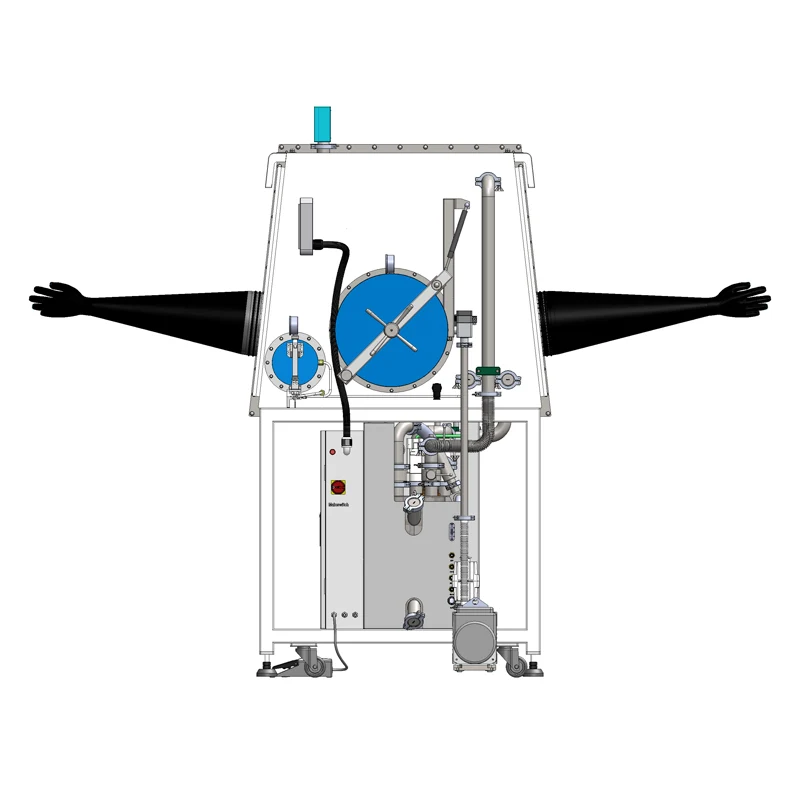
Unlike integrated glove boxes where the purification system is attached directly to the chamber, the split-type design places the purification column, blower, and control valves in a separate cabinet. This configuration brings several real-world benefits:
- Lower thermal load on the chamber: The heat generated during regeneration (typically 200–300°C for copper catalyst columns) is isolated, keeping the working environment stable.
- Easier maintenance: Technicians can access the purification system without entering the glove box or disturbing the inert atmosphere.
- Scalability: For multi-station configurations, the same purification unit can be used; for very large chambers, multiple columns can be added in parallel.
Applications That Benefit from Six-Station, Double-Sided Configuration
Lithium-Ion Battery Research and Pilot Production
Processing lithium metal, electrolyte filling, and cell assembly all require an environment with H₂O and O₂ typically below 1 ppm. A six-station double-sided glove box allows multiple steps—electrode preparation, electrolyte injection, and cell sealing—to be conducted in the same inert atmosphere without cross-contamination. The large chamber volume (commonly 2400 mm × 750 mm × 900 mm or larger) can accommodate glove boxes for pouch cell assembly machines, glove boxes for coin cell crimpers, or even a glove box for vacuum drying ovens.
OLED and Optoelectronic Material Handling
Organic light-emitting diode (OLED) materials are extremely sensitive to oxygen and moisture. Degradation can occur within minutes of exposure to ambient air. A six-station glove box with gas purification system provides the controlled environment needed for material synthesis, device fabrication, and encapsulation. The double-sided access enables one team to work on the substrate preparation while another handles the deposition sources, all under the same low-ppm atmosphere.
Pharmaceutical and Specialty Chemical Synthesis
Many pharmaceutical intermediates and catalysts are air-sensitive. Working with Schlenk lines inside a glove box is common, but for larger-scale reactions or when multiple chemists need simultaneous access, a six-station glove box becomes a practical production tool. The split-type system allows the purification column to be placed near a fume hood or exhaust, simplifying gas venting during regeneration.
Selecting the Right Configuration for Your Lab
When choosing a six-station double-sided split-type glove box, you need to consider several factors beyond the number of stations:
- Chamber dimensions: Ensure the length, depth, and height are sufficient for your largest equipment. Common lengths for six-station boxes range from 1800 mm to 2400 mm.
- Transfer chamber (antechamber): A large antechamber (e.g., 400 mm diameter × 600 mm length) for bulk transfers and a smaller one (150 mm diameter) for small items speeds up operations while preserving atmosphere purity.
- Glove material: Butyl rubber is standard; for applications involving strong solvents, consider Hypalon or Viton. For high-temperature operation, silicone gloves may be used but have higher permeability.
- Purification system capacity: The column should be sized to handle the total chamber volume plus expected ingress from antechamber cycling. A good rule of thumb is at least 60 L of oxygen capacity and 2 kg of moisture capacity for a six-station system, but your TENCAN representative can calculate this based on your specific usage.
- Regeneration gas: Most copper catalysts require a 3–5% hydrogen in nitrogen or argon mixture for regeneration. Ensure your facility can supply this or that the glove box includes a built-in regeneration gas mixing option.
- Instrumentation: High-accuracy moisture and oxygen analyzers (electrochemical or electrolytic) with auto-calibration capabilities help you trust the atmosphere quality.
The six-station double-sided split-type purification glove box from TENCAN is engineered to meet these requirements with robust construction, easy-to-use PLC touchscreen control, and reliable safety interlocks. For laboratories that anticipate future expansion, the split-type design also makes it straightforward to add an additional chamber or a solvent purification system later.
Before requesting a quotation, it is helpful to prepare: your target H₂O and O₂ limits, the number of operators, the largest pieces of equipment you plan to place inside, the type of inert gas (argon, nitrogen, or helium) you will use, and your local utility specifications (voltage, frequency). With this information, TENCAN engineers can recommend the optimal configuration—whether it is a standard six-station model or a custom solution with unique dimensions, glove materials, or additional purification columns.