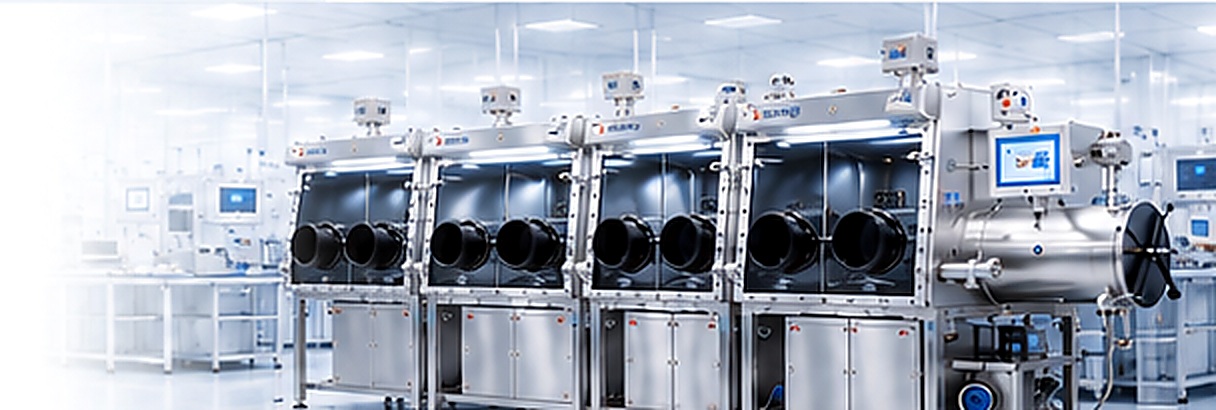
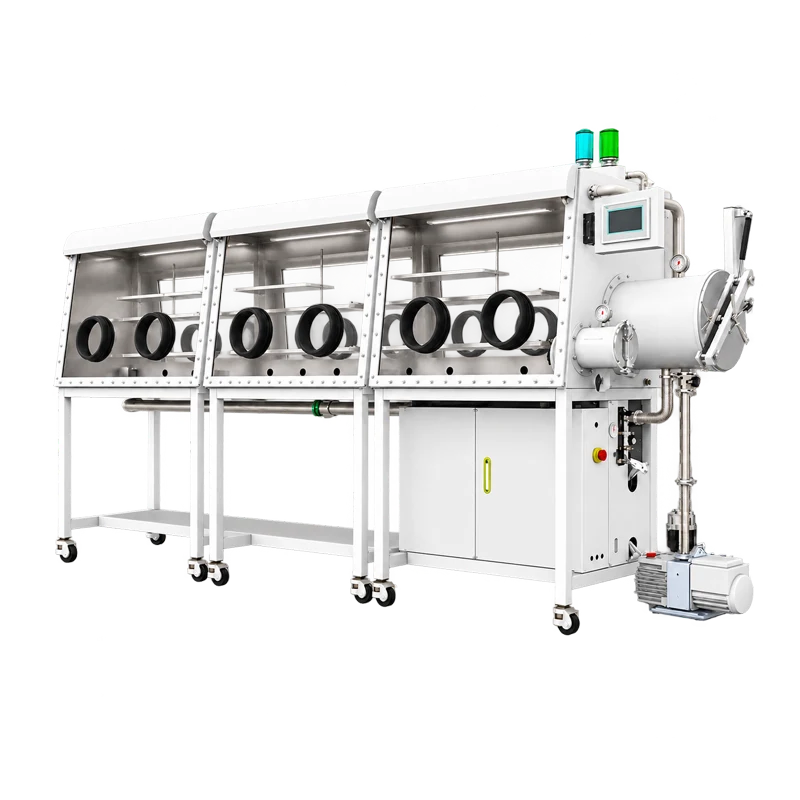
A six-station, double-sided split-type glove box with gas purification is best understood as a shared controlled-environment platform, not as six separate boxes placed side by side. The configuration increases the number of working positions and gives operators access from two opposing faces, while split-type construction organizes the enclosure into connected sections. Those choices affect collaboration, material flow, installation, cleaning, and the way the purification loop responds to disturbance. They also make seal integrity at section joints, the division of glove ports between faces, and sensor placement more important than on a single-station box. The six-station double-sided split-type glove box with gas purification system is the reference configuration here. Working dimensions, port spacing, purification capacity, achievable atmosphere, and accessory compatibility still have to be confirmed in a project-specific specification.
Reading the Configuration: What Six Stations, Two Faces, and a Split Frame Change
The term “six-station” indicates capacity and access, but it does not by itself define how those stations are arranged. Ask whether the count refers to glove ports, independent working positions, or a mixture of both. On a double-sided box, confirm how many stations sit on each face, whether they are offset or directly opposite, and whether one operator can reach the center without strain. A balanced layout can support parallel work; an unbalanced one can leave expensive glove ports unused.
Six stations also mean more gloves, sleeves, seals, and access points. Each is a potential permeation or leakage path, so the layout should be judged with maintenance access, cleaning, and leak testing in mind, not only with operator count.
Double-sided access is a shared-atmosphere decision
A second working face is often chosen for collaboration: one side prepares samples, the other inspects or packages them, and a shared atmosphere avoids an extra transfer. It can also shorten the effective reach across a wide enclosure. The benefit depends on internal clearance. If shelving, equipment, or a partition blocks the center, two faces simply create two crowded edges. Shared atmosphere also means shared risk: a solvent spill on one side can affect material on the other. Define clean and dirty zones before choosing the final port pattern.
Split construction turns interfaces into critical components
A split-type enclosure is organized in sections rather than as one monolithic chamber. That can simplify transport, installation, and service access, and it can allow the working length to be built around a room constraint. The trade-off is a set of interfaces. Joints, connecting ducts, and section-to-section seals must be designed, assembled, and tested as part of the controlled volume. Do not assume that split sections provide independent atmospheres or independent purification; confirm whether the sections share one loop, one control zone, and one sensor set. If they do, a disturbance in one section can propagate to the others.
How the Purification Loop Interacts with a Larger Working Volume
A gas purification system maintains the box atmosphere by circulating gas through purifier material that removes moisture and oxygen, then returning it to the enclosure. The loop generally includes a blower, one or more purifier columns, sensors, valves, and controls. The exact arrangement matters because purification capacity must match the box volume, leak rate, glove area, transfer frequency, and process load. A larger six-station box has more atmosphere to mix and more interfaces to protect, but volume alone is a poor sizing basis. A small box opened frequently can impose a greater load than a larger box kept closed.
Working gas, control gas, and regeneration gas serve different purposes. The working gas fills the box; control gas operates valves or instruments where applicable; regeneration gas restores purifier media. Regeneration is a separate operating state, not a continuous polishing step. Generic temperatures, gas mixtures, or sequences should not be borrowed from another system; follow the model-specific procedure.
| Function | Role | Limit to remember |
|---|---|---|
| Circulation | Moves atmosphere through the purification loop | Does not by itself remove contaminants |
| Purifier column | Captures water and oxygen through reactive media | Finite capacity; regeneration or replacement is required |
| Regeneration | Restores purifier media according to the design | Not a normal operating state |
| Analyzer | Measures concentration at its sample point | Does not purify gas or guarantee uniformity |
| HEPA filter | Removes particles | Does not remove water, oxygen, or solvent vapor |
| Solvent adsorber | Captures selected organic vapors | Not a substitute for water and oxygen purification |
This distinction prevents a common specification error: treating every accessory as if it improves atmosphere purity. HEPA filtration addresses particles. Solvent adsorption addresses selected organic vapors. Neither replaces the water and oxygen removal performed by the purifier loop. Conversely, a purifier does not solve a particle problem or capture every solvent. The process list should be matched to the correct function.
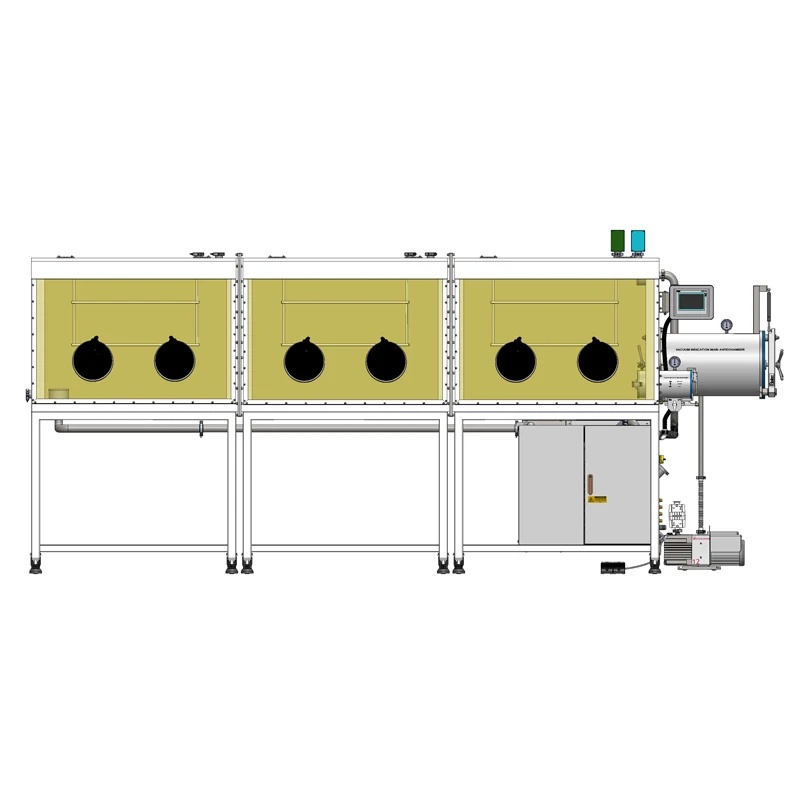
In a six-station double-sided box, the circulation path deserves particular attention. Long enclosures can develop slow-exchange regions behind equipment or at the end farthest from the return. Multiple return points, fan placement, and open shelving can improve mixing, but these are design choices to verify, not assumptions to make from a product name. Ask for the intended sensor locations and any recommended internal clearance that keeps the circulation path open.
Antechamber Transfer: The Repeated Disturbance That Shapes Stability
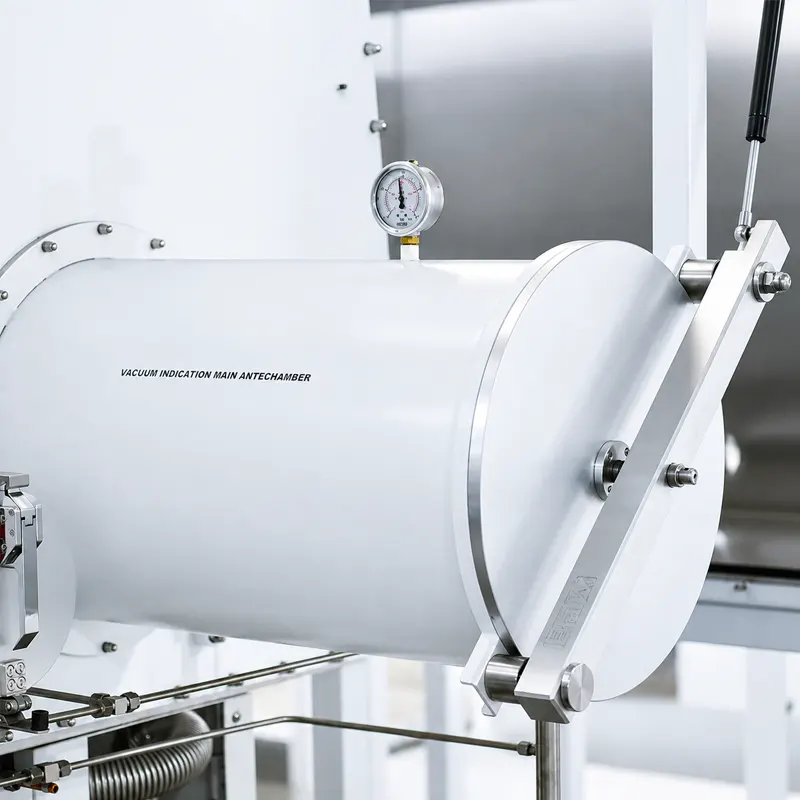
Every material transfer is a controlled disturbance. The antechamber lets an item enter without opening the main box to the room, but its outer door, evacuation, refill, and inner door still introduce a small amount of air, moisture, or particles when used. The goal is not a transfer with no change; it is a transfer whose disturbance is understood, limited, and allowed to recover before sensitive work resumes. Exact cycle times and sequences are design-specific and should come from the operating instructions.
A large glove box antechamber can be useful when the payload is bulky, heavy, or awkward to orient through a small opening. It reduces handling risk and may allow fixtures, small equipment, or containers to be moved as a unit. The trade-off is volume: a larger chamber usually needs more evacuation and refill gas per cycle, and its pump and valve system must be matched to that duty. The right size is the smallest chamber that accepts the real payload with safe clearance. Compatibility with the six-station box must be confirmed at the interface, including door clear opening, mounting, vacuum rating, pump capacity, and interlocks.
Keep three vacuum-related quantities separate. Box working pressure describes the slight positive or negative pressure used during operation. Antechamber vacuum describes the evacuation level reached during transfer. Pump ultimate vacuum describes the pump's capability under defined test conditions. None is interchangeable with leak rate or oxygen concentration, and none should be copied from a general catalog into a specification without its basis.
Reading Oxygen and Moisture Data Without Overinterpreting It
An oxygen or moisture analyzer is a measurement device, not an atmosphere-generating device. Its reading describes the gas at the sample point under the current conditions. It does not prove that every corner of a six-station enclosure has the same concentration. Sensor technology, range, resolution, accuracy, calibration, response time, and sample-line design all affect the number on the display. Resolution is not accuracy: a display that changes in small increments can still carry a larger uncertainty.
If readings rise after a transfer and then fall slowly, possible causes include:
- air ingress through a glove, glove port, door seal, feedthrough, or section joint;
- outgassing from packaging, powders, solvents, or wet components;
- a saturated purifier, an overdue regeneration, or an incorrect valve state;
- restricted circulation caused by equipment blocking the return path;
- a sensor that needs calibration, or a sampling line with a leak or dead volume;
- a transfer cycle that has not yet reached the intended endpoint.
These are candidate causes, not a diagnosis. Change one variable at a time and use the manufacturer's acceptance criteria. Do not “fix” a slow recovery by adding purifier capacity before checking leak paths, process load, and gas distribution. On a split, double-sided box, also ask whether one analyzer serves the whole enclosure or whether additional sample points are available. A single reading can be representative only when the circulation pattern and sensor placement have been validated.
Specifications should state where the measurement was taken, what analyzer was used, and whether the value is a steady-state result or a best-case demonstration. A best-case value from one model should not be generalized to every configuration or every process.
Commissioning the Layout: Turning Assumptions into Evidence
A six-station split box should be proven as a connected system, not accepted on the basis of one display reading. Commissioning should establish that the sections are aligned and sealed, that doors and interlocks operate as intended, that circulation reaches the working areas, and that the purification loop responds predictably to a controlled transfer. The acceptance plan should define the test conditions: working gas, payload, starting state, analyzer location, stabilization period, and the criterion for completion.
Leak tightness, purge recovery, and steady-state atmosphere are related but separate checks. A pressure-hold test looks for mechanical leakage; it does not measure oxygen or moisture. A purge recovery test shows how quickly the system returns to its intended condition after a defined disturbance; it does not prove that every station has the same atmosphere. A steady-state reading shows conditions at one sample point after stabilization; it does not establish performance under a heavy transfer schedule. Each test answers a different question.
Record a baseline after installation and compare it with routine readings. If a split section is added, a glove is changed, or an antechamber is modified, the baseline may shift. Trend data are more useful than a single spot check because they reveal slow changes in leak rate, purifier condition, or operator practice. Acceptance criteria should be agreed in advance and written with their measurement conditions, not summarized as a single purity claim.
Matching Materials, Solvents, and Parallel Work to the Box
The case for inert atmosphere depends on the material, not on the product category. Lithium metal and solid-state battery precursors, perovskites, OLED materials, some semiconductors, air-sensitive reagents, and additive-manufacturing post-processing can all justify controlled atmosphere, but their sensitivity mechanisms differ. Inert atmosphere is not automatically sterile, cleanroom-grade, or suitable for every gas-sensitive sample. Confirm whether nitrogen, argon, or another working gas is acceptable for the specific chemistry, and whether the process needs low oxygen, low moisture, or both.
Solvents require particular care. Their vapors can challenge purifier media and elastomer seals, and they can be redistributed by the circulation loop. A solvent adsorber may be appropriate for selected vapors, but it does not replace water and oxygen purification, and media selection matters. Powders create a different load: they migrate, settle in seals, and complicate cleaning. HEPA filtration can control particles, yet it has no role in removing moisture or oxygen. The process list should separate chemical compatibility, particle control, and atmosphere purity instead of treating them as one requirement.
Six stations and two faces make parallel work possible, but parallel work also creates cross-contamination routes. One side might handle opened materials while the other handles packaging, inspection, or a clean fixture. That division works only if tools, trays, and gloves are controlled and if the shared atmosphere is acceptable for both tasks. If the materials demand incompatible solvents or trace chemistries, a single shared volume may be the wrong choice regardless of how many stations it offers.
Glove selection belongs in the same review. Thickness affects tactility and permeation; length affects reach and the risk of pulling at the port; material affects chemical compatibility. A glove that is comfortable for assembly may be a poor choice for solvent handling. Feedthroughs, heat sources, and analytical instruments also add sealed connections and thermal load, so they should be specified with the box rather than added as an afterthought.
Specification Checks Before Committing to a Six-Station Layout
Before committing to a six-station double-sided split layout, convert the workflow into a verification list. The aim is to make every interface and operating assumption explicit.
- station count on each face, port spacing, handedness, and reach to the center;
- shared or independent sections, and whether one purification loop serves all of them;
- purifier capacity, redundancy, regeneration utilities, and expected process load;
- analyzer type, sample locations, calibration, alarms, and data logging;
- antechamber payload, door clearance, vacuum rating, pump matching, and interlock logic;
- glove material, size, port system, spare seals, and replacement access;
- solvent adsorption, HEPA filtration, electrical and signal feedthroughs, heat load, and cleaning method;
- acceptance tests for leak tightness, purge recovery, and steady-state atmosphere, with test conditions stated;
- installation route, section alignment, service clearance, and operator training.
A supplier cannot select the right configuration from a box volume alone. Provide the material list, including solvents and powders; the largest and heaviest item to be transferred; required working gas; whether oxygen, moisture, or both are critical; the number of operators and peak transfer frequency; heat sources and instruments; cleaning agents; and the acceptance criteria that will be used after installation. Ask explicitly which items are included, which are optional, and which require a different enclosure design.
The central question is not whether six stations sound more capable than two. It is whether the additional working positions, double-sided access, and split construction support a defined workflow without creating interfaces that cannot be monitored or serviced. Use the six-station double-sided split-type glove box with gas purification system as the starting specification, then verify the layout, purification architecture, transfer hardware, and instrumentation as one connected system.