
When a researcher first specifies an inert-atmosphere workstation, the conversation often jumps immediately to oxygen and moisture setpoints. That is understandable, but it skips the practical question underneath: what happens inside the box when samples enter, when gloves move, when a pump pulls vacuum on an antechamber, or when the purification loop is regenerating? A single-station, single-sided glove box with gas purification is a compact system, but it is still a system. Its performance depends on how purge, vacuum, circulation, and operator activity interact.
This article focuses on the single-station, single-sided glove box with gas purification as the core configuration, and it treats the KF stainless steel flexible bellows as a connection component that may appear in the gas or vacuum path. The goal is not to compare catalog numbers. It is to help materials researchers, laboratory managers, and equipment buyers decide when purification is necessary, how the box’s physical layout affects atmosphere recovery, and which details should be confirmed before purchase or installation.
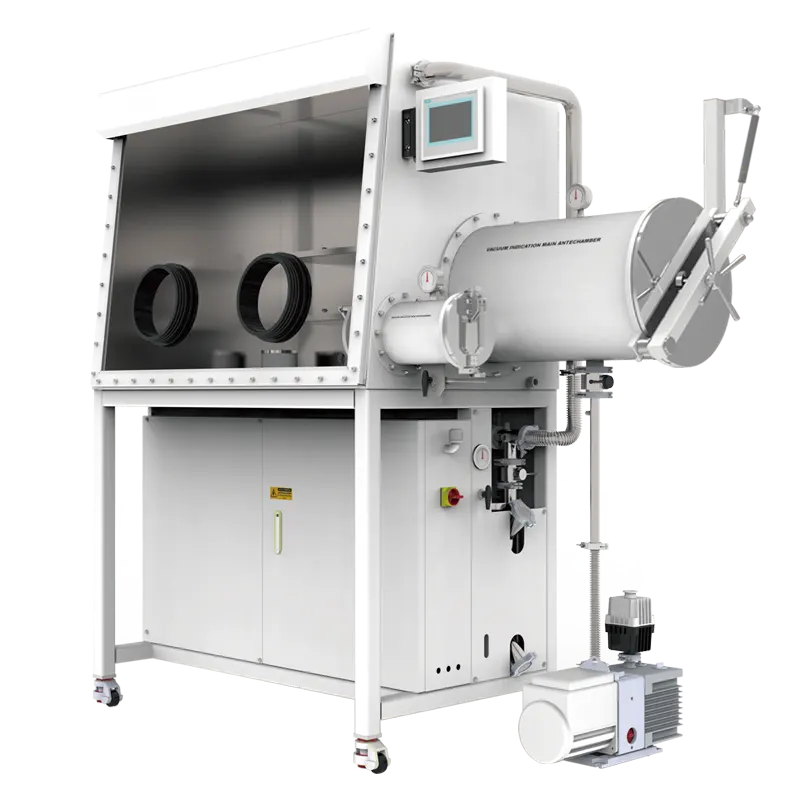
What the Single-Station, Single-Sided Purification Box Is—and Is Not
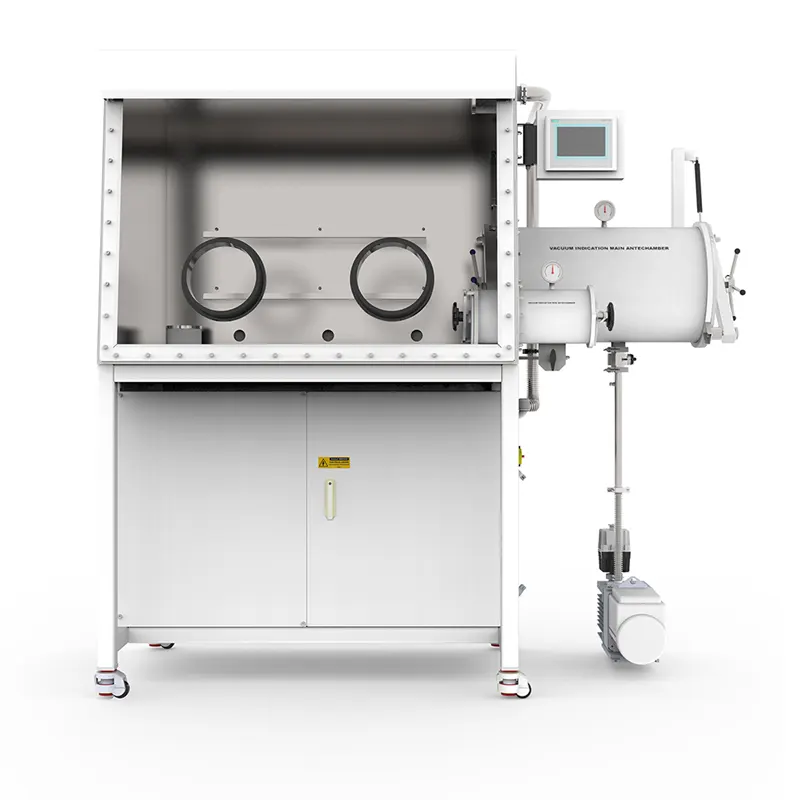
A single-station, single-sided purification glove box is an enclosed workspace designed for one primary operator position. “Single-sided” means the gloves are mounted on one face of the enclosure, so the operator reaches into the working volume from one side. “Single-station” means the box is sized around one working position rather than multiple linked stations. This layout is common in university laboratories, start-up battery labs, and materials research groups where space is limited but air-sensitive handling still matters.
The “gas purification” part is the critical distinction. In this category, the box is intended to work with a closed-loop purification system that continuously circulates the internal atmosphere through a purifier. Depending on the design, the purifier removes oxygen and moisture using reactive media, and the loop includes a blower, piping, valves, and sensors that monitor the atmosphere. The system does not remove contaminants by magic. It moves gas through active material, and when that material is exhausted, it must be regenerated or replaced according to the manufacturer’s procedure.
This description should not be confused with other inert-atmosphere enclosures. A stainless steel vacuum glove box such as a GBV-type enclosure uses a sealed chamber, vacuum pumping, and inert gas replacement to create a controlled environment. That approach can be effective for certain operations, but it is not the same as a continuously purifying loop. An acrylic glove box, such as a GBT-type enclosure, may provide isolation, visibility, and in some configurations a limited vacuum or antechamber capability, but not every acrylic model can be evacuated, and not every one includes a purification system. Similarly, a standalone gas purification cabinet is a loop component, not a complete glove box with a working volume. The single-station purification box sits in a specific place: it combines an operator workspace with an active atmosphere-management loop.
Why the distinction matters during selection
If the application only requires short-term protection from air, a simple purge or vacuum-replacement box may be sufficient. If the application involves repeated opening, sample transfer, solvent use, or long experiments where oxygen and moisture must stay low, a continuous purification loop becomes more relevant. The single-station, single-sided configuration is often chosen when one researcher needs a stable local atmosphere but does not need a multi-user, multi-station production environment. The trade-off is that a smaller working volume can recover faster after a disturbance, while a larger or multi-station box may take longer to return to baseline because more gas, more gloves, and more surface area are involved.
Purge, Vacuum, and Circulation: Three Different Jobs
A frequent source of confusion is treating every atmosphere-control action as if it does the same thing. In practice, a purification glove box uses at least three distinct processes, and they should not be substituted for one another.
| Process | Primary purpose | Hardware involved | What it does not do |
|---|---|---|---|
| Inert gas purge | Replace air in the box or an antechamber with inert gas | Gas inlet, outlet, valves, pressure control | It does not continuously remove oxygen and moisture that enter later. |
| Vacuum pumping | Remove bulk gas and reduce the initial air load before refilling | Vacuum pump, antechamber, seals, KF connections | It does not create a purified atmosphere by itself; it only reduces the starting contamination. |
| Closed-loop circulation | Continuously pass internal gas through purification media | Blower, purifier columns, piping, analyzers, control system | It does not remove particles like a HEPA filter, and it does not replace solvent adsorption. |
| Regeneration | Restore purification media after they have absorbed oxygen or moisture | Heater, gas lines, valves, controller, exhaust path | It is not a normal operating mode; the box atmosphere is not available for sensitive work during regeneration. |
The order matters. A common sequence for introducing equipment through an antechamber is: seal the antechamber, evacuate it, refill with inert gas, and repeat as needed. Each vacuum cycle removes a fraction of the air, and each refill dilutes what remains. The purification loop then handles the residual oxygen and moisture that enter the main box when the inner door is opened. If the antechamber is not evacuated well, or if the inner door is opened too quickly, the purification system is forced to work against a larger contamination load.
This is also where “purge” and “purification” should not be confused. Purging with inert gas can lower oxygen concentration quickly, but it consumes gas and does not remove moisture that desorbs from walls, gloves, or samples. Circulation through a purifier is slower at removing a large initial air load, but it is the process that maintains a low baseline over time. A purification glove box is designed around that maintenance function.
Why circulation alone is not a transfer strategy
Some users assume that because the box has a purification system, they can open the antechamber to the main volume without careful evacuation. That assumption usually leads to slow recovery. The purifier is sized for continuous duty, not for repeatedly absorbing the air admitted during careless transfers. The practical rule is to keep the contamination load as small as possible before it reaches the main chamber. Vacuum and refill cycles in the antechamber do that work; circulation then cleans up what remains.
Antechamber, Pressure, and KF Connections: Where Atmosphere Recovery Is Won or Lost
The antechamber is often the most underappreciated part of a glove box. It is the interface between the outside laboratory and the controlled atmosphere. Its volume, door seals, vacuum capability, and gas connections determine how much air enters the main box during each transfer. A small antechamber with a good seal and a repeatable vacuum cycle can be easier to manage than a large pass-through chamber that is convenient but admits more air per opening.
Pressure is another area where different numbers are often mixed together. The box working pressure, the antechamber vacuum level, the pump’s ultimate vacuum, and the leak rate of the enclosure are separate specifications. A pump may be able to reach a very low absolute pressure on a closed, empty volume, but that number does not describe the pressure inside a glove box during normal operation. Likewise, a box may hold a slight positive pressure for operator comfort and leak protection, but that pressure is not the same as an antechamber evacuation target. When evaluating a system, keep the units and the object of measurement attached to each value. If a data sheet lists a number without saying whether it refers to the box, the antechamber, the pump, or a sensor, that number needs clarification before it can guide a decision.
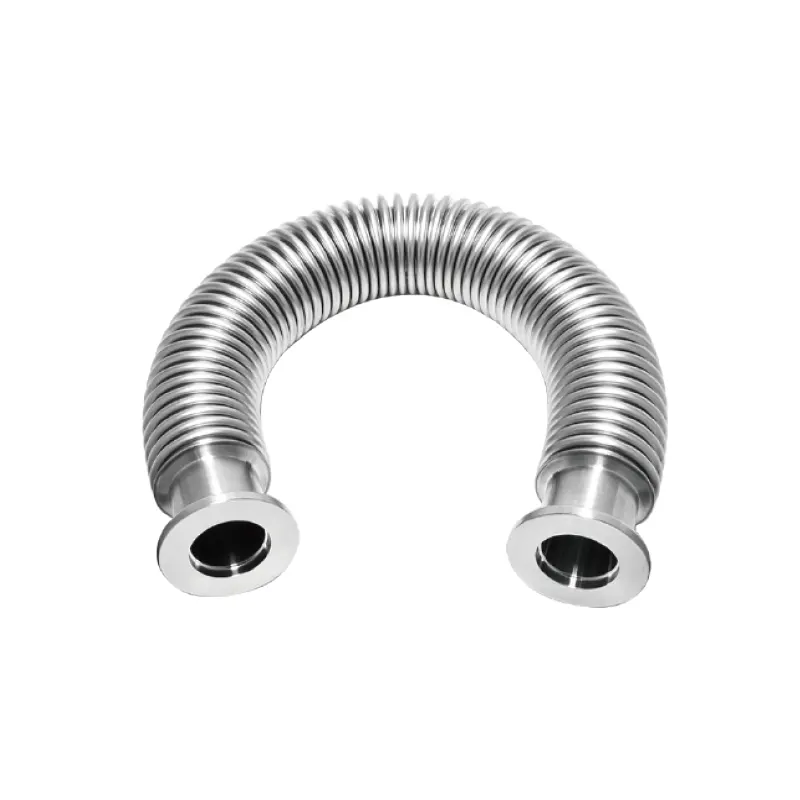
Leak paths are usually found at connections, not in the middle of a welded panel. Gloves, glove ports, door seals, feedthroughs, valves, and KF flanges all create joints. A flexible connection can help here. The KF stainless steel flexible bellows is a component used in vacuum and gas lines where a rigid pipe would transmit stress, misalignment, or vibration. In a glove box context, a bellows may be considered for connecting a pump, a gas line, or another KF-flanged component to the enclosure or to the purification loop. Its value is not that it “improves purification” by itself. Its value is that it can absorb movement and reduce mechanical strain on flanged joints, which helps protect seal integrity.
That does not mean any KF bellows is automatically compatible with any glove box. The user still needs to confirm the KF flange size, the material compatibility with the gas and any solvent vapor, the vacuum or pressure rating, the temperature range, and the leak-tightness requirement. A bellows with the wrong flange size will not fit. A bellows made from an incompatible material may corrode or outgas. A bellows with an inadequate pressure rating may deform or fail. These are selection checks, not assumptions. The same logic applies to gloves, seals, valves, and feedthroughs: each accessory must be matched to the specific system, not chosen by appearance alone.
How transfer practice changes the reading
If oxygen or moisture readings climb after every transfer and take a long time to recover, the cause may be the transfer procedure rather than a failed purifier. Large sample loads, wet solvents, cardboard or paper packaging, and porous materials can carry air and moisture into the box. Opening the inner door before the antechamber has been cycled sufficiently adds to the load. Gloves that are too permeable for the application, or gloves that have been left exposed to laboratory air, can also contribute. Before concluding that the purification system is underperforming, review the sequence: how many vacuum-refill cycles are used, how long the antechamber is held under vacuum, how often the inner door is opened, and what materials are being introduced.
Single-Station Layout, Load, and Workflow Trade-offs
The single-sided, single-station layout has practical advantages. It occupies less floor space, uses less internal gas volume, and usually presents a shorter reach for one operator. A smaller volume can respond faster to purification because the blower has less gas to circulate and the purifier has less contaminant inventory to remove. For laboratories that run one experiment at a time or that need a dedicated atmosphere for a specific material, this can be an efficient configuration.
The trade-off is capacity. One station means one primary working position. If two researchers need to work simultaneously, or if a process requires a long preparation on one side and a separate assembly step on the other, a multi-station or double-sided box may be more appropriate. Adding stations increases the internal volume, the number of gloves, and the number of potential leak paths. It also changes the purification load. A larger box is not simply a scaled-up version of a smaller one; its recovery behavior, gas distribution, and sensor placement need to be considered as part of the system design.
Workflow also affects atmosphere stability. Every time a glove is moved, the flexible glove material displaces gas and creates local pressure changes. Every time a door is opened, gas exchanges with the outside. Every time a pump starts, vibration and pressure transients travel through the piping. These disturbances are normal. The question is whether the system can return to its target conditions within the time required by the experiment. A single-station box with a well-matched purification loop and a disciplined transfer routine often recovers faster than a larger system that is opened frequently.
What the purification loop actually controls
A purification loop typically includes a circulation path, purification columns, and sensors for oxygen and moisture. Some systems also include solvent adsorption, which is important when organic solvents are used inside the box. It is a mistake to treat these functions as interchangeable. HEPA filtration removes particles; it does not remove water or oxygen. Solvent adsorption captures organic vapors; it does not replace the water and oxygen purifier. An oxygen analyzer measures oxygen concentration; it does not remove oxygen. A moisture analyzer measures water concentration; it does not dry the atmosphere. Each component has a job, and the control system coordinates them.
This is why analyzer choice matters. Range, resolution, accuracy, response time, and calibration all affect what the user can trust. A sensor with fine resolution but poor accuracy may show small changes that are not meaningful. A sensor that is slow to respond may make a recovery look worse than it is. A sensor that is not calibrated may drift over time. When interpreting oxygen or moisture readings, consider the analyzer’s specifications and the calibration history, not just the displayed number.
Purification or Replacement? Matching the System to the Application
Not every air-sensitive task requires the same atmosphere strategy. The decision between a purifying glove box and a simpler vacuum-replacement enclosure depends on the material, the required exposure limit, the frequency of use, and the consequences of a temporary oxygen or moisture excursion.
Continuous purification is most valuable when the work requires a stable low-oxygen, low-moisture environment over many hours or days, when the box is opened regularly for sample transfer, or when the material is sensitive enough that even short exposures cause irreversible change. Examples can include lithium metal and solid-state battery components, perovskite and OLED materials, certain semiconductor precursors, and air-sensitive organometallic chemistry. In these settings, the purification loop provides a baseline that the operator can monitor and maintain.
A vacuum-replacement or purge-only enclosure may be sufficient when the material is less sensitive, when the exposure window is short, or when the operation is a one-time transfer rather than a continuous process. However, it is important not to overstate what such a system can do. A vacuum cycle reduces the amount of air present, but it does not continuously remove oxygen and moisture that enter through gloves, seals, or samples. If the application requires a sustained low setpoint, a purification system is the more appropriate choice.
There is also a middle ground: some users begin with a basic enclosure and later add a purification loop or a gas purification cabinet. That path can work if the enclosure is designed to be compatible with the purification system. A standalone purification cabinet is not a complete glove box, and it cannot be connected to an arbitrary enclosure without checking the gas circuit, pressure balance, materials, and control logic. Compatibility is a system question, not a catalog question.
Application details that change the recommendation
When discussing an application with a supplier, broad statements such as “we need an inert atmosphere” are not enough. The supplier needs to know what material is being handled, how much of it, how often it is introduced, and what atmosphere quality is required during the process. A lithium metal sample that is used in a short assembly step has different requirements from a perovskite film that must be annealed and stored for weeks. A solvent-heavy process has different needs from a dry powder transfer. The more specific the application, the more accurately the configuration can be matched.
Verification and Selection Checklist
Before selecting a single-station, single-sided glove box with gas purification, use a checklist that separates the box, the purification loop, and the accessories. This helps prevent one component from being over-specified while another becomes the limiting factor.
- Atmosphere target: What oxygen and moisture levels must be maintained during the process, and for how long? Distinguish between an initial purge target and a continuous operating target.
- Transfer frequency: How many times per hour or per day will the antechamber be opened? Frequent transfers favor a purification loop with sufficient capacity and a well-designed antechamber.
- Sample load: What is the mass, volume, and surface area of the material introduced? Porous and moisture-bearing samples can release water slowly after they are inside.
- Solvent and vapor load: Are organic solvents used? If so, solvent adsorption may be needed, and the purifier’s regeneration schedule may be affected.
- Pressure requirements: Is vacuum needed in the antechamber, the main box, or both? Check the object of every pressure specification and keep units consistent.
- Leak and seal integrity: Review gloves, glove ports, door seals, feedthroughs, valves, and KF connections. A flexible bellows may help reduce strain on rigid connections, but its flange size, material, and rating must be confirmed.
- Analyzer specifications: Check range, resolution, accuracy, response time, and calibration for oxygen and moisture measurement. A reading is only useful if the sensor is appropriate and maintained.
- Regeneration requirements: Understand what gas, temperature, and time are required to regenerate the purification media, and how the box is managed during that period.
- Utility and space constraints: Confirm available power, vacuum, inert gas supply, exhaust, and floor space. These practical limits often shape the final configuration.
It also helps to ask how the system behaves during normal disturbances. What happens when a glove is punctured? How quickly does the loop recover after the antechamber is opened? What maintenance intervals are recommended for gloves, seals, filters, and purification media? These questions do not have universal answers, because they depend on the specific configuration and the user’s process. But asking them before purchase is far more useful than assuming that a purification label guarantees a particular recovery time.
Information to prepare for a supplier discussion
A productive supplier conversation usually starts with a short process description and a list of constraints. Be ready to provide: the material or device being handled; the required oxygen and moisture limits; whether those limits are continuous or only during critical steps; the size and frequency of sample transfers; the solvents or vapors involved; the required antechamber size and vacuum capability; the number of operators and working positions; the available inert gas and vacuum utilities; and any space or integration limits. If a KF bellows or other accessory is being considered, include the existing flange standard, the line size, the gas or vacuum service, and the expected movement or vibration. This information allows the supplier to check compatibility rather than guess.
For a compact laboratory, the single-station, single-sided purification glove box can be a good match when one operator needs a stable atmosphere and the workflow is organized around a single working position. The purification glove box product page provides the starting configuration, while the KF stainless steel flexible bellows is an example of an accessory that should be evaluated as part of the gas and vacuum circuit, not as a standalone upgrade. The most reliable results come from treating the box, the purification loop, the transfer routine, and the connected components as one system—and from confirming every specification that matters to the material inside.
