
A gas purification system cabinet is a separate atmosphere-control unit that works with a compatible sealed enclosure. It is not the glove box workspace itself. The GP20 gas purification system cabinet is an independent purification package; the working volume, gloves, and transfer interface belong to the enclosure it serves. That division matters because the cabinet can only control the atmosphere that the enclosure allows it to control.
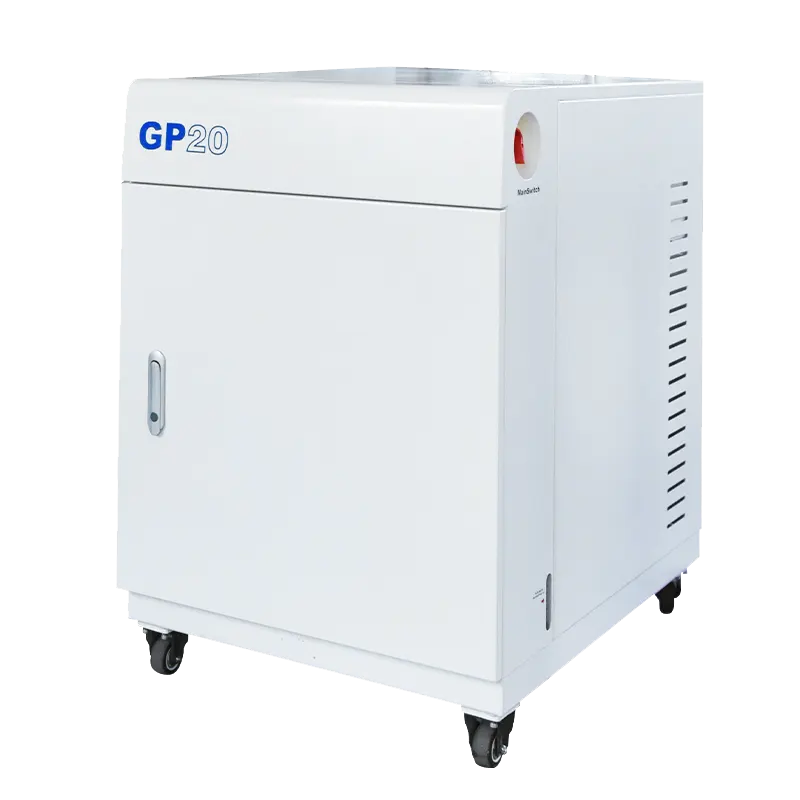
What Does a Gas Purification System Cabinet Do?
In a glove box equipped with a purification loop, gas leaves the enclosure, passes through the purification cabinet, and returns. The cabinet provides the circulation and purification function. The enclosure provides the physical barrier, the glove ports, and the transfer path. During normal operation the loop is closed, but closed does not mean perfect. Air can enter through gloves, transfer chambers, seals, and small leaks. Materials placed inside can release moisture, oxygen, or solvents. The purification system has to manage that incoming load, not merely treat a clean gas stream once.
This is why a purification cabinet is not a simple filter box. In systems designed for water and oxygen control, the purification media are selected for those duties and must be regenerated when their capacity is used. The cabinet also has to manage gas flow, isolation, and the sequence of operation around regeneration. The GP20 should therefore be selected as part of an atmosphere system, not as a standalone appliance.
Working gas, control gas, and regeneration gas are not interchangeable
The working gas is the atmosphere inside the enclosure. Control gas refers to gas used for specified control or auxiliary functions, and its exact role should be read from the cabinet documentation rather than assumed. Regeneration gas is used when the purification media are restored. These streams can differ in purity, supply conditions, and exhaust requirements. Before installation, confirm which gases the GP20 requires, how the streams are switched, and what the enclosure experiences during regeneration. A cabinet supplied with the wrong gas, or operated without the correct regeneration sequence, cannot be expected to deliver the intended atmosphere.
Purification is not the same as filtration
HEPA filtration removes particles. It does not remove water vapor or oxygen. Solvent adsorption can reduce organic vapors, but it does not replace the water and oxygen purification function. An oxygen or moisture analyzer measures the atmosphere; it does not purify it. These distinctions matter when specifying a cabinet and its accessories, because a system can appear complete while one critical function is still missing.
Where the Cabinet Sits in a Closed-Loop System
The useful way to read the system is as three connected boundaries: the enclosure, the purification cabinet, and the utilities that support both. Gas returns from the enclosure to the cabinet, is treated, and is supplied back to the enclosure. Each boundary has its own failure points. A leak in the enclosure adds load to the cabinet. A large or poorly purged transfer chamber admits air with every cycle. A glove material that is not compatible with the process can allow vapor transfer or degrade. The cabinet cannot compensate indefinitely for those conditions.
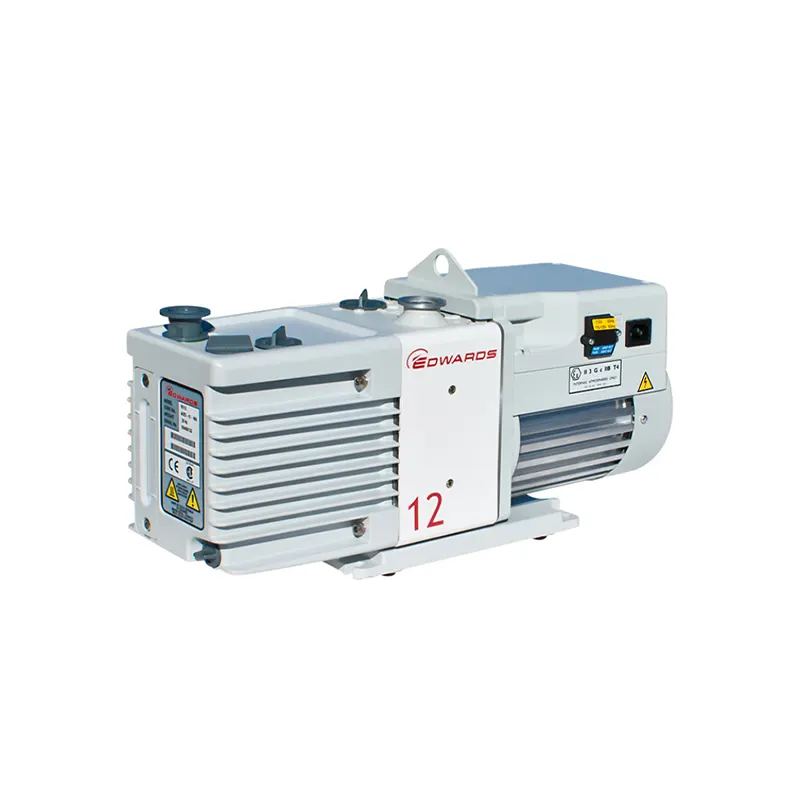
Accessories should be placed in the same system view. A glove box vacuum pump, for example, supports evacuation and transfer tasks. It does not purify the recirculating atmosphere. Pump selection should consider the gas being handled, the required vacuum level, the duty cycle, and the connection to the enclosure. A pump that is suitable for one chamber and process may not be suitable for another. In the same way, a purification cabinet and a vacuum pump have different jobs: the pump moves or removes gas from a volume, while the cabinet manages the quality of the gas returning to the enclosure.
Which Configurations Matter?
The supplied product information identifies one model, the GP20, so it would be misleading to invent a family of variants. The real configuration question is how the cabinet is matched to an enclosure and a workflow. On the enclosure side, a single-station box, a multi-station box, a single-sided or double-sided design, and a split construction all change the working volume, the number of access points, and the practical gas load. These are enclosure choices first, and the cabinet compatibility must then be confirmed against the actual GP20 configuration.
For a new installation, the cabinet, enclosure, transfer chamber, monitoring points, and utilities can be designed together. For a retrofit, the existing enclosure has to be assessed before any connection is proposed. The loop connection type, isolation method, available gas supply, regeneration exhaust, electrical interfaces, and control signals all need to agree. A cabinet should not be described as unconditionally connectable to any sealed box. Compatibility is a documented engineering check, not an assumption based on the product category.
One model can still require project-specific choices
Even with a single cabinet model, the order is not just a catalog number. The enclosure volume, the expected air ingress, the materials to be handled, the required monitoring, and the accessories can change the scope. A user who needs a complete glove box workspace is buying an enclosure plus a purification system, not a purification cabinet alone. A user who already has a suitable enclosure may be considering a retrofit, but that path still depends on the condition of the existing box and the compatibility of the loop.
Which Specifications Should You Check?
Because a purification cabinet is part of a system, the most useful specifications are the ones that describe the boundary conditions. The following checks are more valuable than a single headline number.
Gas and purification requirements
- Identify the working gas, control gas, and regeneration gas required for the actual GP20 configuration. Confirm supply quality, supply and exhaust arrangements, and material compatibility.
- Confirm the regeneration procedure and the conditions under which it may be performed. Do not assume that regeneration can happen while the enclosure is in normal use without isolation and a defined sequence.
- Ask what the purification performance is tied to: which gas, which inlet condition, which flow, and which measurement point. A value obtained at the cabinet is not automatically the value at the gloves.
- Confirm how water and oxygen are monitored, if monitoring is included, and where the sample is taken. Range, resolution, accuracy, calibration, and response time are different attributes.
Enclosure and loop integrity
- Check the enclosure volume, leak-tightness, working pressure, transfer chamber volume, glove material, and the condition of seals. These determine the load that reaches the cabinet.
- Confirm the loop connection size and type, the isolation valves, and the method used to protect the cabinet during maintenance.
- Review the expected material load. Outgassing from samples, solvents, and containers can be more important than the empty-box volume.
- Do not compare a cabinet capacity measured under one set of conditions with another supplier's value measured under different conditions. The test basis matters.
Monitoring and analytical performance
If an analyzer is part of the configuration, check its measuring range, resolution, accuracy, calibration method, and sample location. Resolution is not accuracy. A display that changes in small increments can still have a larger uncertainty. The sample point also matters: a reading taken at the cabinet does not prove that the atmosphere at the glove ports, in a transfer chamber, or near a hot sample is the same. The analyzer reports the atmosphere; it does not create the purification effect.
Connections, utilities, and accessories
Confirm connector types and sizes as configured, electrical and signal interfaces, and any accessory that affects flow or sealing. A pump should be matched to the gas and the load. HEPA filtration should be specified for particle control, not for water or oxygen removal. Solvent adsorption should be specified for the solvents it is intended to handle, not as a universal substitute for purification media. If a feedthrough, valve, or sensor is added later, it becomes part of the sealed boundary and must be checked for leakage and compatibility.
Where It Is Suitable, and What Its Limits Are
A gas purification system cabinet is suitable when the process needs a controlled inert atmosphere inside a compatible enclosure and the enclosure can be engineered, sealed, and operated as part of a loop. Typical settings include lithium and solid-state battery research, perovskite, OLED, and semiconductor work, air-sensitive chemistry, advanced materials, and additive manufacturing pre- or post-handling where reactive powders or oxygen-sensitive materials must be kept under controlled gas. The common thread is a material or process that benefits from reduced exposure to water, oxygen, or other specified contaminants.
The limits are just as important. The GP20 is not a complete glove box and does not provide a working volume on its own. It should not be treated as a universal retrofit for any sealed enclosure. It cannot make a leaking box leak-free, and it cannot guarantee the same atmosphere at every point in a busy box without proper transfer practice and monitoring. It is not a sterile enclosure, a cleanroom classification, a biological safety cabinet, or a hazardous-materials containment system unless a specific design has been verified for that purpose. It also does not make every gas inert to every sample. Material compatibility and process safety remain the user's responsibility.
Nor should the system be sold on absolute language. A purification loop can reduce and control contaminants under defined conditions, but a claim of zero oxygen or zero contamination is not a specification. The meaningful question is what level can be achieved and maintained in the actual enclosure, under the actual load, with the actual gas supply and operating procedure.
How Should You Select or Integrate It?
Start with the enclosure and the work, not with a cabinet alone. Define the number of workstations, the access points, the transfer chamber, the glove material, and the materials or solvents that will enter the box. Then estimate the gas load from air ingress and outgassing, and decide which gas streams are needed. These steps determine whether a purification cabinet is the right central component and what configuration should be discussed.
- Define the enclosure and workflow, including size, stations, transfer path, and the expected frequency of opening.
- List the working, control, and regeneration gases, along with supply, exhaust, and material-compatibility requirements.
- Confirm the GP20 configuration against the enclosure: loop connection, isolation, regeneration sequence, controls, and available utilities.
- Define monitoring points and acceptance checks before installation, including how the enclosure will be leak-checked and how the atmosphere will be verified under a representative load.
- Select accessories by function. Match a vacuum pump to the gas and duty, use HEPA filtration for particles, and use solvent adsorption only for the vapors it is intended to handle.
- Plan commissioning as a system task. The cabinet, enclosure, gloves, transfer chamber, and instruments should be checked together, because the weakest boundary sets the practical result.
The GP20 gas purification system cabinet should therefore be evaluated as the purification side of a matched atmosphere system. The right selection is the one that states the enclosure, gas streams, connections, monitoring, and operating limits clearly enough to be verified after installation.
FAQ: Gas Purification System Cabinet Selection
Is the GP20 a complete glove box?
No. It is an independent gas purification system cabinet. The workspace and gloves belong to a compatible enclosure. A complete installation requires both the enclosure and the purification system, plus the necessary gas and utility services.
Can the cabinet alone guarantee low oxygen and moisture at the gloves?
No blanket guarantee is possible. The result depends on enclosure integrity, gas quality, transfer practice, material load, installation, and the operating procedure. Performance should be verified by measurement at defined points under representative conditions.
Does a vacuum pump improve atmosphere purity?
Not directly. A pump supports evacuation and transfer. Used correctly, it can help control air ingress during transfer, but it does not remove water or oxygen from the recirculating gas. Pump selection should match the gas, required vacuum level, duty, and connections.
Can any sealed box be connected to a purification cabinet?
No. Compatibility must be checked for volume, leak-tightness, connection type, isolation, controls, gas supply, regeneration, and materials. A cabinet should not be treated as a universal add-on.
Is HEPA filtration a substitute for water and oxygen removal?
No. HEPA filtration addresses particles. Water and oxygen control require purification media and a properly managed loop. Solvent adsorption is also a separate function and does not replace water and oxygen purification.
