
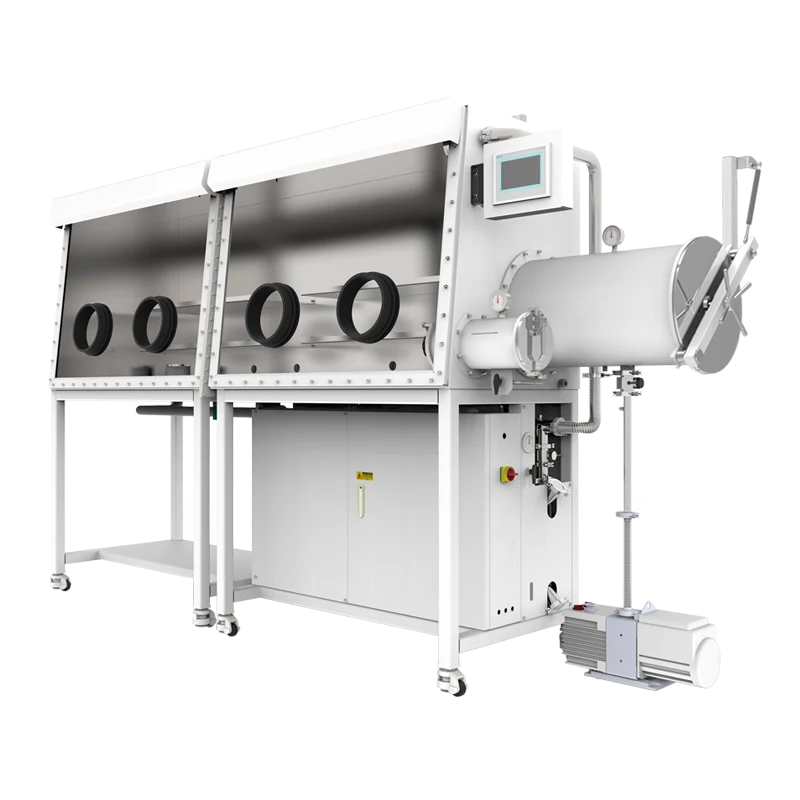
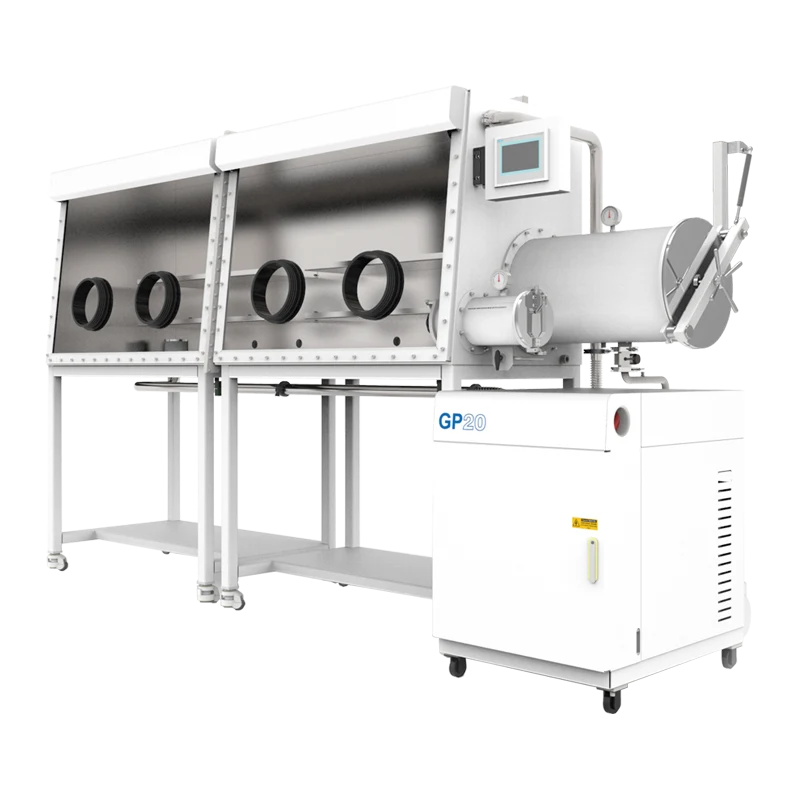
A two-station, single-sided split-type glove box with gas purification is an enclosed workstation for handling air- and moisture-sensitive materials. It places two operator positions along one side of a sealed enclosure and uses a separate gas purification module to recirculate the internal atmosphere through water- and oxygen-removing media. The split arrangement keeps the bulky purification and control hardware outside the main box, while the box itself provides the controlled working space. It is used when a simple vacuum desiccator or plastic glove bag cannot provide enough working volume, repeatable atmosphere control, or room for two people or two sets of tools.
What does the two-station split-type system do?
The primary job is to keep the working atmosphere separated from room air while allowing hands to manipulate samples through gloves. The enclosure is sealed, the gloves are attached to the front, and the internal gas is maintained by the purification loop. Depending on the application, nitrogen or argon may be used as the working gas; the choice should be confirmed against sample chemistry, purifier compatibility, and site gas supply.
Unlike a vacuum glove box that relies on repeated evacuation and refilling, a purification glove box is designed for continuous or intermittent recirculation. Gas is drawn from the enclosure, passed through purifier columns, and returned. This closed-loop approach is what makes long working sessions and repeatable atmosphere control possible, provided the box is leak-tight and the transfer procedures are managed.
Enclosure, purification module, and gas circuit
The name "split-type" describes the physical arrangement. The glove box enclosure and the purification/control module are separate units connected by gas lines. This can make the workstation easier to place in a laboratory, reduce the mass sitting on the bench or frame, and improve access for service. The trade-off is that the installation has more connections to route, support, and leak-test than a single integrated cabinet. A split system is only as good as its piping and joints.
Inside the purification module, a blower or circulator moves gas through one or more purifier columns. The columns contain media that remove water and oxygen, and they require regeneration when their capacity is consumed. Sensors monitor the atmosphere, and the control system manages circulation, regeneration, and alarms. The exact sequence, media, and regeneration gas depend on the model, so those details should come from the manufacturer's manual rather than from a generic description.
What "two-station, single-sided" means in practice
Two-station means that the box is arranged around two operator positions. Single-sided means both positions are on the same accessible face. This layout suits a shared workstation where two researchers work together, where one person moves between two tasks, or where a larger frontage is needed for equipment. It does not mean that the two positions have independent atmospheres. They share the same enclosure and gas circuit, so a solvent release, a dusty sample, or a heavy moisture load at one position affects the whole box.
Station count alone is not a complete description. The usable internal width, depth, height, glove port spacing, glove size, and the space taken up by shelves or feedthroughs all affect whether two people can work comfortably. Ask for a dimensioned drawing rather than relying on the model name.
How does the gas purification system work?
A purification glove box uses a closed gas loop. The circulator pulls atmosphere from the box, sends it through the purifier, and returns it to the enclosure. Water and oxygen are removed by the purifier media; the treated gas is then mixed back into the box volume. Continuous circulation helps homogenize the atmosphere, but it does not eliminate the need for leak control and careful material transfer.
Three gas roles should be kept separate. The working gas is the atmosphere inside the box. Control gas may be used to operate valves or instruments. Regeneration gas is used to restore the purifier media. They serve different purposes and may have different purity requirements. The supplier should state which gas is required for each function and what purity is acceptable.
Water and oxygen removal are not the same as particle filtration
A HEPA filter captures particles. It does not remove water vapor or oxygen. A solvent adsorber captures organic vapors that could load the purifier or contaminate samples, but it does not replace the water and oxygen removal step. An oxygen or moisture analyzer measures the atmosphere; it does not improve it. These distinctions matter when specifying a system, because adding a filter or an analyzer does not automatically increase purification capacity.
Solvent use deserves particular attention. If a process releases solvents, the purifier can be exposed to vapors it was not designed to handle. A suitable solvent adsorption stage and a regeneration schedule should be discussed with the supplier. The same applies to acids, amines, or other reactive vapors: the correct question is not only whether the box can be sealed, but whether the gas circuit and its materials are compatible with the process.
What monitoring tells you and what it does not
An oxygen analyzer and a moisture analyzer report conditions at their measurement points. Their value depends on range, resolution, accuracy, calibration, response time, and location. A display with fine resolution is not automatically a precise measurement. A reading taken during a stable, low-load period is not a guarantee for a busy day with frequent transfers. Ask for the measurement principle, calibration procedure, and the conditions under which any performance figure was obtained.
Which specifications should you check?
The product name identifies the configuration, but final selection should be against a documented specification sheet. The following items matter more than a single headline oxygen or water number.
- Internal dimensions and usable space: confirm width, depth, height, shelf layout, and clearance for the largest item that must be handled inside the box.
- Station and glove layout: check the number and spacing of glove ports, glove size, and whether two operators can work without obstructing each other.
- Split module footprint: plan space for the purification/control unit, service access, and gas-line routing.
- Transfer interface: if an antechamber or vacuum transfer chamber is fitted, confirm its volume, vacuum rating, and pump compatibility.
- Working pressure and leak rate: these are box specifications, not pump specifications; ask for the test method and acceptance criteria.
- Oxygen and water performance: require values tied to defined conditions, measurement points, and calibration.
- Purifier capacity and regeneration: confirm how capacity is rated, how regeneration is triggered, and what gas and utilities are needed.
- Analyzer range and calibration: check whether the range suits the target atmosphere and whether calibration is practical on site.
- Utilities and environment: confirm power, gas supply, ventilation, heat load, and ambient conditions.
- Materials compatibility: verify gloves, seals, piping, and other contact materials against the process gases and solvents.
Pressure, vacuum, and leak rate are different specifications
The box working pressure, the transfer chamber vacuum, the pump's ultimate vacuum, and the leak rate are separate parameters. A pump that can reach a low ultimate vacuum does not prove that the box is leak-tight. A transfer chamber rated for vacuum does not mean the whole box is a vacuum vessel. Keep the original units and the object they describe. If a value is not clearly defined, leave it out of the comparison and ask for clarification.
Connections and accessories: where a KF vacuum clamp fits
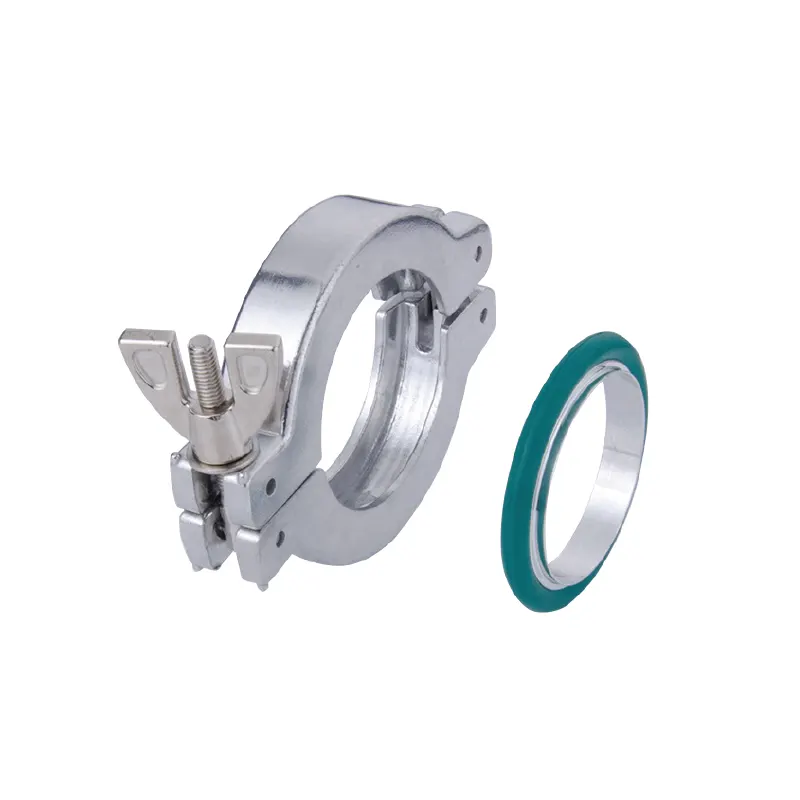
Split-type systems and their vacuum lines may use flanged connections. A KF vacuum clamp secures two compatible KF flanges against a seal; it is a joining and sealing accessory, not a purification device. It does not lower water or oxygen levels, and it cannot correct a mismatched flange, a damaged sealing surface, or the wrong seal material. Where a compatible KF connection is specified, choose the clamp size to match the flange and confirm that the seal is suitable for the process gas and solvent exposure. The KF vacuum clamp product page is useful for identifying this accessory, but the connection schedule for the box should still come from the box manufacturer.
The same rule applies to gloves, feedthroughs, transfer chambers, pumps, and analyzers. Each accessory has a defined function. A glove protects the operator and the atmosphere but does not purify the gas. A feedthrough carries electrical or signal connections but does not create a leak-free seal by itself. A pump supports transfer or evacuation but must be matched to the gas load and the vacuum duty.
Where is the system suitable, and what are its limits?
A purification glove box of this configuration is relevant to lithium metal and solid-state battery research, perovskite and OLED device work, semiconductor and electronic materials, air-sensitive chemical synthesis, advanced materials, and additive manufacturing post-processing where oxygen or moisture must be excluded. These are application areas, not automatic approvals. Suitability depends on the specific gas, sample, process temperature, solvent load, transfer frequency, and the atmosphere specification that the work actually requires.
The limits are just as important. The enclosure is not a sterile isolator, a cleanroom classification, a biological safety cabinet, or a hazardous-duty containment system unless it has been specifically designed and verified for that role. Inert gas protection does not mean that every material is inert in nitrogen or argon; some samples react with the gas itself or require a different atmosphere. A purification system does not remove particles, and a particle filter does not remove water or oxygen.
Transfer and load management
Every time a sample, tool, or container enters the box, it brings a load. The transfer interface, the purging procedure, and the condition of the gloves all affect how quickly the atmosphere recovers. A large transfer chamber is convenient, but it also consumes more purge gas and takes more time to cycle. A small chamber limits what can pass. The right choice comes from the size and frequency of transfers, not from the chamber volume alone. If an antechamber or vacuum transfer chamber is fitted, its vacuum rating and pump compatibility should be checked separately from the box atmosphere.
When a different architecture is better
If the process only needs short-term protection during a simple transfer, a glove bag or a vacuum desiccator may be adequate. If the process needs repeated evacuation and inert gas backfill rather than continuous purification, a vacuum glove box is a different architecture. If the work requires very low oxygen and water under continuous operation, a purification system with documented performance and suitable capacity is the relevant choice. Matching the architecture to the task prevents over-specification and avoids relying on a feature the system does not provide.
How should you select and integrate the system?
Start with the process, not the model name. Define the samples, the gas, the maximum acceptable oxygen and water levels, the duration of each session, the frequency of transfers, the solvents or particles released, the heat load, and the number of operators. Then size the enclosure and the purification capacity around that duty. A two-station box may be appropriate for collaborative work, but it is not automatically better than a single-station box if the second position is rarely used and adds volume to control.
A practical selection sequence
- Define the atmosphere and limits, including whether argon or nitrogen is required and how performance will be verified.
- Size the workspace from the equipment and operator positions, using internal dimensions rather than external footprint.
- Select the transfer method for the largest and most frequent items, then check vacuum and purge requirements.
- Match purifier capacity and regeneration strategy to the expected moisture, oxygen, and solvent load.
- Plan the split module location, gas supply, power, exhaust or ventilation, and service access.
- Confirm analyzer ranges, calibration, alarms, and data records.
- Verify materials compatibility for gloves, seals, piping, and any contact parts.
- Require leak testing, commissioning, and operator training before production use.
During integration, pay attention to the connections between the enclosure and the split module. Longer gas lines add volume and potential leak points. Supports should prevent strain on flanges and fittings. The installation should be leak-tested as a complete system, not as separate boxes. After a transfer, a purifier regeneration, or a glove change, allow the monitoring to stabilize before judging performance. Follow the manufacturer's procedures for purging, regeneration, and safe gas handling; generic advice is not a substitute for the model manual.
For the main product, review the two-station single-sided split-type purification glove box page and request the current specification sheet, dimensioned drawing, and utility requirements. If a KF connection is part of the vacuum or gas path, the KF vacuum clamp page identifies the accessory, but the flange size and seal specification still need to be confirmed against the actual connection. A clamp is a small part; a mismatch at that joint can undermine the whole atmosphere control strategy.
Common questions
Does this glove box include a gas purification system?
The product name identifies a gas purification system, but the configuration, purifier capacity, regeneration method, and instrumentation should be confirmed on the current specification sheet for the exact model.
Can it guarantee sub-ppm oxygen and water?
No universal guarantee should be assumed from a product category. Any low-level performance figure must be tied to a defined test condition, measurement point, and calibration. Ask for the documented value and the conditions under which it applies.
Can I add a HEPA filter or solvent adsorber to improve atmosphere control?
Those devices address particles and solvent vapors, respectively. They do not replace water and oxygen removal. They should be selected for a specific contaminant and checked for compatibility with the purifier and process.
Is a KF vacuum clamp a purification component?
No. It secures compatible KF flanges and their seal. It does not remove water, oxygen, or particles, and it cannot make an incompatible connection safe.
Can two operators work independently?
They share one enclosure atmosphere. Two stations provide space and access, not two separate gas environments. Processes that must be isolated from each other need separate enclosures or a different isolation strategy.
What to verify before ordering
Confirm the exact enclosure dimensions, station and glove layout, split module location, transfer interface, working pressure, leak-test criteria, oxygen and water performance, purifier capacity and regeneration requirements, analyzer specifications, utility connections, and materials compatibility. Ask which accessories are included and which are optional. The goal is not to collect the longest specification list; it is to match the documented capability of the box to the real atmosphere, space, and transfer needs of the work.
