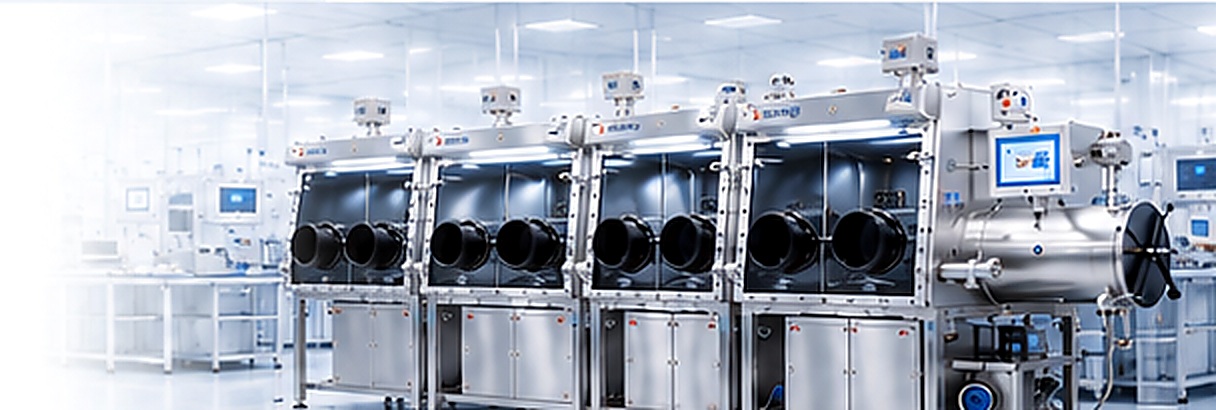
At its core, an organic solvent vapor adsorption system is a specialized accessory for glove boxes that actively removes volatile organic compounds (VOCs) from the circulating inert gas. Researchers and manufacturers in fields like battery material synthesis, perovskite solar cell fabrication, and semiconductor processing use it to prevent solvent vapors from contaminating the ultra-low-water/oxygen environment, thereby protecting both delicate samples and the glove box's purification system. Without such a system, evaporated solvents can poison the molecular sieves and copper catalysts used for moisture and oxygen removal, leading to degraded performance and increased maintenance costs.
How It Works: From Contaminated Gas to Clean Atmosphere
The system is typically installed in-line with the glove box's gas circulation loop. Inside the adsorption unit, a packed column of a high-surface-area adsorbent material (such as activated carbon, zeolite, or specialized polymeric resins) selectively captures organic solvent molecules from the gas stream. The operation involves two alternating cycles: adsorption and regeneration.
During the adsorption phase, glove box gas is continuously pushed through the column by the recirculation blower. The adsorbent traps solvent vapors, while water and oxygen levels remain unaffected (they are handled by the main purifier). The purified gas is then returned to the glove box. Over time, the adsorbent becomes saturated and its efficiency drops. The system then automatically switches to the regeneration phase: a separate stream of hot inert gas (or a vacuum/heating sequence) desorbs the trapped solvents, which are vented to a safe exhaust or collected in a condenser. After regeneration, the column is ready for another cycle.
Key operating parameters include the adsorption capacity (typically expressed as grams of solvent per 100 grams of adsorbent), regeneration temperature (ranging from 100 °C to 350 °C depending on the solvent and adsorbent), and cycle time (hours). A well-designed system maintains the glove box's moisture and oxygen levels below 1 ppm even when volatile solvents like tetrahydrofuran (THF), acetonitrile, or dichloromethane are used in experiments.
Core Components and Key Technologies
An organic solvent vapor adsorption system consists of several integral parts:
- Adsorption Column: Filled with a high-capacity solvent-specific adsorbent. The choice of adsorbent (e.g., coconut-based activated carbon vs. synthetic molecular sieve) determines compatibility with different solvent families.
- Heating Jacket / Regeneration Unit: Provides precise temperature control (often via a precision recirculating water chiller or electrical heaters) to drive off adsorbed solvents without damaging the adsorbent.
- Valve Manifold & Controls: Automated pneumatic or solenoid valves (like pneumatic vacuum baffle valves) switch between adsorption and regeneration modes. A PLC or HMI touchscreen manages the cycle timing and monitors system health.
- Slipstream Pump / Blower: Ensures a controlled flow rate (typically 10-50% of the main circulation) through the adsorption bed to balance effective removal with minimal pressure drop.
- Safety Features: Explosion-proof enclosures, HEPA filter cartridges at the vent line, and over-temperature protection.
Some advanced systems integrate Ethernet feedthroughs for remote monitoring and data logging, allowing operators to track adsorption saturation curves and optimize regeneration schedules.
Performance Metrics and Selection Criteria
When choosing an organic solvent vapor adsorption system for your TENCAN glove box (or any high-integrity glove box), consider the following indicators:
| Parameter | Importance | Typical Range |
|---|---|---|
| Single-pass adsorption efficiency | % of solvent removed per pass | > 95 % for target solvents |
| Adsorption capacity | Grams of solvent before regeneration | 10 – 30 % of adsorbent weight |
| Regeneration time | Downtime of adsorption function | 2 – 6 hours |
| Maximum solvent concentration | Inlet limit to avoid oversaturation | Typically < 5000 ppm |
| Compatible glove box flow rate | Must match main purifier circulation | 100 – 1000 L/min |
| Leak rate integrity | Prevent external air ingress | < 0.05 vol%/h |
Also evaluate the sealing performance of the system's connections. Using compatible KF vacuum clamps and flexible bellows ensures leak-free integration. The adsorbent material should be chosen according to the solvents you use – for example, activated carbon excels with non-polar solvents, while zeolites are better for polar ones. Some manufacturers offer dual-bed systems for mixed-solvent environments.
Applications and Guidance for Different Users
An organic solvent vapor adsorption system is indispensable in any glove box where volatile solvents are handled regularly. Common applications include:
- Lithium-ion battery research: Electrolyte filling, electrode coating (solvents like NMP, EC, DEC).
- Perovskite solar cell fabrication: Spin-coating of precursor solutions (DMF, DMSO, chlorobenzene).
- OLED and display material development: Evaporation and solution processing of organic semiconductors.
- MOF and catalysis synthesis: Solvothermal reactions using alcohols, ethers, or amines.
- Pharmaceutical & chemical processing: Handling of volatile active pharmaceutical ingredients or air-sensitive organometallics.
For small-scale R&D labs with intermittent solvent use, a compact single-column system with manual regeneration control may suffice. Production facilities and high-throughput testing centers should opt for dual-column (parallel) systems that allow continuous purification – one column adsorbs while the other regenerates. Always verify that the adsorption system is compatible with your glove box's vacuum pump and main purification unit. Proper integration will keep your inert atmosphere pristine, extend the life of your purifier, and ensure reproducible experimental results.
References
Learn more about the product and related accessories: